
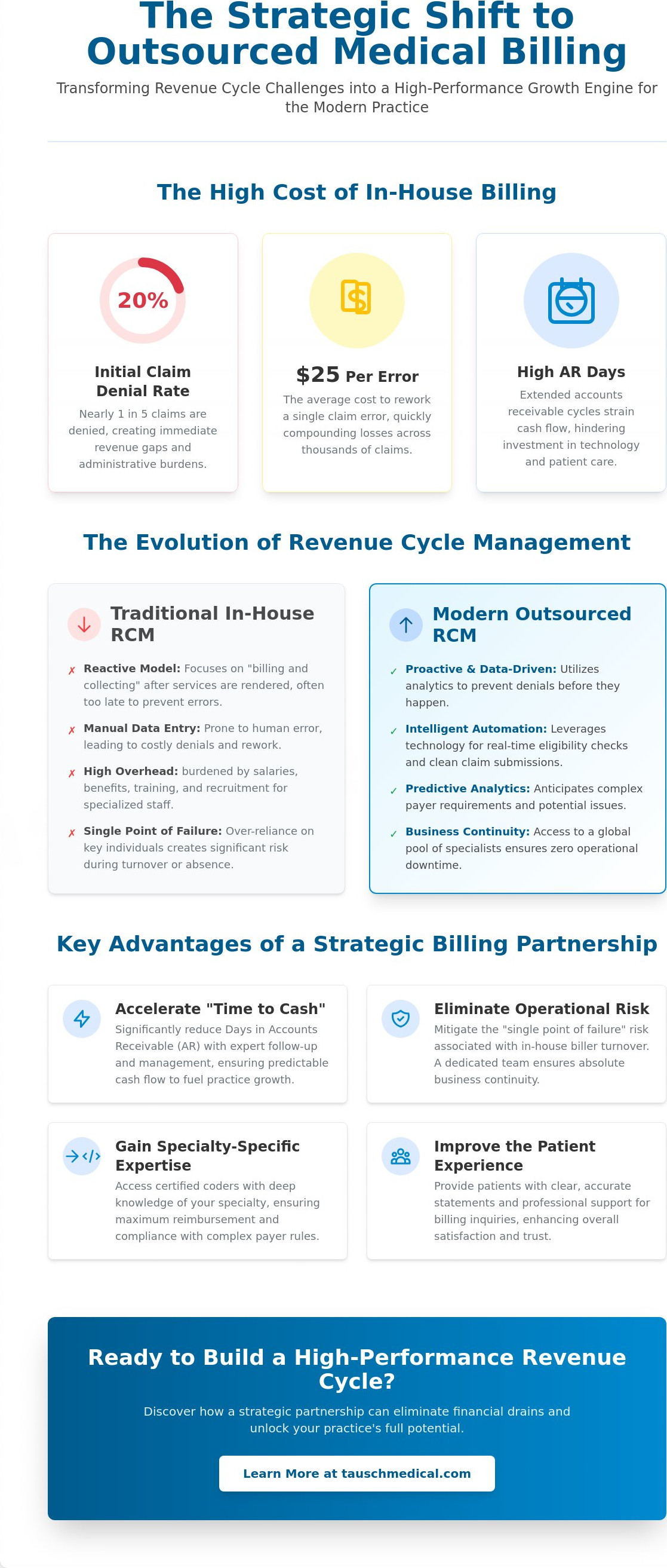
With nearly 20% of medical claims currently facing initial denial and the average cost to rework a single error reaching $25, the traditional in-house model is no longer just a hurdle; it's a significant financial liability. You've likely felt the persistent strain of high AR days and the exhausting cycle of recruiting expert billers who can keep pace with 2026's shifting CMS regulations. For the modern provider, medical billing outsourcing has evolved from a simple cost-cutting measure into a sophisticated strategy for clinical and financial excellence.
We understand that your primary commitment is to patient outcomes, not administrative paperwork. This guide promises to show you how to transform your revenue cycle from an arduous burden into a high-performance growth engine. We'll explore the essential components of a strategic partnership, from advanced insurance verification to rigorous denial management. By the end of this article, you'll possess a clear roadmap for achieving higher clean claim rates and the predictable cash flow your practice deserves.
Key Takeaways
- Understand the transition from manual data entry to intelligent, technology-enabled revenue cycle management that defines the 2026 healthcare landscape.
- Identify the hidden financial drains of internal teams and learn how medical billing outsourcing provides a superior return on investment by eliminating high overhead and recruitment costs.
- Discover proven methods to accelerate your "Time to Cash" by significantly reducing days in accounts receivable through expert management.
- Master a structured framework for evaluating potential partners based on their specialty-specific coding expertise and their ability to integrate seamlessly with your existing EHR.
- Learn how a holistic approach that connects patient scheduling and insurance verification creates a foundation for clinical precision and long-term financial growth.
What is Medical Billing Outsourcing in the 2026 Healthcare Landscape?
In the current fiscal year, medical billing outsourcing has transitioned from a peripheral administrative choice to a core strategic necessity for high-performing healthcare practices. It's no longer defined as the mere task of submitting claims to payers. Instead, it represents a comprehensive Revenue Cycle Management (RCM) partnership that integrates clinical documentation, financial precision, and patient-centered communication. This Medical Billing Overview highlights how the process involves a meticulous sequence of steps designed to ensure healthcare providers receive accurate reimbursement for their services.
The 2026 ecosystem demands a departure from legacy manual data entry. Modern medical billing outsourcing utilizes intelligent, technology-enabled systems to manage the entire lifecycle of a claim. This starts at the very first point of contact during patient scheduling and extends through insurance verification, coding, and final statement resolution. With the global market projected to reach up to $25.96 billion this year, the industry's shift toward specialized, high-tech partnerships is undeniable. Practices that cling to antiquated systems find themselves struggling with the 15% to 20% average denial rate that currently plagues the industry.
The Evolution of Revenue Cycle Management (RCM)
Traditional RCM focused narrowly on "billing and collecting," a reactive model that often left significant revenue on the table. Today, the discipline has evolved into a proactive science driven by data analytics and real-time insights. Leading outsourcing models now prioritize real-time insurance eligibility checks to prevent front-end errors before they manifest as costly denials. As the economy shifts more deeply into value-based care models, legacy billing methods simply lack the granularity needed to track the complex outcomes-based metrics that payers now require for full reimbursement.
Current Industry Trends and Payer Dynamics
Payer dynamics in 2026 are characterized by an unprecedented rise in complex prior authorization requirements across all specialties. These hurdles often delay care and disrupt cash flow. To combat this, sophisticated outsourcing firms are employing predictive analytics to anticipate potential denials before submission. This technological superiority allows practices to maintain a high clean claim rate despite the increasing complexity of federal billing transparency regulations. By leveraging these advanced tools, providers can ensure their operations remain compliant with 2026 standards while focusing their internal energy on clinical excellence rather than administrative disputes.
The Strategic Benefits of Outsourcing Your Billing Operations
Transitioning to an external partnership for your revenue cycle isn't merely a tactical shift to reduce overhead; it's a sophisticated pivot toward long term clinical and financial stability. When you embrace medical billing outsourcing, you're essentially installing a high performance engine into the heart of your practice's operations. The most immediate impact is the acceleration of your "Time to Cash." Professional teams focusing exclusively on your revenue cycle can reduce AR days significantly, ensuring that the liquidity required for growth and innovation is always available. This constant flow of capital allows you to reinvest in world class medical technology without the traditional delays associated with in-house processing.
Beyond the balance sheet, outsourcing eliminates the "single point of failure" risk that haunts many private practices. When a key in house biller leaves or takes extended leave, the entire revenue stream often grinds to a halt. By partnering with a global pool of certified coding and billing specialists, you ensure absolute business continuity. You also gain access to a premium technology stack and predictive analytics tools that would otherwise require prohibitive capital expenditure. This technological superiority means you're always ahead of payer trends, leveraging advanced medical billing services to secure every dollar your practice has earned.
The patient experience also sees a marked improvement. Modern patients expect the same level of transparency and professionalism in their financial interactions as they receive during their clinical consultations. Providing clear, accurate statements and professional support for Navigating Medical Billing builds a level of trust that generic, error prone internal billing simply cannot match. This transparency reduces patient friction and enhances the overall reputation of your practice.
Maximizing Revenue Through Expert Denial Management
There's a fundamental difference between simple "re-billing" and true root-cause denial analysis. Specialized teams don't just resubmit claims; they identify systemic payer errors and coding mismatches that lead to recurring losses. By analyzing the clinical evidence behind every rejection, these experts recover revenue that most internal teams would write off as uncollectible. Industry reports for 2026 indicate that high performing RCM partners typically achieve a successful appeal rate of over 70% for complex clinical denials.
Reducing Administrative Burden on Clinical Staff
Physicians should be focused on the nuances of patient care, not the complexities of ICD-11 coding or the minutiae of prior authorizations. Outsourcing these tasks, along with patient scheduling and insurance verification, streamlines the entire front office workflow. The psychological impact of removing this administrative "friction" is profound, significantly reducing provider burnout and allowing your team to rediscover their passion for medicine. A lean, focused clinical environment is the hallmark of a truly modern healthcare institution.
Outsourced vs. In-House Medical Billing: The Real Cost Comparison
Many healthcare executives mistakenly evaluate the cost of internal billing by looking solely at base salaries. This narrow perspective ignores the "fully loaded" cost of a billing professional, which includes benefits, payroll taxes, and insurance. Industry data indicates that an in-house biller with a $50,000 salary actually costs a practice between $65,000 and $70,000 annually. For mid-sized practices maintaining two billing staff, the commitment often exceeds $8,000 per month in salary alone, before factoring in the infrastructure required to support them. Choosing medical billing outsourcing allows providers to bypass these fixed overheads, converting a rigid expense into a variable cost that scales with actual revenue.
Indirect costs further widen the gap between internal and external models. Maintaining an in-house department requires dedicated office space, high-end hardware, and ongoing software maintenance fees. There's also the significant burden of continuing education. As coding standards and CMS regulations shift, your internal team requires constant, expensive training to remain compliant. When these professionals spend time in training or navigating software updates, your "Time to Cash" inevitably slows. This creates a substantial opportunity cost, where the capital that should be fueling clinical expansion is instead tied up in administrative friction.
The Hidden Expenses of Internal Billing Teams
The most damaging hidden cost is "billing leakage." Internal teams, often overwhelmed by volume, frequently ignore small balances or fail to pursue complex denials because they lack the specialized tools for root-cause analysis. With the average cost to rework a single denied claim hovering around $25, and 15% to 20% of claims facing initial rejection, these inefficiencies drain thousands from your bottom line. Furthermore, the cost of turnover in a billing department is estimated at 1.5 times the annual salary of the departing employee. This includes the expense of recruitment, the loss of institutional knowledge, and the inevitable revenue dip during the three to six months it takes to bring a new hire to full productivity.
Transparency and Control in an Outsourced Model
A common myth suggests that medical billing outsourcing leads to a loss of financial control. In reality, modern RCM partnerships provide greater visibility than manual, spreadsheet-based internal systems. 24/7 cloud-based reporting allows you to monitor your practice's health with clinical precision, offering real-time insights into AR days and collection rates. By establishing clear Key Performance Indicators (KPIs), such as clean claim rates and net collection ratios, you can hold your partner to a standard of accountability that's often difficult to enforce with internal staff. This data-driven approach ensures that your financial growth is based on facts rather than optimistic estimates.
How to Evaluate and Select a Medical Billing Partner
Selecting an external partner for your revenue cycle is a high-stakes decision that requires the same clinical precision you apply to patient care. It's not merely about finding a vendor; it's about identifying a clinical-financial architect who can integrate with your practice's DNA. The evaluation process should follow a structured framework to ensure the partnership can withstand the regulatory complexities of 2026. Start by assessing specialty-specific expertise. A partner who understands the nuances of your specific medical field will inherently produce higher clean claim rates than a generalist firm. Verify their coding certifications and ask for proof of ongoing training regarding the latest CMS updates.
The second critical pillar is the technology stack. Your partner's software must offer seamless integration with your existing EHR to avoid the friction of manual data uploads. In the modern landscape, medical billing outsourcing should provide a bi-directional flow of information, where patient scheduling and clinical documentation trigger billing workflows automatically. This level of integration reduces the risk of human error and ensures that no billable service is overlooked. During your analysis, ask for a deep-dive into their denial management process. Given that 15% to 20% of claims face initial rejection, you need a partner who treats every denial as a data point for systemic improvement rather than just a task to be resubmitted.
Critical Compliance and Security Standards
In 2026, SOC 2 Type II compliance has emerged as the non-negotiable gold standard for any billing firm. This certification proves that a partner maintains rigorous, audited controls over data security and privacy. Beyond this, ensure they have a redundant disaster recovery plan and a clear protocol for data backups. Regular internal audits are also essential to prevent OIG compliance issues. A partner who invests in these high-level security standards provides the peace of mind necessary to focus on clinical innovation. To secure your practice's financial future, consider a consultation for premium medical billing outsourcing today.
The Importance of Provider Credentialing and Enrollment
Revenue leakage often begins before a patient even enters the exam room. Inaccurate provider enrollment creates "unbillable" service gaps that can cost a practice thousands in lost revenue. By choosing a partner who provides integrated provider credentialing and enrollment, you ensure that every clinician is fully authorized to bill across all relevant payer networks. This integration links credentialing directly to clean claim rates, preventing the administrative delays that often occur when these services are siloed. A holistic approach to credentialing is a hallmark of a premium partnership.
Strategic Growth with Tausch Medical: Beyond Standard Billing
Tausch Medical approaches the revenue cycle with the same level of clinical precision and technical superiority that leading practitioners bring to their patients. We don't view ourselves as a mere vendor; we operate as a clinical-financial architect for your practice. While many firms focus solely on the final submission of claims, our holistic model begins at the moment of patient scheduling. By integrating insurance verification and authorization into the initial workflow, we eliminate the front-end errors that traditionally lead to downstream financial friction. This proactive stance ensures that your practice's growth is built on a foundation of verified data and strategic foresight.
The "Tausch Advantage" lies in our ability to merge premium business intelligence with world-class operational support. We specialize in managing the complex "middle-revenue cycle," a critical area where many practices experience significant revenue leakage. By meticulously auditing clinical documentation and ensuring it aligns perfectly with 2026 coding standards, we secure the full value of the services you provide. Our medical billing outsourcing model is designed for providers who refuse to settle for industry-average denial rates and instead demand a partner who shares their commitment to excellence.
Customized Solutions for Complex Medical Practices
Specialty clinics and surgical centers have unique operational demands that a "one-size-fits-all" billing approach cannot meet. Tausch Medical tailors every workflow to the specific nuances of your specialty, ensuring that complex procedures are coded with absolute accuracy. We maintain a commitment to 100% transparency, providing our partners with real-time executive dashboards that offer a clear view of every financial metric. Our expert denial management team doesn't just resubmit rejected claims; they conduct deep-dive root-cause analyses to recover revenue that other firms typically leave behind. This level of detail is what defines a premium partnership.
Partnering for Long-Term Financial Health
True success in the 2026 healthcare market requires moving beyond a simple vendor relationship and toward a proactive growth consultancy. We work alongside you to identify opportunities for portfolio expansion and market positioning, ensuring your financial health supports your clinical ambitions. The transition to a more efficient revenue cycle begins with a clear understanding of your current performance. We invite you to schedule your strategic revenue assessment with Tausch Medical to discover how medical billing outsourcing can be transformed into your practice's most powerful growth engine. Our team is ready to provide the professional support and global expertise your practice deserves.
Securing Your Practice's Financial Future in 2026
The evolution of the healthcare landscape demands a departure from reactive, in-house billing models that often struggle with rising denial rates and regulatory complexity. By embracing medical billing outsourcing, you're not just reducing administrative friction; you're equipping your practice with a precision-engineered revenue engine designed for long-term growth. We've explored how a strategic partnership eliminates the volatility of staff turnover and provides access to sophisticated technology that identifies systemic payer errors before they impact your cash flow.
Tausch Medical serves as your clinical-financial architect, providing a 98%+ clean claim rate and a specialized denial management team dedicated to capturing revenue other firms often overlook. With our comprehensive credentialing and enrollment support, your clinicians can remain focused on patient outcomes while we ensure every service is accurately reimbursed. It's time to transform your revenue cycle from a burden into a competitive advantage that fuels your clinical innovation. Optimize your practice revenue with Tausch Medical today and take the first step toward a more predictable, high-performance financial future. Your commitment to excellence deserves a partner who mirrors your standard of care.
Frequently Asked Questions
What is the typical cost of medical billing outsourcing in 2026?
Most medical billing outsourcing models operate on a percentage of net collections, though flat fee or per claim models exist for specific practice structures. This performance based approach aligns the partner's success with your revenue growth. It effectively converts the high fixed costs of internal salaries and benefits into a predictable, variable expense that scales with your actual patient volume.
Will I lose control over my patient data if I outsource my billing?
You maintain absolute ownership and full visibility of your patient data through secure, cloud based interfaces. Premium partners utilize SOC 2 Type II compliant systems that offer real time reporting, which often provides more transparency than manual internal spreadsheets. You can monitor every claim's status and financial metric with clinical precision, ensuring you're always informed about your practice's fiscal health.
How long does it take to transition from in-house billing to an outsourced service?
A strategic transition from in house operations to an external partner typically spans 30 to 90 days. This period allows for a meticulous integration of workflows, including software synchronization and credentialing verification. A structured onboarding process ensures that there's no disruption to your existing cash flow while the new systems are being calibrated to your specific clinical needs.
Can an outsourcing company work with my existing EHR software?
High performance billing firms are designed to integrate seamlessly with your existing EHR software to maintain a unified clinical and financial record. This bi directional synchronization ensures that patient scheduling and clinical documentation trigger billing workflows automatically. By working within your current technological framework, the partner reduces the need for manual data entry and minimizes the risk of transcription errors.
What is the average increase in collections after outsourcing medical billing?
Practices often see a marked improvement in total collections by reducing initial denial rates and capturing revenue from unpursued small balances. While specific results depend on your current internal efficiency, professional denial management identifies systemic payer errors that internal teams might overlook. This rigorous approach to accounts receivable ensures that you secure the full value for every clinical service provided.
How does medical billing outsourcing handle patient inquiries and statements?
Comprehensive medical billing outsourcing includes the management of patient statements and professional communication regarding financial responsibilities. This ensures that patients receive clear, accurate billing information, which reduces friction and enhances their overall experience with your practice. Professional billing specialists handle inquiries with the same level of care and precision that your clinical staff provides during consultations.
What certifications should I look for in a medical billing company?
You should prioritize partners who hold SOC 2 Type II compliance and maintain rigorous HIPAA security standards. It's also essential to verify that their coding specialists are certified by recognized professional bodies. These credentials serve as a seal of professional credibility, ensuring that your revenue cycle is managed with absolute regulatory precision and data security.
Does outsourcing billing include insurance verification and prior authorizations?
Strategic outsourcing includes insurance verification and prior authorization as fundamental components of the revenue cycle. Addressing these tasks at the point of patient scheduling prevents the front end errors that are responsible for a significant portion of claim denials. This holistic approach creates a seamless flow from the initial appointment to final reimbursement, securing your practice's financial stability.