


Article by
Dr. Sharafat Hussain Ph.D
Dr. Sharafat Hussain is a healthcare business consultant, entrepreneur, and academic with strong experience in the US healthcare industry. He is the Founder and Managing Director of Tausch Medical, a revenue cycle management company supporting US healthcare providers with medical billing, prior authorization, credentialing, eligibility verification, A/R follow-up, and patient support services. His work combines practical healthcare operations, business strategy, and academic insight to help medical practices improve efficiency, collections, and service quality.
What if a strong collections report is hiding a growing backlog of denials or aging claims? If you’re trying to understand how to measure medical billing company performance, one positive metric rarely tells the whole story. Collections and A/R reports can be difficult to interpret, especially when they don’t show what’s driving a trend or who is responsible for following up.
A useful review combines consistent metrics, clear reporting, and accountable next steps. This guide explains which measures can help you assess billing performance, how to interpret them in context, and how to investigate patterns that may point to workflow issues. You’ll also learn how to set practical reporting expectations with a billing partner, so your scorecard supports informed decisions instead of adding to the confusion.
Key Takeaways
- Learn how to measure medical billing company performance with a consistent scorecard that groups KPIs by the work they reflect.
- Use a repeatable review process to compare trends with your practice’s baseline, investigate changes, and agree on follow-up actions.
- Assess whether billing reports answer your key questions and make next steps clear, rather than presenting numbers without context.
- Use daily, weekly, and monthly reports, ad-hoc dashboards, and flexible service models to support accountable performance reviews.
How to Measure Medical Billing Company Performance With a Clear Baseline
A billing KPI is a measurable indicator of a specific revenue-cycle process or outcome. To learn how to measure medical billing company performance, start with a manageable scorecard, not a long list of disconnected numbers. Group measures into claim quality, collections, A/R health, and denial outcomes so every result has a clear purpose. The Medical billing process includes coding and claim submission, which helps explain why claim quality can affect later payment outcomes.
Before reviewing results, agree with your billing partner on each metric’s definition, data source, reporting period, and exclusions. Record a baseline using those same rules. This gives you a fair point of comparison and helps prevent a change in calculation from being mistaken for a change in performance. Practices reviewing medical billing services can use the same discipline to keep reporting discussions focused.
Which medical billing KPIs belong on an initial scorecard?
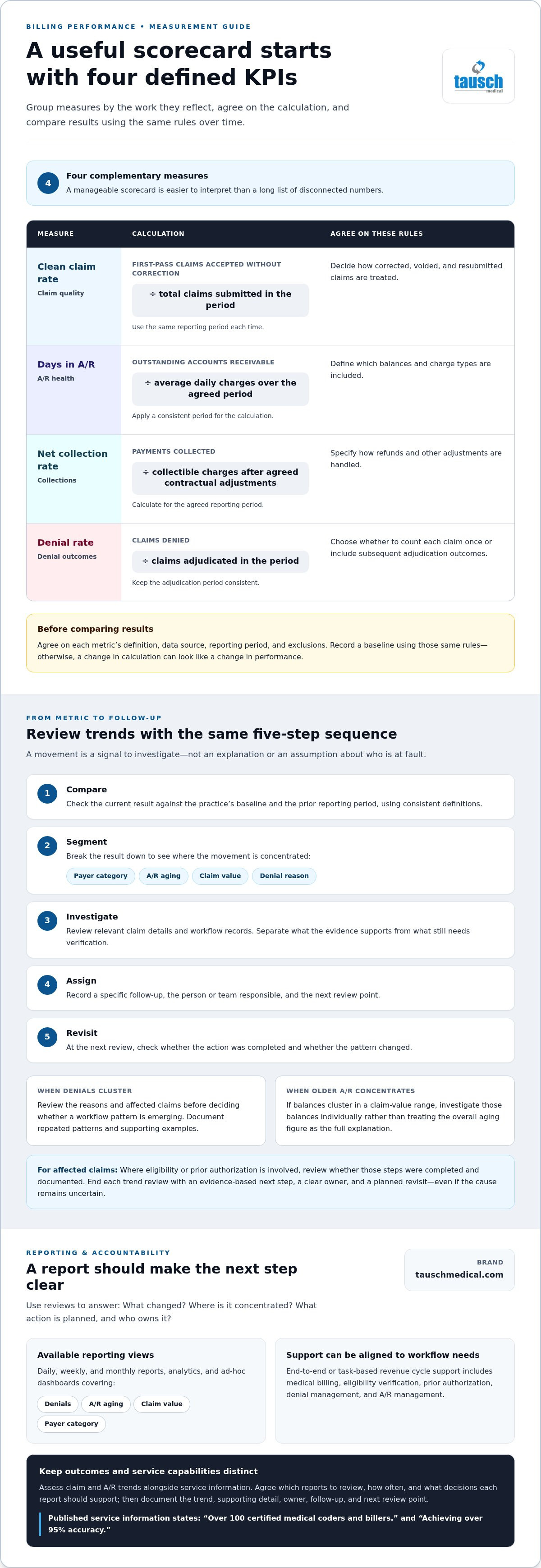
Begin with four complementary measures. For each one, document the calculation and reporting window, then apply those rules consistently over time.
- Clean claim rate: First-pass claims accepted without correction, divided by total claims submitted in the period. Agree on how to treat corrected, voided, and resubmitted claims.
- Days in A/R: Outstanding accounts receivable divided by average daily charges over the agreed period. Define which balances and charge types are included.
- Net collection rate: Payments collected divided by collectible charges after agreed contractual adjustments for the period. Specify how refunds and other adjustments are handled.
- Denial rate: Claims denied divided by claims adjudicated in the period. Decide whether to count each claim once or include subsequent adjudication outcomes.
These definitions make the scorecard easier to interpret. If a result shifts, investigate the process behind it instead of debating what the number includes. For example, a clean claim rate is easier to act on when you can identify whether corrections relate to eligibility details, coding, or another step in the billing workflow.
How to Review Medical Billing Metrics and Turn Trends Into Action
A scorecard becomes useful when a change leads to a focused review, not an assumption about who is at fault. To understand how to measure medical billing company performance over time, follow the same sequence at each review and compare results with the practice’s agreed baseline. A movement in a metric is a signal to investigate, not an explanation by itself.
- Compare: Check the current result against the baseline and the prior reporting period, using consistent definitions.
- Segment: Break the result down by payer category, A/R aging, claim value, or denial reason to see where the movement is concentrated.
- Investigate: Review relevant claim details and workflow records. Note what the evidence supports and what still needs to be verified.
- Assign: Record a specific follow-up, the person or team responsible, and the next review point.
- Revisit: At the next review, check whether the action was completed and whether the pattern changed.
How can payer and A/R detail explain a performance trend?
Segmentation helps distinguish a recurring process issue from a change that needs closer examination. For example, if denials cluster under one payer category, review the reasons and affected claims before deciding whether a workflow pattern is emerging. If older A/R is concentrated in a particular claim-value range, investigate those balances individually rather than treating the overall aging figure as a complete explanation.
Apply the same discipline to denial reasons: identify repeated patterns, document supporting examples, and mark unresolved causes for follow-up. A denial and A/R management approach can help practices connect claim-level findings with the work needed to address them. Where eligibility or prior authorization is involved, review whether those steps were completed and documented for the affected claims. End each trend review with an evidence-based next step, a clear owner, and a planned revisit, even when the cause remains uncertain.
How to Assess a Medical Billing Partner's Reporting and Accountability
Reports should do more than display results. Use them to answer agreed questions: Which trends changed? Where are they concentrated? What action is planned, and who owns it? As you consider how to measure medical billing company performance, assess whether reporting definitions stay consistent and whether each review ends with documented next steps. Separate service capabilities, such as report availability or phone support, from outcomes such as claim and A/R trends.
What does Tausch Medical provide for ongoing revenue-cycle visibility?
Tausch Medical provides daily, weekly, and monthly reports, analytics, and ad-hoc dashboards covering denials, A/R aging, claim value, and payer category. These views can help practices focus reviews on relevant patterns. Tausch Medical also provides end-to-end or task-based revenue cycle support, including medical billing, eligibility verification, prior authorization, denial management, and A/R management. This flexibility lets practices align support with the workflow needs identified in their reviews.
For a practical accountability discussion, agree on which reports to review, how often, and what decisions each report should support. Then record the trend, supporting detail, assigned follow-up, and next review point. Tausch Medical's published service information states: “Over 100 certified medical coders and billers.” and “Achieving over 95% accuracy.” Use your practice’s agreed performance measures alongside service information when assessing results and setting priorities.
Phone support is a service capability, not a billing KPI: “Calls are answered by a human to ensure patient satisfaction - always on hand to answer questions and make sure that no call goes unanswered, 24/7.” Evaluate it separately from financial outcomes, and keep the scorecard focused on measurable results and accountable follow-through.
Make Your Next Billing Review a Practical Step Forward
Performance measurement is most valuable when it leads to a shared plan, not simply another report. Keep the discussion focused on what your practice needs next, whether that means refining a workflow, clarifying ownership, or adjusting the scope of support. A consistent approach to how to measure medical billing company performance can help your team turn financial visibility into informed decisions and steady operational progress.
Want to see how Tausch Medical can support your practice with reliable medical billing, prior authorization, eligibility verification, A/R follow-up, and RCM support? Start with our free two-week trial and experience the difference before making a commitment: https://tauschmedical.com/free-trial-form
Frequently Asked Questions
Is a higher net collection rate always proof of better medical billing performance?
No. A higher rate may look favorable, but it doesn’t explain whether all collectible charges are represented consistently or whether unresolved denials and older balances remain. Check how adjustments, refunds, and the measurement period affect the figure, then review it alongside other financial indicators. A single percentage is a useful signal, not a complete verdict on performance.
How often should a practice review its medical billing company's performance?
Set a regular review cadence that matches your reporting cycle and operational needs, then keep it consistent long enough to spot meaningful patterns. A practice might hold a formal monthly review and address time-sensitive concerns sooner through its usual communication channels. Define when a change warrants discussion, who participates, and how decisions or outstanding questions will be recorded.
Can medical billing company performance be compared fairly across different specialties?
Not reliably without context. A comparison should account for differences in service mix, payer mix, authorization needs, and claim complexity, while using consistent definitions. Practices in Houston, San Antonio, Dallas, Austin, El Paso, Arlington, Plano, New York, Boston, Philadelphia, Washington, D.C., Baltimore, Miami, Orlando, Tampa, Atlanta, Raleigh, Richmond, and Jacksonville should assess their own operating context rather than assume location alone makes results comparable.
What should a practice do if billing reports show a worsening trend?
First, verify that the report covers the intended claims and period, then identify which payer, service type, or balance category is contributing to the change. Review a small set of affected accounts to test possible explanations before deciding on a remedy. Document the evidence, agree on a corrective action and owner, and set a follow-up point to assess whether the trend continues.
Disclaimer
This article is for general informational purposes only and does not constitute legal, medical, billing, coding, compliance, or financial advice. Healthcare rules, payer policies, and reimbursement guidelines may change and may vary by situation. Please consult qualified professionals or official sources before making decisions based on this content. Tausch Medical is not responsible for any loss or liability arising from reliance on this information.


