


Article by
Dr. Sharafat Hussain Ph.D
Dr. Sharafat Hussain is a healthcare business consultant, entrepreneur, and academic with strong experience in the US healthcare industry. He is the Founder and Managing Director of Tausch Medical, a revenue cycle management company supporting US healthcare providers with medical billing, prior authorization, credentialing, eligibility verification, A/R follow-up, and patient support services. His work combines practical healthcare operations, business strategy, and academic insight to help medical practices improve efficiency, collections, and service quality.
A persuasive medical appeal responds to the payer’s stated reason for denying a claim with focused clinical and claim evidence. For providers and billing teams, figuring out how to write a medical appeal letter can be challenging when the denial rationale is difficult to interpret and relevant records are spread across clinical and administrative workflows.
Preparing an appeal can add to an already demanding workload. This guide explains how to address the denial reason, organize supporting clinical, claim, and plan documentation, and create a clear request for reconsideration. It also covers practical ways to track submission requirements, retain correspondence, and build a repeatable appeal workflow.
Key Takeaways
- Use the payer’s denial notice to identify the specific issue your appeal needs to address.
- Learn how to write a medical appeal letter that identifies the claim and responds directly to the denial rationale.
- Organize relevant patient, policy, service, provider, and claim details before drafting.
- Build a repeatable workflow for internal review, attachment checks, submission tracking, and correspondence records.
How to Write a Medical Appeal Letter: Start With the Denial Reason
A strong appeal begins with the payer’s stated reason for denying the claim, not a general defense of the service. The denial notice identifies the issue the reviewer expects the response to address. If the notice cites missing documentation, explain which records are enclosed and how they relate to the claim. If it questions medical necessity, organize the clinical rationale around the patient’s documented condition and care provided.
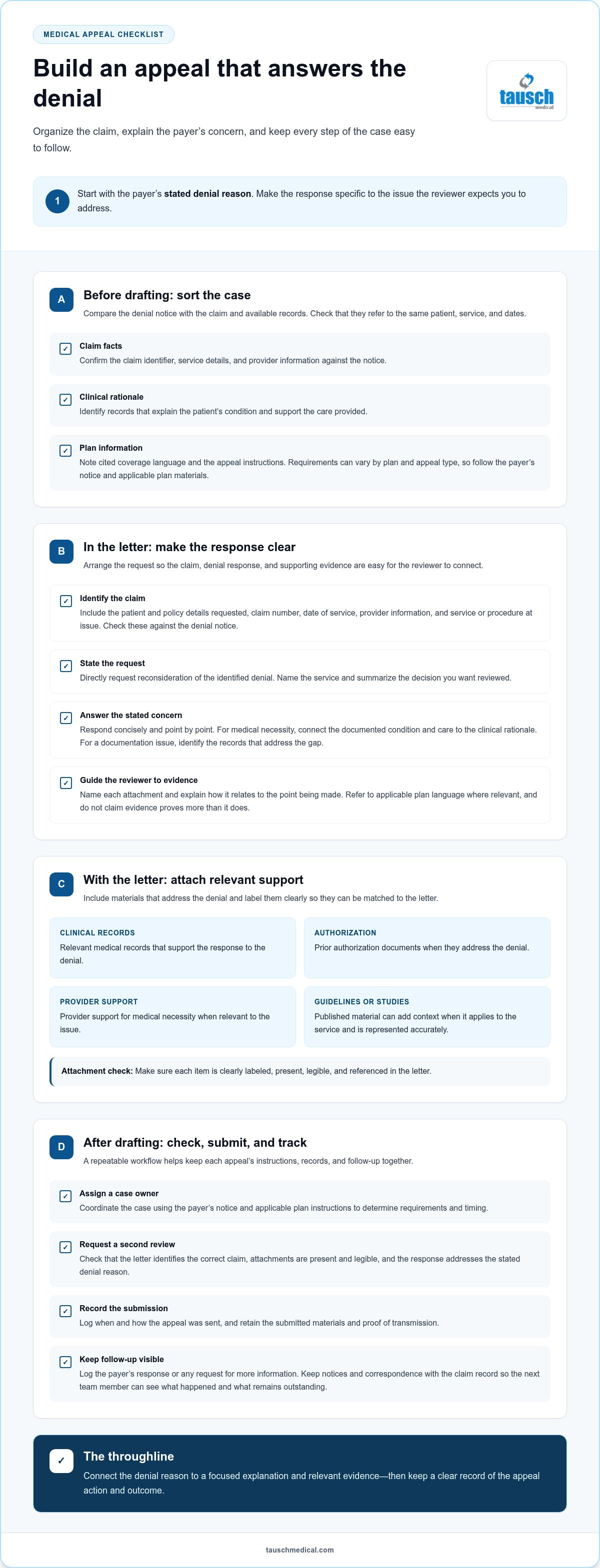
Before drafting, sort the information into three categories: claim facts, clinical rationale, and plan-related details. This helps distinguish an incorrect claim field from a clinical disagreement or a question about coverage. Because health insurance in the United States includes different types of coverage and payer arrangements, appeal instructions and submission requirements can vary by plan and appeal type. Follow the instructions in the payer’s notice and applicable plan materials.
What to review before drafting a medical appeal letter
A medical appeal letter is a request for a payer to reconsider a decision, supported by information relevant to the denial. Compare the notice with the claim and available clinical records, checking that they refer to the same patient, service, and dates. Note the affected service and any cited plan language, then identify evidence that directly addresses the stated reason. For example, if the notice identifies a documentation gap, check whether the relevant record is available and clearly supports the claim. This focused review helps avoid broad assertions that do not resolve the payer’s concern.
- Claim facts: Confirm the claim identifier, service details, and provider information against the notice.
- Clinical rationale: Identify records that explain the patient’s condition and support the care provided.
- Plan information: Record cited coverage language and the notice’s appeal instructions.
This review gives your team a practical foundation for how to write a medical appeal letter that responds to the denial with relevant, organized support.
How to Write a Medical Appeal Letter Step by Step
A clear structure helps the reviewer connect the request to the denied service and the evidence supporting it. As you consider how to write a medical appeal letter, use the payer’s instructions to determine which details and records apply. Then arrange the letter so the claim, request, and response to the denial are easy to follow.
- Identify the claim. Include the patient and policy details requested by the payer, along with the claim number, date of service, provider information, and service or procedure at issue. Compare these details with the denial notice to ensure the appeal refers to the correct claim.
- State the request. Open with a direct statement that you are requesting reconsideration of the identified denial. Name the service and summarize the decision you want the payer to review.
- Answer the denial rationale. Address the payer’s stated concern in a concise, point-by-point explanation. For a medical-necessity denial, connect the patient’s documented condition and care to the clinical rationale. For a documentation issue, identify the records that address the gap. Refer to applicable plan language where relevant, and do not claim that evidence proves more than it does.
- Direct the reviewer to supporting material. Refer to attachments by name and explain how each relates to the point being made. Close with the provider’s contact details and any other information requested in the payer’s appeal instructions.
Which records and evidence should accompany the letter?
Include relevant medical records, prior authorization documents, and provider support for medical necessity when they address the denial. Published guidelines or studies can add context when they apply to the service and are represented accurately. Label each attachment clearly and refer to it in the letter so the reviewer can connect the evidence to the relevant point.
For practices managing related claim follow-up, denial management support can help organize denial-related work alongside billing and A/R processes.
Build a Reliable Medical Appeal Workflow for Your Practice
A repeatable process helps a practice move each appeal from review to follow-up without losing key records. Assign an owner to coordinate the case, and use the payer’s notice and applicable plan instructions to determine submission requirements and timing. Keep those instructions with the case so staff do not assume one plan’s process applies to another.
Before submission, have a second team member check that the letter identifies the correct claim, the attachments are present and legible, and the response addresses the stated denial rationale. Record when and how the appeal was sent, retain the submitted materials and proof of transmission, and log the payer’s response or any request for more information. Keep notices and correspondence with the claim record so the next person handling the case can see what has happened and what remains outstanding.
How denial-management support can help providers
Reviewing denial patterns alongside A/R follow-up can help teams spot recurring workflow issues, such as missing authorization details or inconsistent claim information, and keep open accounts visible for follow-up. This operational support can complement a practice’s internal appeal process, but it cannot guarantee that a payer will reverse a decision. Tausch Medical provides A/R and Denial Management Services as part of broader revenue cycle support.
Keeping a clear record of the denial reason, appeal action, and outcome can make future cases easier to assess. It also gives staff a practical reference for refining how to write a medical appeal letter and coordinating related billing and follow-up tasks. Tausch Medical provides 24/7 support: “Calls are answered by a human to ensure patient satisfaction - always on hand to answer questions and make sure that no call goes unanswered, 24/7.”
Make Your Appeal Process Easier to Sustain
A well-managed appeal process gives your team a clearer path from denial review to payer follow-up while helping keep related revenue-cycle work organized. When administrative demands make consistency difficult, medical billing and denial-management support can help practices coordinate this work. Tausch Medical’s team includes “Over 100 certified medical coders and billers.” The company also states, “Achieving over 95% accuracy.”
With a dependable workflow in place, your team can approach each case with greater clarity and refine how to write a medical appeal letter based on the information available. Want to see how Tausch Medical can support your practice with reliable medical billing, prior authorization, eligibility verification, A/R follow-up, and RCM support? Start with our free two-week trial and experience the difference before making a commitment.
Frequently Asked Questions
These appeal considerations apply to healthcare practices in Houston, San Antonio, Dallas, Austin, El Paso, Arlington, Plano, New York, Boston, Philadelphia, Washington, D.C., Baltimore, Miami, Orlando, Tampa, Atlanta, Raleigh, Richmond, and Jacksonville.
What should be included in a medical appeal letter?
Include enough information to identify the patient, policy, claim, denied service, and provider, as applicable. State what decision you want the payer to reconsider, then connect your explanation to the denial reason and relevant plan language. When deciding how to write a medical appeal letter, make each supporting record purposeful. For example, attach documentation that addresses the specific service or claim issue.
How do you write a strong letter of medical necessity for an appeal?
Ask the treating provider to explain the patient’s relevant clinical circumstances, why the service is recommended, and how the record supports that decision. A useful letter links those facts to the payer’s concern rather than relying on a broad statement such as “the service was necessary.” Add treatment history or clinical guidance only when it helps substantiate the particular request.
Can a provider appeal an insurance denial on a patient’s behalf?
A provider can help prepare clinical information and supporting documentation, but the plan’s process determines who may submit the appeal and whether authorization is needed. Review the denial notice for any required submitter, form, or delivery method before sending materials. Keep the patient informed about what information is being shared and how it supports the appeal.
What should a practice do if a medical appeal is denied?
Review the decision notice and plan instructions to understand the reason for the outcome and whether another review step is available. Keep the payer’s decision with the original appeal, attachments, submission records, and related correspondence. Then determine whether additional documentation or a different process applies. Do not assume the next step or its timing is the same across plans.
Disclaimer
This article is for general informational purposes only and does not constitute legal, medical, billing, coding, compliance, or financial advice. Healthcare rules, payer policies, and reimbursement guidelines may change and may vary by situation. Please consult qualified professionals or official sources before making decisions based on this content. Tausch Medical is not responsible for any loss or liability arising from reliance on this information.


