


Article by
Dr. Sharafat Hussain Ph.D
Dr. Sharafat Hussain is a healthcare business consultant, entrepreneur, and academic with strong experience in the US healthcare industry. He is the Founder and Managing Director of Tausch Medical, a revenue cycle management company supporting US healthcare providers with medical billing, prior authorization, credentialing, eligibility verification, A/R follow-up, and patient support services. His work combines practical healthcare operations, business strategy, and academic insight to help medical practices improve efficiency, collections, and service quality.
A vendor’s headline fee isn’t an ROI calculation. For a medical practice, calculating ROI of outsourced medical billing means comparing the full cost of current operations with benefits reasonably attributable to outsourcing. It doesn’t mean placing a staff salary beside a percentage fee and treating the difference as savings. Projected collections can be difficult to interpret when claim volume, payer mix, staffing, or workflows also change.
This guide lays out a practical way to compare your own baseline, costs, and results. You’ll identify which expenses belong in the calculation, track attributable gains such as reduced denials or faster payments without counting a benefit twice, and account for factors that can distort the comparison. The goal is a clear framework for setting measurable expectations and assessing whether outsourcing supports your financial and operational goals.
Key Takeaways
- Define ROI as attributable net benefit divided by total investment, and keep operational indicators separate from financial returns.
- Use a representative baseline and a consistent comparison period when calculating ROI of outsourced medical billing.
- Apply a clear formula: add attributable benefits, subtract outsourcing investment, then divide the net benefit by that investment.
- Review results alongside billing, eligibility verification, authorization, A/R follow-up, and broader RCM workflow measures.
What Does ROI of Outsourced Medical Billing Actually Measure?
ROI is the percentage return produced by an investment. For outsourced medical billing, subtract the outsourcing investment from benefits the practice can reasonably connect to the service, then divide the result by the full investment. This Return on Investment (ROI) framework is useful when both sides of the comparison use consistent definitions and time periods.
A vendor’s fee alone can’t show whether outsourcing is worthwhile. Compare practice-specific costs and outcomes over comparable periods, using a representative baseline and accounting for changes such as claim volume, payer mix, or staffing. For example, improved collections during a period with substantially higher visit volume shouldn’t automatically be credited to the billing partner. The aim of calculating ROI of outsourced medical billing is to identify what changed and what can fairly be attributed to the service.
Which outcomes belong in a medical billing ROI assessment?
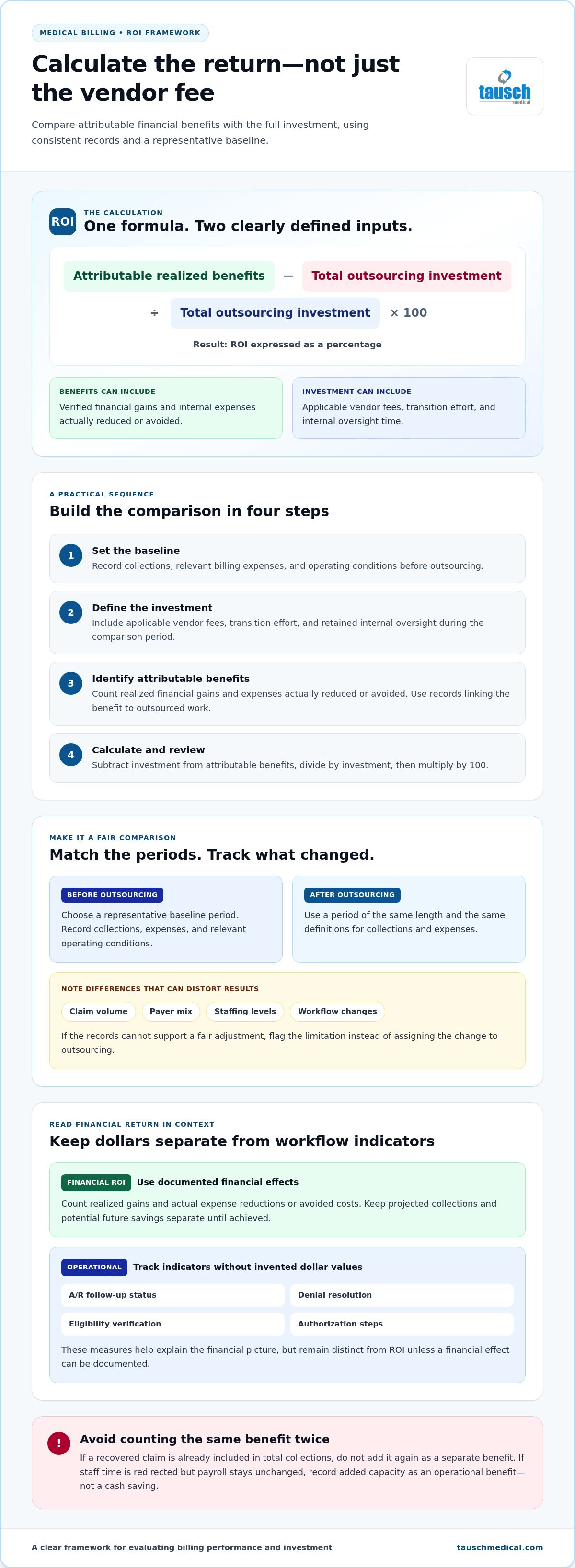
Include realized financial effects, such as collections attributable to improved billing performance and internal expenses actually reduced or avoided. If staff time is redirected to other work but payroll remains unchanged, record the additional capacity as an operational benefit, not a cash saving. Keep projected collections and potential future savings separate from results already achieved.
Operational measures help explain the financial picture, but shouldn’t be assigned invented dollar values. Track specific workflow indicators, such as whether A/R follow-up is current, how denials are being resolved, and whether eligibility verification and authorization steps are completed consistently. These measures are relevant to a practice’s medical billing workflows, but they remain distinct from ROI unless a documented financial effect can be attributed to them. Reporting both categories gives decision-makers more context than a single percentage.
How to Calculate ROI of Outsourced Medical Billing Step by Step
Start with comparable records, not an optimistic projection. Select a representative pre-outsourcing period and a post-outsourcing period of the same length. Use the same definitions for collections and expenses in both periods. Then compare claim volume, payer mix, staffing levels, and workflow changes. Note material differences so they aren’t mistaken for the effect of outsourcing.
- Set the baseline. Record collections, relevant billing expenses, and operating conditions that could affect the results before outsourcing.
- Define the investment. Add applicable vendor fees, transition effort, and the cost of internal time retained for oversight during the comparison period.
- Identify attributable benefits. Count realized financial gains and internal expenses actually reduced or avoided. Use records that connect the benefit to the outsourced work.
- Calculate and review. Subtract total investment from attributable benefits, divide the net benefit by total investment, and multiply by 100 to express ROI as a percentage.
Which costs and benefits should the ROI formula include?
ROI = [(attributable realized benefits − total outsourcing investment) ÷ total outsourcing investment] × 100. Benefits are verified financial gains and expenses reduced or avoided. Investment includes applicable vendor fees and the practice’s transition and oversight costs. Exclude projected gains until they occur. To prevent double counting, if a recovered claim is already included in total collections, don’t add it again as a separate benefit.
When claim volume rises or staffing changes, compare like with like where the records allow. For example, review collections alongside claim volume and note any staffing changes that affect expenses. If the available data don’t support a fair adjustment, flag the limitation instead of assigning the change to outsourcing. A defined medical billing outsourcing service gives the practice a clear scope of billing work to evaluate and helps keep assumptions visible.
How to Evaluate Results and Apply Them to Your Practice
A positive ROI is useful, but it doesn’t tell the whole story. Review the result alongside measures that show how work moves through the revenue cycle, including claim status, denial follow-up, eligibility and authorization checks, and A/R activity. These measures can help locate improvements or bottlenecks without assigning unsupported dollar values to workflow changes.
Interpret the numbers in context. Note changes in claim volume, payer mix, staffing, or internal processes during the review period, and document assumptions, exceptions, and gaps in the data. If records are incomplete or a workflow changed at the same time outsourcing began, identify that limitation rather than treating the outcome as conclusive. Use the findings to focus on specific billing tasks and handoffs that need attention, including the scope of your medical billing services.
How can a practice use trial-period data responsibly?
Before a trial begins, record a baseline and choose the operational measures the practice will review, such as eligibility verification completion, authorization workflow status, denial follow-up, and A/R activity. Define each measure consistently and note who records it. Trial-period observations can show how workflows function in practice, but they are an initial operational assessment, not proof of long-term financial results.
For broader context on outsourcing strategy, practices can also review this outsourced billing strategic guide. A measured approach to calculating ROI of outsourced medical billing helps teams turn trial observations into clear questions and realistic expectations.
Turn Your ROI Analysis Into a Confident Next Step
A well-grounded assessment can help your practice identify which revenue cycle workflows deserve closer attention, clarify what a successful partnership should support, and establish a shared basis for reviewing progress. Keep expectations specific to your practice and revisit them as needs and operating conditions evolve. This makes calculating ROI of outsourced medical billing a useful part of ongoing management, not just a one-time comparison.
Frequently Asked Questions
How do you calculate ROI for outsourced medical billing?
Subtract the outsourcing investment from financial benefits attributable to the service, divide the result by that investment, and multiply by 100. For calculating ROI of outsourced medical billing, use records such as posted payments, documented expense reductions, and vendor charges for the same review period. Separate changes linked to billing work from unrelated shifts in practice activity.
What costs should a medical practice include when calculating outsourcing ROI?
Include expenses incurred because of outsourcing, such as applicable vendor charges, transition work, and staff time spent coordinating or reviewing billing activity. Don’t automatically add unrelated overhead, such as general rent or clinical supplies, unless outsourcing changed that expense and the change can be documented. If an existing employee’s duties shift but their pay stays the same, record the capacity change separately from cash savings.
How long should a practice measure outsourced medical billing performance?
Choose a period long enough to capture the billing activity and payment patterns relevant to your practice, then compare it with a pre-outsourcing period of the same length. There’s no single duration that suits every practice. Keep the periods aligned, note unusual interruptions, and distinguish claims submitted during the review from payments received for older claims.
Can outsourced medical billing improve cash flow even if ROI is difficult to measure?
It may support cash flow when billing processes help move claims and follow-up forward, but workflow changes alone don’t prove a financial improvement. Track observable signs, such as fewer unresolved billing tasks or more consistent A/R follow-up, then compare payment timing and amounts in practice records. Practices in Houston, San Antonio, Dallas, Austin, El Paso, Arlington, Plano, New York, Boston, Philadelphia, Washington D.C., Baltimore, Miami, Orlando, Tampa, Atlanta, Raleigh, Richmond, and Jacksonville can use the same evidence-led approach.
Want to see how Tausch Medical can support your practice with reliable medical billing, prior authorization, eligibility verification, A/R follow-up, and RCM support? Start with our free two-week trial and experience the difference before making a commitment: https://tauschmedical.com/free-trial-form
Disclaimer
This article is for general informational purposes only and does not constitute legal, medical, billing, coding, compliance, or financial advice. Healthcare rules, payer policies, and reimbursement guidelines may change and may vary by situation. Please consult qualified professionals or official sources before making decisions based on this content. Tausch Medical is not responsible for any loss or liability arising from reliance on this information.


