


Article by
Dr. Sharafat Hussain Ph.D
Dr. Sharafat Hussain is a healthcare business consultant, entrepreneur, and academic with strong experience in the US healthcare industry. He is the Founder and Managing Director of Tausch Medical, a revenue cycle management company supporting US healthcare providers with medical billing, prior authorization, credentialing, eligibility verification, A/R follow-up, and patient support services. His work combines practical healthcare operations, business strategy, and academic insight to help medical practices improve efficiency, collections, and service quality.
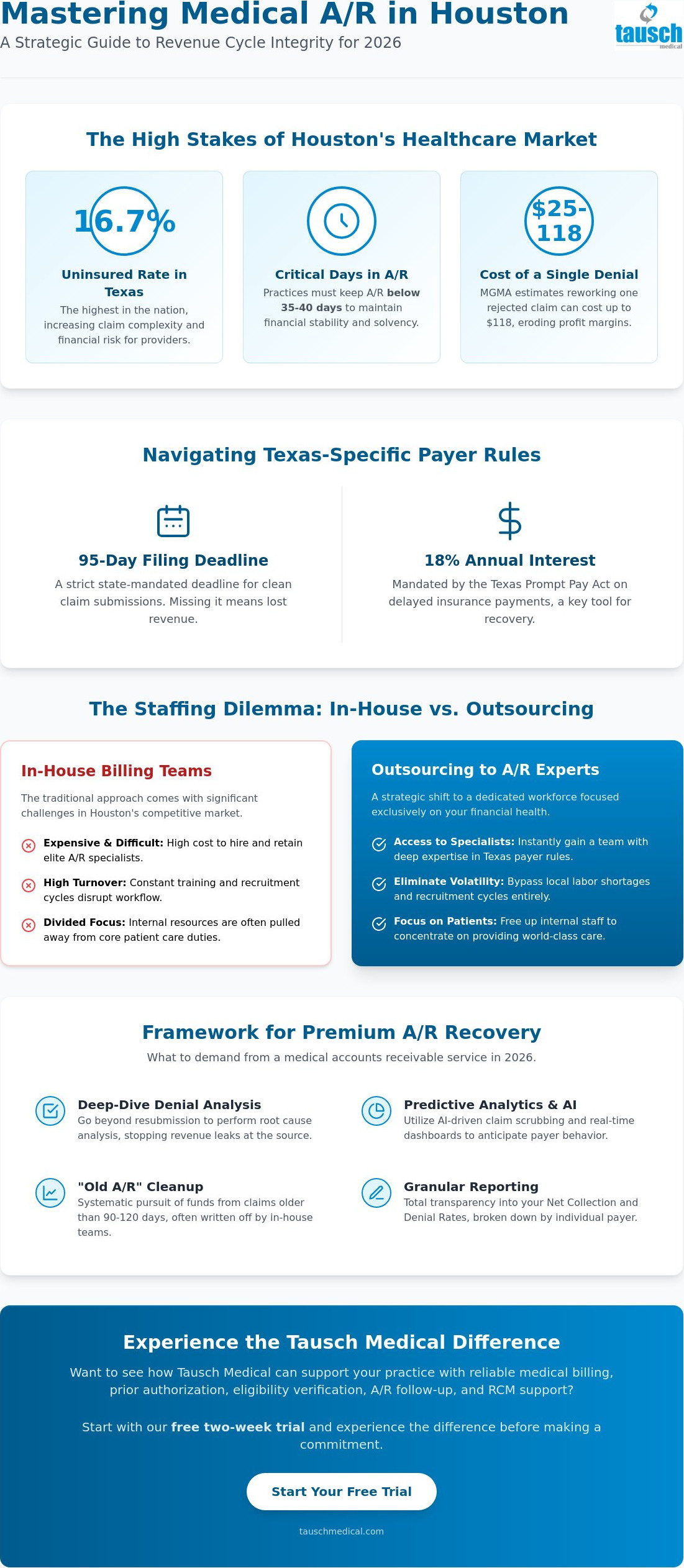
With Texas currently grappling with a 16.7% uninsured rate, the highest in the nation, how much of your hard-earned revenue is trapped in administrative limbo? It's a sobering reality for many practices where high days in A/R and frequent denials from Texas payers disrupt the financial stability required for premium patient care. If you've found that hiring and retaining skilled billing staff in the local market is becoming an uphill battle, you aren't alone. Utilizing professional medical accounts receivable services Houston healthcare leaders rely on is no longer just an option; it's a strategic necessity for maintaining revenue cycle integrity in 2026.
We understand that managing complex payer requirements and the strict 95-day clean claim filing deadline feels like a constant race against the clock. This guide provides a clear roadmap to help you reduce outstanding balances and recover lost revenue through sophisticated recovery protocols. You'll learn how to navigate the latest Texas Prompt Pay Act interest rates and implement expert handling of complex local claims to ensure consistent, predictable cash flow for your practice.
Key Takeaways
- Understand why strategic medical AR management is the essential foundation for practice stability in the high-cost 2026 healthcare landscape.
- Learn to evaluate medical accounts receivable services Houston providers rely on by prioritizing deep expertise in local Texas payer requirements and Medicaid HMO protocols.
- Explore a multi-tiered recovery framework designed to perform deep-dive root cause analyses on persistent claim denials to stop revenue leakage at the source.
- Discover actionable methods to significantly reduce days in A/R, ensuring your practice maintains the liquidity required to invest in world-class medical technology and patient care.
The Impact of Stagnant Accounts Receivable on Houston Practices
Medical AR Management isn't merely a clerical function; it's the clinical-grade strategic process of pursuing unpaid or denied claims to ensure your practice receives every dollar earned. Within the broader framework of Revenue cycle management (RCM), AR recovery acts as the final safeguard against financial erosion. In Houston, the 2026 healthcare environment presents a unique challenge where administrative overhead continues to climb while reimbursement rates remain stagnant. With Texas maintaining the nation's highest uninsured rate at 16.7%, the margin for error in claim submission has never been thinner.
The health of your practice is often mirrored in your "Days in A/R" metric. For a Houston practice to remain solvent and competitive, keeping this number below 35 to 40 days is critical. When claims linger beyond this window, the likelihood of collection drops significantly; especially considering the strict 95-day clean claim filing deadline mandated by Texas law. Revenue leakage typically occurs at two primary points: front-desk eligibility errors and inadequate follow-up on denials. According to the Medical Group Management Association (MGMA), reworking a single rejected claim can cost between $25 and $118. These hidden costs quickly compound, making specialized medical accounts receivable services Houston providers can trust an essential partner in fiscal health.
Staffing Challenges: Hiring vs. Outsourcing in Houston
Finding and retaining elite AR specialists in Houston's saturated market is both difficult and expensive. High turnover rates and the burden of benefits often outweigh the perceived control of an in-house team. Choosing to outsource medical billing allows providers to bypass the recruitment cycle entirely. This shift provides access to a dedicated workforce focused exclusively on recovery without the volatility of local labor shortages. By leveraging medical accounts receivable services Houston experts provide, practices can refocus their internal resources on patient care while ensuring their financial infrastructure remains uncompromising.
Evaluating Medical Accounts Receivable Services: A Houston Reference Guide
Selecting a partner for your revenue recovery requires more than a cursory review of a service list; it demands a rigorous, criteria-based framework that prioritizes local expertise. In the Houston market, understanding the specific adjudication patterns of Blue Cross Blue Shield of Texas and local Medicaid HMOs is non-negotiable. Out-of-state vendors often miss the nuances of Texas-specific regulations, such as the 18% annual interest rate on delayed insurance payments for non-weather-related claims. A sophisticated service doesn't just process claims. It anticipates payer behavior based on historical data and clinical evidence. You can consult with our team to see how this level of local insight protects your bottom line.
Technology in 2026 has evolved beyond simple data entry into the realm of predictive analytics. Premium medical accounts receivable services Houston practices utilize must feature AI-driven claim scrubbing and real-time dashboards. These tools allow you to monitor your Net Collection Rate and Denial Rate by Payer with total transparency. Monthly reporting should provide a clear view of your financial health, allowing you to identify which payers are meeting their obligations and which require aggressive follow-up. Without this level of granular reporting, practice leaders are essentially making strategic decisions in a vacuum.
Key Features of Premium AR Recovery
A world-class approach involves sophisticated AR and denial management workflows that go far beyond simple resubmission. It's about performing a deep-dive analysis to ensure the root cause of every denial is addressed. Additionally, premium partners prioritize "Old AR" cleanup. This involves the systematic pursuit of funds from claims older than 90 or 120 days, which many internal teams write off as uncollectible. Seamless integration with your existing Houston EHR system is also vital. This connectivity prevents data silos and ensures that your clinical and financial workflows remain synchronized and efficient.
Optimizing Your Revenue Cycle with Tausch Medical AR Frameworks
Tausch Medical employs a multi-tiered strategy that balances proactive prevention with aggressive recovery protocols to secure your practice's financial future. Our approach to medical accounts receivable services Houston providers trust is built on the philosophy that every denied claim is a solvable puzzle. We don't simply resubmit paperwork; we engineer systems that prevent denials from recurring while ensuring that existing outstanding balances are liquidated with clinical precision.
Our framework follows three rigorous steps to restore your cash flow:
- Step 1: Root Cause Analysis. We perform an exhaustive audit of your current denials to identify the specific triggers causing revenue leakage. By fixing these issues at the source, we stop the cycle of recurring rejections.
- Step 2: Systematic Follow-up Protocols. Our team implements a persistent follow-up schedule that ensures no claim is left unaddressed. We track every interaction with payers to ensure compliance with the Texas Prompt Pay Act.
- Step 3: Continuous Enrollment Management. We utilize specialized provider credentialing services to ensure that payments aren't blocked by outdated enrollment data or expired certifications.
Beyond Billing: Comprehensive Practice Support
A healthy AR cycle begins long before a claim is even generated. Efficient patient scheduling and rigorous eligibility verification act as the first line of defense against future denials. When these front-end tasks are handled with the same precision as the billing itself, the entire revenue cycle moves with greater fluidity. This integrated approach ensures that patient data is accurate from the first point of contact, significantly reducing the administrative burden on your clinical staff.
The Tausch Medical Difference
The Tausch Medical difference lies in our unique combination of clinical-grade precision and a partnership-first mindset. We view ourselves as an extension of your practice, providing the technological superiority and expert oversight required to navigate the complexities of 2026 healthcare. By choosing specialized medical accounts receivable services Houston experts manage, you gain a dedicated ally focused on your long-term business success and operational excellence.
Want to see how Tausch Medical can support your practice with reliable medical billing, prior authorization, eligibility verification, A/R follow-up, and RCM support? Start with our free two-week trial and experience the difference before making a commitment: https://tauschmedical.com/free-trial-form
Securing Your Practice's Financial Future
Tausch Medical stands as a premium partner, offering specialized expertise in local payer nuances and a proven track record of recovering lost revenue for clinics across the region. We're committed to your long-term success through transparent reporting and uncompromising support. Want to see how Tausch Medical can support your practice with reliable medical billing, prior authorization, eligibility verification, A/R follow-up, and RCM support? Start with our free two-week trial and experience the difference before making a commitment: free trial form
Your practice deserves a financial foundation as robust as the care you provide. By ensuring your revenue cycle is managed with precision, local leaders such as Houston Medical Wellness Clinic can continue to focus on delivering high-quality care and maintaining their standing in the Houston medical community.
Frequently Asked Questions
What are the most common reasons for claim denials in Houston?
The most frequent reasons for claim denials in the local market include eligibility verification errors and failure to meet the strict 95-day clean claim filing deadline. In 2026, many practices also face challenges with the new state-mandated coordination of benefits (COB) questionnaires and revised prior authorization timelines. These administrative oversights often lead to preventable revenue leakage that disrupts a practice's clinical focus and financial stability.
How much does it cost to outsource medical accounts receivable services?
Industry standards for medical accounts receivable services Houston practices utilize typically involve a percentage-based fee structure tied to net monthly collections. While specialty practices like oncology or cardiology may see higher complexity rates, most providers find that outsourcing eliminates the fixed overhead of in-house staffing and training. This model aligns the service provider's success directly with the practice's recovery results, ensuring a partnership focused on maximizing reimbursement.
How long does it take to see an improvement in cash flow after outsourcing AR?
Most practices observe a measurable improvement in cash flow within the first 30 to 60 days of partnering with a professional recovery service. This timeline accounts for the initial audit of the existing aging report and the implementation of systematic follow-up protocols. As the first-pass clean claim rate improves and old balances are liquidated, the reduction in "Days in A/R" creates a more consistent and predictable revenue stream.
Can an AR service help with old, unpaid claims from previous years?
Specialized AR services are highly effective at recovering funds from old, unpaid claims, provided they fall within the legal collection windows. In Texas, providers must bill patients by the first day of the eleventh month after service; this makes the prompt recovery of aging accounts essential. A dedicated team uses advanced analytics to prioritize high-value claims from previous years, ensuring that revenue previously considered uncollectible is successfully returned to the practice's bottom line.
Disclaimer
This article is for general informational purposes only and does not constitute legal, medical, billing, coding, compliance, or financial advice. Healthcare rules, payer policies, and reimbursement guidelines may change and may vary by situation. Please consult qualified professionals or official sources before making decisions based on this content. Tausch Medical is not responsible for any loss or liability arising from reliance on this information.


