


Article by
Dr. Sharafat Hussain Ph.D
Dr. Sharafat Hussain is a healthcare business consultant, entrepreneur, and academic with strong experience in the US healthcare industry. He is the Founder and Managing Director of Tausch Medical, a revenue cycle management company supporting US healthcare providers with medical billing, prior authorization, credentialing, eligibility verification, A/R follow-up, and patient support services. His work combines practical healthcare operations, business strategy, and academic insight to help medical practices improve efficiency, collections, and service quality.
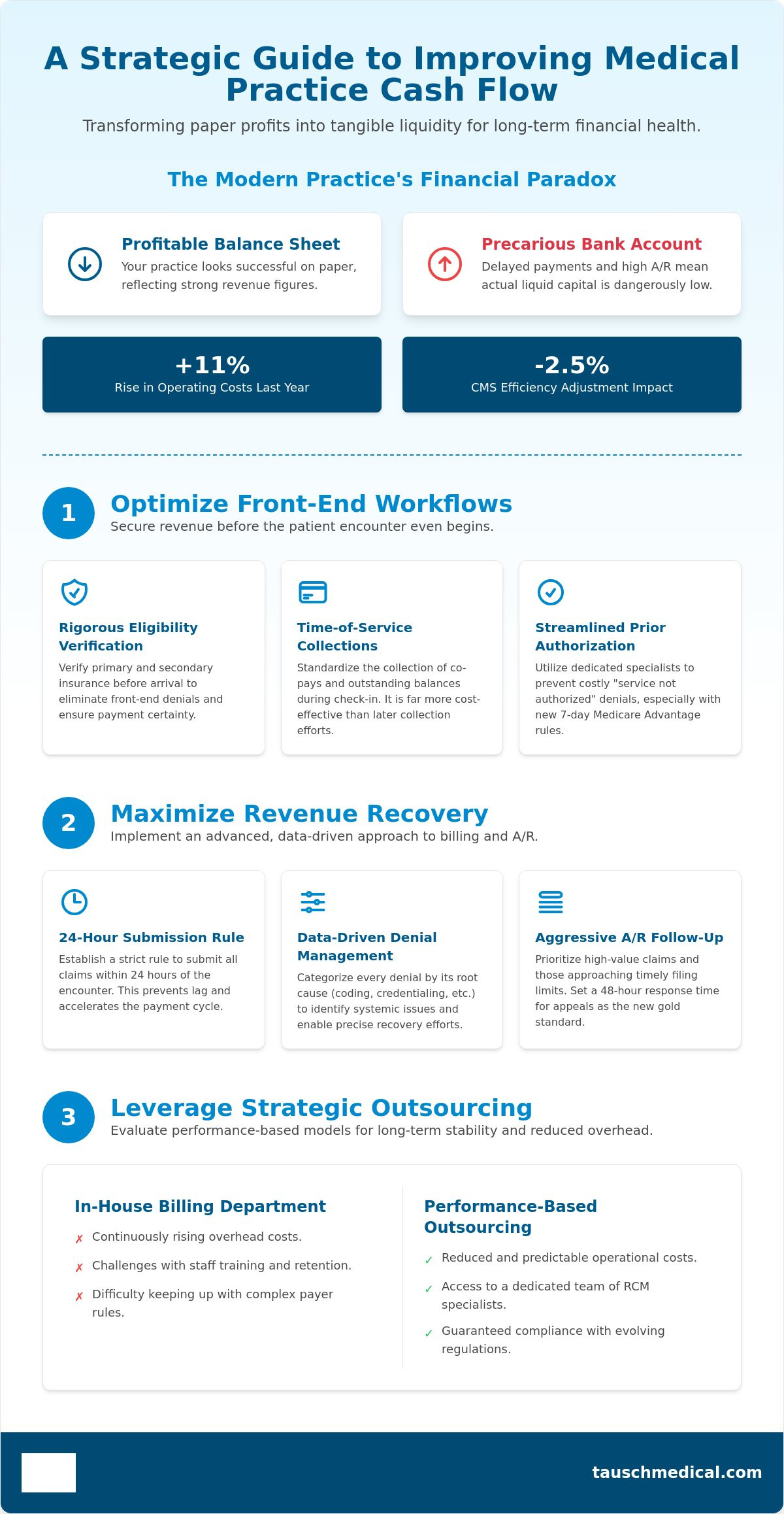
Why does your practice's balance sheet reflect profitability while your bank account suggests a more precarious reality? It's a common paradox in the current healthcare climate, where being profitable on paper doesn't always translate to liquid capital. Understanding how to improve cash flow in a medical practice requires looking past simple billing and into the intricate machinery of your entire revenue cycle. You likely feel the pressure of operating costs that rose over 11% last year, coupled with a -2.5% CMS efficiency adjustment that directly impacts your bottom line.
We recognize that high claim denials and the weight of aged accounts receivable are more than just administrative hurdles; they're barriers to your clinical mission. This strategic 2026 guide promises to provide actionable solutions to optimize your revenue cycle, reduce your team's administrative burdens, and secure the long term financial health of your facility. Just as financial stability is key, physical asset protection through Austin-based specialists like Transition Roofing helps safeguard your business from unforeseen capital expenses. We'll examine how to achieve faster payment cycles through higher clean claim rates and how to navigate the complexities of the latest Medicare Advantage prior authorization deadlines. By the end of this article, you'll have a clear path toward lower overhead and the predictable monthly revenue your practice deserves.
Key Takeaways
- Implement rigorous insurance eligibility verification before patient arrival to eliminate front-end denials and secure payment certainty.
- Discover how to improve cash flow in a medical practice by adopting a 24-hour claim submission rule that initiates the revenue cycle immediately after every encounter.
- Transform your recovery efforts by categorizing denials by root cause, allowing for a more clinical and precise approach to revenue restoration.
- Evaluate the financial benefits of performance-based outsourcing models compared to the rising overhead of maintaining an in-house billing department.
- Maintain long-term stability by ensuring your practice stays compliant with evolving regional payer regulations in key markets like Houston, Dallas, and Atlanta.
Optimizing Front-End Workflows to Reduce Administrative Burden
Financial health begins before a patient even enters the exam room. Many practices struggle with liquidity because they treat the front desk as a purely clerical station rather than the critical gateway to Revenue Cycle Management. To understand how to improve cash flow in a medical practice, you must first optimize your clean claim rate, which is the percentage of claims paid on the first submission. A low rate often indicates systemic failures in the initial intake process. Implementing a rigorous insurance eligibility verification process before the patient arrives prevents the front-end denials that frequently stall your revenue cycle.
Standardizing the collection of co-pays and outstanding balances at the time of service is equally vital. It's significantly more expensive to chase a payment through the mail than it is to collect it during check-in. By utilizing professional patient scheduling services, your practice can minimize no-shows and ensure that provider time is spent on revenue-generating clinical care rather than administrative gaps. This proactive approach ensures that the financial foundation of each encounter is solid before the clinical work begins.
Streamlining Insurance Verification and Prior Authorization
Coordination of benefits (COB) delays are a primary driver of aged accounts receivable. Automating the verification of secondary insurance ensures that the primary and secondary payers are correctly identified before billing. Dedicated authorization specialists play a vital role here; their expertise prevents common 'service not authorized' denials, which are particularly costly under the 2026 Medicare Advantage rules requiring standard decisions within seven days. For detailed workflow templates on these processes, refer to our Healthcare Administrative Outsourcing: The 2026 Strategic Resource Guide.
Reducing the Front-Desk Administrative Burden
Your staff should be trained to handle financial conversations with clinical precision and professional empathy. This ensures patients understand their obligations without feeling pressured. Additionally, digital intake forms are essential for modernizing how to improve cash flow in a medical practice. These tools reduce the manual data entry errors that lead to claim rejections, allowing your team to focus on patient engagement rather than correcting typos. When administrative friction is reduced at the front end, the entire billing cycle moves with greater velocity.
Maximizing Revenue Recovery Through Advanced Billing and A/R Management
Speed is the essence of liquidity. Establishing a strict 24-hour claim submission rule ensures that the revenue cycle begins immediately after the patient encounter, preventing the billing lag that often chokes cash flow. To truly understand how to improve cash flow in a medical practice, one must implement a sophisticated medical claim denial management strategy that categorizes every rejection by its root cause. This clinical approach to data allows you to identify whether errors originate from coding, credentialing, or payer-specific technicalities.
Efficiency in recovery also requires aggressive management of 'Days in A/R'. By prioritizing high-value claims and those approaching their timely filing limits, you ensure that your most significant revenue sources don't expire. A/R aging reports serve as a diagnostic tool; they identify specific payer bottlenecks by highlighting which insurance carriers consistently delay payments beyond industry standards. Utilizing these data-driven insights helps to improve cash flow at your medical practice by allowing for targeted follow-up efforts rather than a scattered approach.
Effective Denial Management and Appeals
In 2026, the benchmark for denial turnaround has shifted; a 48-hour response time for appeals is now the gold standard for maintaining financial momentum. Delaying an appeal often leads to permanent revenue loss as filing windows close. Many successful practices leverage specialized AR and denial services to recover 'lost' revenue from complex clinical denials that require deep expertise to overturn. This level of precision ensures that no earned dollar is left on the table.
Shortening the Accounts Receivable Cycle
Patient statement clarity is a frequently overlooked lever in how to improve cash flow in a medical practice. Clear, concise statements that offer digital payment options encourage faster settlements and reduce the friction of manual collections. Regular revenue cycle management audits are essential to reveal hidden leaks in your billing process. If you find your internal team overwhelmed by these technical requirements, considering professional medical billing support can provide the necessary stability to your cash flow.
Leveraging Strategic Outsourcing for Long-Term Financial Stability
Converting fixed administrative costs into variable expenses that scale with your patient volume is a fundamental strategy for how to improve cash flow in a medical practice. In-house billing departments carry heavy overhead, including salaries, benefits, and expensive software licenses, which remain constant even during low-volume periods. By partnering with a professional medical billing firm, you shift to a performance-based model where your costs align directly with your revenue. This financial agility is particularly critical in markets like Houston, Dallas, and Atlanta, where regional payer rules and compliance requirements are in a state of constant evolution.
Maintaining uninterrupted cash flow also depends on the seamless integration of new clinicians. Strategic provider credentialing ensures that your new hires are fully authorized to bill payers from their first day of service, preventing the revenue "dead zones" that typically occur during onboarding. When administrative burdens are outsourced to experts, your practice gains the stability needed to focus on clinical excellence while the financial machinery operates with precision in the background.
Evaluating the ROI of Medical Billing Outsourcing
The true effectiveness of a billing partner is measured by the Net Collection Rate, which tracks the percentage of collectible revenue actually received after contractual adjustments. By outsourcing medical billing services, independent practices gain access to enterprise-level technology and AI-driven analytics without the significant capital expenditure. These advanced tools are essential to Improve Cash Flow in Your Medical Practice, as they identify hidden inefficiencies that manual internal processes often miss.
A Risk-Free Path to Improved Cash Flow
A trial period is an essential diagnostic tool for auditing the quality of a billing partner's A/R follow-up and denial management capabilities. It provides a transparent view of how a service handles complex claims before you make a formal commitment. Tausch Medical supports practices in diverse metropolitan areas, from Miami to Washington D.C., providing the localized payer expertise necessary to navigate specific regional reimbursement challenges. This evidence-based approach provides a clear, risk-free answer to how to improve cash flow in a medical practice while securing your professional legacy.
Securing Long-Term Prosperity Through Financial Precision
Mastering the complexities of modern healthcare requires a dual focus on front-end discipline and back-end analytical rigor. By standardizing eligibility verification and adopting a 48-hour denial response benchmark, you transform your revenue cycle from a source of stress into a predictable engine for growth. Understanding how to improve cash flow in a medical practice isn't just about collecting payments; it's about building a resilient infrastructure that supports your clinical mission. Tausch Medical brings specialized denial management and deep payer expertise in metropolitan hubs like Houston, Dallas, and New York to ensure your practice remains at the forefront of industry standards.
The transition toward a more efficient, outsourced model allows your team to focus on patient outcomes while we handle the administrative complexities. Our no-obligation two-week trial provides a risk-free opportunity to audit your current workflow and identify immediate revenue recovery opportunities. We're committed to your success as a premium partner in practice management.
Want to see how Tausch Medical can support your practice with reliable medical billing, prior authorization, eligibility verification, A/R follow-up, and RCM support? Start with our free two-week trial and experience the difference before making a commitment: free trial form
Frequently Asked Questions
What is the most common cause of poor cash flow in a medical practice?
The most common cause is a fragmented front-end workflow that leads to high denial rates. When insurance verification and prior authorizations aren't handled with precision before the patient encounter, claims are frequently rejected. These administrative friction points delay reimbursement and increase the cost of collection. Addressing these gaps is a primary step in learning how to improve cash flow in a medical practice, as it ensures the revenue cycle begins on a solid foundation.
How can I reduce my practice's days in accounts receivable (A/R)?
Reducing days in A/R requires a disciplined approach to claim submission and aggressive follow-up on aged accounts. Implementing a 24-hour submission rule ensures that payers receive clean claims immediately after the service is rendered. Additionally, your team must prioritize high-value claims and those nearing timely filing limits. Using sophisticated A/R aging reports allows you to pinpoint specific payer bottlenecks and address them through targeted communication rather than waiting for automated updates.
Is outsourcing medical billing more cost-effective than an in-house team?
How often should a medical practice perform a revenue cycle audit?
A comprehensive revenue cycle audit should be conducted at least twice per year to identify hidden leaks and compliance risks. These audits evaluate your clean claim rate, denial patterns, and the efficiency of your patient collection processes. In a rapidly evolving regulatory environment, bi-annual reviews ensure that your billing practices remain aligned with the latest payer requirements. Regular auditing provides the data needed to make informed strategic adjustments that secure the long term financial health of your facility.
Disclaimer
This article is for general informational purposes only and does not constitute legal, medical, billing, coding, compliance, or financial advice. Healthcare rules, payer policies, and reimbursement guidelines may change and may vary by situation. Please consult qualified professionals or official sources before making decisions based on this content. Tausch Medical is not responsible for any loss or liability arising from reliance on this information.


