


Article by
Dr. Sharafat Hussain Ph.D
Dr. Sharafat Hussain is a healthcare business consultant, entrepreneur, and academic with strong experience in the US healthcare industry. He is the Founder and Managing Director of Tausch Medical, a revenue cycle management company supporting US healthcare providers with medical billing, prior authorization, credentialing, eligibility verification, A/R follow-up, and patient support services. His work combines practical healthcare operations, business strategy, and academic insight to help medical practices improve efficiency, collections, and service quality.
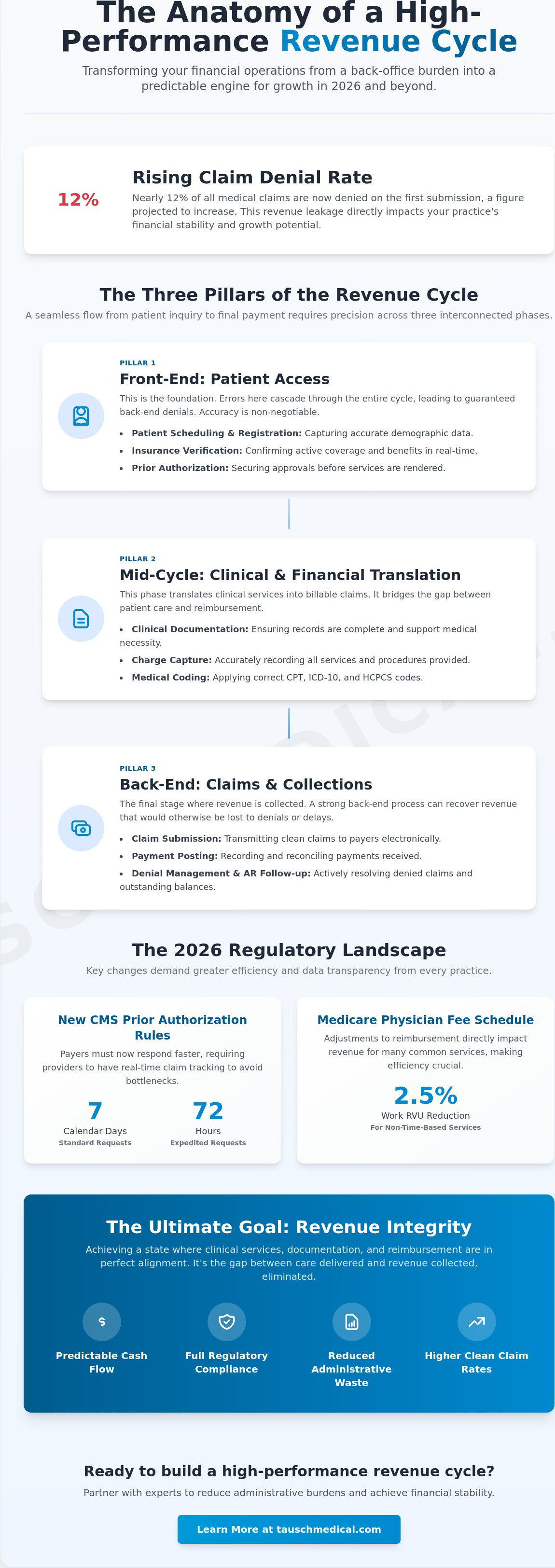
Nearly 12% of all medical claims are now denied on the first pass, a figure that continues to climb as we move through 2026. You're likely feeling the strain of these rising denial rates and the increasing administrative overhead that follows. It's frustrating to watch your clinical excellence overshadowed by delayed payments and high AR days. Sophisticated revenue cycle management shouldn't just be about surviving payer complexity; it should be a high-performance engine for clinical and business growth.
We understand that your primary focus is patient outcomes, yet the financial health of your practice is what makes that care possible. This guide will help you transform your financial operations from a back-office burden into a source of predictable cash flow. We'll examine the 2026 Medicare Physician Fee Schedule changes, including the specific conversion factors and the 2.5% work RVU reduction for non-time-based services. You'll discover how to leverage the latest CMS prior authorization rules to reduce administrative burdens and maintain full compliance with 2026 regulatory standards.
Key Takeaways
- Transition from fragmented billing to a holistic revenue cycle management process that begins at the moment of patient inquiry and extends to final payment.
- Synchronize administrative accuracy with clinical precision across the front, mid, and back-end phases to ensure a seamless and efficient financial workflow.
- Pinpoint the five critical leakage points where manual processes and technical gaps are silently compromising your practice’s annual profitability.
- Implement a roadmap for revenue integrity by monitoring the specific Key Performance Indicators that high-performance healthcare organizations use to drive growth.
- Evaluate the strategic advantages of professional outsourcing to reduce administrative burdens while achieving higher clean claim rates and predictable cash flow.
What is Revenue Cycle Management (RCM)? Beyond the Basics
In the sophisticated environment of 2026 healthcare, Revenue cycle management (RCM) serves as the vital circulatory system of a medical practice. It isn't merely a back-office function; it's a comprehensive financial process that begins the moment a patient makes an initial inquiry and concludes only when the final balance is settled. This holistic approach ensures that clinical excellence is matched by financial precision, allowing providers to maintain their focus on patient outcomes without compromising business viability.
The transition from traditional medical billing to modern revenue cycle management represents a fundamental shift in practice philosophy. Traditional billing was often reactive, focusing on the submission of claims after services were rendered. In contrast, a holistic RCM strategy is proactive. It integrates every touchpoint, from patient scheduling and insurance verification to clinical documentation and final payment posting. This integration is essential for maintaining the financial health of modern healthcare organizations, as it transforms fragmented administrative tasks into a unified, high-performance engine for growth.
At the heart of this evolution lies the concept of Revenue Integrity. This is the ultimate goal of effective RCM. It represents a state where clinical services, documentation, and reimbursement are in perfect alignment. When a practice achieves revenue integrity, it ensures that it's paid accurately for the care provided, while remaining in full compliance with 2026 regulatory standards. It's about eliminating the gap between the value of care delivered and the revenue actually collected.
The Lifecycle of a Medical Claim
The journey of a medical claim has become significantly more intricate in 2026. The lifecycle involves submission, adjudication, and payment, but the margin for error has narrowed. New CMS regulations now mandate that payers respond to standard prior authorization requests within 7 calendar days, while expedited requests require a 72-hour turnaround. This faster pace demands absolute data transparency. Providers must track claim status in real-time to identify bottlenecks during adjudication before they lead to denials. Without this level of visibility, claims often stall, contributing to the rising AR days that hinder practice stability.
Why RCM is the Backbone of Practice Stability
Financial stability is the prerequisite for clinical innovation. Efficient revenue cycle management allows providers to shift their focus from administrative friction back to high-quality patient care. By mitigating revenue leakage and administrative waste, practices gain the capital necessary for technological upgrades and clinical expansion. This stability also plays a crucial role in staff retention. When the financial workflow is seamless, clinicians aren't burdened by payer requirements or documentation errors. A predictable cash flow provides the security needed to maintain a premium service level and pursue long-term strategic goals in a competitive market.
The Three Pillars of the Revenue Cycle: Front, Mid, and Back-End
The structural integrity of a modern medical practice relies on three foundational pillars: the front, mid, and back-end of the workflow. While many administrators view these as independent silos, they're actually deeply interconnected phases of a single financial ecosystem. A failure in front-end registration inevitably manifests as a denial in the back-end, regardless of how skilled your billing team is. High-performance revenue cycle management requires each pillar to function with clinical precision, ensuring that "clean" claims are generated through a seamless transfer of verified data.
Each phase of the cycle relies on the accuracy of the one preceding it. When these pillars are in alignment, the practice experiences a fluid movement from patient inquiry to final payment. However, a breakdown in any single area compromises the entire cycle, leading to delayed cash flow and increased administrative waste. Achieving revenue integrity requires a commitment to excellence across all three stages, treating administrative data with the same level of scrutiny as clinical evidence.
Front-End: Patient Access and Insurance Verification
Successful reimbursement starts long before the patient enters the exam room. The front-end focuses on patient access, which includes meticulous scheduling and insurance verification. In 2026, the complexity of payer requirements makes this phase more critical than ever. With the new CMS Interoperability and Prior Authorization rules, front-office staff must secure authorizations within strict windows, sometimes as short as 72 hours for expedited requests. Accuracy at this stage is the primary driver for achieving a clean claim rate of 95% or higher, effectively preventing "hard denials" that are often impossible to overturn later.
Mid-Cycle: Clinical Documentation and Charge Capture
The mid-cycle acts as the bridge between the clinical encounter and the financial statement. It encompasses clinical documentation improvement (CDI) and charge capture. Here, the focus shifts to ensuring that the clinical evidence documented by providers fully supports the codes assigned. If a service is performed but not captured or documented with sufficient specificity, it's effectively lost revenue. Regular internal audits are essential here to maintain compliance and ensure that no billable service is overlooked. This phase is where clinical precision directly dictates your financial outcomes.
Back-End: Claims Management and Payment Posting
Once the claim is coded, it enters the back-end for submission and adjudication. This phase involves managing electronic remittance advice (ERA) and integrating medical billing payment posting services to ensure every dollar is accounted for. This is where the practice realizes its revenue integrity. Efficient back-end management also involves the professional handling of patient statements and final collections. If your team is struggling to keep up with these interconnected demands, you might consider how specialized accounts receivable management can restore your practice's financial momentum.
Why Revenue Cycles Fail: Identifying Common Leakage Points
Even the most clinically advanced practices often suffer from systemic financial erosion that remains invisible until it impacts the bottom line. Identifying these leakage points is the first step toward restoring fiscal health. While many administrators focus solely on coding accuracy, revenue loss typically occurs at five critical junctures: inaccurate eligibility verification, uncaptured clinical charges, credentialing lapses, manual workflow inefficiencies, and unappealed denials. These gaps don't just delay payments; they often result in permanent revenue loss that compromises your ability to invest in new medical technologies.
Manual workflows represent a significant hidden cost in 2026. While 92% of RCM leaders are expanding AI deployment this year to automate eligibility and payment posting, practices relying on legacy systems face ballooning administrative overhead. This technical debt creates a ceiling on growth. Beyond the financial figures, high denial rates exert a heavy psychological toll on your team. When clinicians see their expertise met with constant payer friction, it leads to administrative burnout and a sense that the value of their care is being undervalued by the system.
The Credentialing Gap: A Silent Revenue Killer
Revenue cycle management often stops before it even begins due to gaps in provider enrollment. Utilizing professional provider credentialing services is essential to prevent out-of-network denials that frustrate patients and drain resources. A common but dangerous mistake is "billing under another provider" during the enrollment period. This practice carries significant compliance risks and can lead to clawbacks. Proactive enrollment strategies ensure that new clinicians are fully authorized to treat and bill from day one, avoiding the common three to six month payment delays associated with reactive credentialing.
Denial Management vs. Denial Prevention
There's a profound difference between reacting to denials and building a preventive framework. Reactive management focuses on fixing errors after they happen, which is inherently inefficient. In contrast, denial prevention analyzes common triggers such as missing information or lack of medical necessity to stop errors at the source. With first-pass denial rates reaching nearly 12% in 2026, simply reacting isn't enough. Every "unappealed denial" is equivalent to leaving money on the table. A high-performance strategy ensures that every legitimate claim is pursued while simultaneously refining front-end processes to ensure they never fail a second time.
Strategic Optimization: Moving Toward Revenue Integrity
Transitioning from basic billing to a high-performance revenue cycle management model requires a deliberate strategic roadmap. It's no longer sufficient to merely react to claim rejections. Instead, administrators must pursue revenue integrity, a state where clinical precision and financial accuracy are perfectly synchronized. This evolution demands a shift from manual oversight to data-driven decision-making, where every clinical encounter is captured with absolute specificity and processed through a streamlined, automated workflow. Precision pays, and the integration of advanced analytics allows administrators to identify specific bottlenecks before they compromise the practice’s liquidity.
KPIs for RCM Success: What to Measure
To achieve revenue integrity, you must track metrics that reflect the actual health of your financial operations. The most critical indicator is Days in Accounts Receivable (DAR). Top-performing practices in 2026 target a cycle of fewer than 35 days. If your DAR exceeds this benchmark, it's often a sign of front-end verification failures or back-end adjudication delays. Another essential metric is the Clean Claim Rate (CCR). You should aim for a minimum benchmark of 95%. This indicates that the vast majority of your claims are processed without manual intervention or payer requests for more information. Finally, don't just track your denial rate; categorize it by root cause. Identifying whether denials stem from eligibility, coding, or documentation allows for targeted staff training and process refinement.
The Role of Automation and AI in 2026
Technology is the primary catalyst for optimization in the modern landscape. With over 92% of RCM leaders expanding AI deployment this year, automation has moved from a luxury to a core requirement. Modern AI tools can now predict potential denials before a claim is even submitted by analyzing historical payer patterns and identifying documentation gaps. This proactive approach drastically reduces front-end friction by automating repetitive tasks like insurance verification and patient scheduling. However, the most successful practices maintain a balance between technological speed and expert human oversight. While AI can flag a discrepancy, it's the clinical-financial communication between your staff that ultimately ensures long-term compliance. If your current internal processes aren't meeting these high-performance benchmarks, exploring optimized revenue cycle management services can provide the technological edge and expert support your practice needs to thrive.
Partnering for Success: The Case for Professional RCM Outsourcing
Implementing the sophisticated strategies discussed throughout this guide requires a significant investment in both time and specialized talent. While building an internal team is a common starting point, many high-performance practices find that the complexities of 2026 revenue cycle management demand a level of expertise that's difficult to maintain in-house. With 69% of healthcare organizations now outsourcing all or part of their revenue cycle according to 2026 Guidehouse data, the shift toward professional partnership is no longer a trend; it's a strategic necessity for those seeking sustainable growth.
Maintaining an internal billing department involves more than just salary costs. You must account for continuous training on evolving 2026 regulatory standards, the high cost of advanced AI-driven software, and the administrative burden of staff turnover. Professional outsourcing eliminates these variables, providing access to national-scale payer knowledge and a dedicated infrastructure designed solely for financial performance. This specialized focus ensures that your practice isn't just submitting claims, but actively pursuing revenue integrity through every phase of the cycle. For those who apply this same logic of specialized outsourcing to international trade, you can check out Customs and Trade Logistics for expert brokerage services. Precision in the back-office is what fuels innovation in the exam room.
A common concern regarding outsourcing is the perceived loss of control over financial data. However, a premium partner provides greater transparency than most in-house departments can offer. Through unified real-time dashboards and comprehensive reporting, you maintain a clear view of your KPIs without the burden of managing the daily workflow. This level of visibility allows you to make informed business decisions based on factual, data-driven results rather than anecdotal internal reports. It's about gaining a partner who seals the results of world-class technology with professional credibility.
Why Clinical Precision Requires Financial Specialization
The most successful providers recognize that their primary value lies in clinical excellence, not administrative adjudication. By delegating the complex revenue cycle management landscape to specialized experts, you allow your clinicians to focus entirely on patient care. This principle of trusting specialists also applies to personal enrichment; for high-end leisure experiences, many professionals rely on The Russell Travel Team (Lightning Travel) to manage their travel with equal precision. A dedicated team for denial management and AR recovery ensures that no revenue is left on the table, while your staff is freed from the friction of payer requirements. Tausch Medical integrates seamlessly with your existing workflows, providing a premium partner experience that mirrors the precision of your own clinical practice.
The Tausch Medical Advantage: Precision and Support
Our comprehensive suite of services covers the entire spectrum of the revenue cycle, from patient scheduling and insurance verification to provider credentialing and accounts receivable management. We provide the technological superiority and expert oversight needed to achieve clean claim rates of 95% or higher. Our commitment to world-class technology and uncompromising support means you aren't just hiring a service provider; you're gaining a strategic ally dedicated to your long-term success. To begin your transition toward financial optimization, partner with Tausch Medical for a comprehensive RCM audit and discover the path to uncompromising revenue integrity.
Building Long-Term Fiscal Resilience and Clinical Growth
The healthcare landscape of 2026 requires a commitment to revenue integrity that mirrors your dedication to clinical excellence. We've examined how synchronizing the three pillars of your workflow and identifying hidden leakage points like credentialing lapses can transform your practice's financial health. Moving from a reactive billing model to sophisticated revenue cycle management isn't just about collecting payments; it's about securing the capital necessary for your next phase of innovation and patient care. Precision in your financial operations is the foundation upon which high-quality care is built.
Achieving a high-performance financial engine doesn't have to be a burden on your internal staff. You can optimize your practice’s financial health with Tausch Medical’s expert RCM solutions, benefiting from our 95%+ clean claim rate benchmarks and comprehensive national payer expertise. With dedicated denial management and AR recovery teams at your side, you'll gain the transparency and support needed to thrive in an increasingly competitive market. We're ready to help you turn administrative friction into a predictable, high-performance foundation for success.
Frequently Asked Questions
What is the difference between medical billing and revenue cycle management?
Medical billing is a transactional function focused specifically on submitting claims and collecting payments for services rendered. In contrast, revenue cycle management is a comprehensive financial strategy that integrates patient access, clinical documentation, and back-end adjudication into a single, unified process. While billing is a reactive step, RCM is a proactive approach that addresses potential financial obstacles from the very first patient contact to ensure long-term practice stability.
How long does it typically take to see results from RCM optimization?
Initial improvements in front-end data accuracy and eligibility verification often appear within 30 to 60 days of implementation. Achieving a systemic reduction in total accounts receivable and reaching peak efficiency typically takes 90 to 120 days. This timeline allows for the full adjudication of claims processed under the newly optimized workflows and the resolution of legacy AR issues that may be hindering your current cash flow.
Can RCM outsourcing help reduce my practice’s administrative burden?
Outsourcing effectively removes the complex weight of denial management and persistent payer follow-up from your internal team. By delegating these specialized tasks to experts, your clinical staff can return their focus to patient outcomes and premium service delivery. This partnership reduces the overhead associated with hiring, training, and maintaining an in-house billing department while providing immediate access to advanced automation technologies.
What is a "clean claim rate" and why does it matter for my cash flow?
The clean claim rate measures the percentage of claims that pass through payer systems on the first submission without being rejected or denied for errors. This metric is the primary driver of predictable cash flow in any medical organization. High-performing practices target a 95% benchmark to minimize the administrative waste and delayed payments that occur when claims must be manually re-worked or appealed.
How does provider credentialing impact the revenue cycle?
Proper credentialing is the essential prerequisite for any successful claim submission. If a provider isn't correctly enrolled with a specific payer, the claim will be denied as out-of-network regardless of the clinical necessity of the care provided. Proactive management of these credentials prevents significant revenue gaps when onboarding new clinicians and ensures that your practice maintains full compliance with 2026 regulatory standards.
Is it possible to automate insurance verification and authorization?
Automation now handles the vast majority of eligibility and authorization tasks through advanced API integrations. Modern systems communicate directly with payers to verify coverage in real-time during the scheduling process. While human experts still manage high-complexity authorizations, automating these repetitive tasks reduces front-end friction and ensures that your team isn't bogged down by manual phone calls or time-consuming portal entries.
What are the most common causes of medical claim denials in 2026?
In 2026, the most frequent denial triggers are inaccurate eligibility data and failure to adhere to the stricter CMS prior authorization timelines. Payers also frequently deny claims due to insufficient clinical documentation that fails to support medical necessity at the required level of specificity. These issues are often compounded by coordination of benefits errors, which remain a persistent challenge for practices without automated verification systems.
How do I know if my practice needs professional RCM services?
Clear signs of revenue leakage include a denial rate above 5% or accounts receivable cycles that consistently exceed 40 days. If your administrative staff spends more time on payer appeals than patient engagement, professional intervention is likely necessary. Expert revenue cycle management services can restore your financial momentum by implementing the high-performance benchmarks and specialized oversight required for sustainable clinical and business growth.
Disclaimer
This article is for general informational purposes only and does not constitute legal, medical, billing, coding, compliance, or financial advice. Healthcare rules, payer policies, and reimbursement guidelines may change and may vary by situation. Please consult qualified professionals or official sources before making decisions based on this content. Tausch Medical is not responsible for any loss or liability arising from reliance on this information.


