


Article by
Dr. Sharafat Hussain Ph.D
Dr. Sharafat Hussain is a healthcare business consultant, entrepreneur, and academic with strong experience in the US healthcare industry. He is the Founder and Managing Director of Tausch Medical, a revenue cycle management company supporting US healthcare providers with medical billing, prior authorization, credentialing, eligibility verification, A/R follow-up, and patient support services. His work combines practical healthcare operations, business strategy, and academic insight to help medical practices improve efficiency, collections, and service quality.
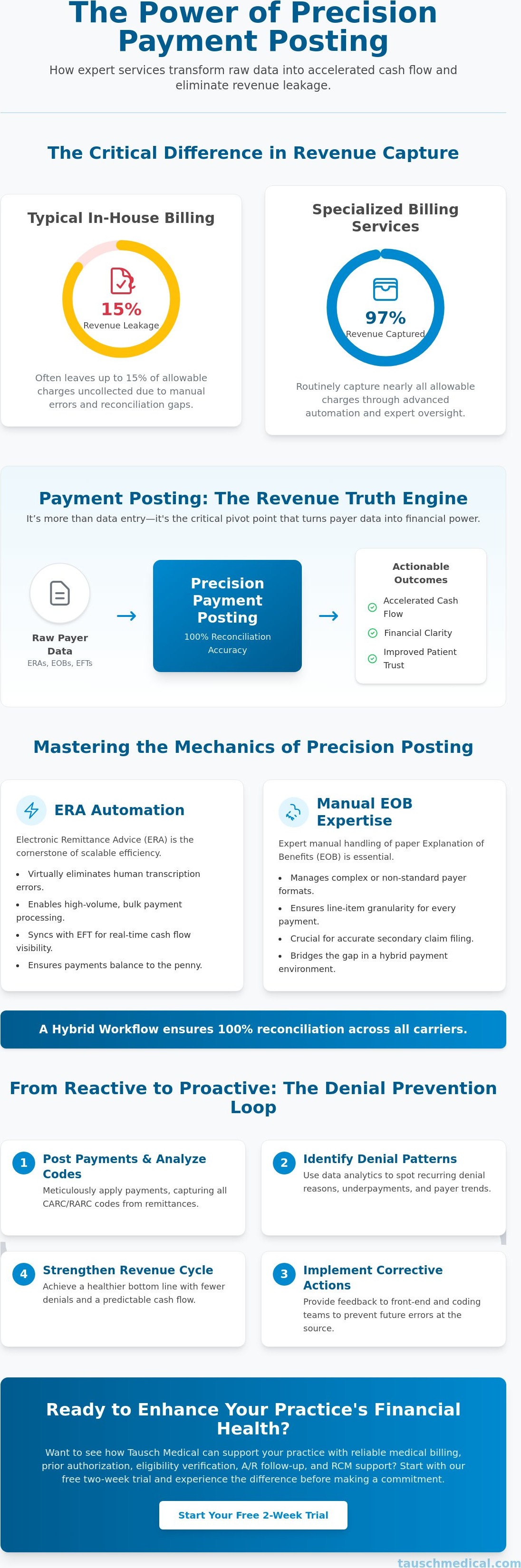
Did you know that the average in-house billing operation often leaves up to 15% of allowable charges on the table, whereas specialized experts using advanced medical billing payment posting services routinely capture nearly 97%? You've likely felt the frustration of unexplained revenue leakage or the exhaustion of watching your days in AR climb while staff struggle with manual reconciliation. It's a common challenge for practices aiming for clinical excellence but feeling held back by administrative friction. Your focus should remain on patient outcomes, not on chasing missing cents through repetitive manual entry.
This article demonstrates how professional posting serves as the strategic engine of your revenue integrity. By transforming raw data into actionable financial intelligence, you can finally eliminate leakage and dramatically accelerate your practice's cash flow. We'll examine how achieving 100% reconciliation accuracy and real-time visibility into payer performance can revolutionize your secondary claim filing. You'll discover how automated workflows don't just reduce errors; they provide the technological superiority needed to navigate the complexities of the 2026 Medicare landscape with absolute confidence.
Key Takeaways
- Understand how payment posting acts as the critical pivot point that converts raw payer data into clear, actionable financial records for your practice.
- Learn the technical nuances between ERAs and EOBs to implement a hybrid workflow that ensures 100% reconciliation accuracy across all insurance carriers.
- Discover how professional medical billing payment posting services create a strategic feedback loop using CARC codes to identify and prevent denials before they impact your bottom line.
- Identify the essential criteria for selecting an EHR-agnostic RCM partner capable of applying clinical precision to your complex financial operations.
- Gain actionable insights into eliminating revenue leakage and accelerating cash flow by transitioning from manual entry to high-precision automated posting workflows.
The Strategic Role of Payment Posting in Revenue Cycle Management
Within the complex architecture of the Medical Billing Process, payment posting functions as much more than a final administrative step. It's the critical pivot point where raw payer data undergoes a sophisticated metamorphosis into actionable financial records. While many providers view it as mere bookkeeping, top-tier medical billing payment posting services treat this phase as a "truth engine." In 2026, the industry has shifted away from simple collections toward comprehensive revenue integrity. This means every digit entered must reflect clinical reality to prevent cascading errors that can haunt a practice's ledger for months.
Accuracy at this juncture is non-negotiable. A single misapplied payment or ignored adjustment code can trigger a chain reaction of incorrect patient statements and false aging reports. By ensuring the data is clean from the moment of entry, practices gain a transparent view of their actual financial health. This level of precision allows for a more agile response to the 2026 CMS regulatory updates, where documentation requirements for technology-assisted services have become increasingly stringent.
Beyond Data Entry: How Posting Drives Financial Clarity
True financial intelligence begins when you look past the total check amount. Line-item posting allows a practice to dissect every service rendered, revealing hidden payer trends and persistent underpayment patterns that aggregate totals often obscure. By meticulously mapping EOBs and ERAs to specific encounters, you create a clean, audit-proof general ledger. This granular level of detail provides the clinical evidence needed to negotiate better payer contracts and identify where the 2026 2.5% efficiency adjustments are impacting your bottom line.
The Patient Experience: Preventing Billing Friction
Precision in financial operations directly influences the patient's journey. When medical billing payment posting services are executed with absolute accuracy, patients receive correct statements the first time. This eliminates the "already paid" billing disputes that clog up call centers and erode trust. By ensuring timely and transparent communication, practices maintain an elegant, professional image that mirrors the quality of care provided in the exam room. It's about creating a seamless bridge between clinical excellence and administrative reliability.
ERAs vs. EOBs: Mastering the Mechanics of Precision Posting
Efficient financial reconciliation requires a deep understanding of the two primary formats for payment data: Electronic Remittance Advice (ERA) and paper-based Explanation of Benefits (EOB). While ERAs offer the benefit of digital standardization, modern multi-specialty practices often find themselves managing a hybrid environment. High-precision medical billing payment posting services bridge this gap by ensuring that whether a payment arrives via an 835 file or a physical check, the data is allocated with line-item granularity. This level of detail is vital for accurate secondary billing; without it, secondary claims are often rejected due to missing primary payment details.
Effective posting also demands the strict segregation of insurance payments from patient responsibilities such as co-pays, coinsurance, and deductibles. When these figures are conflated, the resulting patient statements become confusing and lead to unnecessary disputes. By applying clinical-grade precision to these financial workflows, Tausch Medical helps practices maintain a transparent and trustworthy billing cycle.
Automating ERAs for Scalable Efficiency
Automation is the cornerstone of high-volume reconciliation. Automated ERA posting virtually eliminates the risk of human transcription errors, allowing practices to process bulk payments that must balance to the penny. Speed is also a factor. By synchronizing Electronic Funds Transfer (EFT) data with corresponding ERAs, your cash flow moves at the speed of digital commerce, providing real-time visibility into your actual bank balance.
The Art of Manual EOB Processing
Despite the push for digitization, expert manual intervention remains essential for complex paper EOBs from smaller or specialized payers. These documents often contain non-standard remark codes and idiosyncratic adjustment reasons that require a human expert to decode correctly. Expert manual posting identifies subtle payer discrepancies and adjudication errors that even the most advanced AI algorithms might overlook.
How Payment Posting Services Revolutionize Denial Management
The most sophisticated medical billing payment posting services don't just record the end of a transaction; they initiate a critical diagnostic feedback loop. By identifying denials within 24 hours of a payer's response, your practice gains a decisive advantage in the race against the clock. In 2026, as insurance companies deploy AI to scrutinize claims for even the smallest coding discrepancies, this rapid identification is essential. It allows you to pinpoint the root cause of a denial, whether it's an eligibility oversight or a complex clinical necessity issue, before the trail grows cold.
Predictive denial prevention relies heavily on the meticulous analysis of Claim Adjustment Reason Codes (CARC). These codes aren't just administrative jargon; they're the roadmap to revenue integrity. When you analyze these codes in real-time, you can adjust your front-end insurance verification processes to eliminate recurring errors. This proactive approach is what helps specialized partners achieve collection rates of 93% to 97%, significantly outperforming the 85% to 90% industry average for in-house operations.
Turning Denials into Actionable Data
When you utilize premium medical billing payment posting services, denials are transformed into actionable business intelligence. During the posting phase, denials are categorized into clinical and administrative buckets, allowing your team to prioritize high-value appeals. For instance, with the 2026 2.5% efficiency adjustment applied to work RVUs for thousands of codes, posting reports help you verify if payers are adjudicating claims according to the latest MPFS conversion factors. These insights serve as training tools for front-office staff to prevent errors at the source.
Accelerating Secondary and Tertiary Claims
Speed in posting acts as the catalyst for the entire secondary insurance billing cycle. You can't bill the secondary payer until the primary payment is accurately reflected on the line-item level. Immediate posting ensures that secondary claims are "clean" and sent out within hours, not weeks. This efficiency drastically shortens the total collection window, ensuring your practice's cash flow remains robust and predictable while reducing the burden on your administrative team.
Evaluating Medical Billing Payment Posting Partners
Selecting a partner for your practice requires a framework that prioritizes data sovereignty and clinical-grade accuracy. In 2026, the industry has moved beyond simple outsourcing to a model of deep integration. You shouldn't settle for a black-box service where data disappears into a proprietary system. Instead, premium medical billing payment posting services must offer "EHR-agnostic" expertise. This means your partner possesses the technical flexibility to work within your existing software environment, ensuring you retain full ownership and real-time visibility of your financial data without being forced into a software migration.
Transparency is the hallmark of a professional partnership. You should demand real-time access to dashboards that reflect your current AR status and daily posting activities. This visibility allows you to verify that every dollar is accounted for and that the 2026 conversion factor increases are being correctly applied by payers. Ensure your practice remains at the forefront of financial security by partnering with experts who specialize in medical billing services designed for the 2026 regulatory environment.
Technology Integration and Workflow Compatibility
A seamless data exchange between your billing partner and your EHR is non-negotiable for maintaining operational rhythm. Advanced partners utilize "Lockbox" integrations, where payments are sent directly to a secure bank-managed box and then reconciled digitally. This eliminates the risk of lost checks and significantly speeds up the posting cycle. Your partner should also demonstrate the capability to handle custom reporting requirements, allowing you to track specific KPIs that matter to your specialty's growth.
Compliance, Security, and Audit-Ready Reporting
Security benchmarks in 2026 have evolved. Proposed updates to the HIPAA Security Rule now aim to make previously "addressable" safeguards mandatory, requiring stricter measures like multi-factor authentication and network segmentation. Your partner must go beyond basic compliance, providing detailed audit trails for every transaction. In 2026, the standard for audit-ready posting is defined by a complete, timestamped history for every adjustment and payment that reconciles to the penny against your bank records. This level of rigor ensures that your practice is always prepared for external scrutiny or internal financial reviews.
The Tausch Medical Advantage: Precision in Financial Operations
Tausch Medical stands as a premier national leader in high-precision revenue cycle management, offering a level of clinical precision that is often missing in standard administrative services. We understand that your practice operates on the foundation of accuracy and trust; therefore, we treat your financial data with the same meticulous care you provide to your patients. By deploying a dedicated team that understands specialty-specific billing nuances, we ensure that your medical billing payment posting services are executed without the common errors that lead to revenue leakage.
Our approach eliminates the heavy administrative burden that often falls on healthcare providers. We don't just process transactions; we act as a strategic partner that enhances your practice's operational dignity. This allows you to focus on clinical excellence while we handle the complexities of the 2026 Medicare conversion factors and regulatory shifts. Optimize your revenue cycle with Tausch Medical to experience a partnership built on facts, results, and scientific rigor.
A Premium National Partner for Complex Billing
Managing diverse payer networks across the United States requires a sophisticated understanding of regional variations and specific carrier requirements. Tausch Medical provides 100% transparency through real-time financial reporting, giving you total visibility into your practice's health. Our medical billing payment posting services are designed to integrate seamlessly with your existing patient scheduling and provider credentialing workflows, creating a unified ecosystem that supports long-term growth.
Scaling Your Practice with Expert Support
Transitioning your billing operations to Tausch Medical reduces overhead costs while simultaneously increasing net collections. Our specialized expertise ensures that your practice captures every dollar it's owed, providing an uncompromising standard of service. The Tausch guarantee is simple: accuracy, integrity, and clinical-grade professionalism in every posted line item.
Want to see how Tausch Medical can support your practice with reliable medical billing, prior authorization, eligibility verification, A/R follow-up, and RCM support? Start with our free two-week trial and experience the difference before making a commitment: free trial form
Elevating Revenue Integrity Through Financial Precision
Achieving financial excellence in the current healthcare landscape requires more than just processing payments; it demands a commitment to absolute data integrity. By mastering the transition from raw payer data to actionable business intelligence, your practice can eliminate the unexplained leakage that often erodes profitability. High-precision medical billing payment posting services act as the vital pivot point that ensures every line item is reconciled to the penny. This rigorous approach doesn't just clear your aging reports; it provides the foundation for expert denial management and faster secondary claim filing.
Our SOC 2 compliant workflows and comprehensive RCM integration provide the security and transparency needed to navigate complex regulatory shifts with confidence. We invite you to Request a Professional Revenue Cycle Consultation to see how clinical-grade precision can transform your financial operations.
Want to see how Tausch Medical can support your practice with reliable medical billing, prior authorization, eligibility verification, A/R follow-up, and RCM support? Start with our free two-week trial and experience the difference before making a commitment: free trial form
Empower your practice with the technology and expertise it deserves to thrive in a data-driven future.
Frequently Asked Questions
What is payment posting in medical billing, and why is it critical?
Payment posting is the administrative process of recording insurance reimbursements and patient payments into your billing software. It's critical because it serves as the final verification of the claim lifecycle, ensuring that actual payments match your contracted rates. Without precise posting, your practice can't identify denials or initiate secondary billing, leading to significant revenue leakage and inaccurate financial reporting.
How does accurate payment posting reduce my practice's days in AR?
Accurate posting reduces days in AR by enabling immediate action on unpaid or partially paid claims. When payments are recorded within 24 hours, your system identifies denials instantly, allowing the billing team to initiate appeals or send secondary claims without delay. This rapid turnaround prevents claims from aging unnecessarily and ensures your cash flow remains robust and predictable.
What is the difference between ERA and manual EOB posting?
Electronic Remittance Advice (ERA) is a digital file that automatically populates payment data into your system, whereas manual EOB posting requires an expert to enter data from physical paper statements. While ERAs offer speed and scalability, manual intervention remains essential for smaller payers who don't provide digital remittances. A hybrid approach ensures 100% reconciliation of your revenue regardless of the payer's technological capabilities.
Can payment posting services help identify underpayments from payers?
Yes, professional medical billing payment posting services are specifically designed to flag discrepancies between your contracted rates and actual payments. By meticulously comparing the payer's remittance against your practice's fee schedule, the posting team identifies "silent" underpayments that often go unnoticed in high-volume environments. This proactive monitoring ensures you receive the full reimbursement amount dictated by your insurance contracts.
How does payment posting integrate with my existing EHR or EMR software?
Integration occurs through secure data exchanges that allow a specialized posting team to work directly within your existing software environment. This "EHR-agnostic" approach means you don't have to migrate to a new platform to benefit from expert RCM support. The posting data flows seamlessly into your patient records, ensuring that balances and statements are updated in real-time without requiring manual intervention from your clinical staff.
What happens if a payment is posted incorrectly?
Incorrectly posted payments create a chain reaction of financial inaccuracies, including distorted aging reports and incorrect patient statements that lead to billing disputes. Correcting these errors requires a meticulous audit of the transaction history and manual ledger adjustments. This is why high-precision medical billing payment posting services prioritize line-item accuracy to prevent these cascading errors from ever impacting your practice's financial integrity.
Is outsourcing payment posting more cost-effective than in-house staffing?
Outsourcing is generally more cost-effective because it eliminates the overhead associated with hiring, training, and managing internal billing personnel. Specialized partners typically achieve higher collection rates, often between 93% and 97%, compared to the 85% to 90% industry average for in-house operations. This increase in net collections, combined with reduced administrative costs, provides a superior return on investment for most growing practices.
How does Tausch Medical ensure the security of our financial data?
Tausch Medical ensures data security by utilizing SOC 2 compliant workflows and advanced encryption for all financial transactions. We adhere to the stringent 2026 security benchmarks, which include multi-factor authentication and strict network segmentation to protect sensitive patient information. Our commitment to revenue integrity means every transaction is recorded with a detailed audit trail, providing your practice with total transparency and audit-ready reporting.
Disclaimer
This article is for general informational purposes only and does not constitute legal, medical, billing, coding, compliance, or financial advice. Healthcare rules, payer policies, and reimbursement guidelines may change and may vary by situation. Please consult qualified professionals or official sources before making decisions based on this content. Tausch Medical is not responsible for any loss or liability arising from reliance on this information.


