


Article by
Dr. Sharafat Hussain Ph.D
Dr. Sharafat Hussain is a healthcare business consultant, entrepreneur, and academic with strong experience in the US healthcare industry. He is the Founder and Managing Director of Tausch Medical, a revenue cycle management company supporting US healthcare providers with medical billing, prior authorization, credentialing, eligibility verification, A/R follow-up, and patient support services. His work combines practical healthcare operations, business strategy, and academic insight to help medical practices improve efficiency, collections, and service quality.
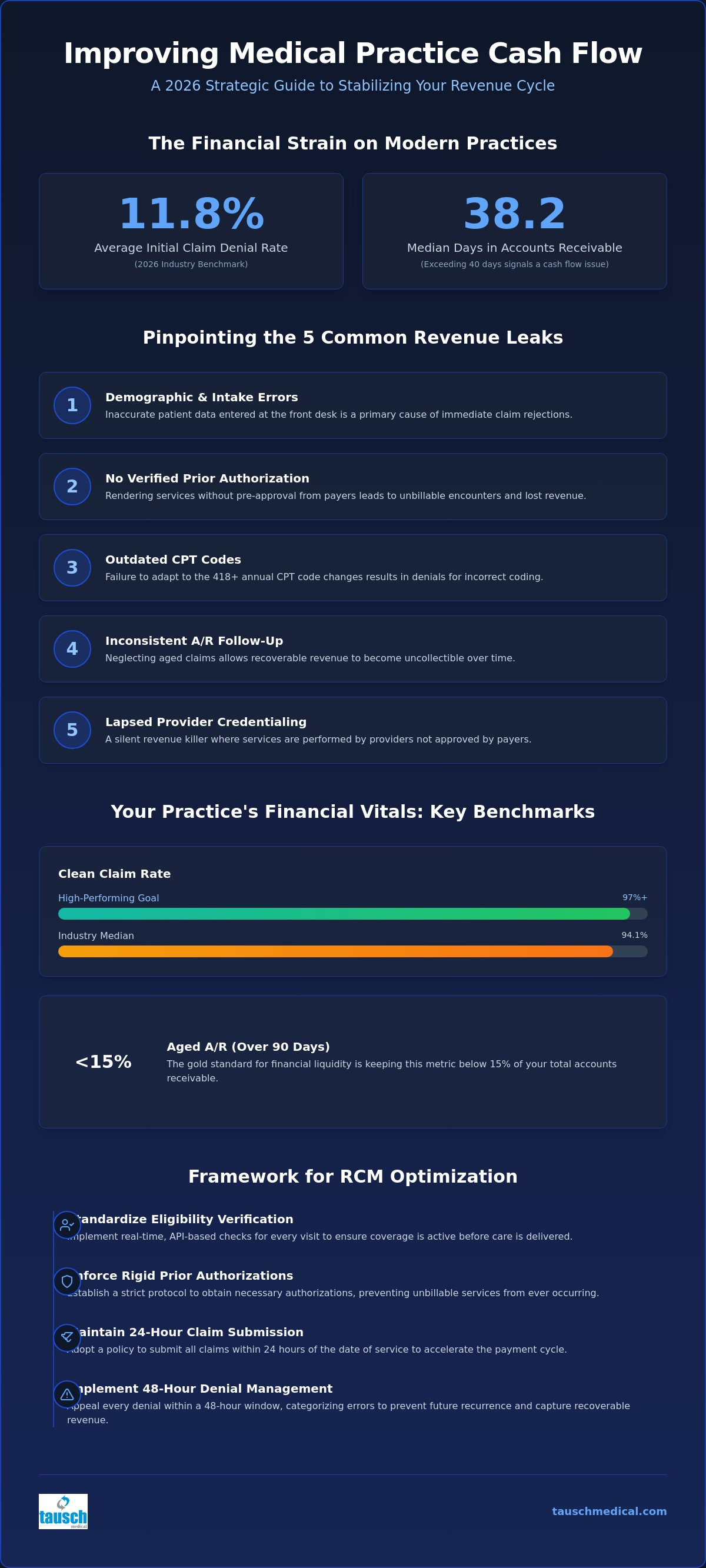
With the average initial claim denial rate reaching 11.8% in 2026, many independent providers are working harder for increasingly unpredictable returns. Learning how to improve medical practice cash flow is no longer just an administrative task; it's a vital diagnostic process for your practice's long-term viability. You likely feel the strain of the 418 CPT code changes and the rigorous CMS Interoperability rules, which demand a level of precision that often exceeds the capacity of a busy front-desk team.
It's frustrating to deliver world-class care only to face a median of 38.2 days in accounts receivable or sudden denials caused by inaccurate eligibility data. This 2026 strategic guide offers a clear framework to plug these revenue leaks, reduce your AR days, and stabilize your financial health through sophisticated Revenue Cycle Management. We'll explore actionable strategies to move beyond reactive billing and build a predictable, premium financial foundation that allows you to focus on your patients.
Key Takeaways
- Identify and plug the five most common administrative leaks that lead to immediate cash flow interruptions and high denial rates.
- Implement a step-by-step framework on how to improve medical practice cash flow by integrating standardized eligibility verification and rigid prior authorization protocols.
- Navigate the 2026 CMS Interoperability mandates by adopting API-based workflows that ensure claim data perfectly matches payer requirements.
- Compare the long-term financial benefits of expert RCM outsourcing against the rising overhead costs of maintaining an in-house billing department.
- Learn how specialized accounts receivable services can recover aged claims with clinical precision, securing the predictable revenue needed for practice growth.
Pinpointing Revenue Leaks: Why Your Practice Cash Flow is Stalling
Understanding how to improve medical practice cash flow requires a forensic look at where capital is quietly escaping your ecosystem. Most financial stagnation isn't the result of a single catastrophic failure; it's the cumulative effect of minor administrative oversights. In 2026, the most common revenue leaks include demographic errors during patient intake, services rendered without verified prior authorization, and the use of outdated CPT codes following the recent AMA updates. Inconsistent follow-up on aged accounts receivable and lapsed provider credentialing round out the top five, creating a persistent drag on your liquidity.
A healthy practice should aim for a clean claim rate of 97% or higher to ensure clinical efforts translate directly into revenue. Falling below the 94.1% industry median means your staff is spending double the time on every dollar earned. Additionally, delayed provider credentialing acts as a silent revenue killer. If a new provider's paperwork is stalled, every patient they see becomes a financial liability rather than an asset, effectively pausing your practice's growth potential.
The Cost of Front-End Administrative Friction
Errors in scheduling and registration create a snowball effect that inevitably leads to denials. When front-desk staff skip rigorous checks, they're essentially inviting cash flow interruptions. This underscores the necessity of accurate insurance verification at the point of entry. Without it, the entire revenue cycle management process is compromised before clinical care even begins.
Diagnostic Check: Assessing Your Days in Accounts Receivable (AR)
You can self-diagnose your practice's health by calculating your AR days. Use this formula: Total Accounts Receivable divided by Average Daily Revenue. In 2026, the median for all specialties sits at 38.2 days. If your practice exceeds 40 days, your capital is trapped in the payer's system instead of your bank account. Keeping AR over 90 days below 15% is the gold standard for maintaining liquidity and supporting practice expansion.
For providers whose long-term growth strategy includes diversification or a future exit, you can explore Home Health Agency Sales to learn how Healthcare Biz Brokers, Inc. supports the valuation and sale of specialized healthcare businesses.
A Step-by-Step Framework to Optimize Your Revenue Cycle
To master how to improve medical practice cash flow, you must move beyond reactive fixes and adopt a disciplined, step-by-step framework. While software offers convenience, it can't replace the expert oversight required to navigate 2026's complex payer requirements. A truly optimized cycle requires clinical precision at every administrative touchpoint, ensuring that your financial health is as robust as the care you provide.
The foundation of this framework starts with standardizing eligibility verification for every single visit. This ensures that coverage is active before clinical resources are spent. You must also implement a rigid prior authorization protocol to prevent "unbillable" services from reaching the coding stage. To maintain momentum, conduct weekly audits of common medical billing workflow issues and establish a strict 24-hour turnaround policy for claim submissions after the date of service.
Strengthening Eligibility Verification and Prior Authorizations
Manual checks are no longer sufficient in an era of API-based payer workflows. Transitioning to real-time verification ensures that patient data matches insurance records at the field level, including specific modifiers and sites of service. This precision prevents the retroactive denials that often plague independent practices. While some providers explore strategic financing options to manage temporary shortfalls, a proactive authorization system ensures your practice doesn't need to rely on external debt for operational expenses.
Implementing Proactive Denial Management and Follow-up
Denials shouldn't sit in a queue; they represent your most accessible recovered revenue. A high-performing practice implements a strategy for appealing denials within a 48-hour window. Robust medical claim denial management focuses on categorizing errors to prevent their recurrence rather than just resubmitting paperwork. If your staff is overwhelmed by these demands, partnering with specialized AR recovery experts can provide the technical depth needed to clear backlogs efficiently.
Scaling Profitability through Strategic RCM Outsourcing
Independent practices often view in-house billing as a way to maintain control, yet the true cost often outweighs the perceived benefits. Beyond base salaries, the overhead of benefits, continuous training for the latest 2026 code updates, and the risk of staff turnover create a fragile financial environment. When considering how to improve medical practice cash flow, the efficiency of specialized medical accounts receivable services becomes undeniable. These experts possess the technical depth to clear aged backlogs significantly faster than an internal team focused on daily intake tasks.
The "multiplier effect" of professional provider credentialing services shouldn't be underestimated. Ensuring that every clinician is correctly enrolled with payers maximizes network participation, preventing the out-of-network leakage that erodes profitability. By delegating these complexities to a dedicated partner, physicians reclaim time previously lost to administrative friction. This shift allows for increased patient volume and improved throughput, which are essential tips for enhancing practice profit in a competitive landscape.
The ROI of Professional Medical Billing Services
The return on investment for professional medical billing services is defined by a measurable increase in net collection rates that consistently exceeds the service fee, effectively turning an administrative cost into a revenue-generating asset.
Transitioning to Expert-Managed Revenue Cycle Management
Partnering with an RCM firm doesn't require a disruptive overhaul of your current clinical workflows. A sophisticated transition process integrates seamlessly with your existing scheduling, providing immediate access to a dedicated team for A/R follow-up and denial services. This expert-led approach ensures that every claim is pursued with clinical precision, stabilizing your practice's financial health while you focus on delivering premium patient care. Learning how to improve medical practice cash flow ultimately leads to a more sustainable, growth-oriented business model.
Securing Your Practice's Financial Future
Mastering how to improve medical practice cash flow requires a transition from reactive billing to proactive, expert-led revenue management. By identifying subtle administrative leaks and implementing a rigorous verification framework, you protect the clinical value you provide. Expert denial management and comprehensive A/R recovery are no longer optional extras; they're essential components of a modern, thriving practice. Leveraging professional expertise allows your team to focus on patient outcomes while securing the liquidity needed for future expansion. Maintaining this stability also involves addressing tax-related challenges, where US Tax Advocate Services LLC can provide critical resolution services for complex IRS matters.
Want to see how Tausch Medical can support your practice with reliable medical billing, prior authorization, eligibility verification, A/R follow-up, and RCM support? Start with our free two-week trial and experience the difference before making a commitment: free trial form
Your practice deserves a financial foundation that is as precise and reliable as your clinical care. We're here to help you achieve the stability and growth your expertise warrants.
Frequently Asked Questions
How quickly can I expect to see cash flow improvements after changing my billing process?
Most practices observe a measurable shift in liquidity within 30 to 60 days of implementing a structured revenue cycle. The initial phase focuses on clearing the existing backlog of aged claims, while the second phase stabilizes the incoming stream through cleaner initial submissions. When you prioritize how to improve medical practice cash flow, the reduction in administrative friction yields immediate dividends in staff productivity and reduced overhead.
What is the most common reason for medical claim denials in 2026?
Inaccurate insurance verification and demographic errors remain the primary drivers of denials in 2026. This is often compounded by the new CMS Interoperability rules, which mandate that prior authorizations match claim data fields with absolute precision. Even a minor discrepancy in a CPT code or modifier can trigger an automated denial, highlighting the need for clinical accuracy during the initial patient intake process.
Should I outsource my billing or hire a dedicated in-house billing manager?
Outsourcing often provides a superior return on investment for independent practices compared to hiring a single in-house manager. A dedicated firm offers a team of specialists rather than one individual, ensuring coverage during staff absences and providing deeper expertise in complex areas like provider credentialing. This model reduces your fixed overhead while granting access to the sophisticated technology required to navigate 2026's intricate payer landscape.
How do high AR days specifically impact the daily operations of a medical practice?
High AR days create a capital deficit that restricts your ability to invest in new medical technology or expand your clinical staff. When your median AR exceeds the 38.2-day industry benchmark, your practice effectively provides interest-free loans to insurance payers. This operational strain often leads to delayed vendor payments and increased administrative pressure on front-desk staff, who must pivot from patient care to collections.
Disclaimer
This article is for general informational purposes only and does not constitute legal, medical, billing, coding, compliance, or financial advice. Healthcare rules, payer policies, and reimbursement guidelines may change and may vary by situation. Please consult qualified professionals or official sources before making decisions based on this content. Tausch Medical is not responsible for any loss or liability arising from reliance on this information.


