


Article by
Dr. Sharafat Hussain Ph.D
Dr. Sharafat Hussain is a healthcare business consultant, entrepreneur, and academic with strong experience in the US healthcare industry. He is the Founder and Managing Director of Tausch Medical, a revenue cycle management company supporting US healthcare providers with medical billing, prior authorization, credentialing, eligibility verification, A/R follow-up, and patient support services. His work combines practical healthcare operations, business strategy, and academic insight to help medical practices improve efficiency, collections, and service quality.
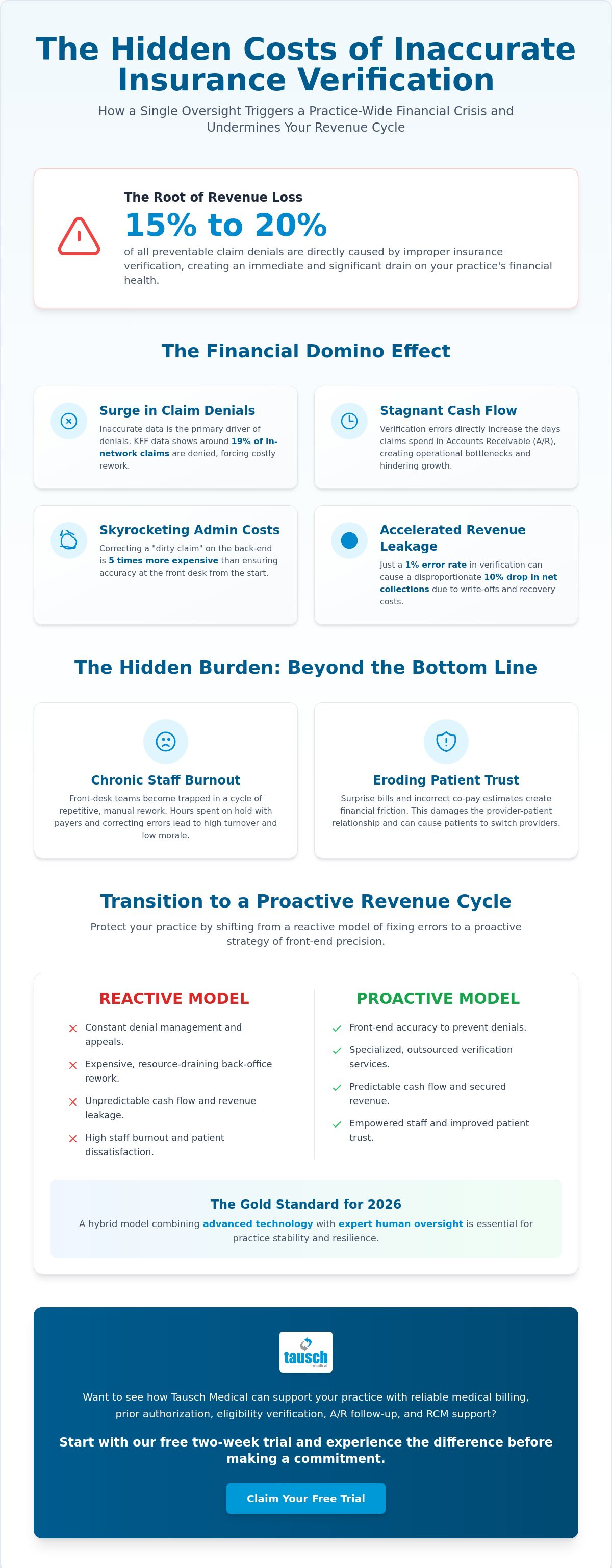
Did you know that improper insurance verification is currently responsible for 15 to 20 percent of all preventable claim denials? It's a staggering figure that highlights how a single administrative oversight can trigger a practice-wide financial crisis. You likely see the daily toll this takes, as your staff spends hours on hold with payers while patients face the frustration of unexpected bills and delayed care. The impact of inaccurate insurance verification goes far beyond a simple data entry error; it's a systemic failure that compromises your clinical focus and your bottom line.
Protecting your practice's financial health requires more than just diligence; it demands a sophisticated, proactive strategy. We'll show you how to navigate the complexities of the 2026 landscape, from managing the 17,000 diagnostic categories of ICD-11 to mitigating the rise of AI-driven denials. This article explores the strategic steps you can take to secure a predictable cash flow and restore efficiency to your front-end workflow. We'll examine the hidden costs of verification errors and provide a roadmap for building a resilient revenue cycle that prioritizes both precision and patient trust.
Key Takeaways
- Understand why insurance errors are the primary driver of preventable claim denials and how they directly increase your days in accounts receivable.
- Explore the significant impact of inaccurate insurance verification on your staff's productivity, including the correlation between manual errors and front-desk burnout.
- Learn how to protect the patient experience by eliminating unexpected billing surprises that stem from poor front-end verification processes.
- Discover why a hybrid model combining advanced technology with expert human oversight is the essential gold standard for practice stability in 2026.
- Identify the strategic advantages of transitioning from reactive billing to a proactive model through specialized medical insurance verification outsourcing.
The Financial Domino Effect: How Inaccuracy Triggers Claim Denials and Revenue Leakage
In the complex ecosystem of modern healthcare, the financial stability of a medical practice hinges on the precision of its initial data entry. The impact of inaccurate insurance verification is often felt immediately through a surge in preventable claim denials, which stalls the entire reimbursement process. When eligibility isn't confirmed with clinical precision at the point of service, the practice faces a direct increase in days in accounts receivable (A/R), creating a bottleneck that hinders operational growth. Industry benchmarks suggest that even a marginal 1% error rate in the verification stage can trigger a disproportionate 10% drop in net collections due to the compounding nature of unpaid claims and the resources lost to recovery efforts.
The Surge in Administrative Costs and Denial Management
When errors slip through the front desk, the burden shifts to the back office, forcing staff into an expensive, reactive cycle of medical claim denial management. Correcting a "dirty" claim is significantly more resource-intensive than submitting a "clean" one from the start. In fact, resolving errors on the back end is typically five times more expensive than ensuring front-end accuracy. This administrative rework doesn't just waste time; it drains the practice's profitability by diverting skilled personnel away from higher-value revenue recovery tasks and toward repetitive, avoidable corrections.
Accelerated Revenue Leakage and Cash Flow Stagnation
Beyond the immediate denial, outdated eligibility data often leads to services that are entirely non-reimbursable, resulting in mandatory write-offs that can't be recovered. This is especially prevalent when staff misses secondary insurance or fails to identify complex coordination of benefits (COB) requirements. These oversights disrupt the entire revenue cycle management process, leading to stagnant cash flow that limits your ability to invest in new technology or staff. Without a rigorous verification protocol, these small gaps in data accumulate into significant revenue leakage that can threaten the long-term viability of even the most established clinical practices.
The Hidden Burden: Impacts on Staff Productivity and the Patient Experience
The impact of inaccurate insurance verification extends deep into the operational culture of a practice, often manifesting as chronic staff burnout. When front-desk teams rely on manual processes, they become trapped in a cycle of repetitive, low-value tasks that invite human error. Instead of focusing on patient engagement, skilled professionals spend hours navigating automated phone menus or waiting on hold with payers. This administrative friction is a primary driver of turnover in 2026. Data from the KFF indicates that roughly 19% of in-network claims denied across various plans, a statistic that underscores the immense volume of rework landing back on your team's desk.
Staff Burnout and the Cycle of Manual Rework
Every minute spent correcting an eligibility error represents a significant opportunity cost. Fragmented data across disparate EHR and payer systems complicates the insurance eligibility verification process, making it nearly impossible for staff to maintain accuracy without specialized support. Practices that fail to streamline these workflows often see their most talented employees leave for less stressful environments. You can protect your team's morale by adopting reliable medical billing and verification workflows that eliminate manual redundancies.
Eroding Patient Trust through Financial Surprise
Mitigating the Risks: Transitioning to Specialized Insurance Verification Services
To successfully reverse the negative impact of inaccurate insurance verification, medical practices must evolve beyond basic digital tools. While automation offers speed, it often lacks the clinical nuance required to navigate complex prior authorizations or the unique requirements of niche payers. A hybrid model that combines advanced technology with expert human oversight represents the gold standard for practice management in 2026. This dual approach ensures that eligibility data is not just captured but meticulously verified for accuracy before the patient encounter occurs. By establishing a verification-first culture, you secure the entire revenue cycle from its inception, preventing the administrative friction that leads patients to appeal an insurance company decision due to avoidable coverage denials.
The strategic shift toward medical insurance verification outsourcing allows providers to reclaim their focus on clinical excellence. Specialized partners bring a level of expertise that internal teams, often stretched thin by front-desk duties, cannot maintain. These services are designed to handle the increasingly stringent standards for medical necessity and the frequent updates to payer policies that define the current healthcare landscape.
The ROI of Professional Verification Outsourcing
When evaluating the financial logic of outsourcing, the primary metric is the comparison between a predictable service cost and the cumulative losses generated by internal verification errors. Tausch Medical streamlines the workflow from the initial scheduling phase to final reimbursement, ensuring that every claim is anchored in verified, real-time data. This precision reduces the high cost of administrative rework and protects the practice from the revenue leakage discussed in earlier sections.
Implementing a Proactive Front-End Workflow
Building a resilient financial foundation requires a disciplined three-step front-end process:
- Step 1: Verify eligibility 48 to 72 hours before the appointment to identify coverage gaps or expired policies early.
- Step 2: Communicate financial responsibility to the patient before they arrive, which significantly improves time-of-service collection rates.
- Step 3: Integrate real-time A/R follow-up to catch and resolve any discrepancies immediately, maintaining a steady and predictable cash flow.
Want to see how Tausch Medical can support your practice with reliable medical billing, prior authorization, eligibility verification, A/R follow-up, and RCM support? Start with our free two-week trial and experience the difference before making a commitment: https://tauschmedical.com/free-trial-form
Securing Your Practice’s Financial Future
The transition from a reactive billing cycle to a proactive, verification-first strategy is no longer optional for practices seeking long-term stability. The impact of inaccurate insurance verification ripples through every department, from front-desk morale to the finality of your net collections. Prioritizing precision at the point of scheduling ensures that your clinical team can focus on care rather than administrative rework. By integrating specialized denial management experts and comprehensive revenue cycle management support, you create a resilient foundation that withstands the complexities of modern payer requirements.
Tausch Medical offers the local expertise in major US healthcare markets necessary to navigate these shifting regulations with confidence. Our commitment to premium service and clinical-grade accuracy allows you to restore predictability to your cash flow while enhancing the overall patient experience. It's time to eliminate the financial uncertainty that stems from manual data entry errors and embrace a more sophisticated approach to practice management.
Want to see how Tausch Medical can support your practice with reliable medical billing, prior authorization, eligibility verification, A/R follow-up, and RCM support? Start with our free two-week trial and experience the difference before making a commitment: free trial form
Frequently Asked Questions
What are the most common insurance verification errors in 2026?
The most frequent errors today involve misidentified primary payers and outdated Coordination of Benefits (COB) information. Staff often overlook secondary insurance or fail to update demographic changes, such as new home addresses or transitions in employer-sponsored plans. These lapses significantly amplify the negative impact of inaccurate insurance verification, as they lead to immediate claim rejections that require extensive manual intervention and administrative rework to resolve.
How often should insurance eligibility be verified for recurring patients?
Eligibility should be verified before every patient encounter, or at a minimum, every 30 days for patients receiving ongoing treatment. Insurance coverage can fluctuate unexpectedly due to policy terminations, employment changes, or plan resets at the start of a new quarter. Verifying eligibility 48 to 72 hours prior to an appointment allows your team to address coverage gaps proactively, preventing the revenue leakage often associated with non-reimbursable services.
Can inaccurate insurance verification lead to legal or compliance issues?
Persistent verification failures can lead to serious compliance risks, including audits under the False Claims Act if services are billed to the wrong payer repeatedly. Inaccurate data might also result in HIPAA violations if sensitive patient information is disclosed to an unauthorized insurer during the claims process. Maintaining clinical-grade precision in your verification workflow is essential for protecting your practice from the legal scrutiny that follows systemic billing inaccuracies and documentation errors.
What is the difference between eligibility verification and prior authorization?
Eligibility verification confirms that a patient has an active insurance policy and determines their specific benefit levels, including deductibles and co-pays. Prior authorization is a more complex step where the payer reviews a specific medical procedure to determine if it meets their standards for medical necessity. While eligibility is the baseline for coverage, failing to secure a prior authorization will result in a denial even if the patient's insurance policy is currently active.
Disclaimer
This article is for general informational purposes only and does not constitute legal, medical, billing, coding, compliance, or financial advice. Healthcare rules, payer policies, and reimbursement guidelines may change and may vary by situation. Please consult qualified professionals or official sources before making decisions based on this content. Tausch Medical is not responsible for any loss or liability arising from reliance on this information.


