


Article by
Dr. Sharafat Hussain Ph.D
Dr. Sharafat Hussain is a healthcare business consultant, entrepreneur, and academic with strong experience in the US healthcare industry. He is the Founder and Managing Director of Tausch Medical, a revenue cycle management company supporting US healthcare providers with medical billing, prior authorization, credentialing, eligibility verification, A/R follow-up, and patient support services. His work combines practical healthcare operations, business strategy, and academic insight to help medical practices improve efficiency, collections, and service quality.
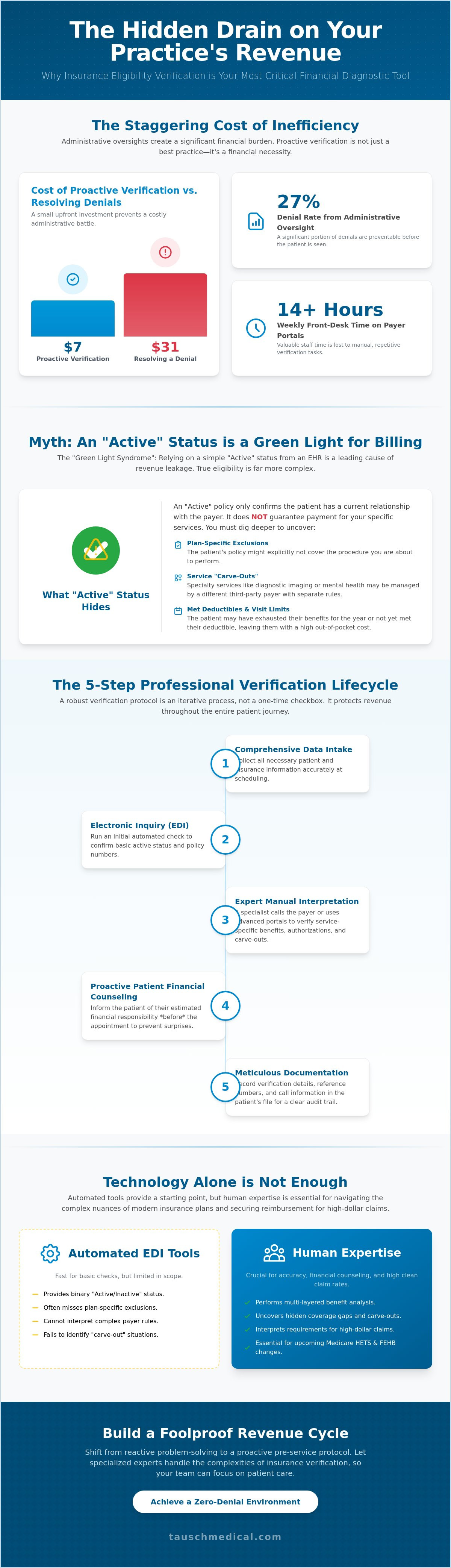
Did you know that resolving a single eligibility-related denial costs your practice an average of $31, while proactive verification costs a mere $7? In an industry that demands clinical precision, allowing a 27% denial rate due to administrative oversight isn't just an inconvenience; it's a direct threat to your financial stability. You likely feel the daily frustration of your front-desk staff spending over 14 hours every week tethered to payer portals, only to face unpredictable patient collections and mounting paperwork.
It's time to stop treating insurance eligibility verification as a clerical task and start viewing it as a sophisticated financial diagnostic tool. This article will dismantle the seven most dangerous myths currently draining your revenue and show you how to build a foolproof cycle through expert eligibility management. We'll explore the critical impact of the 2026 Medicare HETS system overhaul and the new FEHB documentation mandates, providing the insights you need to achieve a zero-denial environment and a premium clean claim rate.
Key Takeaways
- Learn why a simple "active" status often leads to denials and how to perform a multi-layered benefit analysis to uncover hidden coverage gaps.
- Understand the 5-step lifecycle of professional insurance eligibility verification to ensure coverage is confirmed well before the patient arrives.
- Discover the limitations of standard EDI transactions and why human expertise is essential for interpreting complex, high-dollar claim requirements.
- Shift your practice from reactive point-of-service checks to a proactive pre-service protocol that relieves your front-desk staff of administrative burdens.
- Evaluate the strategic ROI of specialized outsourcing to maintain clinical-level precision in your revenue cycle without sacrificing operational control.
The Myth of Binary Status: Why "Active" Insurance Isn’t Enough
The prevailing misconception in medical administration is that a simple "Active" status in an EHR portal provides a definitive green light for billing. This binary perspective is dangerously reductive. In the sophisticated healthcare landscape of 2026, insurance eligibility verification must be redefined as a multi-layered benefit analysis rather than a simple status check. When a system returns an active result, it merely confirms that the patient's relationship with the payer is current; it says nothing about the specific clinical procedure you intend to perform.
Relying on what we call "Green Light" syndrome leads to significant revenue leakage. Automated EHR tools often pull data from general eligibility files that lack the nuance of plan-specific exclusions. A patient might have an active policy, yet the specific service might be entirely excluded from their benefit package. Without a deeper dive, your practice carries the full financial risk of providing care that the payer never intended to reimburse. Active status is a prerequisite, but it's never a guarantee of payment.
Understanding Benefit-Level Granularity
Effective verification requires distinguishing between general coverage and service-specific eligibility. Modern health insurance plans frequently utilize "carve-outs," where specific services like diagnostic imaging, laboratory work, or mental health are managed by a third-party entity. A standard electronic check might show the patient is active under a major carrier, while failing to trigger the notification that the specific service is actually carved out to a different payer with entirely different authorization rules. Identifying these non-covered services before the patient arrives is the only way to protect your bottom line from preventable denials.
The Financial Impact of Surface-Level Checks
The cost of administrative oversight is quantifiable and severe. When a claim is denied because a service-specific exclusion was missed, the average cost to rework that claim is $31, which is more than four times the cost of a proactive, expert verification. These surface-level checks often result in "uncollectible" patient balances. If a patient is informed weeks after a procedure that their insurance didn't cover the service due to a plan-specific exclusion, the likelihood of collecting that balance drops significantly. Robust insurance eligibility verification is the essential foundation of a high clean claim rate. By moving beyond binary status checks, you ensure that every clinical interaction is backed by a verified financial commitment from the payer.
Deep Dive: What a Comprehensive Verification Process Actually Entails
A truly professional workflow follows a rigorous five-step lifecycle: comprehensive data intake, electronic inquiry, expert manual interpretation, proactive patient financial counseling, and meticulous documentation. One of the most persistent fallacies in practice management is the belief that verification is a one-time event occurring before the initial consultation. In reality, insurance eligibility verification must be an iterative process, especially for specialty care or recurring treatments where coverage limits can be exhausted mid-cycle. Government reports on verifying beneficiary and provider eligibility highlight the complexities of maintaining accurate data within federal programs, reinforcing the need for continuous monitoring rather than sporadic checks.
For practices managing chronic conditions or long-term aesthetic treatment plans, re-verification is a clinical-financial necessity. Coverage can lapse, employers can switch plans, or a patient's secondary insurance might become primary due to a change in employment status. Failing to identify these shifts before the next encounter often leads to unrecoverable revenue. A sophisticated verification protocol ensures that every claim is supported by current, verified data, which is why premium medical insurance verification outsourcing focuses on the entire patient journey rather than just the intake form.
The Data Points That Matter Most
Precision in verification requires looking beyond the total deductible amount. Staff must verify the deductible met-to-date, as this figure fluctuates daily based on other claims processed by the payer. Furthermore, confirming co-payment requirements for specific place-of-service codes is essential; a procedure performed in an ambulatory surgical center may carry a different financial responsibility than the same service provided in a physician's office. Expert teams also scrutinize the gap between effective dates and termination dates to ensure the planned date of service falls within a valid coverage window, preventing the common "coverage expired" denial.
Coordination of Benefits (COB) Complexity
Coordination of Benefits errors remain a leading cause of administrative denials, primarily because identifying the primary payer in multi-payer scenarios requires specialized knowledge. Whether applying the "birthday rule" for dependents or navigating the hierarchy of Medicare and commercial secondary plans, the logic is rarely straightforward. Professional teams use advanced strategies to resolve COB conflicts before billing, ensuring the claim is routed correctly the first time. If your staff struggles with these intricacies, exploring our Insurance Verification and Authorization services can provide the clinical precision your revenue cycle requires. This proactive approach eliminates the friction often associated with secondary and tertiary insurance claims, securing your practice's financial position.
Myth: Technology Alone Eliminates Eligibility Denials
While AI-driven tools have become the industry standard in 2026, the belief that software alone can eliminate eligibility denials is a costly fallacy. The "Garbage In, Garbage Out" principle remains the primary bottleneck in insurance eligibility verification. Automated systems are only as reliable as the data provided by payer APIs, which are frequently outdated or incomplete. Even the most advanced platforms can't correct a patient's misspelled name or an transposed digit in a Medicare Beneficiary Identifier (MBI) without human oversight.
Standard 270/271 EDI transactions, while efficient for high-volume checks, often lack the granularity required for high-dollar clinical claims. These transactions provide a technical snapshot of coverage but rarely detail the specific clinical criteria or the subtle documentation requirements that trigger a denial. Relying solely on a software-generated "verified" status without expert supervision leaves your practice vulnerable to sophisticated payer audits. True revenue security requires a hybrid model where technology handles the volume and humans handle the nuance.
When Automation Hits a Wall
Software often returns "unspecified" benefit responses when encountering complex plan structures or newer federal mandates. These instances require a skilled professional to navigate the payer's internal hierarchy and obtain definitive answers. Adhering to rigorous state-level verification protocols often necessitates a level of critical thinking that AI has yet to master. Expert billing teams bridge this gap. They interpret the "gray areas" of coverage that software simply skips, such as specific prior authorization triggers for minimally invasive procedures.
The Cost of Over-Reliance on Tech
The financial risk of over-reliance manifests in "false positives." This occurs when a system marks a patient as covered for a service that actually requires a specific clinical evidence package or a prior authorization. Fixing these errors after the fact creates a massive administrative burden. It often costs more in staff time than the original claim value itself. A hybrid approach, such as medical billing outsourcing, provides a safety net by combining technological speed with clinical precision. This ensures every automated result is validated against real-world billing logic before the patient even enters the treatment room. Expert intervention ensures that technical "active" statuses translate into actual clinical reimbursement.
Establishing a Fail-Safe Verification Protocol for Your Practice
Many practices still operate under the illusion that the front desk is the ideal environment for verifying benefits. This is a strategic error. The check-in area is a high-traffic, high-distraction zone where staff should focus on patient hospitality, not complex financial diagnostics. A truly fail-safe protocol requires transitioning from "Point-of-Service" checks to a dedicated "Pre-Service" model. By shifting insurance eligibility verification away from the lobby and into a centralized hub, you allow your team to perform deep-dive benefit analysis without the pressure of a growing waiting room.
Centralization creates the necessary environment for clinical precision. It allows for the development of sophisticated Standard Operating Procedures (SOPs), particularly for high-deductible health plans which have become the norm in 2026. These SOPs should dictate exactly how to communicate remaining deductibles and out-of-pocket maximums to patients before they arrive. When your verification process is centralized, you ensure that every patient encounter is backed by a verified financial roadmap, reducing the administrative burden on your clinical staff and eliminating the chaos of last-minute coverage disputes. If you're ready to modernize your workflow, our Insurance Verification and Authorization services offer the specialized expertise required to manage these complex protocols.
The 48-Hour Rule for Pre-Verification
Implementing the 48-hour rule is the national gold standard for revenue cycle security. Verifying coverage at least two business days in advance provides a critical window to resolve discrepancies. It gives patients ample time to update their Coordination of Benefits (COB) or provide new insurance information if their primary carrier has changed. This proactive approach significantly reduces wait times at the point of care. Instead of scrambling to find active coverage while the patient waits, your staff can focus on a seamless check-in process, knowing the financial foundation of the visit is already secure.
Empowering Patients with Billing Clarity
Sophisticated verification directly impacts the patient experience by providing transparency through accurate Good Faith Estimates. When you use precise verification data to explain a patient's expected out-of-pocket costs, you build immediate trust. This transparency is a key driver of high patient satisfaction scores; nobody likes a surprise medical bill three weeks after their appointment. There's a documented link between accurate pre-service verification and higher patient collection rates. Patients are far more likely to fulfill their financial obligations when they understand them upfront, making insurance eligibility verification a vital tool for both clinical trust and financial health.
Strategic Advantage: The ROI of Professional Verification Outsourcing
Determining the true return on investment for your administrative workflows requires looking beyond the monthly line item. When comparing in-house teams to professional outsourcing, many practices overlook the hidden costs of recruitment, ongoing training, and the high turnover rates typical of front-office roles. A manual check takes an average of 16 minutes; for a practice processing 500 patients a month, that represents over 130 hours of labor. By shifting this burden to a specialized partner, you reclaim that time for patient-facing activities that actually drive practice growth. Tausch Medical’s expert-led approach doesn't just check a box; it optimizes the entire revenue cycle by ensuring the data entering your system is clinically accurate and financially sound.
A common myth suggests that outsourcing means losing control of the process. In reality, professional insurance eligibility verification provides greater transparency than fragmented in-house efforts. You gain access to sophisticated reporting and a level of consistency that's difficult to maintain with internal staff who are often juggling multiple clinical distractions. Clean eligibility data acts as a preventative measure for your Accounts Receivable. It drastically reduces the volume of claims that ever reach the denial management stage, ensuring your cash flow remains steady and predictable. When the foundation is secure, every subsequent step in the billing process becomes more efficient.
Clinical Precision in Administrative Tasks
At Tausch Medical, we treat administrative workflows with the same clinical precision that you apply to patient care. Our dedicated teams focus exclusively on payer updates, federal mandate changes, and the nuances of complex benefit structures. This singular focus allows us to catch subtle plan exclusions that a generalist front-desk staff would likely miss. We significantly reduce the administrative burden for physicians and clinical staff, allowing them to focus on their primary mission without the constant interruption of "unspecified" insurance responses or missing authorization numbers. This professional rigor ensures that your practice operates with the technological superiority and accuracy that today's healthcare environment demands.
The Logical Conclusion: Integration and Growth
Transitioning from reactive billing to proactive revenue management is the first step toward scaling your practice. Professional verification isn't just an administrative support service; it's a strategic investment in your practice’s long-term stability. By integrating expert verification into your pre-service protocol, you eliminate the friction that causes revenue leakage and patient dissatisfaction. This shift allows you to move away from the "firefighting" mentality of denial management and toward a model of sustainable, predictable growth. Optimize your revenue cycle with Tausch Medical’s expert verification services.
Securing Your Practice Revenue for the 2026 Landscape
The evolution of the healthcare landscape in 2026 demands a shift from simple clerical checklists to sophisticated clinical-financial diagnostics. We've demonstrated that a basic "active" status result is insufficient for revenue security; true stability requires a deep-dive analysis of plan-specific exclusions and coordination of benefits. By implementing a centralized, pre-service insurance eligibility verification protocol, you protect your practice from the most common causes of preventable denials while simultaneously improving patient satisfaction through upfront billing transparency.
Securing your financial foundation requires a partner who understands the intricacies of the modern revenue cycle. Tausch Medical provides national expertise in complex payer networks and specialized denial management to ensure your AR recovery remains optimized. We bring clinical-level precision to administrative outsourcing, allowing your clinical team to focus entirely on patient care. Partner with Tausch Medical for Expert Insurance Verification and transform your administrative overhead into a strategic competitive advantage. Your practice's growth depends on the stability of its revenue, and we're here to ensure that stability is absolute.
Frequently Asked Questions
What is the difference between insurance verification and insurance authorization?
Insurance verification confirms that a patient has active coverage and identifies their specific benefit levels, such as deductibles and co-pays. Authorization is a separate process where the payer grants formal permission for a specific medical service based on clinical necessity. While verification proves the patient is covered, authorization ensures the specific procedure is approved for payment.
How often should a patient’s insurance eligibility be verified?
You should verify eligibility before every scheduled encounter and at least once a month for patients receiving recurring treatments. Coverage status can change abruptly due to employment shifts, plan terminations, or life events. Implementing a consistent re-verification cycle prevents the financial risk of providing services under a policy that has recently lapsed or changed.
Can insurance eligibility verification be fully automated?
No, insurance eligibility verification requires a hybrid approach of technology and human expertise to be truly fail-safe. While automation efficiently handles high-volume electronic inquiries, it often fails to interpret complex benefit "carve-outs" or unspecified payer responses. Expert intervention is essential to resolve data discrepancies that automated systems typically overlook, ensuring every claim is backed by accurate data.
What are the most common causes of eligibility-related claim denials?
The leading causes include providing services after a policy has terminated, failing to identify plan-specific exclusions, and submitting claims with incorrect member identifiers. Administrative errors, such as transposed digits in a Medicare Beneficiary Identifier, are also frequent culprits. These preventable issues account for a significant portion of initial denials, highlighting the need for meticulous pre-service data validation.
How does insurance verification affect the patient experience?
Accurate verification improves the patient experience by providing financial transparency and reducing administrative friction during check-in. When you use verified data to provide a Good Faith Estimate, you eliminate the "billing surprises" that often damage patient trust. This proactive communication leads to higher satisfaction scores and more predictable patient collection rates at the point of care.
What information is needed to perform a complete eligibility check?
A comprehensive check requires the patient's full legal name, date of birth, member ID number, and the specific payer's name and group number. For Medicare beneficiaries, the Medicare Beneficiary Identifier (MBI) is mandatory. Including the planned CPT codes and the provider’s NPI allows for a more granular analysis of whether the specific service is covered under the patient’s current plan.
How does coordination of benefits (COB) impact insurance verification?
Coordination of Benefits determines the payment hierarchy when a patient is covered by multiple plans, and it's a critical component of insurance eligibility verification. If the primary and secondary payers aren't correctly identified according to industry rules, the claim will be denied for incorrect routing. Verifying the COB status upfront ensures that the billing team targets the correct payer from the start.
Why do claims get denied even after a successful eligibility check?
Claims are often denied after a successful check because a simple "active" status response doesn't account for clinical requirements like prior authorizations or medical necessity. A patient may have active coverage, but the specific procedure might require additional documentation or be subject to a frequency limit. Professional verification looks beyond the status flag to confirm the specific clinical rules governing the service.
Disclaimer
This article is for general informational purposes only and does not constitute legal, medical, billing, coding, compliance, or financial advice. Healthcare rules, payer policies, and reimbursement guidelines may change and may vary by situation. Please consult qualified professionals or official sources before making decisions based on this content. Tausch Medical is not responsible for any loss or liability arising from reliance on this information.


