
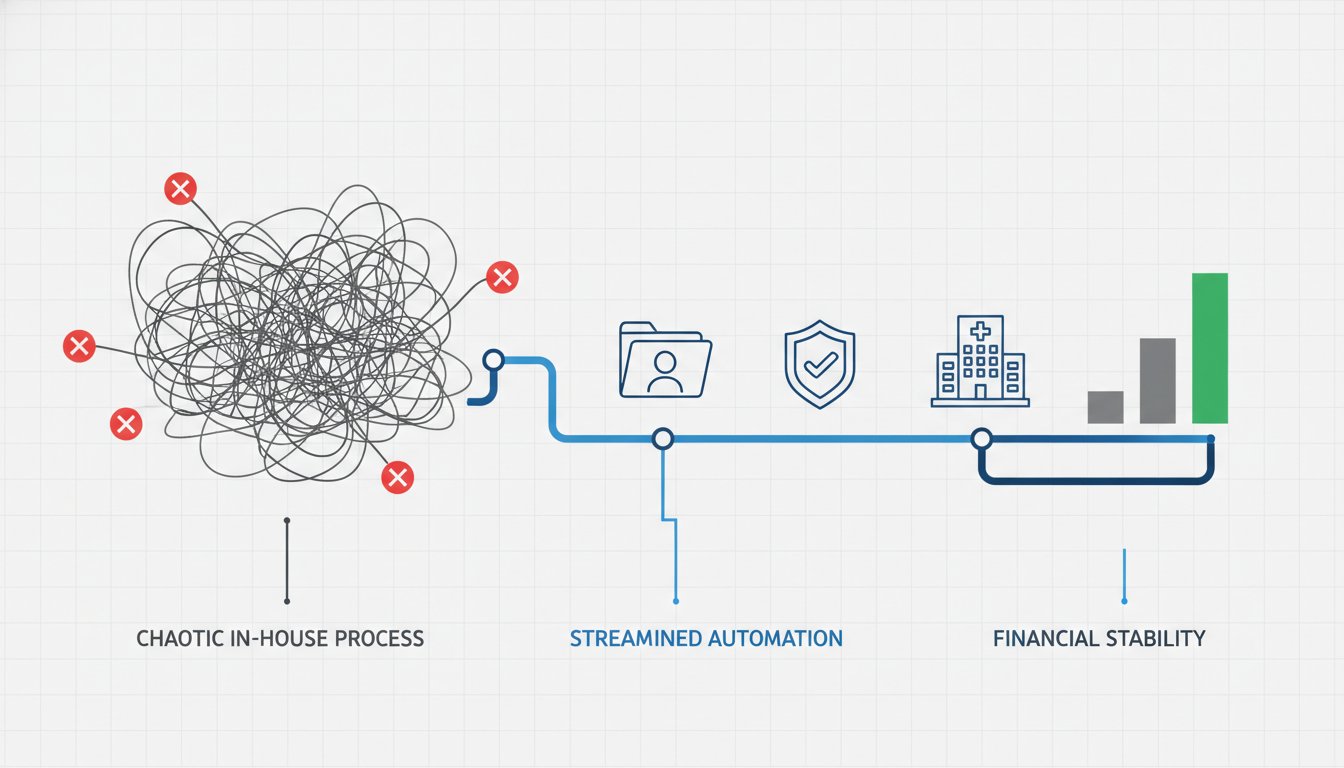

Article by
Dr. Sharafat Hussain Ph.D
Dr. Sharafat Hussain is a healthcare business consultant, entrepreneur, and academic with strong experience in the US healthcare industry. He is the Founder and Managing Director of Tausch Medical, a revenue cycle management company supporting US healthcare providers with medical billing, prior authorization, credentialing, eligibility verification, A/R follow-up, and patient support services. His work combines practical healthcare operations, business strategy, and academic insight to help medical practices improve efficiency, collections, and service quality.
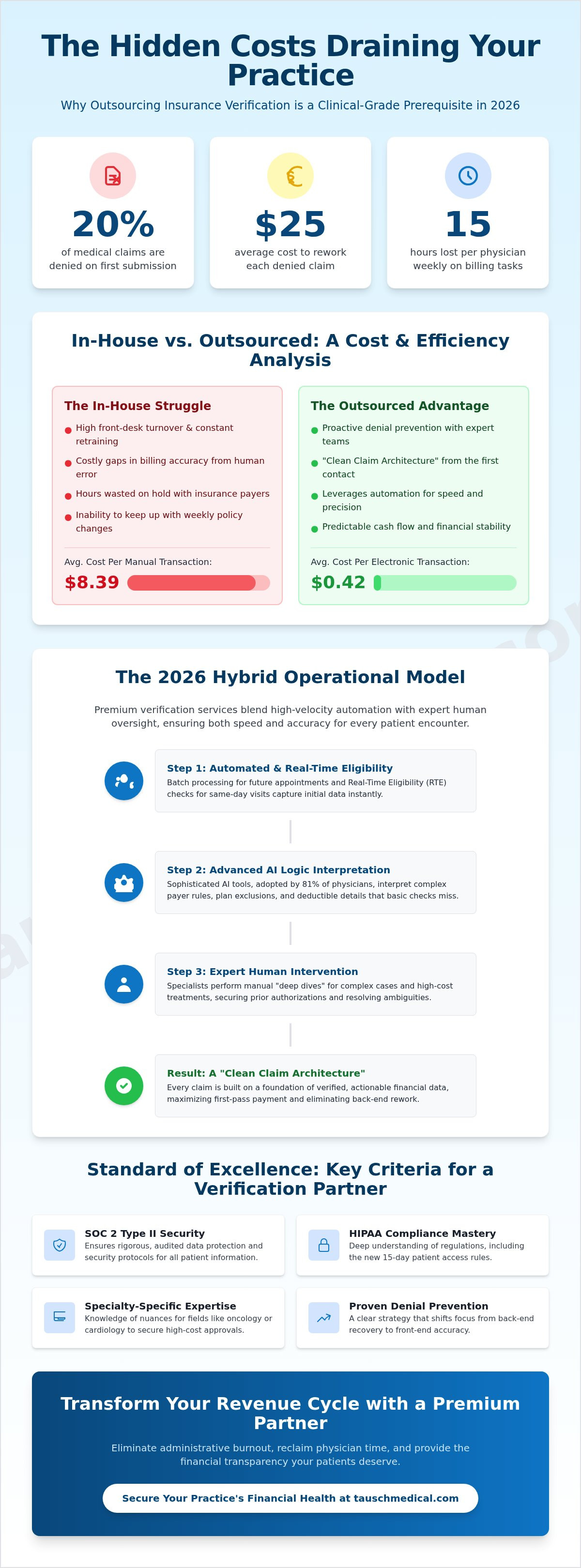
Did you know that 20% of all medical claims are currently denied on the first submission, costing your practice an average of $25 to rework each one? In 2026, the administrative landscape has reached a level of complexity where even minor eligibility errors can disrupt your entire financial ecosystem. You likely feel the weight of these statistics every day as your front desk staff struggles with burnout and increasingly complex prior authorization requirements. Embracing medical insurance verification outsourcing is no longer just a clerical choice; it's a clinical-grade financial prerequisite for any practice aiming for long-term stability and premium service quality.
This guide explores how transitioning to a specialized partner can eliminate these costly denials and reclaim the 15 hours per week that physicians typically lose to billing tasks. We'll examine the strategic benefits of moving toward proactive denial prevention, ensuring your practice achieves predictable cash flow and the level of financial transparency your patients deserve. By the end of this article, you'll understand how to navigate the latest regulatory shifts, including the new 15-day HIPAA patient access rules, while maintaining a lean and efficient administrative structure.
Key Takeaways
- Understand why the 2026 healthcare landscape requires specialized administrative partnerships rather than basic eligibility checks to maintain practice profitability.
- Learn how medical insurance verification outsourcing significantly reduces the $25 average cost of reworking denied claims by shifting focus to front-end prevention.
- Discover the hybrid operational model that combines advanced automation with expert human intervention for flawless real-time eligibility processing.
- Identify the essential "Standard of Excellence" criteria, including SOC 2 Type II security and HIPAA compliance, necessary for selecting a secure outsourcing partner.
- Explore how a premium, clinical-grade approach to verification transforms the patient financial experience and eliminates administrative burnout at the front desk.
The Evolution of Medical Insurance Verification Outsourcing
The concept of medical insurance verification outsourcing has matured into a sophisticated administrative partnership that transcends simple data entry. In 2026, healthcare providers no longer view this as an optional back-office task. Instead, it is a clinical-grade financial strategy. The current environment demands more than just confirming a patient is active in a database. It requires a deep dive into specific plan exclusions, remaining deductibles, and complex prior authorization triggers that shift weekly. Specialized partners now act as a seamless extension of the practice, providing the technological precision necessary to navigate these complexities.
Modern practices are moving away from the "check the box" mentality. They're adopting a model of comprehensive benefit validation. This shift is driven by the realization that front-end precision is the only way to protect the bottom line against increasingly aggressive payer scrutiny. Specialized firms offering medical insurance verification outsourcing bring a level of technological superiority and focused expertise that is nearly impossible to replicate within the walls of a standard clinic. By centralizing this function, practices can ensure that every patient encounter is backed by verified, actionable financial data.
Why In-House Verification is Failing Modern Practices
Traditional in-house models are struggling to keep pace with the 2026 healthcare market. High turnover at the front desk creates a cycle of constant retraining, which lead to gaps in billing accuracy. When a new employee misses a subtle change in a multi-tier insurance plan, the practice pays the price through immediate claim denials. There's also a significant hidden cost in staff productivity. Employees often spend hours on hold with payers; this is a drain on resources that could be better utilized for patient care and enhancing the in-office experience.
The Role of Verification in the Modern Revenue Cycle
Insurance verification serves as the critical first step in the medical billing process, acting as the gatekeeper for every subsequent transaction. It's the bedrock of successful medical billing outsourcing. If the data captured at the point of scheduling is flawed, back-end recovery efforts are already compromised. We advocate for a "clean claim architecture" where accuracy is engineered into the workflow from the very first patient contact. This proactive stance ensures that by the time a provider sees a patient, the financial path is clear. This level of preparation maximizes the likelihood of a first-pass payment and reduces the administrative friction that often plagues the patient experience.
How Outsourced Verification Services Operate in 2026
Operational excellence in 2026 relies on a sophisticated hybrid model that blends high-velocity automation with expert human intervention. While many vendors rely solely on basic portal scraping, premium medical insurance verification outsourcing utilizes advanced logic to interpret complex payer rules. This approach ensures that while 81% of physicians have adopted AI tools by 2026, the technology is always guided by specialists who understand the nuances of clinical documentation. It's not just about speed. It's about ensuring that every data point captured is actionable for the billing team.
The process typically begins with batch eligibility processing for the upcoming week's schedule, followed by Real-Time Eligibility (RTE) checks for same-day appointments. As the industry continues to streamline health insurance verification with AI, the most successful practices are those that balance high-speed algorithms with professional oversight. Manual administrative transactions currently cost an average of $8.39 each, whereas electronic versions drop to just $0.42. By automating the routine while reserving human expertise for complex specialty-specific validations, oncology or cardiology practices can secure approvals for high-cost treatments that generic systems often miss.
Real-Time Eligibility (RTE) vs. Manual Deep-Dives
Automated RTE is sufficient for confirming active coverage, but it often fails to identify "carve-out" benefits or secondary payer coordination. When a patient presents with multiple layers of insurance, a manual deep-dive becomes mandatory to prevent coordination-of-benefit denials. Specialists verify the exact sequence of payers and confirm whether specific services, like mental health or high-end imaging, are managed by a third-party entity. This level of detail is what separates a standard check from a "clean claim architecture."
Prior Authorization and Referral Management
Outsourcing extends beyond simple verification into the high-stakes workflow of authorization management. Experts track every authorization from the moment of request to the final approval, meticulously monitoring expiration dates to prevent "expired auth" denials. They ensure that clinical documentation meets the payer's specific evidence-based criteria before submission. This proactive management allows providers to focus on clinical outcomes rather than administrative hurdles. If your practice is struggling to keep up with these shifting requirements, exploring specialized insurance verification services can provide the stability you need.
Analyzing the ROI: In-House vs. Outsourced Verification
Quantifying the return on investment for administrative functions requires looking beyond surface-level expenses to the structural integrity of your practice’s cash flow. While many administrators view the front desk as a fixed cost, the reality is that inefficient verification processes act as a silent tax on every patient encounter. Transitioning to medical insurance verification outsourcing allows a practice to convert unpredictable administrative friction into a scalable, high-performance asset. This shift isn't merely about cutting costs; it's about reclaiming capital that is currently lost to payer complexity and human error.
The financial impact of "denial rework" remains one of the most underestimated drains on practice profitability. Research indicates that approximately 15% to 20% of all medical claims are denied on the first submission, and the average cost to rework just one of these claims is $25. When these errors originate from eligibility or authorization oversights, the rework cost often escalates due to the additional time required for manual payer intervention. By eliminating these errors at the point of entry, outsourcing ensures that your revenue cycle remains fluid rather than reactive.
The Tangible Costs of In-House Administrative Overhead
Maintaining an internal verification team involves substantial hidden expenditures that go far beyond base salaries. Practices must account for fringe benefits, ongoing training on 2026 regulatory updates, and the cost of specialized software licenses. Perhaps more critical is the "single-point-of-failure" risk. When a key staff member leaves, the practice suffers an immediate drop in billing accuracy and a surge in "Days in AR" (Accounts Receivable). Outsourcing provides an elastic capacity that scales with your patient volume, ensuring that seasonal surges or staff transitions never compromise your financial stability.
Impact on Clean Claim Rates and Denial Prevention
A rigorous pre-service verification protocol is the primary driver of a 95% or higher clean claim rate. When eligibility is confirmed with clinical precision before the patient arrives, the likelihood of back-end recovery success increases exponentially. This proactive stance also reduces "patient responsibility" write-offs by providing clear, up-front cost estimates, which enhances the overall revenue cycle management lifecycle. Accurate data capture allows your front-desk staff to step away from the phone and focus on the patient experience, transforming a high-stress clerical role into a premium service position that fosters long-term patient loyalty.
Key Criteria for Selecting a Verification Partner
Selecting a partner for 2026 requires more than a cursory glance at a service menu. It demands an evaluation of clinical-grade administrative support that mirrors the precision of your own medical practice. A premium medical insurance verification outsourcing partner doesn't simply confirm coverage; they provide a "Standard of Excellence" that includes deep specialty knowledge and technological transparency. You need a partner that functions as a high-performance extension of your team, offering real-time dashboards and claim-level visibility rather than vague monthly summaries.
Specialty expertise is a non-negotiable factor. A partner who understands the specific prior authorization triggers for cardiology or the complex "carve-out" benefits in mental health will prevent denials that a generalist firm would miss. This level of insight ensures that your revenue cycle remains resilient against the shifting rules of 2026 payers. To ensure your practice meets these rigorous standards, it's essential to partner with a specialized insurance verification provider that prioritizes accuracy and financial transparency.
Security, Compliance, and Data Integrity
In the current regulatory environment, data security is the bedrock of any administrative partnership. You must verify that your partner maintains SOC 2 Type II certification and strictly adheres to updated HIPAA guidelines. With the 2026 mandate shortening the patient record access window to just 15 days, your partner's data architecture must be agile and impeccably organized. Ask potential partners about their specific encryption protocols and staff access controls. A robust audit trail for every verification performed is mandatory to protect your practice during CMS or OIG reviews. Compliance isn't just a checkbox; it's a continuous commitment to protecting your practice's reputation and legal standing.
Communication and Integration Capabilities
Seamless integration with your existing EHR, whether it's Epic, Cerner, or Athena, is vital for maintaining a "clean claim architecture." The data must flow bidirectionally without manual entry, which reduces the risk of human error. Evaluate the partner’s communication model; a dedicated account manager is far superior to a generic support ticket system when urgent authorization issues arise. Cultural fit is also a critical consideration. The outsourcing team should reflect the professional tone and clinical precision of your practice, ensuring that every interaction, whether with your staff or a payer, upholds your brand’s premium standards. Look for a partner that views their role as a long-term strategic alliance rather than a simple vendor relationship.
Tausch Medical: Elevating Verification to a Premium Standard
Tausch Medical represents the pinnacle of administrative precision, offering a "white-glove" approach that transforms how providers view their revenue cycle. Our methodology isn't built on generic templates; it's rooted in the same clinical evidence and attention to detail that you bring to your patients. By choosing medical insurance verification outsourcing through Tausch, you're not just hiring a vendor. You're securing a strategic ally that prioritizes technological superiority and fact-based results. This commitment ensures that your practice isn't just surviving payer complexity but thriving within it.
The results we deliver are measurable and consistent. Practices that partner with us see a significant reduction in the administrative burden on their staff, allowing them to reclaim the 15 hours per week typically lost to billing and insurance tasks. We provide the peace of mind that comes from knowing your front-end architecture is flawless, which naturally leads to predictable cash flow and higher patient satisfaction. Our focus on precision translates directly into clinical-grade financial stability for the long term.
Beyond Data Entry: A Strategic Partnership
Our team acts as a comprehensive knowledge center for your practice, providing insights that go far beyond simple eligibility checks. We recognize that verification is most effective when integrated with other core functions like denial management and provider credentialing. This holistic view allows us to identify systemic issues before they impact your bottom line. Tausch Medical is the premier choice for practices seeking uncompromising quality and a partner that understands the intricate link between front-end accuracy and back-end recovery. Our experts ensure that every patient encounter is backed by verified data, reducing the risk of unbillable revenue that can reach $4,000 per day for providers in pending status.
Getting Started: The Transition to Excellence
Transitioning to a premium outsourcing model shouldn't be a source of stress. Our onboarding process is engineered to be seamless, ensuring that your daily operations continue without disruption while we elevate your standards. We don't just focus on cost-cutting; we focus on revenue optimization. By refining your medical insurance verification outsourcing workflow, we help you capture revenue that was previously lost to clerical oversights or complex payer requirements.
The shift to Tausch Medical is a shift toward long-term business success and clinical-grade financial stability. We replace administrative uncertainty with a disciplined, data-driven framework that supports your growth goals. If you're ready to experience the Tausch difference, reach out for a professional consultation and discover how we can transform your practice’s profitability through our specialized suite of services.
Securing Your Practice’s Financial Future in 2026
The landscape of healthcare administration has fundamentally shifted. It's no longer enough to perform basic eligibility checks. In 2026, financial survival depends on a clean claim architecture that begins long before the patient enters the exam room. By embracing medical insurance verification outsourcing, your practice can eliminate the $25 average cost of reworking denied claims while simultaneously reclaiming the 15 hours per week physicians often lose to administrative tasks. This transition isn't just about efficiency; it's about protecting your bottom line with clinical precision.
Tausch Medical was founded circa 2012 with a dedicated focus on supporting high-growth practices through premium administrative support. We provide a comprehensive suite of services, including credentialing and A/R recovery, delivered with national coverage and expert oversight. Our approach ensures that your revenue cycle remains as sophisticated and precise as the care you provide to your patients. Optimize your revenue cycle with Tausch Medical’s expert verification services. We invite you to step into a future of predictable cash flow and uncompromising quality.
Frequently Asked Questions
What is the primary benefit of outsourcing medical insurance verification?
The primary benefit is the systematic elimination of eligibility errors that contribute to the 15% to 20% first-submission denial rate seen across the industry. By utilizing specialized experts, physicians can reclaim an average of 15 hours per week that are typically lost to billing and insurance tasks. This transition allows your staff to focus on patient care while ensuring that every encounter is backed by a "clean claim architecture."
How much does medical insurance verification outsourcing typically cost?
Industry pricing models generally follow a percentage of net collections, a flat monthly fee, or a per-claim rate depending on the volume and complexity of the specialty. While specific costs depend on the scope of the partnership, the investment is typically offset by the reduction in "denial rework" expenses and in-house staffing overhead. It's best to evaluate these services based on the total return on investment and the acceleration of practice cash flow.
Can an outsourcing partner integrate with my current EHR software?
Professional outsourcing partners are designed to integrate directly with major EHR and PM systems, including Epic, Cerner, and Athena, ensuring a seamless bidirectional data flow. This integration allows verified eligibility data and authorization numbers to appear in your system in real-time without requiring manual entry by your front-desk team. It maintains the integrity of your clinical records while enhancing administrative precision through specialized technology.
Does insurance verification include prior authorization management?
Comprehensive medical insurance verification outsourcing usually includes the end-to-end management of prior authorizations and referrals. This process involves monitoring expiration dates and ensuring that all clinical documentation aligns with the payer's specific evidence-based criteria before a procedure occurs. Managing these high-stakes workflows proactively prevents the "expired auth" denials that often plague complex medical specialties.
How does verification outsourcing reduce my medical claim denials?
Outsourcing reduces denials by identifying "carve-out" benefits and secondary payer sequences that automated systems or overextended staff often miss. Since it costs an average of $25 to rework a single denied claim, preventing these errors at the point of entry provides an immediate boost to your bottom line. Experts ensure that every data point is accurate before the claim is generated, which significantly increases your first-pass payment rate.
Is my patient data secure when using an outsourced verification service?
Reputable partners maintain the highest security standards, including SOC 2 Type II certification and strict adherence to the latest HIPAA guidelines. In 2026, your partner must be capable of meeting the updated 15-day deadline for providing patients with access to their records while maintaining robust encryption. Every verification performed should include a detailed audit trail to ensure your practice remains compliant with CMS and OIG regulations.
How long does it take to see an ROI after outsourcing insurance verification?
Most practices begin to see a measurable return on investment within 30 to 90 days as clean claim rates improve and "Days in AR" begin to decrease. The immediate reduction in administrative friction provides instant relief to your front-desk staff, while the long-term financial benefits grow as denial rework costs are eliminated. This rapid stabilization of the revenue cycle creates a more predictable and resilient financial foundation for the entire practice.
Disclaimer
This article is for general informational purposes only and does not constitute legal, medical, billing, coding, compliance, or financial advice. Healthcare rules, payer policies, and reimbursement guidelines may change and may vary by situation. Please consult qualified professionals or official sources before making decisions based on this content. Tausch Medical is not responsible for any loss or liability arising from reliance on this information.


