


Article by
Dr. Sharafat Hussain Ph.D
Dr. Sharafat Hussain is a healthcare business consultant, entrepreneur, and academic with strong experience in the US healthcare industry. He is the Founder and Managing Director of Tausch Medical, a revenue cycle management company supporting US healthcare providers with medical billing, prior authorization, credentialing, eligibility verification, A/R follow-up, and patient support services. His work combines practical healthcare operations, business strategy, and academic insight to help medical practices improve efficiency, collections, and service quality.
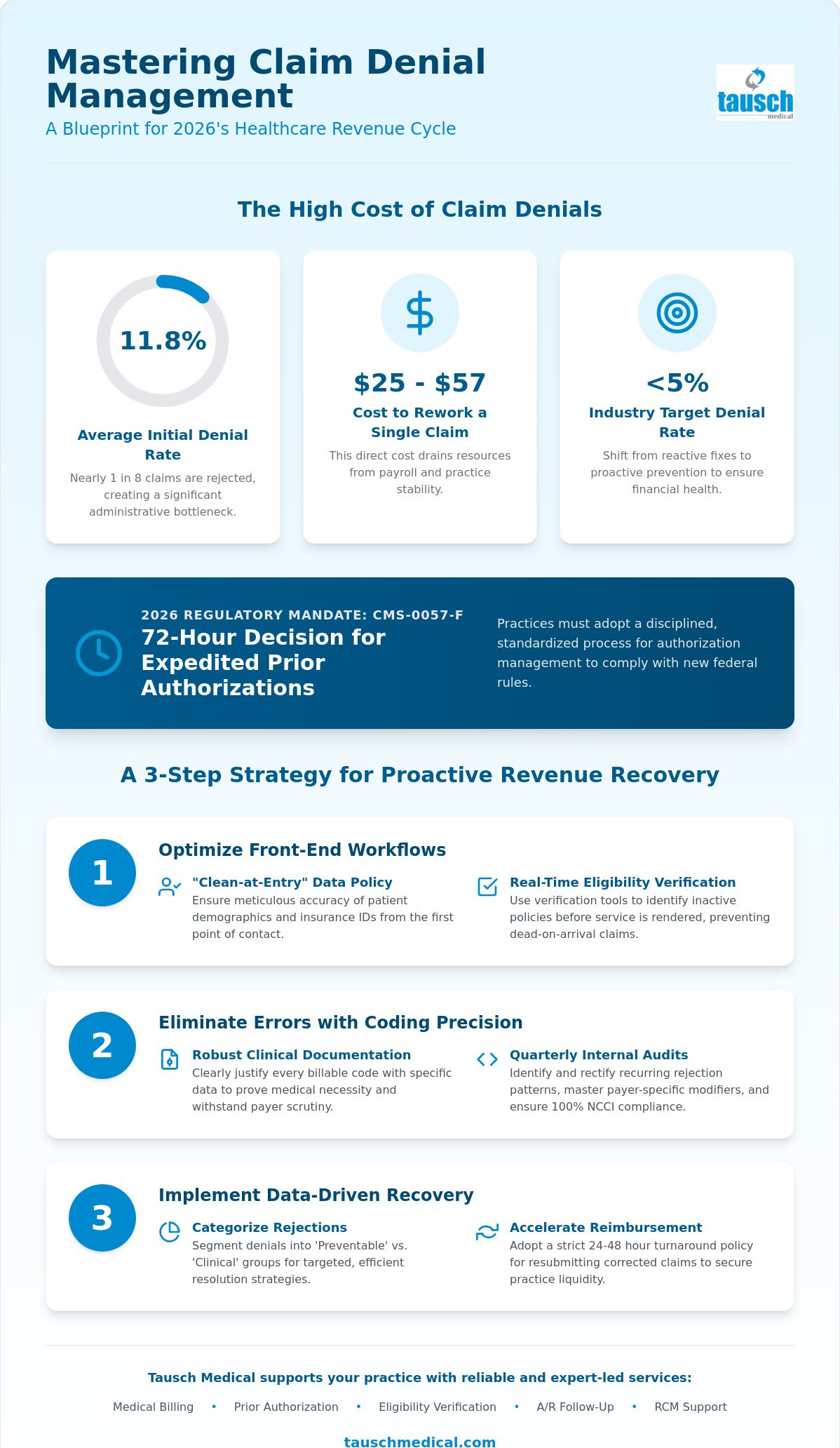
With the average initial claim denial rate reaching 11.8% in 2026, many healthcare providers find that nearly one in eight claims results in a costly administrative bottleneck rather than a reimbursement. You're likely all too familiar with the mounting pressure of complex payer requirements and the frustration of watching your staff burn out while chasing delayed payments. It's a significant challenge to reduce claim denials when the cost to rework a single error now ranges between $25 and $57; a drain on resources that directly impacts your practice's payroll and long term stability.
We believe that financial security shouldn't be a source of constant stress, but rather a reflection of your clinical excellence. This guide provides the actionable steps necessary to master 2026's new regulatory landscape, including the CMS-0057-F mandates for expedited 72-hour prior authorization decisions. You'll learn how to streamline your front-end workflows, eliminate recurring billing errors, and ultimately drive your denial rates below the 5% threshold. By shifting from reactive troubleshooting to a model of proactive revenue recovery, you can secure faster reimbursement cycles and focus on what truly matters: delivering world class patient care.
Key Takeaways
- Establish a rigorous insurance eligibility verification protocol and "clean-at-entry" data policy to eliminate administrative errors at the first point of contact.
- Bridge the gap between clinical documentation and billable codes through quarterly internal audits that identify and rectify recurring rejection patterns.
- Implement a sophisticated strategy to reduce claim denials by categorizing rejections into preventable and clinical segments for targeted resolution.
- Accelerate your reimbursement cycle and secure practice liquidity by adopting a strict 24-48 hour turnaround policy for the resubmission of corrected claims.
Optimizing Front-End Workflows to Prevent Denials Before Submission
The clinical journey doesn't begin in the exam room; it begins at the registration desk. To effectively reduce claim denials, practices must shift from a reactive mindset to a preventative one. Implementing a "clean-at-entry" data policy ensures that patient demographics and insurance IDs are captured with meticulous precision. By utilizing real-time verification tools, your team can identify inactive policies before the physician ever sees the patient, preventing dead-on-arrival claims. This integration is a cornerstone of effective revenue cycle management, where front-office accuracy dictates back-office success.
The Critical Role of Eligibility Verification
In 2026, manual verification is no longer just inefficient; it's a liability. With the average initial denial rate reaching 11.8% this year, relying on staff to call payers for every encounter is a risk your practice shouldn't take. Staff must be trained to navigate the complexities of secondary and tertiary insurance overlaps, which frequently lead to coordination of benefits (COB) rejections. Understanding the impact of inaccurate insurance verification is essential for long-term health. A single typo in a member ID can trigger a cascade of administrative rework, costing your practice between $25 and $57 per claim in labor alone.
Managing Prior Authorizations in 2026
The 2026 regulatory environment, specifically the enforcement of the CMS-0057-F rule, demands a more disciplined approach to insurance authorization management. Standardizing this process involves creating a centralized log for authorization numbers and expiration dates to ensure no procedure is performed without valid coverage. Under new regulations, payers must provide decisions within 72 hours for expedited requests. Your team must be prepared to handle emergency authorizations without risking a total claim loss by maintaining rigorous documentation of all payer communications and reference numbers. This level of clinical precision in administrative tasks is what separates high-performing practices from those struggling with stagnant revenue.
Eliminating Technical Errors Through Clinical Precision in Coding
Precision in coding is far more than an administrative task; it's the translation of clinical expertise into financial viability. To effectively reduce claim denials, practices must move beyond basic ICD-10 selection and embrace rigorous internal audits. Conducting these reviews quarterly allows your team to identify recurring patterns that trigger rejections before they become systemic failures. Achieving 100% compliance with National Correct Coding Initiative (NCCI) edits and payer-specific modifiers is the only way to safeguard your revenue in an era where AI-driven payer adjudication has become the industry standard.
Documentation as a Defense Strategy
Under 2026 CMS standards, medical necessity is defined as healthcare services that are "reasonable and necessary for the diagnosis or treatment of illness or injury or to improve the functioning of a malformed body member." Vague phrases in physician notes, such as "patient requests procedure" or "routine follow-up," often inadvertently trigger denials. Your documentation must serve as a robust clinical evidence bridge, clearly justifying every billable code with specific patient outcomes and diagnostic data to withstand payer scrutiny.
Mastering Payer-Specific Modifier Rules
Regional nuances significantly impact reimbursement cycles. Local payers in major metros like Houston or New York often maintain unique requirements for modifiers that differ from national benchmarks. Following HFMA best practices ensures your team avoids "unbundling" errors, which occur when components of a single service are billed separately. This mistake leads to automatic audits and significant payment delays. Maintaining this level of detail requires constant vigilance. Many high-growth practices choose to utilize professional medical billing services to maintain a sub-2% technical error rate, effectively shielding their revenue from avoidable rejections.
Implementing a Data-Driven Denial Management and Recovery Strategy
Managing revenue in major medical hubs like Houston, Dallas, or New York requires a sophisticated, data-driven approach to navigate localized payer nuances. To effectively reduce claim denials, you must treat every rejection as a valuable data point for continuous improvement. Categorizing denials into "preventable" administrative errors and "clinical" necessity issues allows leadership to target root causes with surgical precision. While many practices allow denials to sit for weeks, industry leaders set a strict 24-48 hour turnaround time for resubmission. Adopting best practices to combat denials involves analyzing specific "Denial Reason Codes" to build a predictive model, ensuring future submissions are optimized before they leave the office.
Strategic AR Follow-Up and Recovery
Practices often lose significant revenue simply because aged claims aren't prioritized by recovery probability. Your team should execute a rigorous medical accounts receivable follow up process specifically targeting the 60+ day buckets where revenue is most at risk. By focusing high-level resources on medical accounts receivable recovery for aged claims, you can maintain practice liquidity and steady cash flow. Prioritizing high-dollar denials ensures that your most valuable clinical work is reimbursed promptly. This level of focus prevents the slow erosion of your practice's financial stability.
The Value of Outsourcing RCM Support
The administrative burden of maintaining an elite in-house billing team often outweighs the benefits, especially given the high turnover rates in the healthcare labor market. Choosing outsourcing revenue cycle management grants your practice immediate access to specialized denial experts who understand the evolving nuances of 2026 payer behaviors. This move significantly reduces the overhead costs and training time associated with internal staff management. It's a strategic shift. Partnering with a dedicated firm transforms your billing department from a passive cost center into a robust engine for long-term practice growth.
Securing Your Financial Future in the 2026 Payer Landscape
Mastering the complexities of modern reimbursement requires a transition from reactive billing to proactive revenue recovery. By implementing "clean-at-entry" data policies and aligning clinical documentation with technical coding precision, you create a robust defense against automated payer rejections. The data-driven strategies we've explored provide a clear roadmap to reduce claim denials and stabilize your practice's cash flow. Our specialized denial management experts offer the clinical precision needed to navigate major US metro payer networks with confidence while reducing the administrative burden on your internal staff.
Want to see how Tausch Medical can support your practice with reliable medical billing, prior authorization, eligibility verification, A/R follow-up, and RCM support? Start with our free two-week trial and experience the difference before making a commitment: free trial form
Your practice deserves a financial foundation that is as reliable and professional as the care you provide to your patients. Transforming your revenue cycle management is not just about recovery; it's about building a sustainable platform for long term success and clinical excellence.
Frequently Asked Questions
What is the most common reason for medical claim denials in 2026?
Administrative inaccuracies, particularly during the initial patient registration and insurance verification phases, remain the leading cause of rejections. Statistics for 2026 indicate that approximately 77% of denials for ACA marketplace plans are triggered by non-clinical errors such as mismatched member IDs or expired policy details. Establishing a rigorous "clean-at-entry" protocol is the most effective defense against these systemic administrative bottlenecks.
How can a practice calculate its net claim denial rate?
To determine your net denial rate, divide the total number of claims denied by the total number of claims submitted over a defined period, such as a month or quarter. This percentage serves as a critical KPI for your billing team's technical precision. With the industry's average initial denial rate hovering near 11.8% this year, maintaining a rate below 5% is the hallmark of a high-performing medical practice.
What is the difference between a claim rejection and a claim denial?
A claim rejection is a technical failure caught by the clearinghouse or payer's front-end scrubbing system before the claim is adjudicated; it usually requires a simple data correction. A claim denial, however, occurs after the payer has processed the claim and determined it is unpayable due to medical necessity or coverage limitations. While rejections are often resolved quickly, denials necessitate a more complex, evidence-based appeal process.
Can outsourcing medical billing actually reduce our denial rate?
Strategic outsourcing is a highly effective way to reduce claim denials because it provides immediate access to specialized RCM experts and advanced scrubbing technology. Professional teams maintain a sub-2% technical error rate by performing real-time eligibility checks and ensuring 100% compliance with current NCCI edits. This allows your clinical staff to focus on patient care while external experts manage the complexities of payer-specific modifier requirements.
How long do we have to appeal a denied claim with major payers?
While timelines vary by contract, most major payers allow between 90 and 180 days from the date of the initial denial notice to file a formal appeal. However, to preserve practice liquidity, it is best practice to address and resubmit corrected claims within 24 to 48 hours. Delaying the appeal process increases the likelihood of the claim falling into the 65% of denials that are never successfully recovered.
Want to see how Tausch Medical can support your practice with reliable medical billing, prior authorization, eligibility verification, A/R follow-up, and RCM support? Start with our free two-week trial and experience the difference before making a commitment: https://tauschmedical.com/free-trial-form
Disclaimer
This article is for general informational purposes only and does not constitute legal, medical, billing, coding, compliance, or financial advice. Healthcare rules, payer policies, and reimbursement guidelines may change and may vary by situation. Please consult qualified professionals or official sources before making decisions based on this content. Tausch Medical is not responsible for any loss or liability arising from reliance on this information.


