


Article by
Dr. Sharafat Hussain Ph.D
Dr. Sharafat Hussain is a healthcare business consultant, entrepreneur, and academic with strong experience in the US healthcare industry. He is the Founder and Managing Director of Tausch Medical, a revenue cycle management company supporting US healthcare providers with medical billing, prior authorization, credentialing, eligibility verification, A/R follow-up, and patient support services. His work combines practical healthcare operations, business strategy, and academic insight to help medical practices improve efficiency, collections, and service quality.
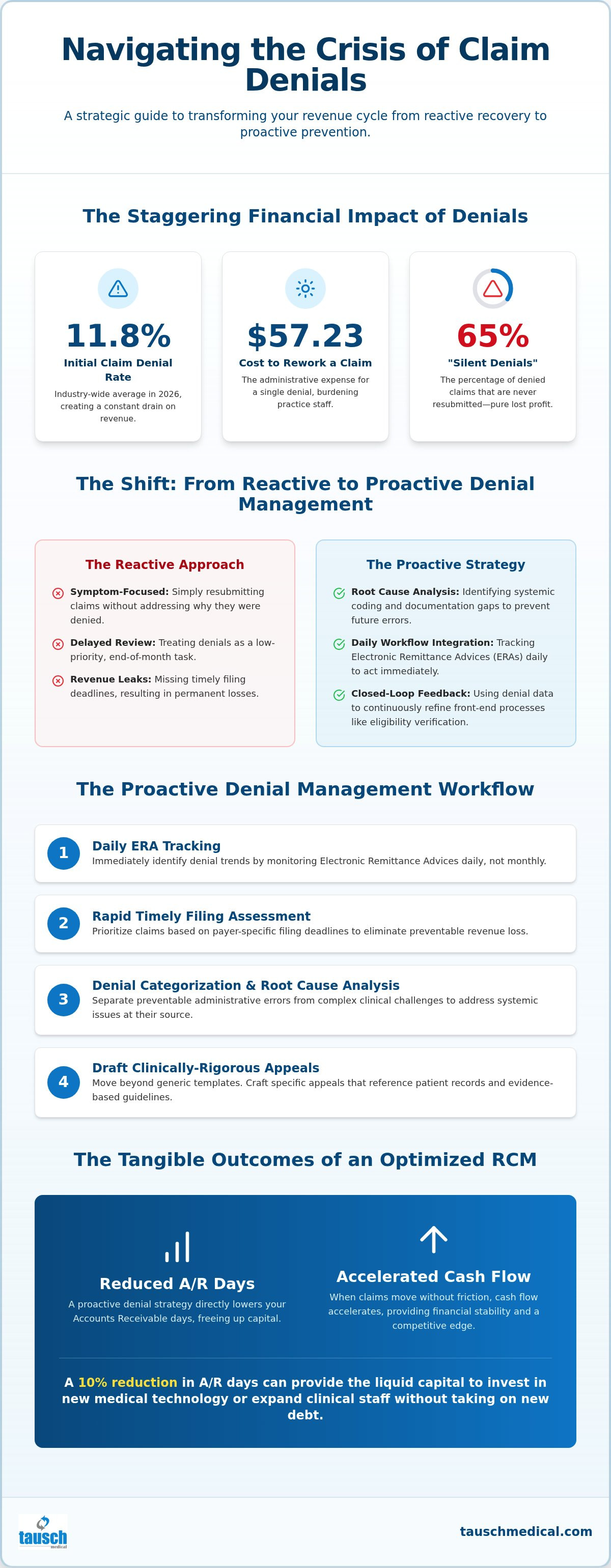
With the industry-wide initial claim denial rate reaching 11.8% in 2026, many healthcare providers find that their revenue cycle is leaking capital at an unsustainable rate. The administrative cost to rework a single denied claim has surged to $57.23, creating a heavy burden on staff who are already managing complex patient needs. Selecting elite medical billing denial management services is no longer just a back-office decision; it's a vital move for clinical and financial stability. You likely recognize the frustration of seeing hard-earned revenue vanish due to timely filing expirations or opaque reporting structures that offer little clarity on your practice's fiscal health.
This guide will show you how to transform your financial operations by choosing a partner that addresses root causes rather than just treating symptoms. We'll explore how a sophisticated approach to denial management can lower your Days in AR and accelerate cash flow. By the end of this article, you'll have a clear roadmap for evaluating partners who provide the transparency and precision necessary to maintain a clean, predictable revenue cycle in an increasingly automated environment. We will examine the specific metrics and technological capabilities that distinguish a true revenue optimizer from a standard billing firm.
Key Takeaways
- Discover why a closed-loop feedback system is essential for transitioning from reactive claim resubmissions to proactive denial prevention.
- Learn to implement a structured daily workflow for tracking Electronic Remittance Advices to eliminate revenue loss from timely filing expirations.
- Identify the specific transparency requirements and real-time reporting features you should expect from premium medical billing denial management services.
- Understand how integrating credentialing and eligibility verification into your denial strategy creates a more predictable and accelerated cash flow.
- Gain a framework for evaluating potential RCM partners based on their ability to address root causes and reduce your overall administrative burden.
Strategic Medical Billing Denial Management Services: Beyond Simple Resubmissions
The healthcare industry faces a quiet crisis where approximately 65% of denied claims are never resubmitted. These "silent denials" represent pure profit left on the table, often because administrative teams lack the specialized knowledge to challenge complex payer decisions. Effective medical billing denial management services must evolve beyond a back-office cleanup crew. They should function as a sophisticated extension of your Revenue cycle management, bridging the gap between clinical documentation and financial recovery with absolute precision.
In 2026, the distinction between front-end rejections and back-end denials is more critical than ever. Rejections occur when a claim fails clearinghouse edits, while denials happen after a payer has processed the claim and found a reason to withhold payment. Modern payer policies now utilize advanced predictive models to scan for lack of medical necessity, requiring faster and more clinically rigorous responses. A closed-loop system ensures that every denial provides actionable data to refine your insurance eligibility verification process, preventing future errors before they even occur.
Root Cause Analysis: Stopping Revenue Leaks at the Source
Tausch Medical prioritizes recovery by categorizing denials into preventable administrative errors and complex clinical challenges. By analyzing AR data, we identify systemic coding patterns or documentation gaps that trigger repetitive denials. This forensic approach allows us to deploy medical billing denial management services that don't just fix individual claims but actually harden your entire billing infrastructure against future losses.
The Impact on Accounts Receivable Days
A proactive denial strategy is the most direct lever a practice can pull to reduce accounts receivable days. When claims move through the cycle without friction, the entire practice stabilizes and gains a significant competitive advantage. A 10% reduction in AR days can provide the immediate liquid capital needed to invest in new medical technology or expand your clinical staff without taking on additional debt.
How to Implement an Effective Denial Management Workflow
A successful denial management process requires more than just high-level oversight; it demands a granular, day-by-day execution strategy. Most practices struggle because they treat denials as an end-of-month administrative task. By the time they review the logs, the window for recovery has often closed. Implementation begins with the daily tracking and categorization of all Electronic Remittance Advices (ERAs). This immediate visibility allows your team to identify trends before they become systemic revenue leaks.
Speed is the primary factor in modern recovery. You must perform a rapid assessment of "timely filing" windows, as these deadlines vary significantly by payer. Missing a window by even 24 hours can result in a permanent loss of revenue that no appeal can salvage. When addressing medical necessity denials, generic template letters are largely ineffective in 2026. Payers now use sophisticated AI to filter out boilerplate responses. Your team must draft clinical appeals that specifically reference patient records and evidence-based guidelines. This high-touch approach should be paired with a continuous feedback loop to your medical billing and front-desk teams to prevent the same errors from recurring.
Managing the Medical Claim Denial Appeal Process
Successful Level 1 and Level 2 appeals require meticulously organized documentation, including the original claim, the remittance advice, and relevant clinical notes. To ensure your staff never misses a critical requirement, consult our medical claim denial appeal process checklist. Refining these internal procedures is a hallmark of elite medical billing denial management services. Practices looking for this level of precision often find that outsourcing A/R follow-up provides the necessary specialized knowledge.
Leveraging Local Payer Knowledge in Major US Metros
Payer behaviors aren't uniform across the country. In Texas hubs like Houston and Dallas, local Blue Cross Blue Shield policies may differ drastically from Cigna or Aetna requirements in New York or Boston. Partnering with a firm that understands the specific nuances of regional Medicare Administrative Contractors (MACs) ensures that your appeals are tailored to local expectations. This regional expertise is vital for navigating the complex landscape of medical billing denial management services in high-volume urban environments.
Selecting a Partner for Medical Practice Revenue Optimization
Choosing the right partner for medical billing denial management services requires looking beyond surface-level promises of higher collections. In 2026, absolute transparency is the benchmark of a premium service. You should expect real-time AR and denial dashboards that provide a granular view of your practice's financial performance at any moment. This level of visibility ensures that your leadership team isn't making decisions based on outdated monthly reports but on live, actionable data.
A truly integrated partner coordinates seamlessly with provider credentialing services to eliminate one of the most common preventable denial categories. The Tausch Advantage lies in our ability to combine national operational scale with specialized local expertise in key markets like San Antonio, Atlanta, and Miami. We understand that a payer's behavior in Georgia often differs from the requirements of Blue Cross Blue Shield in Texas. This regional intelligence allows us to navigate local Medicare Administrative Contractors (MACs) with a level of precision that generic national firms simply can't match. By offloading these complexities, you drastically reduce the administrative burden on your clinical staff, allowing them to focus entirely on patient care.
Why Tausch Medical is the Preferred Choice for 2026
We position medical billing outsourcing as a strategic growth engine rather than a mere cost-center. Our organizational structure creates a unique synergy between our scheduling, insurance verification, and denial management teams. This interdisciplinary approach ensures that data from the back-end denial process informs front-end scheduling and verification, creating the closed-loop system necessary for long-term success.
Experience the Difference with a Risk-Free Trial
We believe that trust should be earned through clinical evidence and financial results. Our two-week trial allows your practice to witness real recovery outcomes before you make any formal commitment. Tausch Medical's trial includes a full audit of your current AR health. This period provides an unvarnished look at your revenue cycle's potential for optimization and the immediate impact of our specialized expertise.
Want to see how Tausch Medical can support your practice with reliable medical billing, prior authorization, eligibility verification, A/R follow-up, and RCM support? Start with our free two-week trial and experience the difference before making a commitment: free trial form
Securing Your Practice's Financial Future Through Strategic Optimization
Navigating the complexities of 2026 payer policies requires a shift from reactive claim resubmissions to a proactive, closed-loop revenue strategy. By prioritizing root cause analysis and leveraging regional payer expertise in major markets like Houston, Dallas, and New York, your practice can reclaim lost revenue and stabilize its cash flow. The most effective medical billing denial management services don't just fix errors; they harden your entire financial infrastructure against future leaks while significantly reducing the administrative burden on your clinical team, allowing for a greater focus on patient-centered excellence, a goal shared by regional providers like Modern Vintage Home Care that specialize in senior support throughout the Sugar Land and Houston areas.
Tausch Medical provides the clinical precision and comprehensive RCM support needed to turn your billing department into a growth engine. Our expertise in complex clinical appeals ensures that even the most challenging denials are met with evidence-based responses that payers can't ignore. We're committed to your long-term success and invite you to see the results firsthand without any initial risk. Your path to a cleaner, more predictable revenue cycle begins with a partner who understands the nuances of the modern medical landscape.
Want to see how Tausch Medical can support your practice with reliable medical billing, prior authorization, eligibility verification, A/R follow-up, and RCM support? Start with our free two-week trial and experience the difference before making a commitment: free trial form
Frequently Asked Questions
What is the industry average for medical claim denials in 2026?
The average initial claim denial rate across the healthcare industry is 11.8% in 2026 according to Qualigenix reports from April. This figure has risen from 10.2% in previous years, reflecting the increased complexity of automated payer scanning and AI-driven review models. Monitoring your internal rates against this national benchmark helps identify if your current revenue cycle requires more specialized intervention to protect your practice's bottom line.
How long does the medical claim denial appeal process typically take?
The medical claim denial appeal process typically ranges from 30 to 90 days, though this varies based on the payer's specific requirements and the level of appeal. Level 1 appeals are often resolved more quickly, while Level 2 or 3 reviews involving complex clinical necessity can extend several months. Professional medical billing denial management services prioritize these timelines to ensure every appeal is filed well within the specific timely filing windows of each insurance carrier.
Can outsourcing denial management services really improve my practice's cash flow?
Outsourcing your denial management can significantly improve cash flow by reducing the time claims spend in accounts receivable and ensuring that silent denials are recovered. Since approximately 65% of denied claims are never resubmitted, a dedicated partner ensures that no capital is left behind. This expert oversight transforms the billing department from a cost-center into a strategic growth engine, allowing your clinical staff to focus on patient care while we secure the revenue you've earned.
What are the most common reasons for medical billing denials in specialty practices?
Disclaimer
This article is for general informational purposes only and does not constitute legal, medical, billing, coding, compliance, or financial advice. Healthcare rules, payer policies, and reimbursement guidelines may change and may vary by situation. Please consult qualified professionals or official sources before making decisions based on this content. Tausch Medical is not responsible for any loss or liability arising from reliance on this information.


