


Article by
Dr. Sharafat Hussain Ph.D
Dr. Sharafat Hussain is a healthcare business consultant, entrepreneur, and academic with strong experience in the US healthcare industry. He is the Founder and Managing Director of Tausch Medical, a revenue cycle management company supporting US healthcare providers with medical billing, prior authorization, credentialing, eligibility verification, A/R follow-up, and patient support services. His work combines practical healthcare operations, business strategy, and academic insight to help medical practices improve efficiency, collections, and service quality.
Workflow efficiency isn't a software feature; it's the strategic removal of administrative friction through specialized outsourcing. Many high-volume clinics find their revenue growth stagnant because front-desk burnout and rising claim denials create a ceiling that technology alone cannot break. You likely feel the weight of mounting A/R days and the constant pressure of verification tasks. Discover how streamlining medical practice workflows through professional managed services can eliminate these bottlenecks and restore your focus to clinical excellence.
This guide explores the transition from administrative chaos to a refined revenue cycle where clean claim rates and seamless scheduling become your new operational standard. We'll examine the specific impact of outsourcing prior authorizations and eligibility checks on your bottom line. By the end, you'll understand how to transform your practice into a model of clinical and financial precision for 2026 and beyond.
A key part of this transformation involves reducing the burden of insurance education; for example, The Modern Medicare Agency helps patients navigate their plan options, which simplifies the eligibility verification process for your administrative team.
Key Takeaways
- Identify the "Big Three" administrative bottlenecks—manual eligibility verification, scheduling conflicts, and claim re-submissions—to regain operational control.
- Learn how streamlining medical practice workflows through proactive scheduling and predictive RCM can significantly reduce no-shows and submission errors.
- Compare the long-term ROI of outsourcing your medical billing against the costs of managing high-turnover in-house administrative staff.
- Understand how expert provider credentialing services accelerate revenue generation for new clinicians by ensuring immediate insurance readiness.
Identifying and Eliminating Administrative Bottlenecks in Medical Workflows
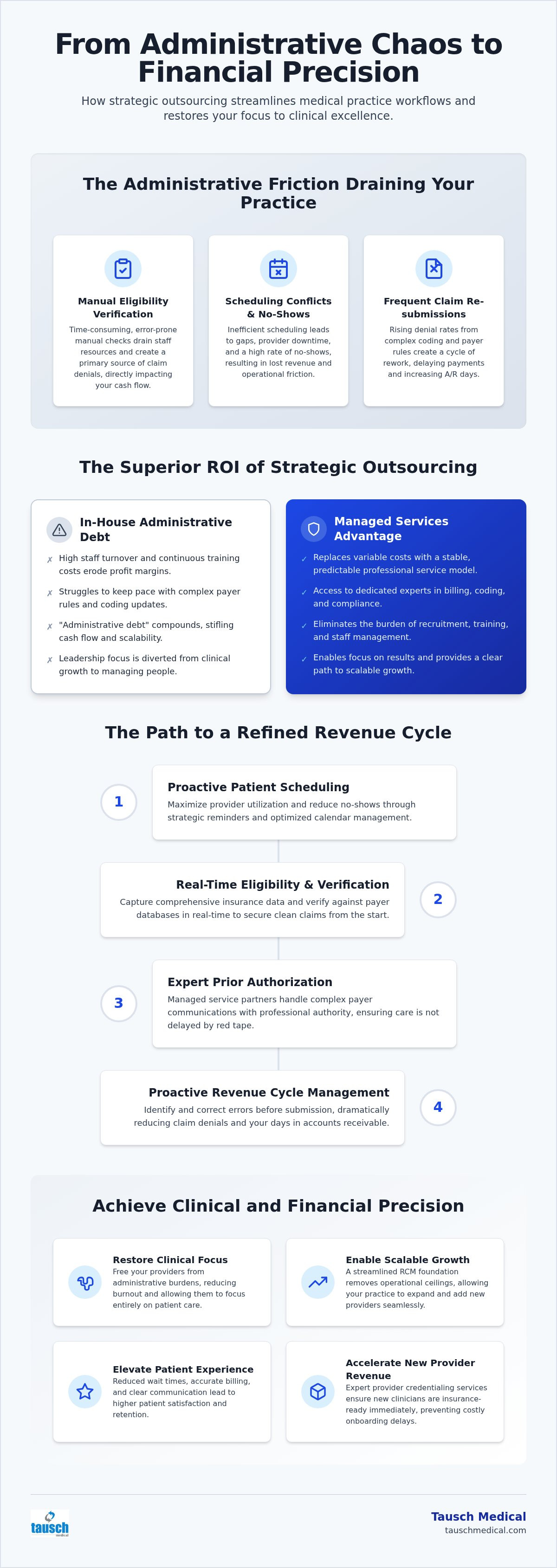
True success in streamlining medical practice workflows requires the seamless synchronization of clinical care and financial administration. It's a strategic alignment where every patient interaction supports both health outcomes and the practice's fiscal integrity. When these systems fall out of sync, three primary bottlenecks typically emerge: manual eligibility checks, scheduling conflicts, and frequent claim re-submissions. These friction points act as a direct drain on your resources. Administrative friction correlates directly to provider burnout; staff spend more time fighting paperwork than assisting patients. This environment inevitably leads to patient dissatisfaction as wait times increase and billing errors create unnecessary stress for those you serve. This need for specialized automation is universal; for example, many firms now rely on AML CTF compliance software Australia to handle complex regulatory requirements without increasing their administrative burden.
The Hidden Cost of Internal Administrative Complexity
Maintaining an in-house billing team presents significant challenges as payer requirements evolve toward 2026 standards. Internal teams often struggle to keep pace with complex coding updates and shifting authorization protocols, which results in "administrative debt." This debt compounds over time, stifling your practice's cash flow and limiting your ability to scale operations in competitive markets like Houston or New York. By addressing these inefficiencies, you restore a vital "clinical focus" to your facility. Doctors can return to their primary mission of patient care while professional medical billing services manage the intricate financial landscape. This shift doesn't just improve the bottom line; it elevates the entire patient experience by ensuring that administrative hurdles never interfere with the delivery of premium healthcare. Transitioning to a managed model allows your practice to operate with the clinical precision and technical superiority that modern patients expect.
Practical Strategies for Optimizing the Patient Lifecycle
Optimizing the patient lifecycle requires a departure from reactive firefighting toward a disciplined, proactive framework. While many practices rely solely on software automation, streamlining medical practice workflows actually depends on the quality of the data entered at the very first touchpoint. A proactive patient scheduling system doesn't just fill slots; it maximizes provider utilization by identifying gaps and reducing no-shows through strategic reminders. This ensures your clinical staff operates at peak capacity without the friction of empty exam rooms.
Shifting from reactive billing to proactive Revenue Cycle Management (RCM) allows your team to identify and correct errors before they ever reach the payer's portal. By utilizing specialized insurance verification services, you secure clean claims from the outset. This precision eliminates the need for costly rework and significantly reduces your days in accounts receivable. It's about building a foundation of accuracy that supports long-term scalability and clinical excellence.
Integrating Eligibility Verification and Prior Authorization
Automating the verification process at the point of scheduling follows a clear, logical sequence. First, capture comprehensive insurance data during the initial patient contact. Second, verify eligibility against current payer databases in real-time. Finally, immediately flag procedures that require additional documentation. This is vital because prior authorization remains the most significant hurdle in modern specialty workflows. It demands clinical evidence and persistent payer communication that often overwhelms internal staff. Managed service partners handle these complex communications with professional authority, ensuring that care isn't delayed by administrative red tape. For those looking to refine these front-end processes, exploring patient scheduling support can be a transformative first step.
Achieving Scalable Growth Through Strategic RCM Outsourcing
Scalable growth requires a shift from managing people to managing results. While maintaining an in-house team seems like it offers control, the reality of high turnover and training costs often erodes your margins. Outsourcing medical billing provides a superior ROI by replacing variable administrative debt with a stable, professional service model. This transition is essential for streamlining medical practice workflows because it removes the burden of recruitment and training from your leadership team.
Practice expansion often stalls during provider onboarding. Many clinics lose significant revenue due to enrollment delays that could've been avoided with better planning. Utilizing professional provider credentialing services ensures your new clinicians are revenue-ready from their first day. Additionally, aggressive A/R denial management serves as a primary driver for recovering capital that would otherwise remain trapped in payer processing cycles.
Transitioning from In-House Complexity to Managed Excellence
Success depends on choosing a partner with deep expertise in regional payer landscapes, such as those in Houston, Dallas, or Atlanta. A true partner creates a feedback loop where clinical documentation improves based on real-time billing insights. You'll measure the health of this streamlined workflow through two critical KPIs: your Clean Claim Rate and total Days in A/R. When these metrics improve, your practice gains the financial freedom to invest in new technologies and patient services. It's a move toward clinical and operational precision that defines the modern healthcare landscape.
Securing Your Practice's Future Through Operational Precision
Transitioning to a managed revenue cycle is the most effective path toward streamlining medical practice workflows in 2026. By eliminating administrative bottlenecks and resolving complex denial patterns, you reclaim the time needed for clinical excellence. Our specialized experience in the Houston and New York healthcare markets provides the regional insight necessary to navigate evolving payer requirements. Success isn't just about reducing A/R days; it's about building a scalable foundation where your financial health matches your clinical reputation.
Want to see how Tausch Medical can support your practice with reliable medical billing, prior authorization, eligibility verification, A/R follow-up, and RCM support? Start with our free two-week trial and experience the difference before making a commitment: free trial form. Your journey toward a more efficient, profitable practice starts today.
Frequently Asked Questions
How does streamlining medical workflows improve patient satisfaction?
Streamlining medical practice workflows directly impacts the patient experience by reducing wait times and clerical errors that lead to billing disputes. Patients in competitive markets like Houston and New York expect a premium, friction-free journey from check-in to final statement. When administrative tasks are handled with precision, clinical staff can focus entirely on care, fostering a relationship built on trust rather than frustration.
What are the most common causes of billing workflow interruptions in 2026?
In 2026, the most frequent interruptions stem from manual eligibility verification and the increasing complexity of prior authorization requirements. These bottlenecks often cause delays in care and lead to high denial rates if not managed proactively. Practices that rely on outdated internal processes struggle to keep pace with evolving payer rules, resulting in stagnant revenue and increased administrative debt that hinders scalability.
Can outsourcing patient scheduling really reduce administrative costs?
Outsourcing patient scheduling significantly lowers overhead by eliminating the need for a large, high-turnover in-house front desk team. Professional scheduling services optimize provider utilization and reduce no-shows through disciplined follow-up protocols. This strategic shift allows your internal staff to prioritize high-value clinical tasks, ensuring that your practice in San Antonio or Dallas operates with maximum efficiency and reduced operational expenditure.
How long does it take to see results from a managed RCM service?
Most practices observe improved visibility into their financial health within the first few weeks of implementation. Significant improvements in key performance indicators, such as reduced A/R days and higher clean claim rates, typically materialize within 30 to 90 days. This timeline allows for the establishment of a robust feedback loop between clinical documentation and professional billing experts, ensuring sustainable growth and operational precision.
Disclaimer
This article is for general informational purposes only and does not constitute legal, medical, billing, coding, compliance, or financial advice. Healthcare rules, payer policies, and reimbursement guidelines may change and may vary by situation. Please consult qualified professionals or official sources before making decisions based on this content. Tausch Medical is not responsible for any loss or liability arising from reliance on this information.


