


Article by
Dr. Sharafat Hussain Ph.D
Dr. Sharafat Hussain is a healthcare business consultant, entrepreneur, and academic with strong experience in the US healthcare industry. He is the Founder and Managing Director of Tausch Medical, a revenue cycle management company supporting US healthcare providers with medical billing, prior authorization, credentialing, eligibility verification, A/R follow-up, and patient support services. His work combines practical healthcare operations, business strategy, and academic insight to help medical practices improve efficiency, collections, and service quality.
What if the biggest risk in changing medical billing support isn’t the new service, but the work no one clearly owns during the handoff? A medical billing service implementation checklist helps turn that uncertainty into a controlled transition, with responsibilities and workflows defined before billing tasks move. The goal is continuity across claims, collections, and patient communications, not simply a change in who submits claims.
It’s reasonable to want confidence that day-to-day revenue cycle work will keep moving as your team adapts to 2026 coding updates. This practical checklist will help you prepare for launch, clarify ownership, set reporting expectations, and define escalation paths. You’ll also learn how to compare end-to-end support with task-based services, so the model you choose fits your practice’s workflows and priorities.
Key Takeaways
- Establish a baseline for claims, denials, A/R aging, and workflow ownership so you can assess the transition against your practice’s starting point.
- Use the medical billing service implementation checklist to sequence scope decisions, workflow documentation, access preparation, and handoff testing.
- Map eligibility verification, prior authorization, claim processing, and A/R follow-up to clear owners based on the services included in your plan.
- Match end-to-end or task-based support to your operational priorities, then review denials, A/R aging, claim value, payer category, and unresolved workflow issues after launch.
Before implementing a medical billing service, define your practice’s starting point
A successful transition protects billing continuity while clearly transferring defined responsibilities. Before work moves, document what happens today and who owns each step; otherwise, gaps in claim handling or follow-up can be difficult to distinguish from existing workflow issues. A medical billing service implementation checklist is most useful when it begins with this baseline, rather than assuming that the new arrangement will resolve undocumented problems.
Create a readiness snapshot before changing billing workflows
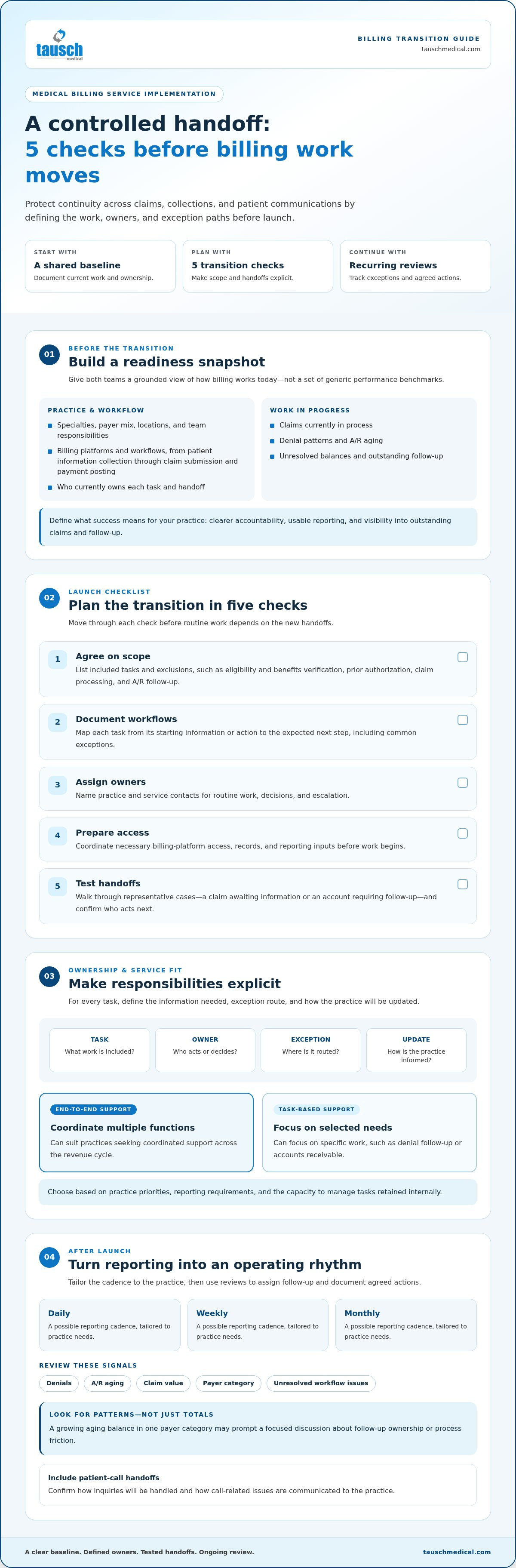
Build a concise inventory of your specialties, payer mix, billing platforms, and current workflows, from patient information collection through claim submission and payment posting. Record the claims currently in process, denial patterns, A/R aging, and unresolved balances, then identify the person responsible for each task and handoff. This snapshot gives both teams a shared reference point without relying on generic performance benchmarks.
For a Texas-based practice, include its operating context, such as locations, team responsibilities, and the platforms staff use, while avoiding assumptions about payer-specific rules. Tausch Medical’s medical billing services can support practices with billing needs, and a clear inventory helps connect those needs to defined workflows. For a foundation on how billing activities fit together, review the Medical billing process.
Define success in practical terms: clearer accountability, agreed reporting that staff can use, and visibility into outstanding claims and follow-up. Decide which baseline measures matter to your practice and how you’ll compare them after launch. For a broader view of how these measures relate across the revenue cycle, explore the revenue cycle management strategic guide. This preparation makes the next transition decisions more precise and grounded in your actual operations.
Use this medical billing service implementation checklist to plan the transition
Once your starting point is documented, translate it into a sequence of decisions and tests. The medical billing service implementation checklist should make clear what work moves, how information flows, and who resolves exceptions, so the transition doesn’t depend on informal assumptions.
- Agree on scope. List included tasks and exclusions, such as eligibility and benefits verification, prior authorization, claim processing, and A/R follow-up.
- Document workflows. Map each task from the information or action that starts it to its expected next step, including common exceptions.
- Assign owners. Name the practice and service contacts responsible for routine work, decisions, and escalation.
- Prepare access. Coordinate the necessary billing-platform access, records, and reporting inputs before work begins.
- Test handoffs. Walk through representative scenarios, such as a claim awaiting information or an account requiring follow-up, and confirm who acts next.
Make responsibilities and workflow handoffs explicit
For every task, record the owner, what information they need, how exceptions are routed, and how the practice will be updated. Agree on a reporting cadence and select useful measures, such as claim status, denials, and A/R follow-up, so reviews lead to clear decisions rather than ambiguous updates.
Support can be structured around an end-to-end revenue cycle or selected tasks, depending on your practice’s priorities and internal capacity. Tausch Medical’s medical billing services can align defined billing responsibilities with the workflow you document. Before launch, use a small set of test cases to verify that records, ownership, and escalation paths carry through each handoff; resolve gaps before routine work depends on them.
Evaluate service fit and establish a controlled post-launch review
Choose a service model that fits the work your practice needs covered and the capacity it wants to retain internally. End-to-end support can coordinate multiple revenue cycle functions, while task-based support can focus on selected needs, such as denial follow-up or accounts receivable. Consider which model aligns with your priorities, reporting requirements, and ability to manage remaining tasks. The medical billing outsourcing guide offers further context for evaluating an outsourced approach.
Once work begins, schedule recurring reviews of denials, A/R aging, claim value, payer category, and unresolved workflow issues. Look for patterns, not just totals: a growing aging balance in one payer category, for example, may call for a focused discussion about follow-up ownership or process friction. Practices with specific denial or receivables needs can align those priorities with A/R and denial management services.
Turn implementation expectations into an ongoing operating rhythm
Set a reporting cadence that supports timely decisions, with daily, weekly, or monthly reporting tailored to the practice’s needs. Use each review to identify exceptions, assign follow-up, and document agreed actions. The medical billing service implementation checklist should also account for patient calls: confirm how inquiries will be handled and how call-related issues are communicated to the practice. Tausch Medical provides 24/7 phone support, and calls are answered by a human to ensure patient satisfaction, staying always on hand to answer questions and make sure that no call goes unanswered.
Want to see how Tausch Medical can support your practice with reliable medical billing, prior authorization, eligibility verification, A/R follow-up, and RCM support? Start with our free two-week trial and experience the difference before making a commitment by submitting our free trial form.
Set your next billing transition up for lasting progress
Use your medical billing service implementation checklist as a working guide, revisiting which responsibilities stay in-house and what reporting helps your team make informed decisions as practice needs evolve. Tausch Medical brings Over 100 certified medical coders and billers. and analytics-driven reporting with tailored reports to support an approach aligned with your operational priorities.
Want to see how Tausch Medical can support your practice with reliable medical billing, prior authorization, eligibility verification, A/R follow-up, and RCM support? Start with our free two-week trial and experience the difference before making a commitment: free trial form
Frequently Asked Questions
Is Tausch Medical a HIPAA-compliant medical billing company?
Yes. Tausch Medical is a HIPAA-compliant medical billing company. As part of implementation, your practice can define who needs access to billing information and how work-related communication should be handled. Agreeing on these expectations early helps teams coordinate responsibilities while keeping the transition aligned with your practice’s information-handling processes.
Can a medical billing service work with our existing billing software?
Yes. Tausch Medical has experience across multiple billing software platforms. Include your current platform in the implementation discussion, then identify which workflows and reports the service will use within it. For example, clarify how a claim’s status or an A/R follow-up item will be recorded so the practice and billing team can work from a consistent view.
Can a practice outsource only part of its revenue cycle?
Yes. Tausch Medical offers task-based support as well as end-to-end outsourcing, allowing a practice to focus outsourced work on selected needs. The medical billing service implementation checklist can help define that boundary, such as assigning A/R follow-up externally while retaining other responsibilities internally. Tausch Medical supports healthcare providers in Houston, San Antonio, Dallas, Austin, El Paso, Arlington, Plano, New York, Boston, Philadelphia, Washington, D.C., Baltimore, Miami, Orlando, Tampa, Atlanta, Raleigh, Richmond, and Jacksonville.
How quickly can a medical billing service implementation be completed?
There isn’t one implementation timeline that fits every practice, and a specific duration shouldn’t be assumed. The scope of support, the workflows involved, and readiness of platform access and records all shape the launch plan. Tausch Medical describes its turnaround as quick; agree on implementation milestones with clear owners so your team knows what needs to be ready before billing work transitions.
Disclaimer
This article is for general informational purposes only and does not constitute legal, medical, billing, coding, compliance, or financial advice. Healthcare rules, payer policies, and reimbursement guidelines may change and may vary by situation. Please consult qualified professionals or official sources before making decisions based on this content. Tausch Medical is not responsible for any loss or liability arising from reliance on this information.


