


Article by
Dr. Sharafat Hussain Ph.D
Dr. Sharafat Hussain is a healthcare business consultant, entrepreneur, and academic with strong experience in the US healthcare industry. He is the Founder and Managing Director of Tausch Medical, a revenue cycle management company supporting US healthcare providers with medical billing, prior authorization, credentialing, eligibility verification, A/R follow-up, and patient support services. His work combines practical healthcare operations, business strategy, and academic insight to help medical practices improve efficiency, collections, and service quality.
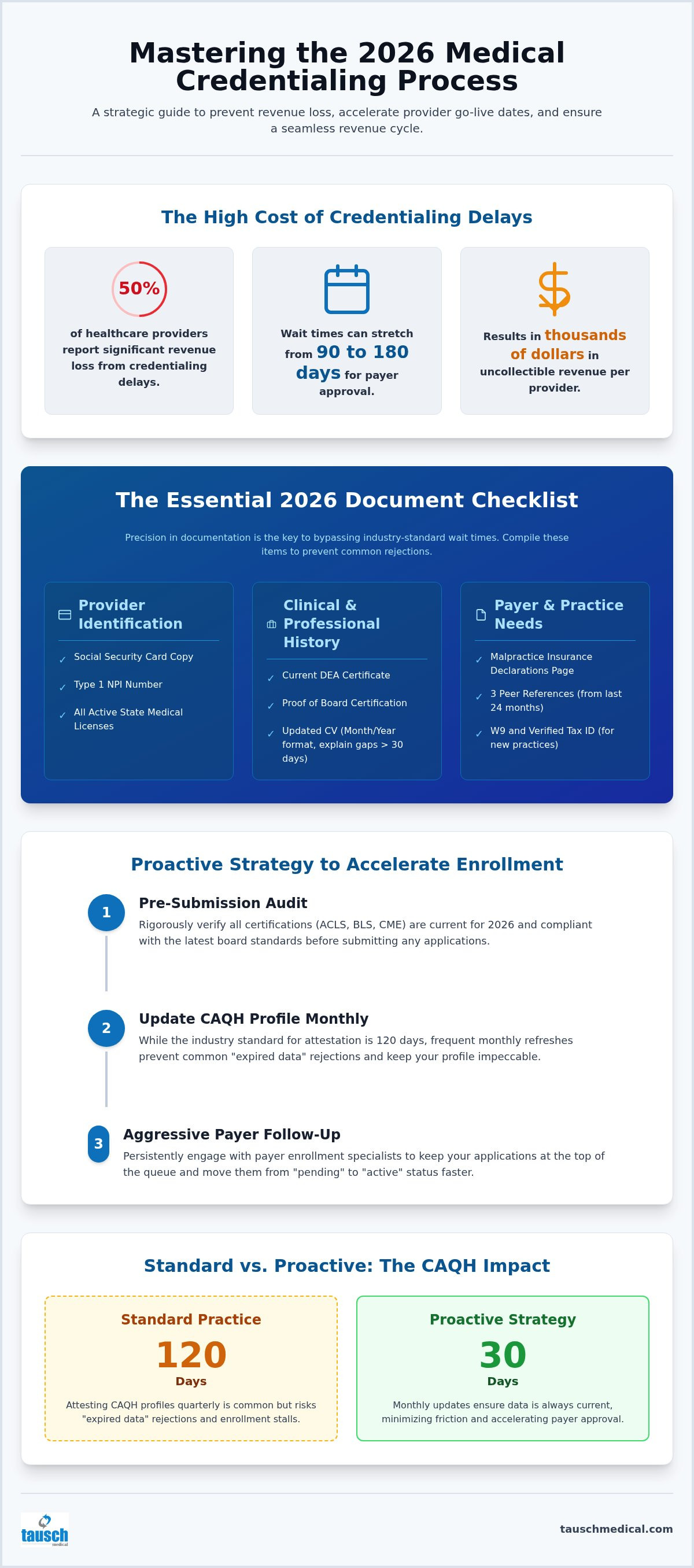
Over 50% of healthcare providers report significant revenue loss specifically due to credentialing delays. In 2026, a single administrative oversight in your medical credentialing process checklist can stall your practice's growth for months. It's frustrating to watch highly skilled providers sit idle while waiting up to 180 days for payer approval. You're likely tired of the high error rates in CAQH profiles and the shifting mandates from state boards that seem designed to create bottlenecks.
This guide is designed to cut through this complexity, offering a path to faster "go-live" dates and protected practice revenue. We'll show you how to master the latest NCQA windows and monthly monitoring mandates. This guide provides a clinical look at the 2026 requirements, ensuring your enrollment process is an integrated, error-free component of your broader Revenue Cycle Management strategy.
Key Takeaways
- Understand the critical connection between precise credentialing and your ability to submit clean claims for optimized revenue cycle management.
- Utilize our comprehensive medical credentialing process checklist to compile essential 2026 documentation, including state licenses, DEA certificates, and board certifications.
- Learn how monthly CAQH profile attestations and pre-submission audits prevent common "expired data" rejections from major insurance payers.
- Discover proactive strategies to shorten provider enrollment timelines and accelerate "go-live" dates for new clinical staff.
The Strategic Impact of Credentialing on Your Revenue Cycle
The medical credentialing process is the rigorous verification of a provider's professional qualifications, ensuring they meet the exacting standards of insurance payers. It's the foundation of your practice's financial health. Without precise execution, your ability to provide medical billing services becomes paralyzed. When a provider isn't properly enrolled, claims are rejected immediately, creating a cascade of administrative friction. Integrating a robust medical credentialing process checklist early ensures that every NPI and license is validated before the first patient encounter.
Errors at this foundational stage directly trigger complex medical claim denial management issues later in the cycle. Payers are increasingly intolerant of data discrepancies. A single mismatched address or an expired certification can lead to months of back-and-forth communication, draining your staff's productivity and delaying cash flow.
Why Delays in Credentialing are Costly for Major Metro Practices
In competitive markets like Houston or Dallas, a 120-day delay in enrollment isn't just an inconvenience; it's a financial drain. Practices can lose thousands of dollars in uncollectible revenue while providers remain unable to bill for their time. These credentialing-related hold-ups are the most preventable leaks in your revenue cycle management strategy. For practices in high-stakes environments like New York and Washington D.C., the speed of provider enrollment determines your market agility. A proactive medical credentialing process checklist minimizes these gaps, turning administrative necessity into a competitive advantage.
The Essential 2026 Medical Credentialing Document Checklist
Precision in documentation is the only way to bypass the 90 to 150 day industry standard wait time. A comprehensive medical credentialing process checklist starts with core identifiers. You'll need to secure a clear copy of the provider's Social Security card, their Type 1 NPI number, and all active state-specific professional medical licenses. Clinical documentation follows, requiring a current DEA certificate and proof of Board Certification status. Your CV must be formatted with exact month and year dates for every position held. Gaps longer than 30 days usually require a written explanation.
Payer-specific requirements are often the cause of "expired data" rejections. Ensure you have the current professional liability (malpractice) declarations page showing the required coverage limits. Additionally, provide contact information for three peer references who've worked with the provider within the last 24 months. Organizing these clinical details early avoids the administrative friction that stalls enrollment.
Scenario-Specific Requirements: New Providers vs. New Practices
Launching a new practice in Texas or Florida adds complexity, such as the need for a W9 and a verified Tax ID. For groups in Atlanta or Miami, adding a provider requires CAQH profile attestation every 120 days. If you rely on hospital privileges, our provider credentialing services include a specialized sub-checklist for admitting arrangements. This ensures clinical coverage before the provider's first day. Keeping these documents organized prevents the revenue leaks discussed in the previous section.
Managing the Enrollment Timeline and Payer Requirements
Managing the enrollment timeline effectively transforms the medical credentialing process checklist from a static list into an active revenue strategy. The first phase of this strategy involves a rigorous verification of clinical standing.
Step 1: Perform a pre-submission audit to ensure all certifications (ACLS, BLS, CME) are current for 2026. You must verify these credits are fully compliant with the latest board standards before the application reaches the payer desk. Step 2: Attest and update CAQH profiles monthly to avoid "expired data" rejections from payers. While the industry standard for attestation is 120 days, frequent refreshes ensure your data remains impeccable and prevents common administrative flags. Step 3: Execute aggressive follow-up with payer enrollment specialists to move applications from "pending" to "active." This persistence keeps your file at the top of the specialist's queue, preventing it from being buried under newer submissions.
Streamlining the Process with Professional Credentialing Services
For many independent practices, outsourcing medical billing services is the most effective way to handle this heavy administrative lifting. A specialized medical credentialing company understands the local payer nuances in markets like Raleigh or Jacksonville, where specific state mandates can derail an application. Tausch Medical integrates these critical enrollment steps with our AR denial services for a holistic financial approach. By aligning your medical credentialing process checklist with broader revenue cycle management, you eliminate the gaps that lead to uncompensated care and protect your practice's long-term profitability. It's a strategic move that turns administrative burden into clinical availability.
Securing Your Practice’s Financial Foundation
Mastering provider enrollment isn't merely an administrative hurdle; it's a strategic necessity for maintaining a healthy cash flow. By implementing a rigorous medical credentialing process checklist, you eliminate the data discrepancies that often stall revenue for months. We've explored how precise documentation and aggressive payer follow-up can reduce standard wait times, allowing your providers to focus on clinical excellence rather than paperwork. Tausch Medical brings specialized local expertise in Texas and East Coast payer networks to ensure your practice remains agile and profitable. Our comprehensive approach integrates credentialing with a holistic financial strategy designed for modern healthcare environments. You don't have to navigate these complexities alone.
Want to see how Tausch Medical can support your practice with reliable medical billing, prior authorization, eligibility verification, A/R follow-up, and RCM support? Start with our free two-week trial and experience the difference before making a commitment: free trial form
Frequently Asked Questions
How long does the medical credentialing process typically take in 2026?
The 2026 standard for provider enrollment ranges from 90 to 150 days. Medicare applications often finish in 60 to 90 days, but private payers and telehealth mandates push timelines toward the 150-day mark. Using a strict medical credentialing process checklist is vital for practices in Houston or New York to avoid the 180-day delays common with government applications or multi-state licensing.
What are the most common reasons for credentialing application delays?
Administrative errors and expired data flags are the leading causes of delays. Payers frequently reject submissions due to mismatched addresses, outdated CAQH profiles, or unexplained CV gaps. In competitive markets like Dallas or Miami, even one missing peer reference can stall the process for weeks. Regular audits ensure your documentation remains impeccable and meets the latest 2026 payer standards.
Do I need to be credentialed with every insurance payer individually?
You must secure individual contracts with each insurance panel to receive in-network reimbursement. Although the CAQH ProView system centralizes data, payers in cities like Atlanta or San Antonio maintain unique enrollment requirements and internal review timelines. Successful revenue cycle management requires a proactive approach. This ensures no payer is overlooked during the initial setup or provider onboarding phase.
What is the difference between medical credentialing and provider enrollment?
Credentialing is the phase where a payer verifies clinical qualifications, licenses, and background. Provider enrollment is the administrative step of linking that verified provider to your practice's Tax ID for billing. Both are essential parts of a medical credentialing process checklist to ensure your practice in Washington D.C. can submit clean claims and avoid immediate denials.
Can a provider see patients while their credentialing is still pending?
Providers can see patients, but you can't bill most insurance payers for those services until enrollment is active. Seeing patients during this pending phase often leads to uncompensated care or high patient costs. Practices in Jacksonville or Raleigh typically wait for the official go-live date to protect revenue and maintain compliance with the No Surprises Act and payer contracts.
Disclaimer
This article is for general informational purposes only and does not constitute legal, medical, billing, coding, compliance, or financial advice. Healthcare rules, payer policies, and reimbursement guidelines may change and may vary by situation. Please consult qualified professionals or official sources before making decisions based on this content. Tausch Medical is not responsible for any loss or liability arising from reliance on this information.


