


Article by
Dr. Sharafat Hussain Ph.D
Dr. Sharafat Hussain is a healthcare business consultant, entrepreneur, and academic with strong experience in the US healthcare industry. He is the Founder and Managing Director of Tausch Medical, a revenue cycle management company supporting US healthcare providers with medical billing, prior authorization, credentialing, eligibility verification, A/R follow-up, and patient support services. His work combines practical healthcare operations, business strategy, and academic insight to help medical practices improve efficiency, collections, and service quality.
Physicians and their clinical staff are currently sacrificing an average of 13 hours every single week to the complex administrative labyrinth of prior authorizations. You likely feel the weight of this burden through rising treatment abandonment rates and the persistent burnout of your front-office team. When revenue leakage from unauthorized procedures becomes a recurring line item, it's clear that traditional workflows are no longer sufficient. Professional healthcare denial management services offer a sophisticated framework to dismantle these systemic bottlenecks by aligning clinical evidence with rigorous payer protocols.
This article demonstrates how specialized authorization strategies help your practice achieve 95% approval rates while accelerating patient access to critical care. We will examine the essential intersection of clinical precision and revenue integrity in the 2026 landscape. You'll discover how seamless RCM integration and proactive denial prevention transform administrative hurdles into a sustainable competitive advantage for your medical practice.
Key Takeaways
- Learn why integrating prior authorization into your broader healthcare denial management services is the most effective proactive strategy for navigating complex 2026 CMS regulations.
- Discover the operational efficiency of implementing real-time insurance verification at the point of scheduling to identify authorization requirements before they become administrative bottlenecks.
- Understand the importance of standardizing clinical documentation to satisfy specific payer criteria, minimizing repetitive requests for information and accelerating patient access to care.
- Explore how specialized outsourcing allows practices in high-growth urban centers to achieve 98% approval rates and seamless scalability without increasing internal headcount.
The Complexity of Healthcare Denial Management and Prior Authorization
Effective healthcare denial management services don't start after a claim is rejected; they begin before the patient even enters the exam room. By positioning the prior authorization process as a proactive medical claim denial management strategy, providers can neutralize revenue risks at their source. This shift from reactive appeals to front-end accuracy is the cornerstone of clinical and financial stability.
The 2026 landscape presents a specific paradox for US providers. While major payers like Humana and UnitedHealthcare have pledged to reduce authorization requirements for nearly one third of services, the remaining requests face unprecedented scrutiny. CMS now mandates electronic authorizations through FHIR-based APIs to improve transparency. These technological shifts often increase the initial administrative load as practices struggle to bridge the gap between legacy systems and new regulatory standards.
Delays in this delicate phase carry a high price. When patients wait days for a decision, treatment abandonment rates climb, directly eroding practice reputation and long-term revenue. A single bottleneck can transform a routine procedure into a significant financial loss for the organization.
Why Manual Authorization Workflows Lead to Revenue Leakage
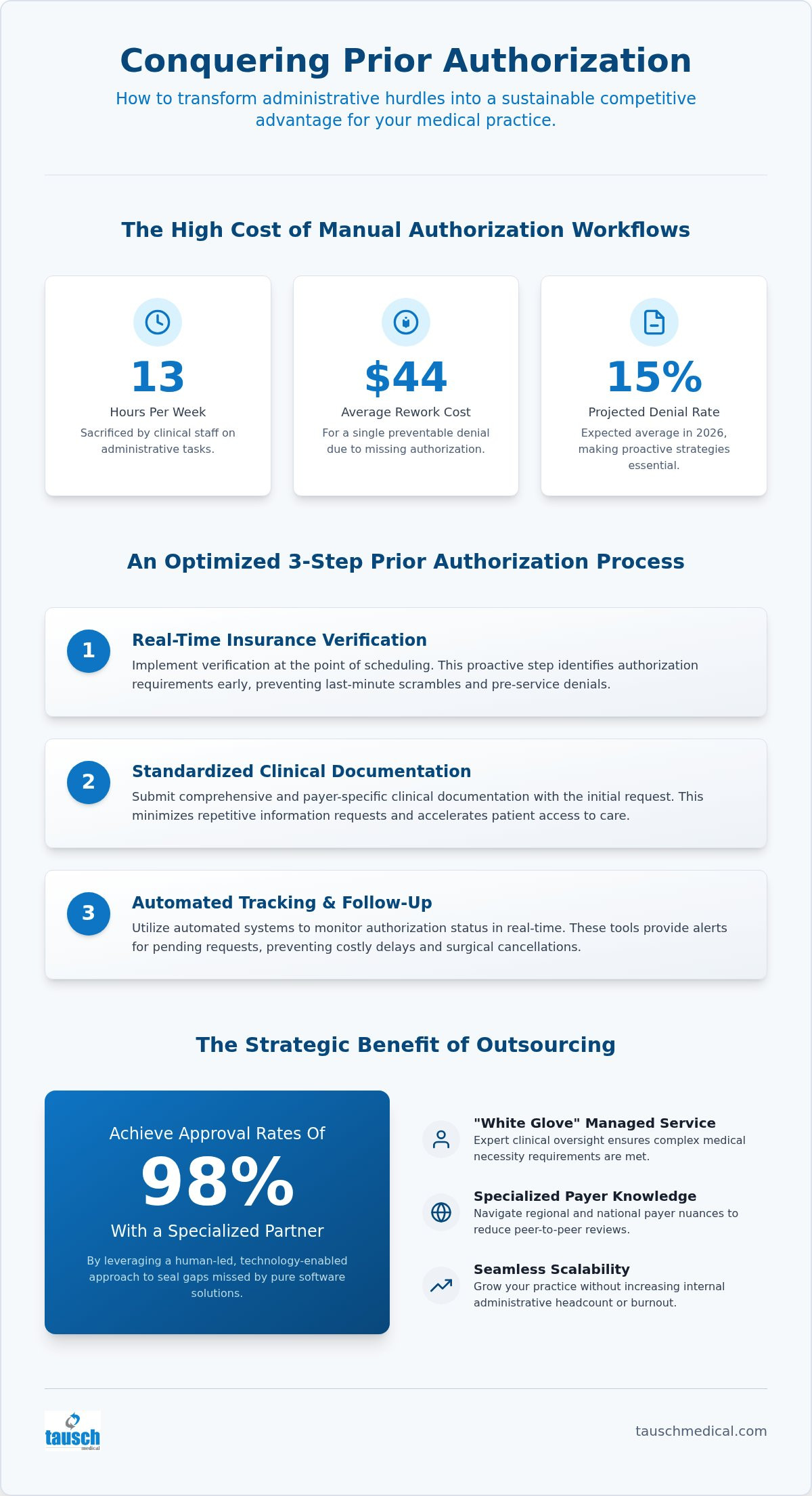
Manual workflows are the primary driver of extended A/R days. A single missing authorization creates a ripple effect that often results in a preventable denial, costing an average of $44 to rework in 2026. Beyond the immediate denial, there's a profound hidden cost. When clinical staff spend 13 hours each week on payer hold lines, they aren't focusing on patient care. This diversion of talent leads to clinical inefficiency and burnout, ultimately slowing the entire revenue cycle. Professional healthcare denial management services eliminate these manual frictions, ensuring that authorizations are secured promptly to keep cash flow consistent.
Optimizing Your Practice’s Prior Authorization Process
Transforming the prior authorization workflow requires a structured, three-step approach that integrates directly with your healthcare denial management services. Efficiency begins with Step 1: implementing real-time insurance verification at the exact point of scheduling. This early identification ensures that requirements are met before clinical resources are allocated, preventing the last-minute scrambles that often lead to claim rejections.
Step 2 focuses on standardizing clinical documentation to satisfy specific payer criteria. Many providers follow the Consensus Statement on Improving the Prior Authorization Process, which advocates for greater transparency and clinical alignment. By submitting comprehensive documentation initially, you significantly reduce the volume of requests for additional information. Finally, Step 3 involves utilizing automated tracking systems. These tools prevent surgical cancellations by alerting staff to pending authorizations. With the average denial rate expected to reach 15% in 2026, these automated safeguards are no longer optional for protecting your practice's revenue.
Leveraging Specialized Payer Knowledge for Faster Approvals
Payer rules aren't universal. Understanding the distinct nuances of Texas-based payers in Houston and Dallas compared to national carriers in New York or Florida is vital for success. Clinical experts who navigate these regional variations can reduce the Peer-to-Peer review burden by anticipating objections before they arise. This level of specialized oversight ensures that initial submissions are robust enough to secure immediate approval. Practices seeking to refine these front-end operations often find that integrating specialized healthcare denial management services through a trusted RCM partner provides the necessary technological and clinical edge.
The Strategic Benefits of Outsourcing Prior Authorization Services
While many platforms promise autonomous AI workflows, the reality of complex medical necessity requires a "White Glove" managed service model. Transitioning to specialized healthcare denial management services ensures that clinical expert oversight seals the gaps that pure software might miss. This human-led, technology-enabled approach allows practices to achieve a 98% approval rate through dedicated outsourcing revenue cycle management. It's about more than just automation; it's about clinical precision in every submission.
Scalability is a critical factor for specialty clinics in high-growth metropolitan areas like Houston, San Antonio, and Atlanta. Outsourcing allows these organizations to expand their patient volume without the financial strain of increasing internal headcount. Additionally, professional partners provide the technical infrastructure needed to meet the January 1, 2027, CMS electronic prior authorization mandate. Adapting to these FHIR-based API requirements early prevents operational disruptions and maintains revenue integrity during the transition.
Enhancing Patient Experience and Provider Satisfaction
Patient loyalty in competitive urban markets often hinges on the speed of care. There's a direct correlation between timely approvals and positive online practice reviews. When patients don't face weeks of uncertainty, their satisfaction scores rise. Internally, removing the authorization burden frees up front-desk staff to focus on patient scheduling and the in-office experience. This shift reduces burnout and allows your team to perform at their highest clinical and administrative potential. Comprehensive healthcare denial management services ultimately foster a more harmonious environment for both patients and providers.
Securing Your Practice's Future in a Shifting Regulatory Landscape
The 2026 healthcare landscape demands a transition from reactive appeals to proactive clinical and financial alignment. Integrating robust healthcare denial management services into your daily workflow protects your practice from revenue leakage associated with unauthorized procedures. We've explored how real-time verification and standardized documentation neutralize bottlenecks while preparing your organization for the 2027 CMS electronic mandates. Tausch Medical provides the specialized expertise and comprehensive RCM integration necessary to reduce administrative burdens in Texas and major US markets. Elevating these standards ensures your focus remains on delivering world-class patient care.
Want to see how Tausch Medical can support your practice with reliable medical billing, prior authorization, eligibility verification, A/R follow-up, and RCM support? Start with our free two-week trial and experience the difference before making a commitment: free trial form
Frequently Asked Questions
What exactly does a prior authorization service cover for specialty practices?
A comprehensive prior authorization service manages the entire lifecycle of approval requests, from initial eligibility verification to final payer confirmation. For specialty practices in Houston and Dallas, this includes reviewing clinical documentation against specific payer criteria to ensure medical necessity is clearly established. These services eliminate the administrative burden on your staff, allowing them to focus on patient care while experts navigate complex authorization requirements.
How long does the typical prior authorization process take in 2026?
Timelines in 2026 depend heavily on the payer's technological adoption. While major carriers like Humana aim to provide decisions on 95% of electronic requests within one business day, manual submissions often still require several days. Specialized services accelerate this timeline by utilizing electronic portals and maintaining direct communication lines with payers in major markets like New York and Atlanta to prevent delays.
Will outsourcing prior authorization integrate with my current EHR system?
Professional outsourcing is designed to complement your existing infrastructure rather than replace it. These services integrate seamlessly with most major EHR systems used by practices in Austin and San Antonio, ensuring that all authorization data and clinical notes remain centralized. This synergy maintains a single source of truth for your patient records while offloading the high-volume administrative tasks to a dedicated team of RCM experts.
How do prior authorization services handle claim denials and appeals?
When a request is rejected, integrated healthcare denial management services immediately trigger a root-cause analysis to identify documentation gaps or coding errors. The team then manages the formal appeal process, including Peer-to-Peer coordination when necessary. This proactive approach ensures that revenue leakage is minimized for providers in Miami and Tampa by addressing denials before they impact the practice's accounts receivable health.
Disclaimer
This article is for general informational purposes only and does not constitute legal, medical, billing, coding, compliance, or financial advice. Healthcare rules, payer policies, and reimbursement guidelines may change and may vary by situation. Please consult qualified professionals or official sources before making decisions based on this content. Tausch Medical is not responsible for any loss or liability arising from reliance on this information.


