


Article by
Dr. Sharafat Hussain Ph.D
Dr. Sharafat Hussain is a healthcare business consultant, entrepreneur, and academic with strong experience in the US healthcare industry. He is the Founder and Managing Director of Tausch Medical, a revenue cycle management company supporting US healthcare providers with medical billing, prior authorization, credentialing, eligibility verification, A/R follow-up, and patient support services. His work combines practical healthcare operations, business strategy, and academic insight to help medical practices improve efficiency, collections, and service quality.
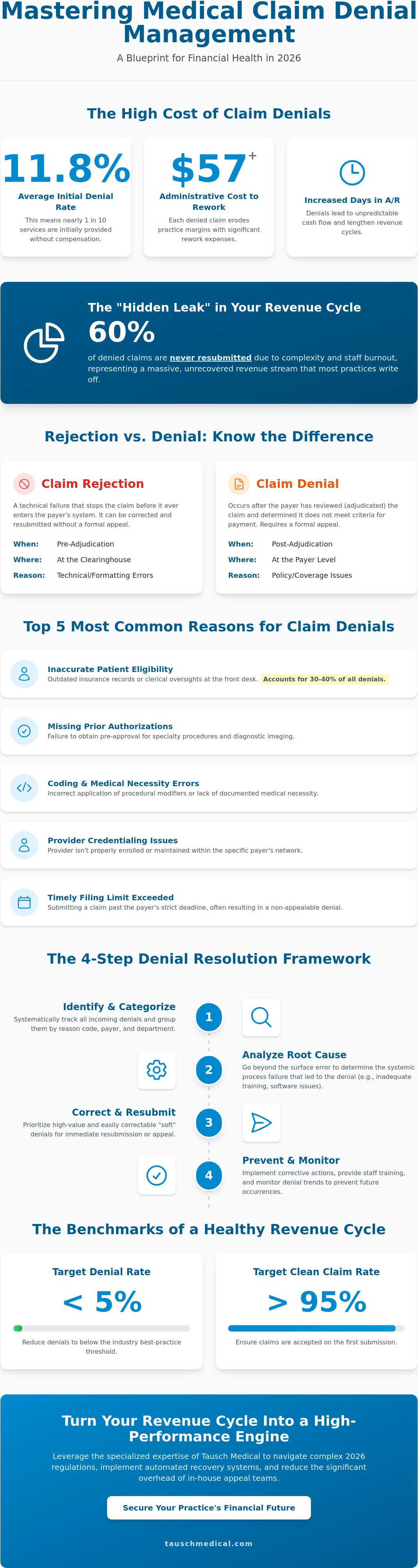
With the average initial claim denial rate climbing to 11.8% in 2026, many premium practices are essentially providing one out of every ten services without compensation. Mastering medical claim denial management is no longer a secondary administrative goal; it's a sophisticated clinical-financial strategy that safeguards your practice's independence and long-term growth. You've likely experienced the exhaustion of managing lagging reimbursements and the high administrative cost of re-working claims, which industry data now places at over $57 per occurrence. It's disheartening to see world-class patient care compromised by the increasing complexity of payer bureaucracy and AI-driven scrutiny.
This guide offers a comprehensive roadmap to transform your financial health, providing the exact methodology needed to reduce your denial rates to under 5% while maximizing your net collection ratios. We'll explore how to leverage the latest CMS-0057-F transparency rules and implement automated recovery systems to ensure your practice remains both profitable and focused on its clinical mission. By the end of this article, you'll understand how to turn your revenue cycle into a predictable, high-performance engine that supports your commitment to excellence.
Key Takeaways
- Distinguish between clearinghouse rejections and payer-level denials to prioritize recovery efforts and streamline your administrative workflow.
- Identify and mitigate the most frequent catalysts for revenue loss, specifically focusing on patient eligibility inaccuracies and neglected prior authorizations.
- Implement a structured four-step framework for medical claim denial management that utilizes root-cause analysis to prevent recurring errors.
- Achieve a "Clean Claim" benchmark of 95% or higher by integrating automated scrubbing technology and enhancing front-office data entry protocols.
- Leverage the specialized expertise of Tausch Medical to navigate complex 2026 regulations and reduce the significant overhead of in-house appeal teams.
What is Medical Claim Denial Management in 2026?
In the current fiscal year, medical claim denial management has evolved from a back-office administrative task into a sophisticated clinical-financial discipline. It's a strategic process designed to investigate, analyze, and resolve insurance claims that payers have adjudicated but refused to reimburse. Unlike simple clerical corrections, modern denial management focuses on identifying the root causes of these failures to prevent their recurrence. This systematic approach is the cornerstone of a healthy Revenue Cycle Management (RCM) system, ensuring that clinical excellence translates directly into financial stability.
The 2026 landscape is defined by unprecedented payer scrutiny. Commercial insurers now deploy advanced AI-powered systems to review and automatically deny claims in milliseconds, often before a human reviewer ever sees the file. For independent practices, this means there's no longer any tolerance for late or imprecise submissions. Understanding the technical distinction between a rejection and a denial is the first step toward recovery. A rejection is a pre-adjudication technical failure, typically occurring at the clearinghouse level, which prevents the claim from even entering the payer's system. A denial, however, occurs after the payer has reviewed the claim and determined it does not meet their specific criteria for payment.
The True Cost of a Denied Claim
The financial impact of a denial extends far beyond the initial lost reimbursement. Direct administrative costs for reworking a single denied claim rose to $57.23 recently, a significant burden that erodes practice margins. Indirectly, these denials trigger unpredictable cash flow and increase your average days in accounts receivable (A/R). Perhaps the most damaging aspect is the "Hidden Leak"; industry data suggests that approximately 60% of denied claims are never resubmitted. This represents a massive, unrecovered revenue stream that most practices simply write off as a cost of doing business, often due to staff burnout and the complexity of payer bureaucracy.
Hard Denials vs. Soft Denials
Effective medical claim denial management requires a clear categorization of data to prioritize recovery efforts. We distinguish between "hard" and "soft" denials to determine where to allocate resources. Hard denials are non-appealable losses, such as services not covered under a patient's specific plan or missed timely filing deadlines, which usually require a financial write-off. Soft denials are temporary rejections caused by correctable issues like missing information or coding errors. By grouping your data by reason code and department, you can identify high-value recovery opportunities and focus your team on the "soft" denials that offer the highest probability of a successful appeal and immediate cash infusion.
The 5 Most Common Reasons for Claim Denials
Successful medical claim denial management begins with a clinical-grade diagnosis of why payments are being withheld. By consulting authoritative insights on denial management, we can see that most revenue leakage isn't caused by clinical failures, but by administrative friction. Even the most prestigious practices often find their cash flow restricted by preventable technicalities that occur long before a claim reaches an adjudicator's desk.
- Inaccurate or incomplete patient eligibility data, often stemming from outdated insurance records or simple clerical oversights.
- Missing or improperly obtained prior authorizations, particularly for high-value specialty procedures involving advanced equipment from IMT Medical Devices and diagnostic imaging.
- Coding errors, including a lack of demonstrated medical necessity or the incorrect application of procedural modifiers.
- Credentialing discrepancies where the provider isn't properly enrolled or maintained within the specific payer's network.
- Administrative hurdles such as duplicate claim submissions or filing past the payer's strict timely filing limits.
Front-End Failures: Verification and Authorization
Revenue integrity starts at the registration desk. Industry analysis shows that front-desk errors account for nearly 30-40% of all denials. Implementing rigorous insurance verification protocols is the most effective way to stop denials before they occur. Real-time eligibility checks eliminate demographic errors by instantly validating coverage details against the payer's database at the point of service. If you find your team is overwhelmed by these manual checks, exploring specialized billing support can provide the necessary relief and precision.
Back-End Bottlenecks: Coding and Credentialing
Precision in the back office is equally critical for long-term financial health. Outdated ICD-10 or CPT codes lead to immediate rejections, as payers constantly update their "black box" denial logic to favor automated rejections. Additionally, many practices suffer from "out-of-network" denials simply because their enrollment paperwork lagged or expired. This is why professional provider credentialing services are essential for maintaining your revenue stream. By identifying patterns in how specific payers deny claims, you can adjust your coding strategies to meet their evolving requirements. Effective medical claim denial management ensures that your technical documentation matches the clinical excellence you provide every day.
The Denial Management Lifecycle: A 4-Step Resolution Framework
To achieve true clinical-financial synergy, a practice must move beyond reactive billing and adopt a structured approach to revenue recovery. A robust medical claim denial management strategy relies on a closed-loop lifecycle that transforms every rejected claim into a valuable data point for operational improvement. This four-step resolution framework ensures that no revenue is left unrecovered due to administrative oversight or payer complexity.
- Step 1: Identification. The process begins by aggregating all Remittance Advice (RA) and Explanation of Benefits (EOB) data. This phase requires a meticulous review of electronic remittance advice (ERA) to flag every claim that didn't result in full payment.
- Step 2: Analysis. Once identified, each denial undergoes a root-cause analysis. We group these claims by department and reason code to determine if the failure originated in patient registration, clinical documentation, or the coding department.
- Step 3: Resolution. This is the action phase where staff members submit corrected claims, file formal appeals, or communicate directly with payer representatives to resolve technical discrepancies.
- Step 4: Prevention. The final, most critical stage involves implementing systemic changes. By analyzing trends, you can update your internal protocols to ensure the same error doesn't repeat in future billing cycles.
By mastering medical claim denial management, you transform your billing department from a cost center into a strategic asset. Adhering to Best Practices for Denials Prevention and Management allows your team to focus on high-value recovery rather than repetitive clerical rework.
Root-Cause Analysis: Finding the 'Why'
Effective analysis requires a deep dive into Claim Adjustment Reason Codes (CARC) to categorize issues with precision. It's essential to distinguish between provider-specific patterns, such as a recurring modifier error, and payer-wide glitches that might indicate a larger systemic issue with the insurer's software. Maintaining a comprehensive "Denial Log" is vital for this process, as it allows you to track recovery rates over time and identify which payers are increasingly utilizing AI to trigger automated denials.
The Appeals Process: Best Practices
When a soft denial occurs, a persuasive appeal letter backed by strong clinical documentation is your most powerful tool. You must clearly demonstrate that the service provided met all clinical evidence standards and payer-specific policies. Success also depends on navigating the strict hierarchy of Level 1, 2, and 3 appeals, each with its own set of evidentiary requirements. For 2026 claims, the timely filing limit is generally 12 months for Medicare Part A and B, though many commercial payers have restricted this window to as few as 90 days from the date of service.
Strategies to Reduce Denials and Improve Cash Flow
To move beyond the 11.8% industry average denial rate, practices must pivot from reactive resolution to proactive prevention. A sophisticated approach to medical claim denial management prioritizes a "Clean Claim" goal of 95% or higher. Achieving this benchmark requires more than just careful coding; it demands a seamless integration of front-end accuracy and back-end precision. One often overlooked strategic gap is the direct link between provider enrollment and claim success. If your credentialing status isn't current within a payer's network, even a perfectly coded claim will trigger an immediate rejection. Standardizing workflows for prior authorization is equally vital, ensuring no clinical service is performed without a verified, valid authorization already documented in the system.
Regularly auditing your medical billing outsourcing partner's performance is another pillar of a healthy revenue cycle. You shouldn't assume that high-volume processing automatically equals high-quality results. A premium partner will welcome transparency, providing detailed reports that correlate denial reasons with specific operational failures. This level of oversight ensures that your external team remains as committed to your practice's financial health as your internal staff.
The Role of Technology and Automation
In 2026, technology acts as the first line of defense in medical claim denial management. Advanced clearinghouse platforms now offer automated scrubbing that catches demographic and technical errors before the claim ever reaches the payer's gateway. AI-driven predictive analytics takes this a step further by identifying claims with a high probability of denial based on historical payer behavior and recent policy shifts. By automating the status-check process, your team can stop wasting hours on hold with insurance companies. Instead, they can focus on high-value recovery tasks that directly impact your bottom line.
Staff Training and Accountability
Human expertise remains the final arbiter of financial success. Creating a robust feedback loop between the billing office and clinical staff ensures that documentation nuances are understood on both sides of the practice. Establishing clear Key Performance Indicators (KPIs), such as keeping "Days in AR" under 35 and maintaining a high Net Collection Rate, fosters a culture of accountability. Continuous education on 2026 coding updates is non-negotiable, as payers frequently adjust their internal logic to capitalize on staff knowledge gaps. If you're ready to optimize your practice's financial performance, our specialized denial management solutions provide the technological edge and expert oversight necessary for long-term growth.
Why Outsource Denial Management to Tausch Medical?
Navigating the intricacies of 2026 reimbursement requires more than just a competent billing clerk; it demands a partner who operates at the intersection of clinical precision and financial strategy. By entrusting your medical claim denial management to Tausch Medical, you gain immediate access to specialized experts who possess a granular understanding of evolving payer rules and the latest CMS regulations. This transition allows your practice to shed the heavy administrative burden and significant overhead costs associated with maintaining an in-house appeal team, which often lacks the specialized training to counter AI-driven payer scrutiny effectively.
Our approach isn't merely about processing paperwork. We provide a level of transparency and advanced reporting that most independent practices struggle to achieve on their own. By integrating our specialized services into your broader Revenue Cycle Management strategy, we ensure that every clinical service is accurately captured, authorized, and reimbursed. This holistic oversight transforms your financial operations from a series of disjointed tasks into a streamlined, high-performance engine.
Recovering Lost Revenue with Expert Intervention
Many practices unintentionally foster a "write-off culture" where claims deemed too complex or time-consuming are simply abandoned. Tausch Medical specializes in identifying these supposedly unrecoverable claims, utilizing a national perspective to recognize payer-wide denial traps that a single-office view might miss. We have the resources and the tenacity to pursue disputes through multiple levels of appeal, ensuring that your clinical work is properly compensated. This expert intervention allows your medical staff to focus exclusively on patient outcomes, while we handle the persistent bureaucracy of payer disputes with clinical-grade precision.
Scaling Your Practice with a Strategic Partner
A partnership with Tausch Medical is designed to facilitate long-term growth by capturing every dollar your practice earns. We don't offer generic templates; instead, we provide customized solutions for insurance verification, authorization, and accounts receivable recovery that align with your specific specialty and patient volume. By eliminating the friction in your billing process, you create the financial stability necessary to invest in new technologies and expand your clinical offerings. It's time to move beyond the unpredictability of lagging reimbursements. Optimize your revenue cycle today with Tausch Medical and secure the financial future your clinical excellence deserves.
Future-Proofing Your Practice’s Financial Success
Mastering medical claim denial management is the defining factor for practices seeking to maintain their clinical independence in an increasingly complex fiscal environment. By moving from reactive firefighting to a structured lifecycle of analysis and prevention, you ensure that every procedure performed is a procedure paid. The transition toward a "Clean Claim" benchmark of 95% or higher is achievable when you combine advanced technological scrubbing with rigorous front-end verification and staff accountability.
Securing your revenue stream requires a partner who understands the nuances of complex AR recovery and offers comprehensive Revenue Cycle Management solutions. Tausch Medical provides the national support for provider credentialing and the specialized expertise needed to navigate the aggressive, AI-driven payer logic of 2026. Capturing every dollar you've earned isn't just a financial necessity; it's the foundation that allows you to continue delivering world-class care without compromise.
Partner with Tausch Medical to eliminate denials and boost your revenue. Your practice’s long-term growth and financial stability are within reach, and we're here to ensure you achieve them.
Frequently Asked Questions
What is the difference between a claim rejection and a claim denial?
A claim rejection is a technical failure that occurs at the clearinghouse level before the payer adjudicates the file. In contrast, a claim denial happens after the payer has processed the claim and found it doesn't meet their specific criteria for payment. Rejections are usually corrected and resubmitted immediately, while denials require a deeper analysis through your medical claim denial management process to resolve effectively.
How much does it cost to rework a denied medical claim in 2026?
The cost to rework a denied claim is substantial, often consuming the entire profit margin of the clinical service provided. Industry data indicates that the administrative labor and overhead required for a single resubmission have increased significantly over the last few years. This financial drain is why a proactive strategy focusing on clean claims is far more sustainable than attempting to recover revenue through manual rework.
What are the most common reason codes for medical claim denials?
Common reason codes often include duplicate submissions, eligibility inaccuracies, and missing prior authorizations. Payers also frequently cite "timely filing exceeded" or "lack of medical necessity" as catalysts for refusing payment. Identifying these codes is the first step in root-cause analysis, allowing your team to address systemic issues in registration or clinical documentation before they impact your net collection ratio.
Can a practice appeal a denial after the timely filing limit has passed?
Appealing a denial after the timely filing limit has passed is exceptionally difficult and usually results in a permanent "hard" denial. Most commercial payers enforce strict windows ranging from 90 to 180 days, while Medicare allows up to 12 months from the date of service. Unless you can prove a payer-side error or an extreme technical glitch, these claims are typically written off as unrecoverable losses.
How can I improve my practice's clean claim rate?
You can improve your practice's clean claim rate by implementing automated scrubbing technology and rigorous front-desk training. Aiming for a benchmark of 95% or higher requires real-time insurance verification at the point of service to eliminate demographic errors. This proactive approach ensures that claims are technically perfect before they reach the payer's gateway, significantly reducing the need for manual intervention later.
Is it better to manage denials in-house or outsource to a medical billing company?
Outsourcing is often the superior choice for practices that want to access specialized expertise without the high overhead of an in-house team. Professional billing companies provide advanced technology and a national perspective on payer trends that are difficult to replicate internally. This allows your clinical staff to focus on patient care while experts manage the complexities of medical claim denial management.
What is a 'soft denial' and how should it be handled?
A soft denial is a temporary rejection that the payer issues because of missing information or minor technical errors. These are typically correctable and have a high probability of being paid upon resubmission or formal appeal. Effective handling involves a quick turnaround to ensure you don't miss the secondary timely filing window, which is often shorter than the initial submission deadline.
How does provider credentialing affect claim denials?
Provider credentialing is a fundamental pillar of revenue integrity; if a provider isn't properly enrolled in a payer's network, all associated claims will be denied as "out-of-network." These denials are often unappealable and lead to immediate revenue loss. Maintaining up-to-date credentialing ensures that your practice remains compliant with payer contracts and avoids these preventable financial setbacks that compromise your cash flow.
Disclaimer
This article is for general informational purposes only and does not constitute legal, medical, billing, coding, compliance, or financial advice. Healthcare rules, payer policies, and reimbursement guidelines may change and may vary by situation. Please consult qualified professionals or official sources before making decisions based on this content. Tausch Medical is not responsible for any loss or liability arising from reliance on this information.


