


Article by
Dr. Sharafat Hussain Ph.D
Dr. Sharafat Hussain is a healthcare business consultant, entrepreneur, and academic with strong experience in the US healthcare industry. He is the Founder and Managing Director of Tausch Medical, a revenue cycle management company supporting US healthcare providers with medical billing, prior authorization, credentialing, eligibility verification, A/R follow-up, and patient support services. His work combines practical healthcare operations, business strategy, and academic insight to help medical practices improve efficiency, collections, and service quality.
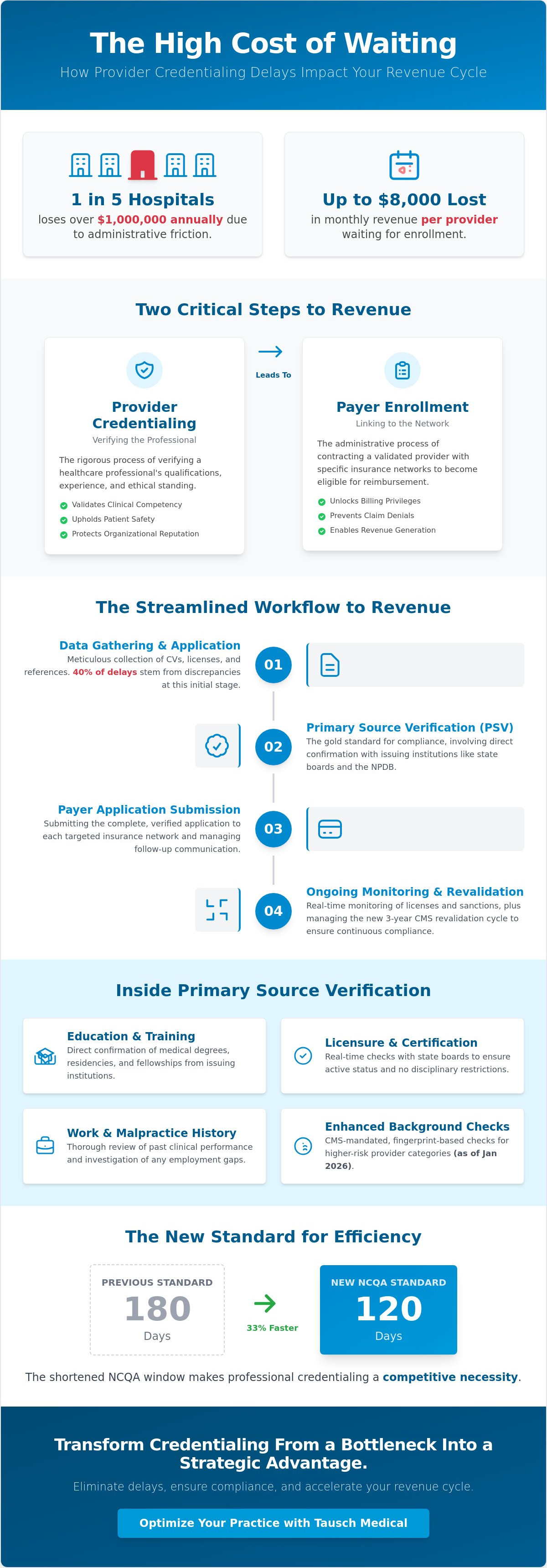
One in five hospitals reports losing over $1 million annually due to delays in provider credentialing. It's a staggering figure that highlights how administrative friction directly impacts the clinical mission. When you consider that a single practice can lose up to $8,000 in monthly revenue for every provider caught in the enrollment backlog, it's clear that expert provider credentialing services are no longer just a back-office task. They're the strategic bedrock of your practice's financial health and long-term stability in 2026.
You likely feel the weight of overwhelming CAQH maintenance and the frustration of waiting months for a payer response while your new hires sit on the sidelines. It's exhausting to watch potential revenue leak away due to documentation discrepancies or shifting regulatory goalposts. This guide will show you how professional credentialing streamlines your entire revenue cycle, ensures 100% compliance with the latest NCQA standards, and finally eliminates those administrative bottlenecks. We'll explore the transition to the new three-year CMS revalidation cycle and how a structured approach creates an accelerated path to revenue for every clinician in your network.
Key Takeaways
- Distinguish between credentialing verification and payer enrollment to eliminate the out-of-network claim denials that disrupt your practice's financial stability.
- Leverage professional provider credentialing services to significantly accelerate speed-to-revenue for new clinical hires and practice expansions.
- Master the Primary Source Verification (PSV) workflow to ensure your organization remains fully compliant with evolving NCQA and payer standards.
- Identify the critical specialty-specific requirements and quality control benchmarks necessary when selecting a premium administrative partner.
- Discover how a unified approach to revenue cycle management transforms credentialing from a manual bottleneck into a strategic business advantage.
What Are Provider Credentialing Services?
At its core, medical credentialing is the rigorous, systematic process of verifying that a healthcare professional possesses the necessary qualifications, clinical experience, and ethical standing to provide care. While it might appear to be a simple collection of documents, provider credentialing services represent a vital layer of risk management that upholds the integrity of the entire clinical environment. By 2026, the industry has shifted away from the "one-and-done" mentality of previous decades. Modern standards now mandate real-time monitoring of provider status, ensuring that any change in licensure or sanctions is identified immediately rather than waiting for a multi-year re-verification cycle. This transition protects the organization's reputation and ensures that patient safety remains uncompromised through continuous clinical oversight.
Credentialing vs. Provider Enrollment
It's common to hear these terms used interchangeably, but they serve distinct functions within the revenue cycle. Credentialing validates the individual's professional identity and clinical competency. Enrollment, on the other hand, is the administrative bridge that links that validated provider to a specific insurance network. You can't secure reimbursement without both. A common misconception is that enrollment happens automatically once a provider is credentialed. In reality, even the most impeccably credentialed specialist cannot bill a payer until the enrollment contract is finalized. This separation is why many practices face revenue leakage; they assume the process is complete when the verification is done, only to find claims denied because the provider wasn't yet "active" in the specific payer's system.
The Core Components of the Verification Process
Precision is non-negotiable. A comprehensive verification involves several layers of primary source checks that leave no room for error. This isn't just about checking boxes; it's about building a foundation of trust. Effective provider credentialing services must include:
- Education and Training: Direct confirmation of medical degrees, residencies, and fellowships from the issuing institutions to prevent fraudulent claims.
- Licensure and Certification: Real-time checks with state boards to ensure active status and the absence of any disciplinary restrictions.
- Malpractice and Work History: A thorough review of past clinical performance, including a deep dive into any employment gaps that could signal professional risks.
- Enhanced Background Checks: As of January 2026, CMS has implemented fingerprint-based checks for higher-risk provider categories, adding another layer of security to the process.
The National Committee for Quality Assurance (NCQA) has recently shortened the credentialing window from 180 to 120 days for accredited organizations. This change makes efficiency a competitive necessity. When these components are handled with clinical precision, the path to reimbursement becomes clear and predictable. It's the difference between a practice that reacts to administrative hurdles and one that operates with the confidence of a world-class institution.
The Step-by-Step Workflow of Professional Credentialing
Executing a flawless credentialing cycle is a high-stakes logistics operation that leaves no room for administrative oversight. The process begins with meticulous information gathering, where every detail of a provider's professional dossier is scrutinized. This includes gap-free CVs, active state licenses, and verified peer references. Research indicates that over 40% of enrollment delays stem from simple documentation discrepancies during this initial phase. By treating this stage with clinical precision, professional provider credentialing services prevent the downstream bottlenecks that lead to revenue disruption.
Primary Source Verification (PSV) Explained
In the medical field, trust must be verified at the source. Primary Source Verification is the gold standard for compliance, requiring direct contact with the original institutions that issued a provider's credentials. This isn't a mere background check. It involves querying the National Practitioner Data Bank (NPDB) and confirming every residency, fellowship, and board certification directly with the granting body. To understand the full scope of these requirements, one can explore the foundational question: What is Provider Credentialing? and how it serves as a shield against liability. PSV protects your practice from audit failures and ensures that your clinical staff meets the rigorous safety benchmarks set by CMS and private payers.
Managing the CAQH ProView Profile
The Council for Affordable Quality Healthcare (CAQH) serves as the central hub for the majority of U.S. insurance payers. While it's designed to streamline applications, it's often the most common point of failure for in-house teams. Profiles require quarterly re-attestation; missing a single deadline can cause a provider to be dropped from multiple networks simultaneously. With the phased implementation of laws like California's AB 1041, which mandates CAQH use for all applications by 2028, maintaining an accurate and re-attested profile is mandatory. Professional services automate these updates, ensuring that your data remains current and your network status remains uninterrupted.
Once the profile is pristine, the focus shifts to payer application submission and relentless follow-up. Since payers are now mandated to process "clean" applications within 30 days, any delay usually points to a documentation error. Ongoing monitoring is equally critical. We track expiration dates for licenses and DEA certifications well in advance, aligning with the new three-year CMS revalidation cycle. If your team is struggling to keep up with these shifting requirements, it's time to consider how premium provider credentialing services can secure your practice's future.
The Strategic Impact: Linking Credentialing to Your Revenue Cycle
Many administrators mistakenly view credentialing as a static, clerical requirement. In reality, it's the financial valve that controls your organization's cash flow. If this valve is constricted by delays or errors, your entire clinical mission suffers. Professional provider credentialing services serve as the essential first step in successful medical billing outsourcing, ensuring that the foundation for reimbursement is secure before a single patient is seen. By treating enrollment as a strategic priority rather than an afterthought, you eliminate the friction that leads to revenue leakage and administrative fatigue.
Preventing Claim Denials Before They Happen
Credentialing-related denials are among the most frustrating causes of revenue loss because they're entirely preventable. When a provider sees patients during a "hold" period before their enrollment is finalized, the practice essentially provides free care. Nearly one in three practices reports that their revenue has been disrupted by issues specifically related to the enrollment process. Adhering to the latest NCQA Credentialing Standards is no longer optional; it's a proactive revenue cycle management tool. Integrated provider credentialing services identify these risks in real-time, preventing "out-of-network" claim rejections that can take months to appeal and resolve.
Accelerating Provider Onboarding
The relationship between onboarding speed and a provider's "speed-to-revenue" is direct and measurable. While the average industry timeline for payer enrollment can stretch between 90 and 180 days, an optimized professional workflow utilizes parallel processing to shorten this window significantly. Consider the financial stakes. A high-volume specialist can lose an average of $6,000 to $8,000 in revenue for every month they remain uncredentialed. A 30-day delay isn't just an administrative annoyance; it's a substantial hit to your practice's bottom line. By outsourcing these tasks, you free your clinical staff from the burden of "paper-pushing," allowing them to focus exclusively on patient outcomes while we handle the complex submissions and rigorous payer follow-ups required to get them active in the system.
Reducing this administrative burden doesn't just save money. It preserves the professional morale of your clinical team. When a new hire can begin generating revenue and seeing patients immediately, the return on investment for that provider is realized much faster. This level of operational excellence is what defines a premium medical practice in 2026, turning a complex regulatory necessity into a distinct competitive advantage.
What to Look for in a Credentialing Partner
Selecting a partner for provider credentialing services is a high-stakes decision that impacts every facet of your clinical operations. It requires a balance of technological sophistication and deep regulatory knowledge. In an era where 43% of provider groups struggle with fragmented systems, your partner should offer a unified strategy that bridges the gap between administrative tasks and clinical excellence. World-class support isn't just about processing forms; it's about ensuring your practice remains agile in a shifting regulatory landscape.
NCQA-compliant workflows are the non-negotiable baseline for any serious partnership. With the shortened 120-day credentialing window now in effect for accredited organizations, your partner must demonstrate a track record of meeting these accelerated timelines without sacrificing clinical precision. You should expect transparent, real-time reporting that provides a clear view of every application's status. This level of visibility eliminates the "black box" of traditional administration, allowing you to project revenue with confidence. A premium partner also understands that credentialing is the foundation of your entire Revenue Cycle Management (RCM), ensuring that every verified provider is positioned for immediate, successful billing.
Technology vs. Human Expertise
AI automation has made significant strides in data entry, but it cannot solve the complex payer enrollment issues that arise from nuanced work histories or documentation gaps. While 32% of practices use three or more systems to manage this data, the real value lies in a "human-in-the-loop" approach. Expert advocates can navigate the idiosyncrasies of payer committees and resolve the documentation discrepancies that cause 40% of enrollment delays. Choosing a partner that balances tech-efficiency with expert human advocacy ensures that your providers aren't just data points, but active, revenue-generating members of your network.
Specialty Expertise and Payer Mix Knowledge
Your partner must possess a deep understanding of the specific requirements of Medicare and Medicaid alongside private payer networks. For instance, the Medicare enrollment application fee for organizations in 2026 is $750, and missing a detail in this high-stakes submission can lead to costly restarts. Navigating the unique hurdles of niche specialties, such as behavioral health or complex surgery, requires more than a generalist's touch. It requires established relationships with national payer networks and a mastery of the new three-year CMS revalidation cycle. If you're ready to move beyond administrative "paper-pushing" and secure your practice's financial future, explore how our provider credentialing services can transform your operations.
US-based support remains a critical factor for success. Dealing with complex state medical board actions or SAM.gov screenings requires a team that understands the domestic healthcare environment intimately. When your partner operates as an extension of your own clinical team, they provide the security and reliability needed to maintain 100% compliance. This commitment to excellence is what distinguishes a mere vendor from a true strategic partner.
Optimizing Your Practice with Tausch Medical
Operational excellence in 2026 requires more than just keeping pace with administrative demands; it requires a partner that anticipates them. Tausch Medical doesn't treat provider credentialing services as a standalone clerical function. Instead, we integrate this vital process into a comprehensive Revenue Cycle Management (RCM) strategy designed for high-growth organizations. By aligning our verification protocols with the most stringent global standards, we ensure that your practice remains a leader in clinical excellence while maintaining an uninterrupted flow of revenue. Precision is our signature, and premium administrative support is the vehicle through which we deliver it.
One of the most significant advantages of outsourcing to Tausch Medical is the immediate reduction of "hidden costs" associated with administrative turnover. Managing credentialing in-house often leads to a cycle of training and re-training staff, where a single departure can result in missed deadlines and expired certifications. These errors are costly. When you consider that documentation discrepancies cause 40% of all enrollment delays, the value of expert-led verification becomes clear. We provide a stable, expert-led environment that eliminates the risks of internal instability, allowing your team to focus on the clinical mission while we handle the complex logistics of payer relations.
A Partnership Focused on Growth
We view ourselves as a strategic extension of your practice rather than a mere service provider. Our team takes on the heavy lifting of continuous monitoring, specifically managing the new three-year CMS revalidation cycle and real-time license tracking. This proactive approach ensures that your providers never face "network drops" due to administrative oversight. The peace of mind that comes from 100% compliance allows you to scale your operations with confidence. We don't just react to changes in the regulatory environment; we prepare your practice to thrive within them, ensuring every new hire is revenue-ready from day one.
Get Started with a Revenue Consultation
Every practice has a unique footprint, and a generic approach to administration won't suffice. We begin by assessing your current credentialing health and identifying the specific revenue gaps that might be slowing your growth. Whether you're managing a niche surgical group or a large behavioral health network, we customize a service plan that fits your provider volume and payer mix perfectly. This assessment is the first step toward reclaiming the thousands of dollars lost each month to enrollment friction. If you're ready to experience the Tausch Advantage, Contact Tausch Medical for a professional credentialing assessment and take the first step toward a more resilient, profitable future.
Securing Your Practice's Financial Future
The healthcare landscape of 2026 leaves no room for administrative delays or documentation errors. Expert provider credentialing services have evolved into a primary mechanism for preventing revenue leakage and ensuring clinical continuity across your entire organization. By shifting from a reactive mindset to a proactive, strategic model, your practice can finally eliminate the "hold" periods that drain resources and frustrate your clinical team. Success today requires more than just submitting forms; it demands NCQA-compliant workflows and the clinical precision of dedicated US-based account specialists who understand the nuances of your specific specialty.
When you integrate these complex processes with broader RCM and billing expertise, you transform a regulatory requirement into a distinct competitive advantage. You don't have to navigate shifting payer standards or overwhelming CAQH maintenance alone. Streamline your practice with Tausch Medical's credentialing services and experience the security that comes from expert advocacy and zero missed deadlines. Your focus belongs on patient outcomes while we secure the foundation of your revenue cycle. Let's build a more resilient and profitable future for your practice together.
Frequently Asked Questions
How long does the provider credentialing process typically take?
The average timeline for provider credentialing ranges from 60 to 180 days, depending on the complexity of the provider's history and specific payer requirements. While CMS and NCQA now mandate that payers process "clean" applications within 30 days, the initial verification and documentation gathering phases often extend the total duration. Starting the process at least four months before a provider's start date is essential to avoid revenue disruptions.
What is the difference between credentialing and privileging?
Credentialing is the systematic process of verifying a provider's professional qualifications, education, and clinical history to ensure they meet established standards. Privileging, however, is the formal authorization granted by a specific healthcare facility allowing that provider to perform certain clinical procedures. Credentialing validates the individual's competency, while privileging defines their specific scope of practice within your clinical setting.
Why do insurance companies require re-credentialing every few years?
Insurance companies require re-credentialing to ensure that every provider in their network maintains active licensure and continues to meet safety and quality benchmarks. Effective January 1, 2026, CMS has reduced the revalidation cycle from five years to three years for certain specialties. This shift emphasizes the need for continuous monitoring of sanctions and license status rather than relying on periodic, multi-year checks.
Can a provider see patients while their credentialing is still pending?
A provider can technically see patients while their credentialing is pending, but your practice cannot bill most insurance payers for those services. Claims submitted during this "hold" period are typically denied as out-of-network, leading to significant revenue leakage. Since a practice can lose up to $8,000 per month for every uncredentialed provider, it's financially prudent to wait for enrollment confirmation before scheduling patients.
What documents are required to start the medical credentialing process?
How does outsourcing credentialing improve a practice's cash flow?
Outsourcing improves cash flow by significantly accelerating the "speed-to-revenue" for new clinical hires and reducing the administrative burden on your internal staff. By utilizing professional provider credentialing services, you eliminate the "black box" of payer follow-ups and ensure 100% compliance. This proactive approach prevents the costly claim denials and network drops that frequently disrupt the financial health of smaller practices.
What is CAQH and why is it important for my practice?
CAQH is a national standardized database that allows providers to share their credentialing information with multiple insurance payers through a single portal. It's critical because it streamlines the application process and is becoming a legal requirement in states like California. However, failing to complete the mandatory quarterly re-attestation can lead to immediate network termination, making diligent CAQH profile management a top priority for your administrative team.
Does Tausch Medical handle credentialing for all medical specialties?
Tausch Medical provides expert-led credentialing support for a wide range of medical specialties, from behavioral health to complex surgical disciplines. Our team understands the unique documentation hurdles and specific payer mix requirements for each niche, ensuring a premium administrative experience. We act as a strategic extension of your practice, providing the world-class support needed to navigate the evolving regulatory landscape of 2026 with confidence.
Disclaimer
This article is for general informational purposes only and does not constitute legal, medical, billing, coding, compliance, or financial advice. Healthcare rules, payer policies, and reimbursement guidelines may change and may vary by situation. Please consult qualified professionals or official sources before making decisions based on this content. Tausch Medical is not responsible for any loss or liability arising from reliance on this information.


