


Article by
Dr. Sharafat Hussain Ph.D
Dr. Sharafat Hussain is a healthcare business consultant, entrepreneur, and academic with strong experience in the US healthcare industry. He is the Founder and Managing Director of Tausch Medical, a revenue cycle management company supporting US healthcare providers with medical billing, prior authorization, credentialing, eligibility verification, A/R follow-up, and patient support services. His work combines practical healthcare operations, business strategy, and academic insight to help medical practices improve efficiency, collections, and service quality.
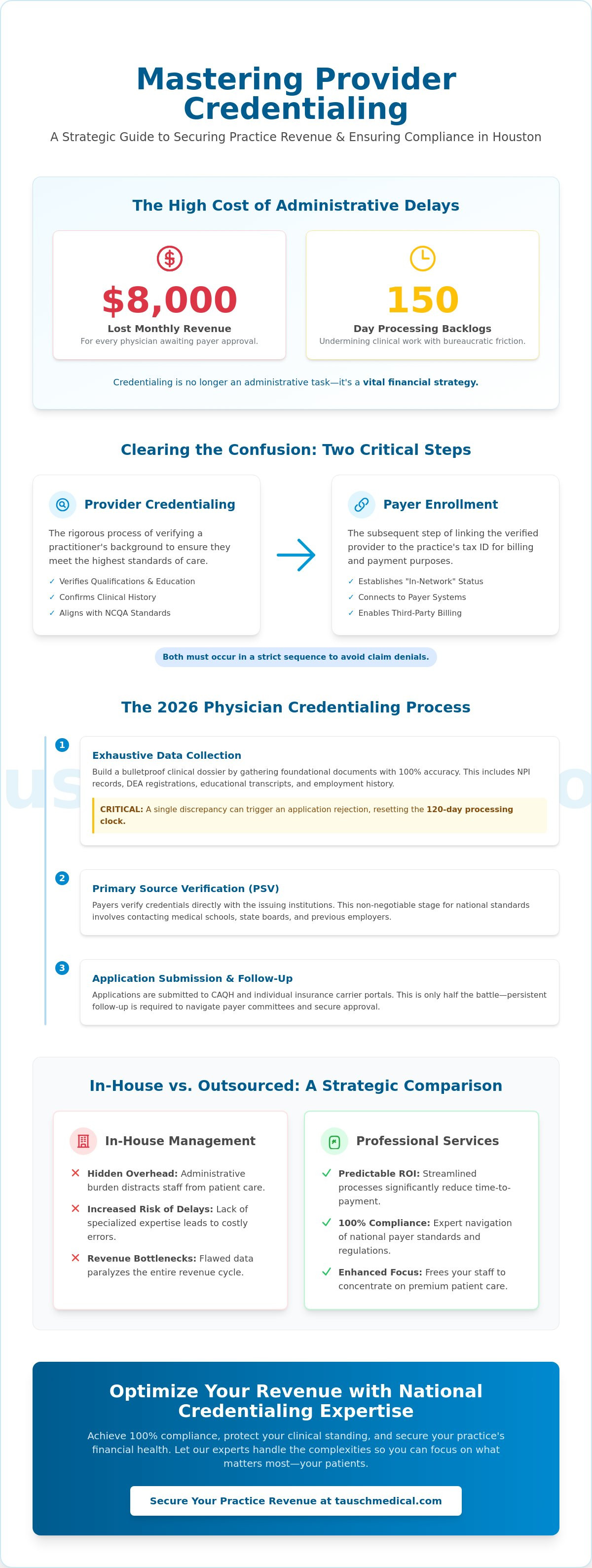
A single medical practice can lose up to $8,000 in monthly revenue for every physician waiting on payer approval, a staggering figure that underscores why provider credentialing Houston is no longer just an administrative task, but a vital financial strategy. You likely feel the mounting pressure of 150-day processing backlogs and the increasing complexity of Texas regulations, such as the DOCTOR Act and the recent CE Broker mandates. The pursuit of clinical precision shouldn't be undermined by the friction of bureaucratic delays, yet many providers find themselves seeing patients without a clear path to reimbursement.
We promise to help you master the intricacies of physician enrollment and payer credentialing to secure your practice revenue and clinical standing. By following this strategic reference, you'll learn how to achieve 100% compliance with national payer standards and significantly reduce the time it takes to get paid. We'll explore the latest 2026 regulatory updates and provide actionable insights into streamlining your operations so your staff can focus on premium patient care rather than chasing insurance companies.
Key Takeaways
- Understand how credentialing acts as the strategic foundation for your practice's financial health and ability to bill third-party payers.
- Master the specific 2026 provider credentialing Houston requirements, including the rigorous standards for primary source verification and data collection.
- Evaluate the hidden overhead of in-house administrative management against the predictable ROI of professional credentialing services.
- Pinpoint the essential traits of a high-performance partner who offers comprehensive support for both commercial and government insurance programs.
- Discover how achieving 100% compliance with national payer standards protects your clinical standing and secures long-term revenue.
The Strategic Impact of Provider Credentialing in Houston Healthcare
In the sophisticated ecosystem of modern medicine, professional excellence alone isn't enough to sustain a thriving practice. At its core, What is provider credentialing? It's the rigorous, formal process of verifying a practitioner's qualifications, education, and clinical history to ensure they meet the highest standards of care. For medical groups, provider credentialing Houston represents more than a compliance checklist; it is the strategic foundation of financial viability. Without precise verification, a practice's ability to bill third-party payers is effectively paralyzed. This process ensures alignment with National Committee for Quality Assurance (NCQA) standards, shielding your organization from liability while cementing your reputation for clinical excellence.
Market access in Houston's dense medical landscape depends entirely on your "in-network" status. Patients increasingly prioritize providers who accept their insurance, making credentialing a competitive necessity. If your credentials aren't current or verified with uncompromising accuracy, you aren't just losing a patient; you're losing market share to competitors who've prioritized administrative readiness. A proactive approach transforms this bureaucratic hurdle into a distinct business advantage that protects your clinical standing.
Credentialing vs. Payer Enrollment: Clearing the Confusion
Many administrators mistakenly use these terms interchangeably, yet they serve distinct functions within the revenue cycle. Credentialing verifies the individual doctor's history and competency. Enrollment is the subsequent step that links that verified provider to your practice's tax ID for payment purposes. Both must occur in a strict sequence to avoid the friction of "out-of-network" claim denials. A valid medical license is merely the entry point; it doesn't grant automatic insurance participation. Relying on licensing alone is a common misconception that results in months of lost revenue.
The Financial Consequences of Credentialing Delays
The "cost of vacancy" for a new provider is a silent profit killer. Verified data from 2026 indicates that healthcare practices can lose between $6,000 and $8,000 in monthly revenue for each physician waiting on their credentialing to be completed. These delays bloat your accounts receivable and heighten the risk of retroactive denials, where payers refuse to cover services rendered before the official approval date. Long-term success in medical billing outsourcing depends on this clean data. If the provider credentialing Houston process is flawed, the entire revenue cycle suffers, creating a bottleneck that even the most advanced billing software cannot resolve.
The 2026 Physician Credentialing Process: A Step-by-Step Reference
Achieving 100% accuracy during the 2026 physician credentialing cycle requires a meticulous approach to data integrity. For provider credentialing Houston, the journey begins with an exhaustive collection of foundational documents, including National Provider Identifier (NPI) records, Drug Enforcement Administration (DEA) registrations, and official educational transcripts. Even a minor discrepancy in employment dates or a missing board certification can trigger an immediate application rejection, resetting the 120-day processing clock. This initial phase is about more than gathering papers; it's about building a bulletproof clinical dossier that satisfies the scrutiny of payer committees from the outset.
Once the data is centralized, the process moves into Primary Source Verification (PSV). This stage is non-negotiable for national payer standards. Payers don't just look at a copy of a diploma; they contact the medical school directly. This rigorous confirmation extends to previous employers, state boards, and residency programs. Because of the technical burden involved, many practices weigh the benefits of In-house vs. outsourced credentialing to ensure these verifications are handled with the necessary speed and clinical precision.
Submitting the application is only half the battle. Applications are uploaded to the Council for Affordable Quality Healthcare (CAQH) and specific insurance carrier portals. However, the "nudge" phase is where many applications stall. Professional services maintain continuous communication with payer committees, proactively addressing questions before they become formal denials. If you find your administrative staff overwhelmed by these technical hurdles, exploring a specialized credentialing partner can restore focus to patient care and long-term business success.
The CAQH ProView Standard
CAQH ProView is the industry standard for credentialing data management. Maintaining a current profile is essential, yet many practices overlook the quarterly re-attestation requirements. To keep a profile in "current" status, you need a precise checklist: updated malpractice face sheets, current state licenses, and recent board certifications. Failure to re-attest can lead to immediate suspension of insurance payments, even for established providers who have been in the network for years.
Primary Source Verification (PSV) Requirements
PSV is the gold standard for clinical safety and regulatory compliance. It involves direct contact with medical schools and licensing boards to confirm a provider's history. A critical component of this arc is the National Practitioner Data Bank (NPDB). Payers query the NPDB to check for any history of malpractice payments or adverse actions. In 2026, payers have tightened scrutiny, now requiring explanations for employment gaps longer than 30 days. This level of detail ensures provider credentialing Houston remains compliant with evolving federal and state regulations.
In-House vs. Outsourced Credentialing: A Strategic Comparison
Choosing between maintaining an internal administrative team and partnering with an external specialist is a defining decision for any growing practice. While an in-house approach might seem cost-effective on the surface, the hidden overhead of training, software licensing, and inevitable human error often outweighs the predictable flat fee of a professional service. In the context of provider credentialing Houston, the expertise gap is particularly pronounced. General office managers, though highly capable, are often stretched thin across scheduling and patient relations. They rarely possess the granular knowledge required to navigate the 2026 shifts in Texas medical board rules or the intricacies of continuous monitoring mandates. This lack of specialization creates a fragile system where a single missing document can stall your revenue for months.
Professional firms bring a technology advantage that most individual practices cannot replicate. Advanced tracking software monitors expiration dates for licenses, DEAs, and malpractice insurance with clinical precision. This automated vigilance prevents the "dropped" contracts that occur when a re-credentialing deadline is missed. Beyond technology, outsourcing provides essential continuity. If your primary in-house credentialer leaves, your entire application pipeline usually grinds to a halt. A professional partner ensures that your provider credentialing Houston efforts remain uninterrupted, protecting your market access regardless of internal staff turnover.
Evaluating the Return on Investment (ROI)
Reducing the credentialing window by just 30 days can effectively pay for the service itself by unlocking thousands in billable revenue sooner. When you utilize specialized provider credentialing services, your front-office staff is liberated from the burden of paperwork. This shift allows them to focus on premium patient experiences and clinical support, which are the true drivers of practice growth. The opportunity cost of having a high-value employee chase insurance adjusters is a strategic drain that sophisticated medical groups simply don't accept.
Common Pitfalls of DIY Credentialing
Inconsistent data remains the leading cause of application rejection. Payers now require explanations for employment gaps as short as 30 days, a level of detail that DIY efforts often overlook. Missed re-credentialing deadlines can lead to immediate termination of insurance contracts, forcing you to turn away loyal patients. Navigating the PECOS system for Medicare enrollment is notoriously difficult for those without specialized experience. Without the steady hand of a professional, these technical hurdles often lead to preventable financial losses and administrative exhaustion.
Critical Selection Criteria for a Credentialing Partner
Selecting a partner for provider credentialing Houston is a high-stakes decision that dictates your practice's market accessibility and financial trajectory. In a landscape where CMS has reduced revalidation cycles to three years for certain specialties and Texas continues to implement rigorous mandates like the 2026 CE Broker reporting, a generalist approach is no longer sufficient. You must prioritize firms with deep, documented experience in both major commercial payers and complex government programs. A partner's ability to navigate the nuances of Texas Medicaid alongside national carriers like Blue Cross Blue Shield of Texas ensures that your revenue streams remain diverse and resilient. Uncompromising accuracy in these initial stages prevents the administrative friction that leads to long-term claim denials.
Transparency is the hallmark of a premium service provider. You should demand real-time reporting that allows you to track the status of every application as it moves through the payer committee pipeline. This visibility eliminates the "black hole" of traditional credentialing, where practices are left guessing about their enrollment status. Furthermore, verify that the partner provides comprehensive, end-to-end support. This includes not just the initial application, but the continuous monitoring and re-attestation required to maintain "in-network" status. A partner who understands the specific regulatory environment of the Houston healthcare market can proactively address local payer trends before they impact your bottom line.
Technical Proficiency and Software Integration
Modern credentialing requires more than just spreadsheets; it demands sophisticated technology. Inquire if a potential partner uses automated tracking systems to monitor license, DEA, and malpractice insurance expirations. This clinical precision prevents the catastrophic "dropped" contracts discussed in previous sections. The ability to integrate credentialing data directly with your existing EHR or billing software is a vital efficiency. To ensure accountability, insist on a dedicated account manager who serves as your single point of professional contact, bridging the gap between technical data and clinical application.
Payer Relationship Management
Established relationships with major carriers provide a distinct competitive advantage. A partner with a direct line to provider relations departments at UnitedHealthcare or Cigna can often navigate "closed" panels that appear inaccessible to the uninitiated. They understand the specific language required to appeal for network entry based on community need or specialty scarcity. This expertise is especially critical for practices expanding into telehealth or multi-state operations, where credentialing requirements vary significantly by jurisdiction. If you're ready to elevate your practice's administrative standards, it's time to partner with a professional credentialing service that prioritizes your clinical and financial success.
Optimizing Revenue with Tausch Medicals National Credentialing Expertise
Tausch Medical stands at the intersection of clinical excellence and administrative mastery. We offer comprehensive provider credentialing services that treat data accuracy with the same rigor a surgeon applies to a delicate procedure. Our "clinical precision" approach ensures that every application is audited for consistency and compliance before it ever reaches a payer's desk. This proactive scrutiny is why we remain a trusted partner for provider credentialing Houston, helping practices avoid the $8,000 monthly revenue losses identified earlier in this reference. We don't just process paperwork; we build a secure foundation for your practice's financial health.
True financial optimization requires more than just submitting forms. It demands a significant reduction in the time-to-enrollment window to accelerate practice cash flow. Our expertise doesn't exist in a vacuum; it dovetails perfectly with our full-suite medical billing and revenue cycle management (RCM) solutions. By aligning your credentialing data with your billing infrastructure, we eliminate the friction points that typically cause claim denials. This holistic view of the revenue cycle ensures that once a provider is credentialed, the path to reimbursement is clear, unobstructed, and fully compliant with national standards.
The Tausch Advantage: Beyond the Application
We provide a "white-glove" experience that respects the limited time of busy physicians and their clinical teams. Our proactive maintenance schedule uses automated tracking to prevent credentialing lapses before they occur, ensuring that your "in-network" status never wavers. While we are a leading choice for provider credentialing Houston, our reach is national. We support providers across the United States with the same level of premium, personalized service. This scale allows us to bring global best practices and technological superiority to your local facility, ensuring you remain at the forefront of administrative efficiency.
Taking the Next Step Toward Practice Growth
Onboarding with Tausch Medical is designed to be seamless and dignified. We take the administrative burden off your front desk immediately, allowing your team to focus on premium patient outcomes rather than bureaucratic hurdles. We invite you to schedule a consultation to audit your current credentialing status and discover how a strategic partnership can protect your clinical reputation and market access. Don't let preventable delays dictate your financial future. Contact Tausch Medical to streamline your provider credentialing today.
Securing Your Practice's Financial Future
The shift toward continuous monitoring and the rigorous verification standards of 2026 means that administrative errors are now more costly than ever before. We've established that mastering provider credentialing Houston is a vital financial lever for reducing time-to-reimbursement and protecting your clinical standing in a highly competitive medical landscape. By moving beyond the inherent risks and turnover associated with in-house management, you can bridge the expertise gap and ensure your practice remains fully compliant with both national payer standards and the latest Texas regulatory mandates.
Tausch Medical offers a decade of experience in complex medical billing workflows, providing a strategic foundation for your long-term growth. Our dedicated account managers deliver the clinical precision and white-glove support your organization deserves, backed by comprehensive RCM integration that streamlines your entire revenue cycle. Secure your revenue—partner with Tausch Medical for professional credentialing. We're ready to help you transform your administrative challenges into a sustainable competitive advantage that lets you focus on what matters most: your patients.
Frequently Asked Questions
How long does the provider credentialing process typically take?
The credentialing process generally takes between 60 and 120 days to complete from the date of submission. However; due to increased scrutiny and new regulatory requirements in 2026, some payers are experiencing processing backlogs that can extend these timelines to 150 days. Starting the application early is essential to ensure your practice remains on schedule for its clinical and financial goals.
What is the difference between credentialing and payer enrollment?
Credentialing is the formal process of verifying a physician's clinical history and qualifications; while payer enrollment is the administrative step that links a verified provider to your practice's tax ID. You must complete credentialing first to prove the provider's competency before an insurance carrier will assign a provider number for billing. Skipping the sequence often results in immediate claim denials.
Why is CAQH profile maintenance critical for Houston providers?
CAQH ProView is the universal industry standard used by nearly all national and local insurance carriers to access provider data. For those managing provider credentialing Houston, failing to complete the required quarterly re-attestation can lead to an immediate suspension of insurance payments. Keeping this profile current with updated malpractice face sheets and licenses is a non-negotiable requirement for clinical continuity.
How do credentialing delays impact medical practice revenue?
Delays in the credentialing cycle can cause a practice to lose between $6,000 and $8,000 in monthly revenue for every provider waiting on approval. These bottlenecks lead to a significant increase in accounts receivable and prevent new physicians from seeing insured patients. Without a proactive strategy, these administrative pauses can destabilize a practice's cash flow for an entire fiscal quarter.
What documents are required for the initial credentialing application?
A complete application requires a National Provider Identifier (NPI), current DEA registration, and official medical school transcripts. You must also provide a current state medical license; board certifications; and a comprehensive work history that explains any employment gaps longer than 30 days. Collecting these documents with clinical precision at the start prevents the "nudge" phase from becoming a source of friction later.
Can a national credentialing service handle local Texas payer networks?
A premier national service possesses the technical infrastructure to navigate both broad national carriers and specific Texas-based networks. Success in provider credentialing Houston requires an intimate understanding of local mandates; such as the DOCTOR Act and the Texas Medical Board's latest rules. A national partner with a localized expertise provides the most resilient defense against shifting state regulations.
How often do providers need to be re-credentialed by insurance carriers?
Most commercial insurance carriers require re-credentialing every two to three years to maintain active network status. It's important to note that as of January 2026; CMS has reduced the revalidation cycle from five years to three years for several specialties. Continuous monitoring of these dates is vital to prevent a provider from being "dropped" from a lucrative payer contract.
What happens if a provider sees a patient before their credentialing is finalized?
If a provider renders services before their credentialing is finalized; the insurance carrier will typically deny the claim or process it at an out-of-network rate. Most payers do not offer retroactive reimbursement for services provided before the effective date of the contract. Seeing patients prematurely often results in uncollectible revenue and administrative exhaustion for your billing team.
Disclaimer
This article is for general informational purposes only and does not constitute legal, medical, billing, coding, compliance, or financial advice. Healthcare rules, payer policies, and reimbursement guidelines may change and may vary by situation. Please consult qualified professionals or official sources before making decisions based on this content. Tausch Medical is not responsible for any loss or liability arising from reliance on this information.


