


Article by
Dr. Sharafat Hussain Ph.D
Dr. Sharafat Hussain is a healthcare business consultant, entrepreneur, and academic with strong experience in the US healthcare industry. He is the Founder and Managing Director of Tausch Medical, a revenue cycle management company supporting US healthcare providers with medical billing, prior authorization, credentialing, eligibility verification, A/R follow-up, and patient support services. His work combines practical healthcare operations, business strategy, and academic insight to help medical practices improve efficiency, collections, and service quality.
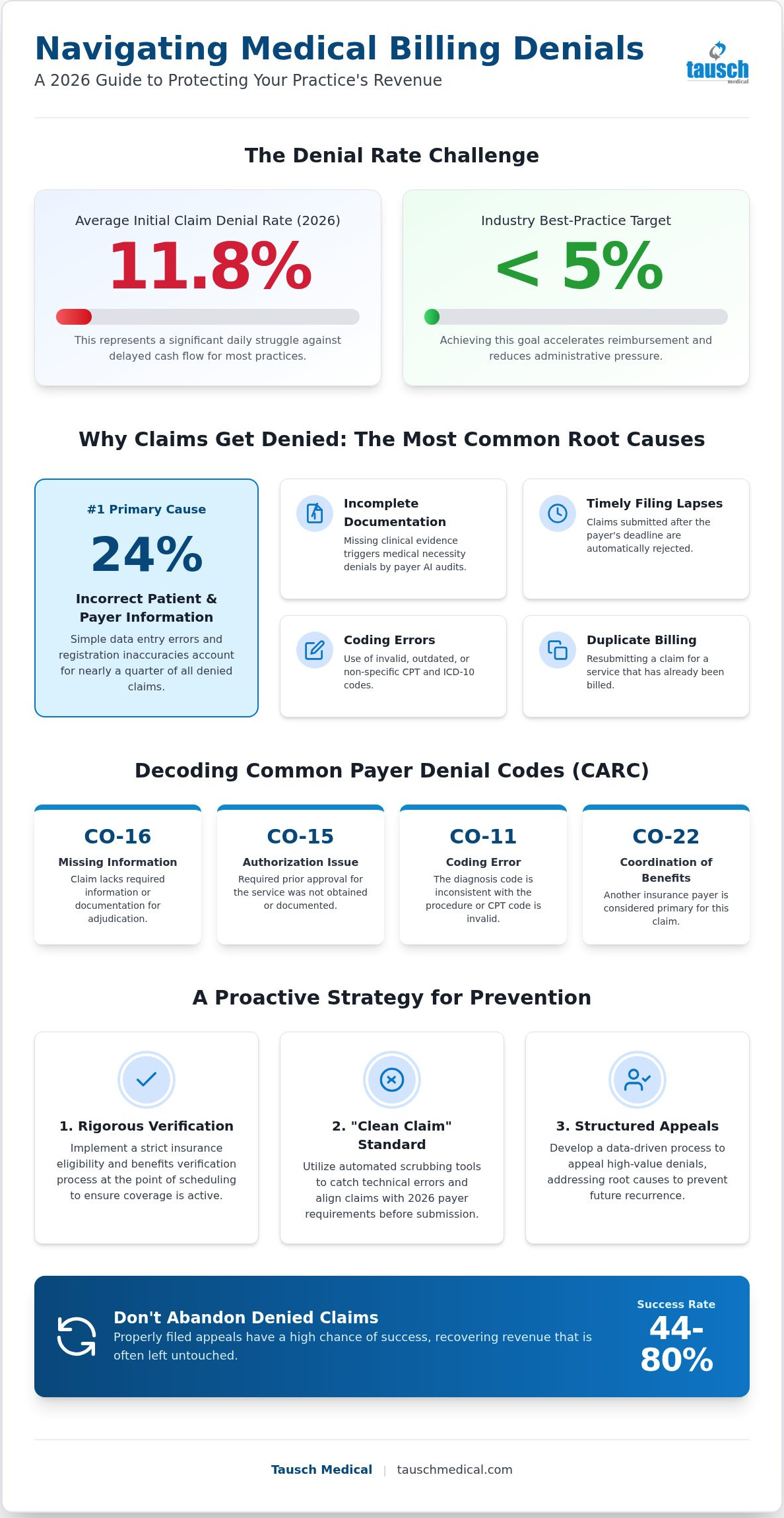
Did you know that the average initial claim denial rate in the United States has climbed to approximately 11.8% in 2026? For many healthcare providers, this isn't just a statistic. It's a daily struggle against rising administrative costs and delayed cash flow that hampers clinical growth. Understanding the common reasons for medical billing denials is the first step toward reclaiming your practice's financial stability. Whether the issue stems from registration errors or the new 2026 CMS efficiency adjustments, these obstacles shouldn't dictate your operational success.
You've likely felt the burden of evolving payer rules and the complexity of updated CPT codes for telehealth and remote monitoring. This guide will help you identify these root causes and implement expert-led strategies to safeguard your cash flow throughout 2026. We'll provide a comprehensive roadmap to achieving denial rates below 5%, accelerating your reimbursement cycles, and reducing the administrative pressure on your dedicated staff.
Key Takeaways
- Identify the most common reasons for medical billing denials, such as registration inaccuracies and documentation gaps, to stop revenue leakage at the source.
- Implement a rigorous insurance eligibility verification process during scheduling to ensure every patient encounter is financially viable from the start.
- Establish a "clean claim" standard by utilizing automated scrubbing tools that align with complex 2026 payer requirements before submission.
- Develop a structured, data-driven appeal process that prioritizes high-value claims and utilizes specialized accounts receivable management to reduce days in A/R.
The Most Common Reasons for Medical Billing Denials in 2026
Administrative inaccuracies remain the primary catalyst for revenue leakage. Incorrect patient identifiers, often stemming from front-desk oversight, account for roughly 24% of all denied claims in 2026. These avoidable friction points disrupt the entire medical billing process, turning routine submissions into costly reworks. Beyond simple data entry errors, missing or incomplete documentation frequently triggers medical necessity denials. Payers now utilize sophisticated AI algorithms to audit claims upfront, requiring clinical evidence that is both precise and comprehensive to justify high-cost procedures.
High-volume practices often face the dual threat of duplicate billing and timely filing issues. These aren't just clerical slips; they're symptoms of systemic workflow failures. Perhaps most damaging are "soft denials," minor rejections that staff often ignore due to administrative fatigue. While individual amounts may seem trivial, their cumulative impact creates a significant financial drain. Effective accounts receivable management is essential to capture this lost revenue before it becomes uncollectible. Identifying these common reasons for medical billing denials allows your practice to transition from reactive recovery to proactive prevention.
Decoding Frequent Payer Denial Codes (CARC)
Claim Adjustment Reason Codes (CARC) provide the standardized vocabulary used by payers to explain why a claim was not paid in full. Interpreting these codes accurately is vital for a swift recovery.
- CO-16: Indicates missing information or documentation required for adjudication.
- CO-11: Signals coding errors, often related to invalid or outdated CPT codes.
- CO-15: Points to authorization issues, where the required prior approval was not obtained.
- CO-22: Refers to coordination of benefits, suggesting another payer may be primary.
Proactive Strategies to Reduce Claim Denials
Shifting from a reactive recovery mindset to a proactive prevention model is essential for maintaining a healthy practice in 2026. Industry leaders like AAPC highlight that common reasons for denied claims often mirror the same systemic failures seen in previous years. Understanding the common reasons for medical billing denials is only the first step; you must also implement a rigorous insurance eligibility verification process at the point of scheduling. This ensures coverage is active and specific benefits are understood before a single service is rendered. It's about catching discrepancies at the door, rather than chasing them through an appeal.
Establishing a "clean claim" standard is equally vital for operational efficiency. Utilizing automated scrubbing tools allows practices to catch technical discrepancies before submission. These tools align your claims with the latest 2026 payer requirements, including the nuanced CMS efficiency adjustments. Training your team on these nuances reduces administrative friction and prevents the common reasons for medical billing denials from recurring. For a deeper dive into systemic improvements, consult our comprehensive medical claim denial management guide.
The Critical Importance of Prior Authorization
Securing authorizations for specialty procedures is a complex but necessary hurdle to avoid CO-15 denials. Retroactive authorizations are rarely successful in 2026. Payers have tightened their criteria significantly, making it nearly impossible to justify services after the fact. Practices must document medical necessity clearly and obtain approval prior to the date of service. Many successful providers choose to outsource these tasks to professional insurance verification services to ensure 100% compliance without taxing internal staff. You can outsource medical billing services to Tausch Medical for a precision-driven approach to revenue protection.
Optimizing Denial Management and Revenue Recovery
Maintaining a reactive stance toward denials is no longer a viable strategy for modern practices. You must implement a structured appeal process that prioritizes high-value denials and identifies recurring payer patterns. Research indicates that properly filed appeals succeed 44% to 80% of the time, yet many practices leave this revenue untouched due to administrative fatigue. By analyzing these trends, you can address the common reasons for medical billing denials at their source. The integration of sophisticated accounts receivable management provides the necessary oversight to track outstanding claims and drastically reduce days in A/R.
Enrollment-related rejections are often overlooked but can be financially devastating. Utilizing professional provider credentialing services prevents these rejections by ensuring all clinicians are correctly enrolled with payers before services are rendered. This foundational step eliminates technical barriers to payment that often stall cash flow. While internal management might seem simpler, professional outsourcing is the most cost-effective way to handle complex RCM workflows. It shifts the burden of constant payer updates from your clinical staff to specialized experts who live and breathe reimbursement logic.
Leveraging Tausch Medical for RCM Success
Our specialized medical billing services provide a dedicated team specifically for denial follow-up. This level of focus is difficult to achieve in-house without sacrificing patient care. For practices in major hubs like Houston, Dallas, or New York, having a local partner is a distinct advantage. We understand the specific regional payer rules and local market nuances that often vary by state. Tausch Medical offers a risk-free trial that serves as a diagnostic tool for your practice's financial health, allowing you to experience our precision-driven approach firsthand.
Securing Your Practice's Financial Future in 2026
Mastering 2026 reimbursement requires more than reactive fixes. Precision matters. By addressing the common reasons for medical billing denials through rigorous eligibility checks and documentation, your practice can reclaim lost revenue. Specialized denial management experts aren't merely a luxury; they're foundational pillars of a world-class facility. A proactive RCM model ensures cash flow remains protected across the United States.
Want to see how Tausch Medical can support your practice with reliable medical billing, prior authorization, eligibility verification, A/R follow-up, and RCM support? Start with our free two-week trial and experience the difference before making a commitment: free trial form
We're ready to help you transform your revenue cycle into a model of stability and growth at Tausch Medical.
Frequently Asked Questions
How much does the average medical claim denial cost a practice to appeal?
Research indicates that the average cost to rework a single denied claim is approximately $43. This figure accounts for the administrative time spent by staff in Houston, Dallas, or San Antonio practices to research and refile the appeal. When you multiply this by a high volume of claims, the financial drain on your operations becomes a significant barrier to long-term profitability. Beyond financial safeguards, holistic practice management also includes physical security; for example, Sunshield Group specializes in high-performance glass protection that serves as a model for securing medical facilities.
Can medical billing denials be prevented through automation?
Automation is highly effective at reducing common reasons for medical billing denials by catching technical errors before submission. Scrubbing tools and AI-enabled eligibility platforms verify patient data in real-time, preventing registration inaccuracies that plague many practices in New York, Miami, or Atlanta. While automation streamlines the front-end, expert oversight remains essential for navigating the nuanced clinical justifications required for complex specialty procedures.
What should I do if a claim is denied for lack of medical necessity?
If a claim is denied for lack of medical necessity, you must review the clinical documentation against specific 2026 guidelines. Ensure the notes provide the clinical evidence required to justify the service. It's often necessary to file a formal appeal with a supporting letter. Tausch Medical's specialists frequently assist providers in hubs like Washington D.C. or Philadelphia in these high-stakes recovery efforts.
Disclaimer
This article is for general informational purposes only and does not constitute legal, medical, billing, coding, compliance, or financial advice. Healthcare rules, payer policies, and reimbursement guidelines may change and may vary by situation. Please consult qualified professionals or official sources before making decisions based on this content. Tausch Medical is not responsible for any loss or liability arising from reliance on this information.


