


Article by
Dr. Sharafat Hussain Ph.D
Dr. Sharafat Hussain is a healthcare business consultant, entrepreneur, and academic with strong experience in the US healthcare industry. He is the Founder and Managing Director of Tausch Medical, a revenue cycle management company supporting US healthcare providers with medical billing, prior authorization, credentialing, eligibility verification, A/R follow-up, and patient support services. His work combines practical healthcare operations, business strategy, and academic insight to help medical practices improve efficiency, collections, and service quality.
A medical practice's financial health is often decided before the physician even enters the exam room. While clinical excellence remains your focus, the projected growth of the global revenue cycle management market to $189.28 billion by 2026 underscores that a precise front end medical billing workflow is a non-negotiable pillar of success. You've likely experienced how minor registration errors translate into high denial rates, creating unpredictable cash flow and overwhelming your staff with repetitive corrections. It's a frustrating reality where clerical technicalities undermine your professional expertise.
This guide provides a strategic blueprint to optimize your operations, helping you achieve a 95% clean claim rate while reducing administrative burden. We'll examine the 2026 CMS efficiency adjustments and detail how to implement a clean, automated process. You'll gain the insights necessary to transform your intake operations into a sophisticated engine for predictable revenue and premium patient experiences.
Key Takeaways
- Understand how a precise front end medical billing workflow serves as the foundation for your entire revenue cycle, covering every step from patient scheduling to charge capture.
- Identify why comprehensive insurance eligibility verification is the most critical defense against common registration errors and avoidable claim denials.
- Learn to leverage automated tools and strategic intake processes to reduce administrative burnout while ensuring high-quality data collection at the front desk.
- Evaluate the long-term ROI of outsourcing specialized RCM tasks versus maintaining in-house operations to maintain a competitive advantage in 2026.
The Foundation of Revenue: Defining the Front End Medical Billing Workflow
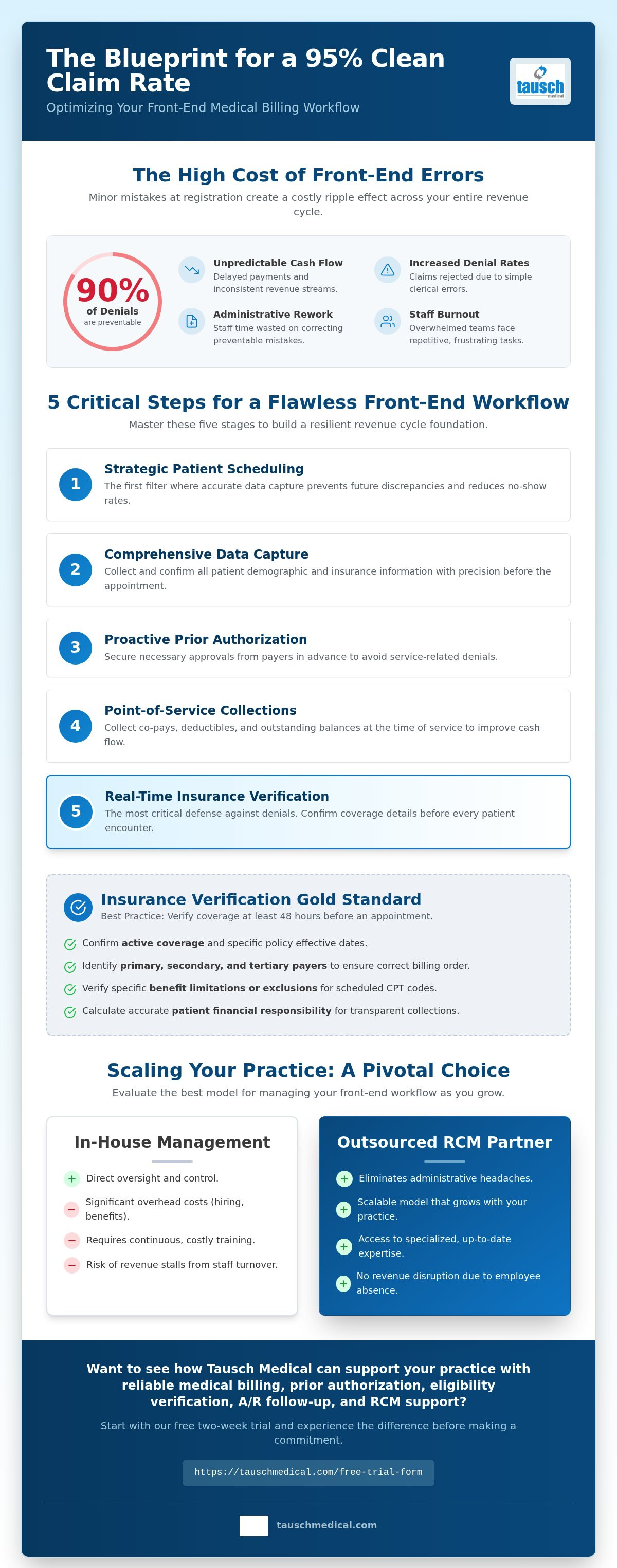
The front end medical billing workflow represents the critical initial phase of the patient encounter, encompassing every administrative task from the first point of contact to point-of-service charge capture. It isn't merely a clerical entry point; it's the strategic foundation of revenue cycle management. As detailed in this Medical Billing Overview, the process involves intricate coordination between providers, patients, and payers. When this coordination falters at the start, the financial consequences are severe. Industry data suggests that roughly 90% of all claim denials are preventable through front-end accuracy, making a refined front end medical billing workflow the single most influential factor in a practice's fiscal health.
Why Front-End Errors Lead to Back-End Denials
A single typo in a patient's surname or a digit off in an insurance ID creates a ripple effect that complicates the entire billing cycle. This impact of inaccurate insurance verification often results in claims being rejected before they even reach the adjudication stage. In busy metropolitan clinics across Houston or Dallas, front-desk bottlenecks don't just delay patient care; they directly inflate Days in A/R. When staff members are rushed, they skip vital steps like verifying primary versus secondary coverage or confirming prior authorization requirements. These small omissions lead to a cascade of administrative rework, burning out your team and stalling your cash flow. Precision at the front desk ensures that your clinical expertise is properly reimbursed without the friction of avoidable back-end disputes or the need for constant, exhausting appeals.
Optimizing the 5 Critical Steps of Your Front-End Workflow
A high-performing front end medical billing workflow relies on clinical precision during the administrative intake. Strategic patient scheduling serves as the first filter; it's the moment where accurate data capture prevents future discrepancies and reduces no-show rates. By 2026, mastering Healthcare Revenue Cycle Management requires more than just generic software; healthcare providers increasingly explore Healthcare Data Automation and Revenue Cycle Management Software to protect operating margins and eliminate workflow bottlenecks. It demands a proactive stance on prior authorization management to address increasingly complex payer requirements and point-of-service collections to secure cash flow before the patient encounter concludes.
Implementing Real-Time Insurance Eligibility Verification
Verifying coverage at least 48 hours before an appointment is the gold standard for preventing front-end rejections. Front-desk teams should follow a rigorous checklist to ensure no detail is overlooked:
- Confirm active coverage and specific policy effective dates.
- Identify primary, secondary, and tertiary payers to determine the correct billing order.
- Verify specific benefit limitations or exclusions for the scheduled CPT codes.
- Calculate accurate patient responsibility to facilitate transparent point-of-service collections.
Many practices find that specialized insurance verification services offer a more reliable solution than burdened in-house staff, allowing your team to focus on patient care. If you're currently struggling with high rejection rates, our medical claim denial management guide provides deeper strategies for revenue recovery. Managing these steps effectively ensures your practice maintains financial stability and operational excellence. If you're looking to streamline your intake, you might consider how professional scheduling support can transform your front-office efficiency.
Scaling Your Practice: Outsourcing vs. In-House Front-End Management
Deciding between in-house management and outsourcing medical billing services is a pivotal choice for any growing practice. While in-house teams offer direct oversight, they also bring significant overhead in the form of recruitment, ongoing training, and employee benefits. A professional front end medical billing workflow managed by an external partner eliminates these administrative headaches, providing a scalable model that expands with your patient volume. You're no longer limited by the capacity of a single desk or the risk of staff turnover stalling your revenue.
For new practices establishing roots in competitive hubs like Raleigh or Atlanta, specialized knowledge is indispensable. Navigating local payer requirements requires more than general billing knowledge; it demands specific expertise in provider credentialing to ensure you're in-network and ready to collect from day one. Regarding security, reputable partners utilize advanced encryption and HIPAA-compliant remote infrastructures. These systems often provide more robust protection than a standard office network, effectively neutralizing the common objection to remote billing environments.
The Benefits of a Professional RCM Partner in 2026
Tausch Medical approaches revenue management with clinical-grade precision, particularly within our provider credentialing services. We don't just process data. Instead, we act as a strategic extension of your clinic. Our "experience the difference" philosophy focuses on removing the clerical friction that prevents clinical growth. By integrating the insights from our strategic guide for healthcare providers, you can transition from reactive billing to proactive, long-term financial planning. This partnership allows you to reclaim your focus, ensuring your front end medical billing workflow remains a financial asset rather than an operational bottleneck.
Securing Your Practice's Financial Future
Refining your front end medical billing workflow isn't just an administrative improvement; it's a strategic necessity for clinical growth in 2026. By prioritizing eligibility verification and proactive authorization, you eliminate the root causes of preventable denials. Whether you're managing a clinic in New York or Houston, leveraging specialized expertise in local payer networks ensures a more predictable cash flow. Tausch Medical provides the comprehensive A/R and denial management support required to reduce administrative burnout while maintaining clinical-grade precision.
Want to see how Tausch Medical can support your practice with reliable medical billing, prior authorization, eligibility verification, A/R follow-up, and RCM support? Start with our free two-week trial and experience the difference before making a commitment: free trial form
Empower your team and your practice by choosing a partner dedicated to your long-term success.
Frequently Asked Questions
What is the difference between front-end and back-end medical billing?
Front-end billing involves patient-facing tasks like scheduling, registration, and eligibility verification. Back-end billing occurs after the clinical encounter, focusing on claim submission, payment posting, and denial management. To enhance the patient-facing portion of this phase, utilizing Integrity Statements for professional billing and statement delivery ensures clear communication and prompt payment. A robust front end medical billing workflow ensures that the back-end team receives clean data, which minimizes the need for costly appeals and repetitive administrative rework.
Reducing denials requires a dual approach of rigorous data validation and staff training. You should implement real-time eligibility checks 48 hours before every appointment to catch coverage changes. Standardizing the intake process with a digital checklist helps eliminate manual entry errors. Consistently verifying patient identity and insurance details at every visit prevents the most common causes of claim rejections.
Is it better to outsource insurance verification or handle it in-house?
Outsourcing is often superior for practices looking to scale without increasing fixed labor costs. In-house staff frequently struggle with high call volumes and complex payer rules, leading to rushed errors. A specialized partner provides dedicated experts who focus solely on verification and authorization. This ensures clinical-grade precision and allows your on-site team to prioritize patient engagement and clinical duties.
What are the most common front-end billing errors in 2026?
The most frequent errors include outdated insurance information, missing prior authorizations, and incorrect coordination of benefits. With the 2026 CMS efficiency adjustments, documentation requirements have become stricter. Even minor discrepancies in patient demographics or provider NPI numbers can trigger immediate rejections. Maintaining a meticulous front end medical billing workflow is the best defense against these increasingly technical payer requirements.
Disclaimer
This article is for general informational purposes only and does not constitute legal, medical, billing, coding, compliance, or financial advice. Healthcare rules, payer policies, and reimbursement guidelines may change and may vary by situation. Please consult qualified professionals or official sources before making decisions based on this content. Tausch Medical is not responsible for any loss or liability arising from reliance on this information.


