


Article by
Dr. Sharafat Hussain Ph.D
Dr. Sharafat Hussain is a healthcare business consultant, entrepreneur, and academic with strong experience in the US healthcare industry. He is the Founder and Managing Director of Tausch Medical, a revenue cycle management company supporting US healthcare providers with medical billing, prior authorization, credentialing, eligibility verification, A/R follow-up, and patient support services. His work combines practical healthcare operations, business strategy, and academic insight to help medical practices improve efficiency, collections, and service quality.
Did you know that national denial rates have climbed above 10% in 2026, with some specialties facing a staggering 20%? When it costs nearly $100 in administrative labor to rework a single denied claim, every dollar sitting in your 90 day bucket is a drain on your practice's clinical precision. We recognize that inconsistent cash flow and staff burnout from endless payer phone calls make effective medical accounts receivable follow up feel like an insurmountable challenge. It's time to treat your revenue cycle with the same rigor as a surgical procedure.
This guide teaches you how to implement assertive strategies that reduce aging buckets and stabilize your financial health. We'll explore a sophisticated system for claim prioritization and root cause analysis, ultimately reducing your Days Sales Outstanding and securing the premium status your practice deserves.
Key Takeaways
- Identify why the first 30 days of the revenue cycle represent the most critical window for preventing claims from falling into high-risk aging buckets.
- Master a segmentation strategy that prioritizes unpaid claims based on dollar value, payer type, and strict timely filing limits to maximize recovery.
- Learn how to implement an assertive medical accounts receivable follow up process that moves beyond simple collections to provide systematic root-cause analysis.
- Evaluate the benefits of professional RCM support in navigating the increasingly complex 2026 payer rules while reducing the administrative burden on your internal staff.
The Critical Role of Medical Accounts Receivable Follow Up
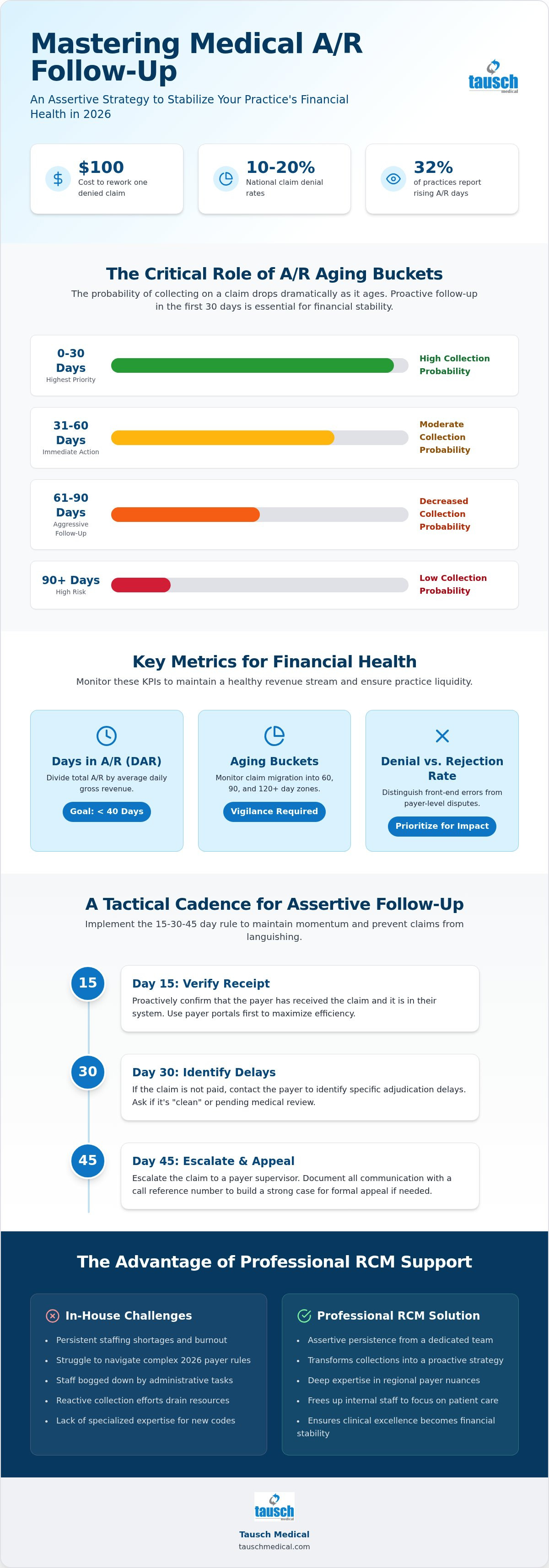
Effective medical accounts receivable follow up isn't merely a clerical task. It's the proactive engine of a healthy practice. By systematically tracking unpaid claims and resolving payer discrepancies, providers ensure that clinical excellence translates into financial stability. Within the broader framework of Revenue cycle management (RCM), the first 30 days are paramount. Industry data confirms a sharp decline in the probability of collection as claims age. This makes immediate intervention the only viable path to full recovery.
Stagnant cash flow creates a ripple effect that prevents practices from investing in world-class medical technology or expanding patient capacity. This back-end success is deeply rooted in front-end precision. Without meticulous insurance verification at the point of service, even the most assertive follow-up efforts face unnecessary friction. High-performing practices treat their billing cycle with the same clinical precision they apply to patient care.
Essential A/R Metrics Every Practice Should Track in 2026
To maintain clinical-grade financial health, practices must monitor specific key performance indicators that signal the health of their revenue stream.
- Days in Accounts Receivable (DAR): Calculate this by dividing your total A/R by your average daily gross revenue. Leading physician groups aim for a DAR under 40 days to ensure liquidity.
- Aging Buckets: Monitor claims as they migrate into the 60, 90, and 120+ day danger zones. In 2026, 32% of group leaders reported rising A/R days, highlighting the need for vigilance.
- Denial vs. Rejection Rate: Distinguish between rejections (front-end errors) and denials (payer-level disputes) to prioritize your medical accounts receivable follow up for maximum impact.
A Tactical Cadence for Assertive A/R Follow-Up
Recovery requires a surgical approach to prioritization. Instead of working through a chronological list, high-performing practices segment their aging buckets by dollar value, payer type, and strict timely filing limits. This ensures your team focuses on high-impact claims before they expire. For many providers, managing this complexity internally is a significant drain on resources. Specialized A/R and denial services offer the technical expertise needed to navigate these variables with clinical precision.
Consistency is the foundation of assertive medical accounts receivable follow up. We recommend a 15-30-45 day rule to maintain momentum. At day 15, verify claim receipt. By day 30, identify specific adjudication delays. By day 45, escalate the claim to a supervisor. This cadence prevents claims from languishing in the 60 or 90 day buckets. Effective follow-up moves beyond simple resubmission. It uses root cause analysis to identify coding or authorization errors, preventing future denials. If your staff is overwhelmed by these repetitive tasks, professional accounts receivable management can restore your focus to patient care.
Step-by-Step Workflow for Successful Claim Resolution
Success depends on disciplined execution. Follow these three steps to ensure no claim is left unpaid:
- Step 1: Payer Portal Verification. Always check status via online portals before picking up the phone. This saves hours of administrative time and provides instant documentation for your records.
- Step 2: Assertive Payer Communication. When calling, ask specific questions. Don't just ask if a claim is "processing." Ask if it's "clean," if it's pending a medical review, and always secure a call reference number.
- Step 3: Documentation and Appeal. Create a meticulous paper trail. If a claim is denied unfairly, use your documented communication history to force payer accountability during the formal appeal process.
Scaling Your Practice with Professional A/R Management
Managing an in-house billing department for medical accounts receivable follow up is becoming a significant operational risk. Practices face persistent staffing shortages while trying to navigate the intricate 2026 payer landscape. CMS's implementation of separate conversion factors and updated RPM codes requires a level of specialization that general administrative staff rarely possess. Professional outsourcing provides the assertive persistence that internal teams, often bogged down by daily patient care, cannot maintain. It transforms a reactive collection effort into a proactive financial strategy.
Regional expertise remains a vital component of successful recovery. Payer behaviors in major healthcare hubs like Houston, Dallas, and Atlanta exhibit unique adjudication nuances that require local market knowledge. Understanding these specific patterns allows for more precise interventions and faster resolution times. To explore deeper recovery strategies beyond basic follow-up, we recommend reviewing our Medical Claim Denial Management Guide for comprehensive insights.
The Tausch Medical Advantage: Precision and Persistence
Our commitment to excellence in medical billing focuses on the architecture of zero-loss revenue cycles. We deploy specialized teams specifically trained in complex medical accounts receivable follow up to ensure no claim is neglected. This specialized focus allows your clinicians to return their full attention to patient care without the distraction of administrative gridlock. By integrating a data-driven partner, your practice can experience a measurable reduction in Days Sales Outstanding (DSO), stabilizing cash flow for future expansion. We provide the clinical-grade precision your financial health deserves.
Securing Your Practice’s Financial Future
Transforming your revenue cycle requires more than simple persistence; it demands a strategic architecture that prioritizes high-value claims and addresses root-cause errors. By implementing a disciplined medical accounts receivable follow up cadence, your practice can significantly reduce Days Sales Outstanding and reclaim capital for future growth. It's time to move beyond reactive collections and adopt a proactive recovery model. Our specialized expert teams understand the unique payer behaviors in major US healthcare hubs, providing the clinical precision needed to navigate the evolving regulatory landscape of 2026. Elevating your financial performance is the first step toward expanding your clinical impact and ensuring long-term stability.
Want to see how Tausch Medical can support your practice with reliable medical billing, prior authorization, eligibility verification, A/R follow-up, and RCM support? Start with our free two-week trial and experience the difference before making a commitment: free trial form
Frequently Asked Questions
What is the industry standard for Days in Accounts Receivable (DAR)?
The industry benchmark for Days in Accounts Receivable (DAR) is under 40 days for physician groups. Maintaining liquidity requires keeping your DAR within this range to ensure consistent cash flow. If your metrics exceed this threshold, it often indicates a bottleneck in your medical accounts receivable follow up process. Monitoring this KPI monthly allows you to identify systemic issues before they impact your practice's clinical expansion.
How often should my billing team follow up on unpaid claims?
Your team should follow a structured cadence starting with a status check 15 days after submission. A second touch at 30 days identifies adjudication delays, while a 45 day touch escalates the claim to a payer supervisor. This proactive cycle prevents claims from languishing in 60 or 90 day aging buckets. Consistent communication ensures that payers remain accountable and that discrepancies are resolved before timely filing limits expire.
What are the most common reasons for claims to sit in A/R?
Claims often sit in A/R due to missing clinical documentation, incorrect patient eligibility data, or coding inaccuracies. In 2026, industry data shows that national denial rates have climbed above 10%, often due to evolving payer requirements for remote patient monitoring. Additionally, an estimated 27% of healthcare claims are mispriced. Identifying these root causes through rigorous medical accounts receivable follow up is essential for preventing administrative gridlock.
Can outsourcing A/R follow-up really improve my practice’s cash flow?
Outsourcing provides a level of assertive persistence that in-house teams often lack due to competing clinical priorities. Specialized partners deploy dedicated teams to navigate complex 2026 payer rules and regional nuances in major hubs like Houston or Atlanta. This expertise leads to a measurable reduction in Days Sales Outstanding and a higher clean claim rate. By removing the administrative burden, your practice can focus entirely on delivering premium patient care.
Disclaimer
This article is for general informational purposes only and does not constitute legal, medical, billing, coding, compliance, or financial advice. Healthcare rules, payer policies, and reimbursement guidelines may change and may vary by situation. Please consult qualified professionals or official sources before making decisions based on this content. Tausch Medical is not responsible for any loss or liability arising from reliance on this information.


