


Article by
Dr. Sharafat Hussain Ph.D
Dr. Sharafat Hussain is a healthcare business consultant, entrepreneur, and academic with strong experience in the US healthcare industry. He is the Founder and Managing Director of Tausch Medical, a revenue cycle management company supporting US healthcare providers with medical billing, prior authorization, credentialing, eligibility verification, A/R follow-up, and patient support services. His work combines practical healthcare operations, business strategy, and academic insight to help medical practices improve efficiency, collections, and service quality.
What if a stalled credentialing application is quietly putting a physician’s schedule, claims, and cash flow at risk? When enrollment progress is unclear, practice teams can struggle to tell whether a delay stems from missing records, an unanswered request, or a payer’s review process. Meanwhile, administrators are often managing these tasks alongside the demands of daily operations.
Physician credentialing services can help bring structure and consistent follow-through to this work, but preventing delays also depends on keeping key records organized and monitoring each process checkpoint. This article explains the operational warning signs to watch for, the information and status updates to track, and how credentialing support can work alongside billing and broader revenue-cycle operations. With clearer ownership and visibility, your team can identify bottlenecks sooner and keep enrollment work moving without losing sight of the practice’s day-to-day needs.
Key Takeaways
- Credentialing verifies a physician’s qualifications, while payer enrollment establishes participation in an insurance network; understanding the distinction helps clarify where a process may be delayed.
- Use a shared status log to record application ownership, submission dates, outstanding items, and next follow-up actions.
- Physician credentialing services can support organized follow-through while connecting credentialing tasks with billing and related administrative workflows.
- Explore how credentialing support can fit alongside medical billing services to coordinate essential practice operations.
Physician Credentialing Delays: Where Practice Operations Can Feel the Impact
Credentialing verifies a physician’s qualifications and professional background. Payer enrollment is a separate step: it establishes the provider’s participation in an insurance network so the practice can seek reimbursement under that arrangement. The processes are related, but they are not interchangeable. The medical overview of credentialing offers additional context on why this verification matters.
A delay in either process can make operational planning less predictable. Depending on the practice and payer, a provider’s planned schedule may need to be adjusted while participation is unresolved, and billing teams may need to track which services are ready to submit under the relevant payer arrangement. The impact isn’t the same in every setting, but uncertainty can complicate coordination across scheduling, administration, and billing.
Credentialing progress matters because it helps practices align provider schedules, enrollment status, and billing workflows with greater clarity.
What can happen when a physician’s credentialing process stalls?
Open requests and unclear application status can draw staff time away from daily responsibilities. Team members may need to revisit records, check for outstanding items, and coordinate updates, while managers plan around a provider’s anticipated start or payer participation without a clear resolution date. These demands can make it harder to assign ownership and sequence related tasks.
Organized physician credentialing services can help practices maintain visibility over the work and its next steps. Tausch Medical provides provider credentialing services alongside administrative support. For a broader process overview, see the provider credentialing services guide.
How to Keep Physician Credentialing Work Moving: A Practical Checkpoint Sequence
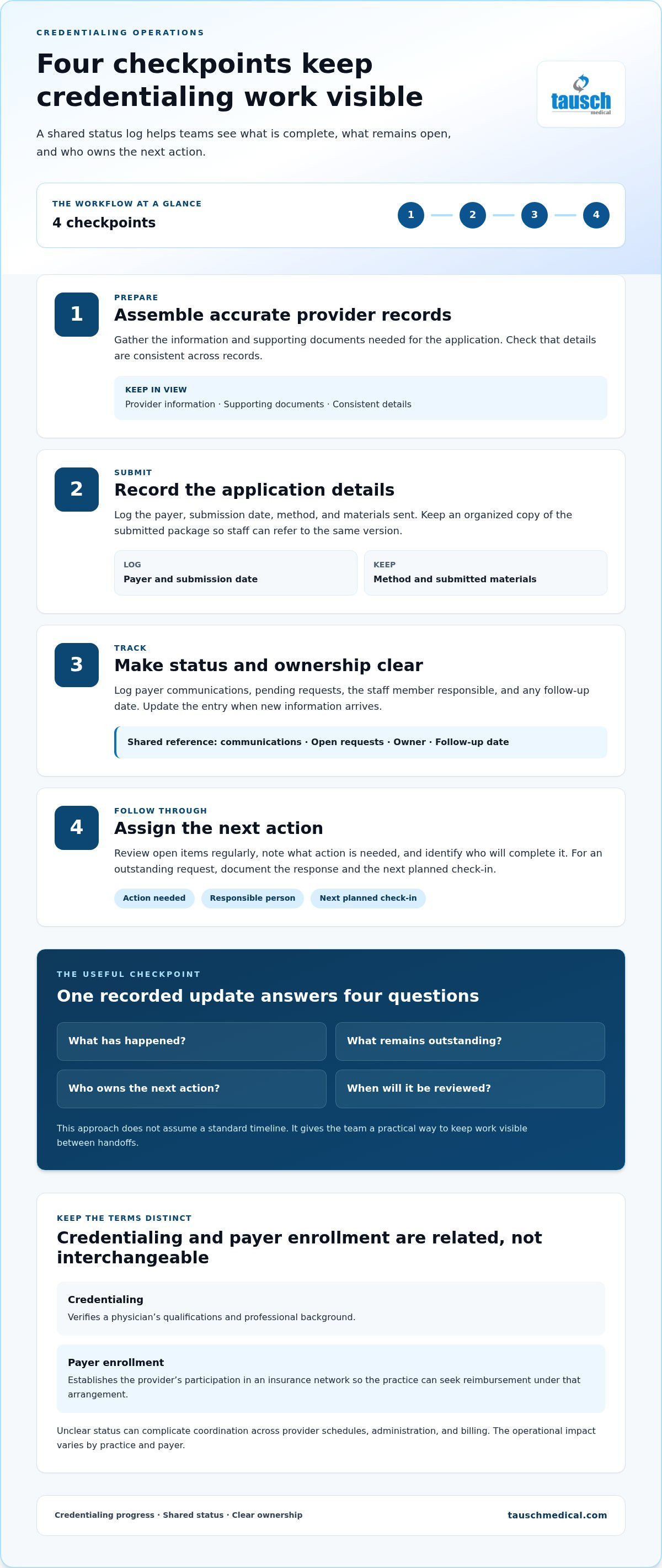
A clear sequence makes it easier to see what’s complete, what remains open, and who owns the next action. Use a shared status log so the process stays visible to the people coordinating provider records, applications, and payer follow-up.
- 1. Assemble accurate provider records. Gather the information and supporting documents needed for the application, and check that details are consistent across records.
- 2. Submit the application. Record the payer, submission date, method, and materials sent. Keep an organized copy of the submitted package so staff can refer to the same version.
- 3. Track the status. Log payer communications, pending requests, the staff member responsible, and any follow-up date. Update the entry when new information arrives.
- 4. Follow up and assign next steps. Review open items regularly, note what action is needed, and identify who will complete it. If a request is outstanding, document the response and the next planned check-in.
A useful credentialing checkpoint is a recorded status update that identifies what has happened, what remains outstanding, who owns the next action, and when it will be reviewed. It doesn’t assume a standard timeline; it gives the team a practical way to keep work from disappearing between handoffs.
Which records and follow-up checkpoints help practices stay organized?
Keep provider information consistent and submitted materials together, then use the log as the shared reference for payer contacts and pending requests. This reduces guesswork when responsibilities shift or staff need to plan related administrative work. Practices seeking added support with this process can explore Tausch Medical’s provider credentialing services.
Physician Credentialing Services Connected to Billing: Practical Next Steps
Credentialing and billing intersect through provider and payer information that administrative teams use to coordinate enrollment and claims workflows. If credentialing status is unclear, billing staff may need to confirm whether a provider’s enrollment is complete before determining how related billing tasks should proceed. Keeping responsibilities visible helps credentialing and billing teams work from consistent updates instead of relying on assumptions.
How can coordinated support reduce administrative friction?
Defined ownership and organized follow-up give each task a clear next step. For example, credentialing staff can track application updates and outstanding payer requests, while billing staff can align their workflow with the latest enrollment information. This doesn’t guarantee a particular outcome, but it can make handoffs clearer and help practices manage administrative work with greater coordination.
At Tausch Medical, physician credentialing services sit alongside billing and revenue-cycle support for healthcare practices. Practices can explore medical billing services as part of this connected operational approach. For a broader look at how revenue-cycle activities fit together, read the revenue-cycle management strategic guide.
Want to see how Tausch Medical can support your practice with reliable medical billing, prior authorization, eligibility verification, A/R follow-up, and RCM support? Start with our free two-week trial and experience the difference before making a commitment by filling out our free trial form.
Keep Credentialing Progress Aligned With Practice Operations
Credentialing and payer enrollment are distinct steps, yet delays in either can affect how a practice coordinates provider schedules, billing readiness, and administrative work. Accurate records, clear task ownership, and a shared log of status updates help teams maintain visibility and plan next steps without assuming every payer process follows the same timeline.
Well-managed physician credentialing services can fit alongside billing and revenue-cycle support, connecting enrollment follow-up with related practice workflows. The free two-week trial offers healthcare providers a risk-free opportunity to experience Tausch Medical’s support before making a commitment.
Want to see how Tausch Medical can support your practice with reliable medical billing, prior authorization, eligibility verification, A/R follow-up, and RCM support? Start with our free two-week trial and experience the difference before making a commitment.
Frequently Asked Questions
How long does physician credentialing take?
Physician credentialing often takes about 90 to 120 days, though timing varies by payer, application completeness, and verification needs. Commercial plan credentialing commonly falls within that range; Medicare enrollment may take 60 to 90 days, while Medicaid timing varies by state. Treat these as planning estimates and track application status rather than assuming one standard schedule.
What happens if a physician is not credentialed with a health plan?
If a physician’s enrollment with a health plan is incomplete, the practice may need to review how scheduling and billing workflows should proceed for that plan. The specific impact depends on the payer and practice circumstances. Tracking enrollment status and sharing updates with scheduling and billing staff helps the team plan based on current information.
Can physician credentialing services help reduce administrative work?
Yes. Physician credentialing services can help organize provider records, application submission, status tracking, and follow-up, giving staff clearer ownership of open tasks. A shared log can show pending requests and next actions, reducing repeated searches and handoff confusion, though it can’t guarantee a shorter payer review. Tausch Medical serves practices in Houston, San Antonio, Dallas, Austin, El Paso, Arlington, Plano, New York, Boston, Philadelphia, Washington, D.C., Baltimore, Miami, Orlando, Tampa, Atlanta, Raleigh, Richmond, and Jacksonville.
How does physician credentialing connect to medical billing?
Credentialing verifies a provider’s qualifications, while payer enrollment establishes participation in a health plan. Billing teams use enrollment information to coordinate claims-related tasks for that payer. When provider status or details are unclear, staff may need to verify information before proceeding. Coordinating credentialing with billing, insurance verification, authorization, denial management, and accounts receivable follow-up helps align administrative workflows.
Want to see how Tausch Medical can support your practice with reliable medical billing, prior authorization, eligibility verification, A/R follow-up, and RCM support? Start with our free two-week trial and experience the difference before making a commitment.
Disclaimer
This article is for general informational purposes only and does not constitute legal, medical, billing, coding, compliance, or financial advice. Healthcare rules, payer policies, and reimbursement guidelines may change and may vary by situation. Please consult qualified professionals or official sources before making decisions based on this content. Tausch Medical is not responsible for any loss or liability arising from reliance on this information.


