


Article by
Dr. Sharafat Hussain Ph.D
Dr. Sharafat Hussain is a healthcare business consultant, entrepreneur, and academic with strong experience in the US healthcare industry. He is the Founder and Managing Director of Tausch Medical, a revenue cycle management company supporting US healthcare providers with medical billing, prior authorization, credentialing, eligibility verification, A/R follow-up, and patient support services. His work combines practical healthcare operations, business strategy, and academic insight to help medical practices improve efficiency, collections, and service quality.
What if the best way to reduce administrative burden medical practice teams face isn’t adding another tool, but redesigning the work already on their plates? When paperwork interrupts clinical tasks, responsibilities are unclear, and insurance follow-up keeps recurring, even a capable team can lose valuable time to avoidable friction.
These challenges are familiar to practice leaders. A useful first step is to trace how work moves from request to completion, then identify where it stalls, gets repeated, or waits for an owner. This guide explains how to find administrative bottlenecks, clarify responsibilities, and streamline routine workflows without adding unnecessary complexity.
You’ll learn how to assess billing, eligibility checks, prior authorization, and accounts receivable follow-up, then decide where practical support may help. The aim is a more consistent operation that gives staff more time for patient care and higher-priority work.
Key Takeaways
- Map recurring administrative tasks to find delays, unclear ownership, and incomplete information that lead to avoidable rework.
- To reduce administrative burden medical practice teams face, standardize repeatable workflows and assign clear responsibility for each step.
- Prioritize payer and patient-access tasks, including eligibility checks, authorizations, and claims follow-up, where timely information helps keep work moving.
- When backlogs persist, operational support for billing, scheduling, and revenue cycle workflows can complement staff capacity while clinical decisions remain with clinicians.
Why Administrative Burden Builds Up in a Medical Practice
Administrative burden is the recurring operational work that competes with clinical responsibilities and time spent with patients. Clinical documentation supports care decisions; operational tasks keep the practice moving around that care. Scheduling appointments, checking eligibility, obtaining authorizations, submitting claims, and following up on unpaid or denied claims all serve a purpose. Fragmented processes, however, can make each task harder to complete.
These tasks sit within the broader field of health administration, where coordination across people, processes, and information is essential. In a practice, friction builds when task ownership is unclear, information must be entered repeatedly, or an issue is discovered only after it has delayed the next step. For example, missing insurance details may lead to repeated calls or messages before a visit or claim can proceed.
Which administrative tasks are consuming practice capacity?
Review four practical categories: documentation, patient access, payer interactions, and revenue-cycle follow-up. Documentation may include completing or routing records. Patient access includes scheduling and registration. Payer work includes eligibility checks and authorizations. Follow-up includes claim status, denials, and accounts receivable. Workloads vary, so trace how each task moves through your own practice rather than assuming the same source of friction applies everywhere.
Observe handoffs as well as individual tasks. Note where staff pause for missing information, repeat data entry, redirect work, or revisit an item that was thought complete. A delay that appears to come from billing may begin earlier with incomplete registration. A scheduling interruption may stem from uncertainty about who handles the next step. Following the process from its starting point to its outcome helps reduce administrative burden medical practice teams experience by showing where work actually accumulates.
How to Reduce Administrative Burden Through Better Workflows
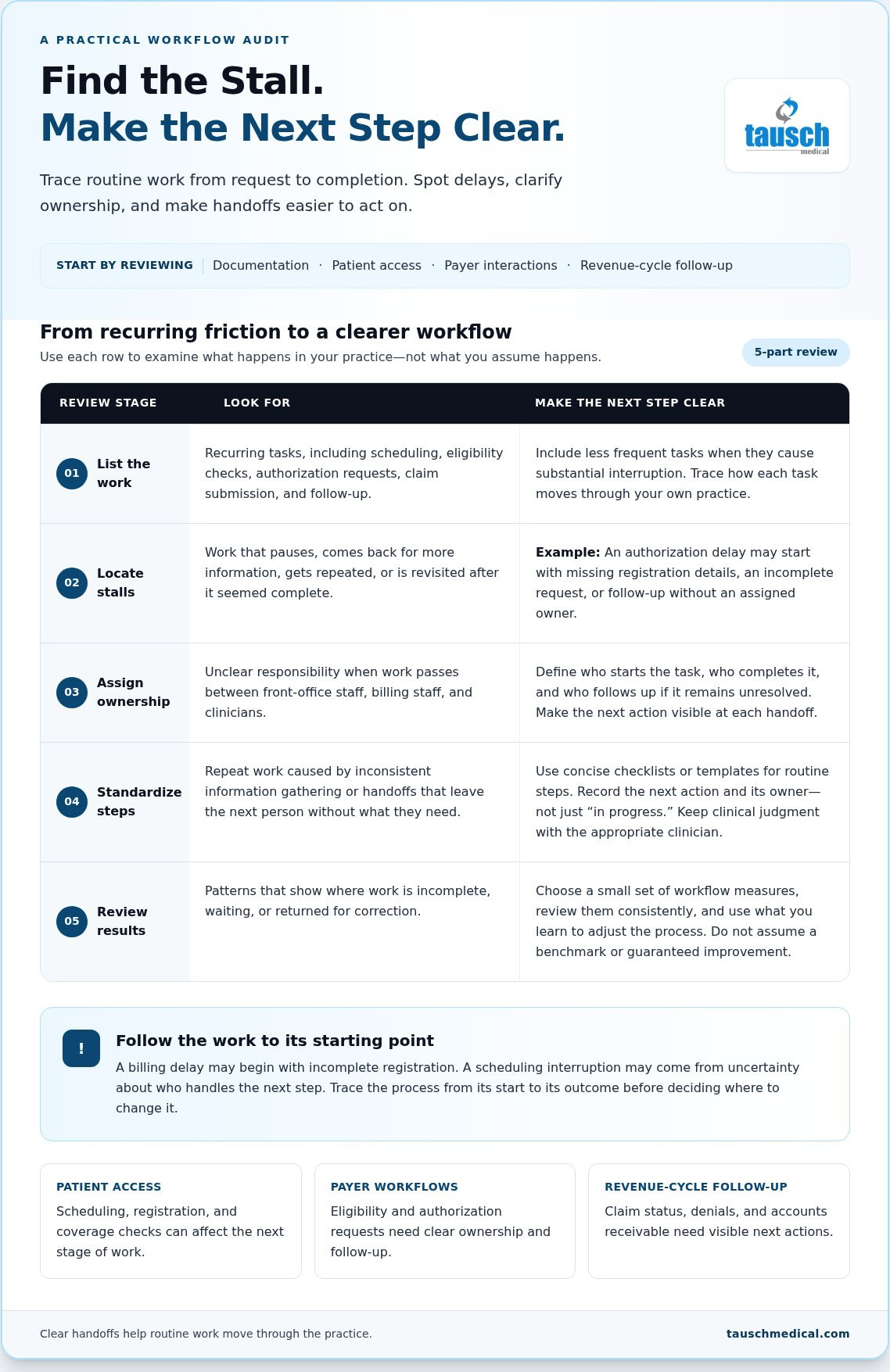
Before adding tools or shifting responsibilities, audit how work moves through the practice. Follow a few examples of each routine task from initiation to completion. This focused review can reveal whether delays come from unclear ownership, missing information, or follow-up without a defined next step.
- List recurring tasks. Include patient-access and payer workflows such as scheduling, eligibility checks, authorization requests, claim submission, and follow-up. Include tasks that happen less often but create substantial interruption when they arise.
- Locate bottlenecks. Trace each task from initiation to completion. Record where it pauses, gets returned for more information, or is repeated. For example, if an authorization request is held up, note whether the delay starts with missing registration details, an incomplete request, or a follow-up that was not assigned.
- Assign an owner at each stage. Clarify who starts the task, who completes it, and who follows up if it remains unresolved. Make the next action clear when work passes between front-office staff, billing staff, and clinicians.
- Standardize repeatable steps. Use concise checklists or templates for routine information gathering and handoffs. Include the details the next person needs to act, and leave clinical judgment with the appropriate clinician.
- Review results. Choose a small set of measures that reflects your workflow, such as incomplete requests, items awaiting follow-up, or tasks returned for correction. Review them consistently and use the findings to adjust the process, without assuming a benchmark or guaranteed improvement.
How can a practice clarify task ownership and handoffs?
Make responsibility visible at every transition. For example, define who verifies coverage before a visit, who routes an authorization request, and who checks its status if a response hasn’t arrived. A shared checklist should record the next action and its owner, not simply mark a task as “in progress.” For patient-access workflows, patient scheduling support can complement a clearly defined process.
Start with the payer or patient-access workflows that generate the most repeat work, then refine the process based on what your review reveals. This practical approach can help medical practices streamline administrative workflows without making technology the first or only solution.
When Practice Support Can Help Reduce Administrative Burden
Improved workflows can clarify responsibility and prevent avoidable rework, but they can’t create capacity when routine tasks continue to outpace the team. Persistent billing or authorization backlogs, follow-up that is repeatedly deferred, and staff pulled away from other essential duties may signal that internal process changes aren’t enough. The goal is to add operational capacity around defined workflows, not to replace the practice’s clinical expertise.
Which administrative workflows can specialized support address?
Specialized support can complement staff across connected front-office and revenue-cycle tasks. Eligibility verification helps establish coverage information before the visit. Prior authorization workflows keep requests and follow-up organized. Medical billing support manages claim-related processes, while accounts receivable follow-up keeps unresolved balances visible for action. These activities are linked: information gathered during patient access can affect billing later, so clear handoffs between stages matter.
For practices evaluating support for claims and billing processes, medical billing services can work alongside established task ownership and workflows. The insurance verification impact guide offers additional context on why accurate coverage information matters in that sequence. Clinical decisions remain with clinicians, while operational support can help manage repeatable administrative work and follow-up.
To reduce administrative burden medical practice leaders should first identify the workflows creating the most persistent strain. Then consider whether additional operational support fits those needs. Reviewing how support handles specific tasks, such as eligibility checks, authorization follow-up, or unresolved claims, can help leaders assess how it fits their processes.
Make More Room for Patient-Focused Work
A practical way to reduce administrative burden medical practice teams face is to start with the work itself: identify recurring bottlenecks, clarify who owns each handoff, and standardize repeatable steps. Review a few practice-selected measures to see where rework or backlogs persist. When internal workflow changes aren’t enough, targeted operational support can help with billing, eligibility verification, authorization, denial management, A/R follow-up, patient scheduling, and provider credentialing, while clinical decisions remain with clinicians.
Start with the workflow creating the most friction, such as a recurring authorization delay or a growing list of claims awaiting follow-up. Clarify the desired next step and who owns it, then use that definition to guide process changes or operational support. A clearer process can give your team more room to focus on patients and priority work.
Frequently Asked Questions
What is the best first step to reduce administrative burden in a medical practice?
Map recurring administrative work from beginning to end. List tasks such as scheduling, eligibility checks, authorization requests, claims, and follow-up, then note where work pauses or gets repeated. Use those observations to choose a process to address first, and identify who owns each step before changing the workflow.
Can outsourcing administrative tasks reduce workload for medical practices?
Yes. Outsourcing selected operational workflows can add capacity for billing, eligibility verification, authorization, denial management, and A/R follow-up, while clinical decisions remain with clinicians. Tausch Medical supports practices in Houston, San Antonio, Dallas, Austin, El Paso, Arlington, Plano, New York, Boston, Philadelphia, Washington, D.C., Baltimore, Miami, Orlando, Tampa, Atlanta, Raleigh, Richmond, and Jacksonville.
How can a medical practice reduce repetitive billing and insurance work?
Clarify who gathers insurance details, submits authorization requests, handles claims, and follows up on unresolved items. Use consistent checklists for routine information and make the next owner clear at each handoff. Reviewing incomplete or returned tasks can show where information is missing and which part of the process needs refinement.
Does reducing administrative burden mean using fewer EHR tools?
No. The goal isn’t necessarily to use fewer EHR tools, but to identify whether staff are duplicating work across processes. Clear workflows, consistent data entry, and defined handoffs can help teams use existing tools more effectively while preserving the information clinicians need to support care. For practices seeking specialized platforms to streamline departmental operations, discover SMAART Medical Systems, Inc. to learn how radiology management software can enhance clinic workflows.
Disclaimer
This article is for general informational purposes only and does not constitute legal, medical, billing, coding, compliance, or financial advice. Healthcare rules, payer policies, and reimbursement guidelines may change and may vary by situation. Please consult qualified professionals or official sources before making decisions based on this content. Tausch Medical is not responsible for any loss or liability arising from reliance on this information.


