


Article by
Dr. Sharafat Hussain Ph.D
Dr. Sharafat Hussain is a healthcare business consultant, entrepreneur, and academic with strong experience in the US healthcare industry. He is the Founder and Managing Director of Tausch Medical, a revenue cycle management company supporting US healthcare providers with medical billing, prior authorization, credentialing, eligibility verification, A/R follow-up, and patient support services. His work combines practical healthcare operations, business strategy, and academic insight to help medical practices improve efficiency, collections, and service quality.
Billing complaints often begin before a claim is submitted. Reducing patient complaints about billing starts with clear expectations and accurate information at the front desk, where insurance details, cost estimates, and patient records can shape what follows. Even a correctly processed bill can cause concern if the statement is hard to understand or the amount differs from what a patient expected.
Patients want to know what their insurance may cover, what they may owe, and whom to ask when something is unclear. This article explains common causes of billing complaints and how front desk staff can prevent confusion before a visit by verifying coverage, updating registration details, and explaining financial expectations in plain language. It also covers practical ways to make statements easier to understand and respond constructively to concerns.
Key Takeaways
- Listen to the patient’s full concern, review the itemized details, and correct genuine errors clearly.
- Before the visit, confirm insurance information and explain what a cost estimate covers and what may affect the final amount.
- Use plain-language statements that distinguish insurance payments from the patient’s remaining balance.
- Track recurring complaint patterns to identify where billing communication or processes may need improvement.
1. What are the most common causes of patient billing complaints?
Billing errors are a common trigger: a claim may contain incorrect patient details, coding, or charges that don’t match the services delivered. A clear handoff between clinical and billing staff, followed by claim review before submission, can catch discrepancies early. Statements can also frustrate patients when codes lack plain-language explanations or insurance payments aren’t distinguished from the remaining balance.
Complaint rates are meaningful only when practices use consistent definitions and denominators. Compare complaints per claim or statement across billing processes, then group concerns by charge amount, registration data, statement clarity, and resolution time.
When a patient raises an issue, staff should listen without interruption, review itemized details, and explain the charge clearly. If they find an error, correct it promptly and reissue the statement if needed. Train billing staff to explain balances in plain language and route unresolved concerns to the appropriate account representative.
For hospitals, 42 CFR § 482.13 requires a process for prompt grievance resolution, and the Centers for Medicare & Medicaid Services defines promptly resolved complaints as addressed promptly or within 24 hours with staff present. Practices can explain estimate limits and how to dispute a charge, while recognizing that final amounts may change after insurance adjudication.
When affordability is the concern, payment plans or financial assistance may help; these don’t correct an actual billing error. Track complaint volume per claim or statement, categories, and time to resolution, then review trends to identify recurring causes. A consistent medical billing process can support accurate claims and clearer follow-up.
2. How can front desk staff prevent billing complaints before the visit?
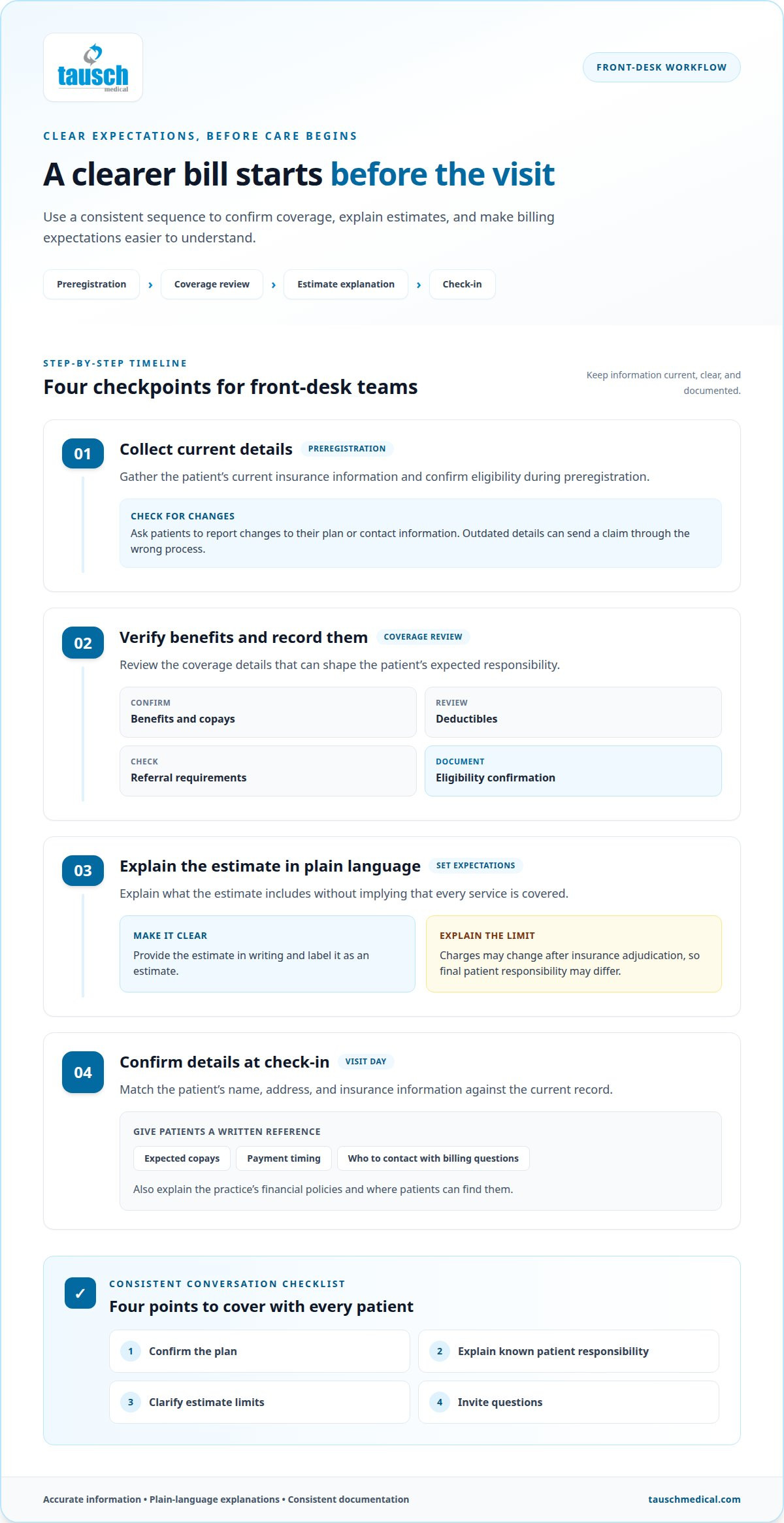
Before a visit, collect current insurance details and confirm eligibility during preregistration. Verify benefits, copays, deductibles, and referral requirements, then document the confirmation clearly. Ask patients to report changes to their plan or contact information, since outdated details can send claims through the wrong process. This gives staff a practical basis for discussing expected balances.
Explain coverage in plain language without implying that every service is covered. Tell patients which services an estimate includes and which charges may change after insurance adjudication. Provide the estimate in writing, label it as an estimate, and explain that the final patient responsibility may differ. This helps prevent confusion if a later statement reflects the insurer’s processing.
At check-in, confirm the patient’s name, address, and insurance information against the current record. Explain the practice’s financial policies and where patients can find them before care begins. A brief written summary can identify expected copays, payment timing, and whom to contact with billing questions. These details clarify communication without interrupting clinical workflows.
Front-desk teams can use a consistent conversation checklist: confirm the plan, explain known patient responsibility, clarify estimate limits, and invite questions. Invest in staff training so explanations of coverage and balances stay accurate and consistent. Practices seeking help coordinating insurance checks with billing workflows can explore medical billing outsourcing support as an operational option.
3. Common causes of patient billing complaints
Confusing statements can turn routine payment questions into complaints. A patient may see an unfamiliar service description, an insurance adjustment, and a remaining balance without understanding how they relate. If the statement doesn’t distinguish the amount billed, coverage applied, and amount due, patients may question the charge even when the claim was processed correctly.
Administrative discrepancies are another source of frustration. A misspelled name, outdated address, or incorrect insurance record can delay a statement or send it to the wrong place. Patients may then receive a balance notice without earlier context. Review complaint records for recurring registration issues and trace each concern to the relevant account or process.
Timing and inconsistent communication matter, too. A patient might receive an explanation of benefits before the practice’s statement and mistake it for a payment request. A delayed bill can feel unexpected, while a reminder without service details may prompt questions instead of payment. Financial policies should explain the statement sequence and tell patients whom to contact.
Affordability concerns differ from billing errors, so staff should identify the issue before responding. A patient disputing a charge needs an account review; someone concerned about payment may need information about available payment plans or financial assistance. Thank patients for raising concerns, document the issue and resolution, and review complaint categories regularly. This can reveal patterns in charges, statement clarity, coverage questions, and resolution times, helping practices target changes that support patient satisfaction.
Tausch Medical: Patient Scheduling
Tausch Medical’s Patient Scheduling supports a coordinated front-end workflow, connecting appointment planning with insurance verification and authorization. This helps practices prepare appointments consistently and share relevant information before a patient arrives.
Tausch Medical also provides Medical Billing Services and Accounts Receivable Management. These services support billing workflows and outstanding-balance follow-up alongside scheduling and coverage-related processes.
Want to see how Tausch Medical can support your practice with reliable medical billing, prior authorization, eligibility verification, A/R follow-up, and RCM support? Start with our free two-week trial and experience the difference before making a commitment.
Make billing communication part of practice improvement
A consistent approach to reducing patient complaints about billing can strengthen how a practice responds to concerns over time. Use recurring feedback to refine communication, clarify who owns follow-up, and help patients understand what happens next. The goal is to make the process easier for future patients to navigate.
Tausch Medical offers Medical Billing Services, Insurance Verification and Authorization, and Accounts Receivable Management to support practice billing operations.
Want to see how Tausch Medical can support your practice with reliable medical billing, prior authorization, eligibility verification, A/R follow-up, and RCM support? Start with our free two-week trial and experience the difference before making a commitment.
Frequently Asked Questions
What are the most common causes of patient billing complaints?
Complaints often arise when a patient’s understanding of a visit differs from the account details. A statement may show a service the patient doesn’t recognize, or insurance processing may leave an unexpected balance. Start by identifying whether the concern involves the service, the amount, coverage, or how the charge was explained.
How can clinics reduce billing errors that trigger complaints?
To reduce patient complaints about billing, clinics can review recurring error patterns alongside individual claims. Compare complaint categories with payer responses to spot issues such as missing documentation or a recurring modifier problem. Assign responsibility for correcting the underlying workflow, not just the individual account. A corrected statement should clearly show the resolved charge and patient balance.
How can front desk staff prevent billing complaints before the visit?
Give staff a consistent way to record insurance verification outcomes, including the plan reviewed and any referral requirement identified. If a patient’s plan or contact details differ from the existing record, update the registration information before the appointment proceeds. Clear notes help the billing team understand what was discussed and reduce the chance of conflicting explanations later.
What steps reduce patient confusion about EOB vs the actual bill?
Clearly label an explanation of benefits (EOB) as “not a bill,” and explain that it describes how the insurer processed a claim. Tell patients to look for a separate statement from the practice showing any amount due. A short note on the statement can clarify the difference and help patients avoid mistaking insurer information for a payment request.
What’s the best way to communicate estimates and out-of-pocket costs?
Provide a written estimate that names the planned service and explains what it includes. State plainly that insurance processing can affect the final patient responsibility, and distinguish estimated amounts from confirmed balances. If a service or coverage detail changes before the visit, update the explanation so patients understand what changed and why instead of relying on an earlier estimate.
Want to see how Tausch Medical can support your practice with reliable medical billing, prior authorization, eligibility verification, A/R follow-up, and RCM support? Start with our free two-week trial and experience the difference before making a commitment: https://tauschmedical.com/free-trial-form
Disclaimer
This article is for general informational purposes only and does not constitute legal, medical, billing, coding, compliance, or financial advice. Healthcare rules, payer policies, and reimbursement guidelines may change and may vary by situation. Please consult qualified professionals or official sources before making decisions based on this content. Tausch Medical is not responsible for any loss or liability arising from reliance on this information.


