


Article by
Dr. Sharafat Hussain Ph.D
Dr. Sharafat Hussain is a healthcare business consultant, entrepreneur, and academic with strong experience in the US healthcare industry. He is the Founder and Managing Director of Tausch Medical, a revenue cycle management company supporting US healthcare providers with medical billing, prior authorization, credentialing, eligibility verification, A/R follow-up, and patient support services. His work combines practical healthcare operations, business strategy, and academic insight to help medical practices improve efficiency, collections, and service quality.
An estimated 27% of claim denials in U.S. clinics stem from eligibility-related errors. Understanding how medical billing services increase revenue starts with preventing avoidable data and submission problems, then following claims through to payment. Accurate patient and insurance information, timely processing, and consistent follow-up can help practices manage earned revenue more efficiently. A clear view of how medical billing services increase revenue also shows why each step, from registration to claim resolution, matters.
It’s easy to focus on the claim itself, but revenue depends on every step around it, from verifying coverage and authorization to resolving denials and tracking unpaid balances. This article explains how medical billing services increase revenue by supporting accurate claims, coordinated revenue-cycle work, and reliable data. You’ll see where errors interrupt reimbursement, how billing workflows address them, and why accurate information at registration matters.
Key Takeaways
- Trace delays from coding and claim submission through follow-up to identify where reimbursement slows down.
- Coordinate billing, denial management, and accounts receivable work so claims are addressed throughout the revenue cycle.
- Accurate patient registration and insurance details help prevent avoidable claim issues before submission.
- Learn how medical billing, eligibility verification, authorization, and A/R management can support a more consistent revenue workflow.
1. Improving cash flow through faster claims processing
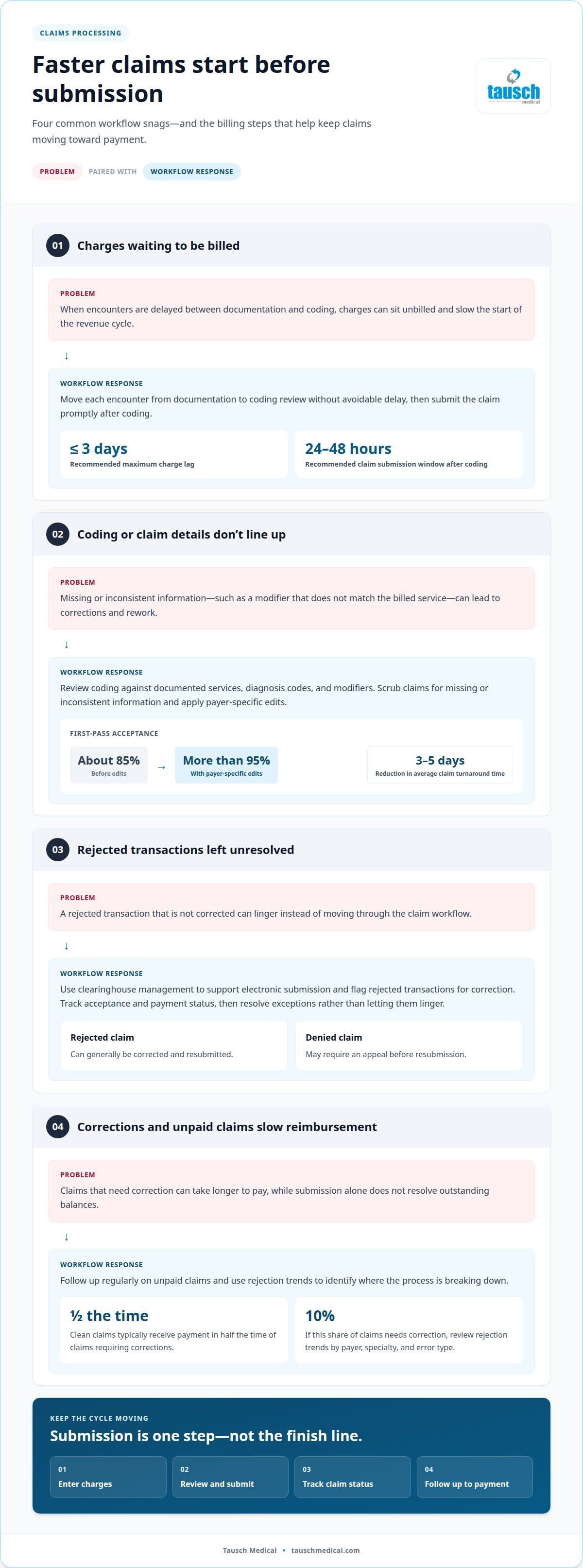
Cash flow starts with complete charge entry. A workflow that moves each encounter from documentation to coding review without avoidable delay helps prevent charges from sitting unbilled. Industry benchmarks recommend a charge lag of no more than 3 days and claim submission within 24-48 hours after coding. A medical billing workflow can also connect this process with medical billing services, keeping submission steps coordinated.
Before a claim leaves the practice, coding review checks that documented services, diagnosis codes, and modifiers align. Claim scrubbing then flags missing or inconsistent information, such as a modifier that does not match the billed service. Payer-specific edits can raise first-pass acceptance from about 85% to more than 95%, while reducing average claim turnaround time by 3-5 days. These checks help catch errors before they become rework.
After internal review, clearinghouse management supports electronic claim submission and helps flag rejected transactions for correction. Track acceptance and payment status, then resolve exceptions instead of letting them linger. Rejected claims can generally be corrected and resubmitted, while denied claims may require an appeal before resubmission.
Clean claims typically receive payment in half the time of claims requiring corrections, making first-pass accuracy relevant to reimbursement speed and accounts-receivable cycles. For example, if 10% of claims need correction, reviewing rejection trends by payer, specialty, and error type can reveal where the workflow is breaking down. Regular follow-up on unpaid claims keeps those findings connected to collection activity, rather than treating submission as the end of the process.
2. Medical billing services and revenue-cycle functions
A revenue cycle connects charge capture, claim submission, payment posting, denial follow-up, and patient balance tracking. Coordinating these functions helps providers see where work stalls instead of treating each claim as a separate task. McKinsey & Company estimates that 30-50% of routine medical billing administrative tasks can be automated, freeing staff to address exceptions and denials.
Medical billing fees may be based on a percentage of collections or a flat fee. A percentage-based arrangement varies with collections, while a flat fee is more predictable as volume changes. Compare the work each option covers, how adjustments are handled, and which services cost extra.
When comparing medical billing services, assess claim accuracy, denial follow-up, payment posting, reporting, and compatibility with your practice’s existing software. Match these capabilities to your specialty, claim volume, and specific revenue-cycle gaps.
Outsourcing can mean less day-to-day control over billing operations. Clear approval workflows, accessible reports, and regular communication about unresolved claims help your practice maintain visibility while routine work is handled externally.
Assess return on investment by comparing collections, denial trends, days in accounts receivable, and staff time before and after a change. Use comparable periods and account for service fees and changes in claim volume. This helps show whether outcomes reflect improved collections or other factors.
For practices considering external support, medical billing outsourcing can bring billing tasks into a coordinated workflow, while reporting helps track progress and identify recurring issues.
3. Accurate patient registration and insurance data
Accurate registration starts with confirming patient identity and insurance details before submitting a claim. Staff verify the patient’s name, date of birth, member ID, plan, and current coverage, and record referral or authorization details when relevant. A changed health plan or mistyped member ID can send a claim to the wrong payer, delaying reimbursement and disrupting cash flow.
Eligibility errors are a material denial driver: an estimated 27% of claim denials in U.S. clinics stem from eligibility-related errors. U.S. clinics should target an eligibility-related denial rate below 2%. A consistent verification step checks coverage for the scheduled service and flags inactive policies or mismatched information before billing begins.
Accurate registration also helps staff explain expected patient responsibility and collect payments through the practice’s available channels. Clear, timely statements and a straightforward payment process can reduce confusion about balances. For example, a patient who understands the amount due and how to pay has clearer next steps than someone who receives an unexplained balance after a claim is processed.
As patient volume changes, standardized data checks and billing workflows help practices manage additional encounters without allowing registration errors to accumulate. Robotic process automation has the potential to shorten the claims processing cycle by 50%, while consistent verification keeps exceptions visible for staff review. Reducing manual rework can also give front-office teams more time for patient-facing responsibilities.
Strengthen the connection between registration accuracy and claims workflows with medical billing support that includes eligibility verification.
Tausch Medical: Medical Billing Services
Tausch Medical supports practices that need coordinated claims, coverage checks, and follow-up on outstanding balances. Its Medical Billing Services, Insurance Verification and Authorization, and Accounts Receivable Management address key points where incomplete information or unresolved claims can interrupt revenue. Practices can use Medical Billing Outsourcing when internal capacity or follow-up workflows need additional support.
These services connect front-end insurance information with billing and accounts receivable follow-up, supporting revenue-cycle work at each stage. Focus on where delays occur: eligibility and authorization checks before service, claim handling after an encounter, or follow-up on unpaid balances.
Want to see how Tausch Medical can support your practice with reliable medical billing, prior authorization, eligibility verification, A/R follow-up, and RCM support? Start with our free two-week trial and experience the difference before making a commitment: free trial form
Build a more resilient revenue cycle
Use claim and payment patterns to guide workflow decisions as part of ongoing operational planning. Understanding how medical billing services increase revenue can help your practice identify where administrative support fits its priorities.
Want to see how Tausch Medical can support your practice with reliable medical billing, prior authorization, eligibility verification, A/R follow-up, and RCM support? Start with our free two-week trial and experience the difference before making a commitment: free trial form
Frequently Asked Questions
How do medical billing services increase provider revenue?
Medical billing services help turn completed, documented work into collected payments and reduce preventable administrative leakage. For practices in Houston, San Antonio, Dallas, Austin, El Paso, Arlington, Plano, New York, Boston, Philadelphia, Washington, D.C., Baltimore, Miami, Orlando, Tampa, Atlanta, Raleigh, Richmond, or Jacksonville, start by identifying where billed services fail to become paid claims. Then track the gap by payer and service line.
What revenue gains or collection improvements do medical billing services typically achieve?
There is no single standard revenue gain or collection increase for every practice. Results depend on baseline denial patterns, payer mix, claim volume, patient balances, and how consistently outstanding accounts are worked. Compare collections across similar periods and separate newly collected balances from changes in service volume. This helps distinguish billing improvements from growth driven by increased patient demand.
How do medical billing companies reduce claim denials and improve reimbursement?
Billing teams can classify denials by payer, reason, and service, then address recurring causes systematically. For example, repeated requests for missing referral records point to a need for better referral documentation. A payer’s request for supporting records calls for a complete response and tracked appeal. Reviewing resolved and unresolved cases together helps teams spot patterns and prevent repeat issues from becoming routine.
How do billing services improve clean claim rates and days in accounts receivable?
Track clean-claim rate consistently by dividing accepted claims by submitted claims, using the same reporting period and definition each time. To assess days in accounts receivable, compare outstanding balances with average daily charges, then review aging by payer and balance size. This can show whether delays cluster around one payer, older claims, or smaller balances accumulating across the ledger.
Disclaimer
This article is for general informational purposes only and does not constitute legal, medical, billing, coding, compliance, or financial advice. Healthcare rules, payer policies, and reimbursement guidelines may change and may vary by situation. Please consult qualified professionals or official sources before making decisions based on this content. Tausch Medical is not responsible for any loss or liability arising from reliance on this information.


