


Article by
Dr. Sharafat Hussain Ph.D
Dr. Sharafat Hussain is a healthcare business consultant, entrepreneur, and academic with strong experience in the US healthcare industry. He is the Founder and Managing Director of Tausch Medical, a revenue cycle management company supporting US healthcare providers with medical billing, prior authorization, credentialing, eligibility verification, A/R follow-up, and patient support services. His work combines practical healthcare operations, business strategy, and academic insight to help medical practices improve efficiency, collections, and service quality.
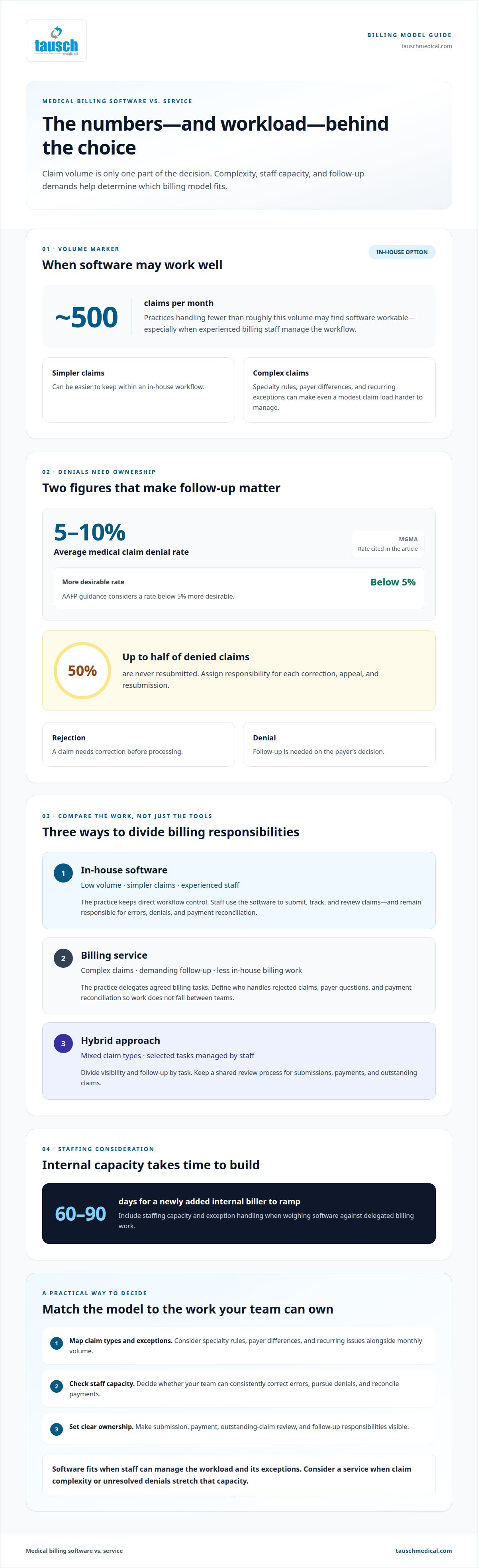
The medical billing software vs service decision depends on more than claim volume. For U.S. practices handling fewer than roughly 500 claims per month, software can work well when experienced billing staff manage the workflow. A billing service may better fit practices with complex claims or limited in-house capacity.
It’s reasonable to see software as a way to retain workflow control and a service as a way to delegate billing work, but each has tradeoffs. This medical billing software vs service comparison explains what software does, how outsourced services differ, and when outsourcing may suit a small practice with few claims. Use the practical criteria here to weigh staffing, claim complexity, and control before choosing a model.
Key Takeaways
- Assess claim complexity alongside volume to determine how much billing work your practice can manage internally.
- Compare software’s workflow tools with the hands-on work a billing service can take on.
- Consider staffing capacity and denial follow-up when weighing the true operational fit of each option.
- Identify where billing support, insurance verification, authorization, or accounts receivable management could ease pressure on your team.
Can a small practice with low claim volume benefit from outsourcing?
Yes. Low claim volume can make software practical, but claim complexity and staff capacity also matter. A billing service may suit a small practice when follow-up demands exceed what its in-house team can manage.
Claim Complexity and Volume
Practices handling fewer than roughly 500 claims per month may find software workable, especially with experienced billing staff. Yet volume alone doesn’t reveal the effort each claim requires: specialty rules, payer differences, and recurring exceptions can make a modest claim load difficult to manage. A practice with straightforward claims may keep the workflow internal, while complex claims can benefit from consistent review and follow-up. Map common claim types and exceptions before choosing.
Physician Control and Claim Visibility
With software, in-house staff handle claims, so the physician can shape workflows and review status reports directly. That control depends on having staff who can interpret the actual claim data and act on exceptions. A service takes on assigned billing work, which reduces the practice’s day-to-day handling but changes how work is delegated. Track submission, payment, and outstanding claims in a shared review process; a medical billing workflow should make each stage clear.
Rejections, Denials, and Follow-Up
A rejection typically signals a claim needs correction before processing, while a denial requires follow-up on the payer’s decision. The average medical claim denial rate is between 5 and 10 percent, according to MGMA; AAFP guidance considers a rate below 5% more desirable. Up to 50 percent of denied claims are never resubmitted, so assign responsibility for each correction, appeal, and resubmission. Software supports tracking, but staff must resolve issues; a service can manage assigned follow-up.
| Option | Claim volume and complexity | Staffing | Control and follow-up |
|---|---|---|---|
| In-house software | Low volume, simpler claims | Experienced staff needed | Direct workflow control; staff handle denials |
| Billing service | Complex claims or demanding follow-up | Less in-house billing work | Work delegated; follow-up assigned |
| Hybrid approach | Mixed claim types | Staff manage selected tasks | Divide visibility and follow-up by task |
Choose software when your staff can manage the workload and its exceptions. Consider outsourcing when complexity or unresolved denials stretch that capacity.
What Is Medical Billing Software?
Medical billing software organizes billing tasks, while an in-house team uses it to submit, track, and review claims. Its value depends on your office workflow and whether staff can handle exceptions consistently.
In-House Software Advantages and Disadvantages
Software can centralize patient and claim information, flag errors, and report bill status, helping someone in the office follow work through each stage. The practice retains direct workflow control, but staff remain responsible for correcting errors, pursuing denials, and reconciling payments. Outsourcing differs because a service performs assigned billing tasks instead of simply providing tools. A newly added internal biller may need a 60- to 90-day ramp.
HIPAA and HITECH shape how covered practices and business associates handle protected health information. When a billing relationship involves a business associate, a business associate agreement documents each party’s responsibilities for handling that information.
Software Costs and Small-Practice Features
Software expenses can include implementation, licensing, support, and clearinghouse charges, so compare the full operating cost, not just the subscription. For a small or independent practice, useful features include claim processing, insurance-status checks, error flags, and reports showing bill status. These tools help staff spot missing information and track workflow progress.
To move from in-house software to an outside billing service, inventory active claims and denials, document procedures and access needs, then coordinate records and follow-up responsibilities. Maintain an up-to-date list of unresolved claims during handoff. For practices considering delegated billing work, medical billing outsourcing offers an alternative to managing every step internally.
Advantages and disadvantages of outsourced billing services
Software provides tools; an outsourced service carries out agreed billing tasks. That distinction affects staffing, workflow control, and how you compare operating costs.
Service Charges and Percentage Rates
Outsourced billing can cover work such as claim submission, payment posting, and follow-up, while software leaves those tasks with practice staff. A service’s price depends on the practice’s needs and is provided after a quote request; specialty, claim volume, and included tasks shape the cost. Compare any percentage-based quote by checking which collections it applies to and whether coding review or denial follow-up is included.
Delegating billing can reduce the office’s day-to-day workload, but responsibilities still need to be clearly defined. Specify who handles rejected claims, payer questions, and payment reconciliation so tasks don’t fall between teams.
Total Cost and Return on Investment
To compare total costs, annualize software implementation and add support, clearinghouse charges, and in-house staffing. For a service, account for its full scope and the internal work it replaces.
Estimate return on investment by comparing each model’s total expense with its effect on collections and staff time. Review claim outcomes, payment follow-up, and administrative workload over the same period. Otherwise, the comparison may miss revenue held up by unresolved work.
For a practice evaluating delegated billing tasks, explore outsourced medical billing support as an alternative to managing every step internally.
Tausch Medical: Medical Billing Services
Tausch Medical provides medical billing services for practices seeking support with claim processing and related revenue-cycle work. Outsourcing may fit when in-house staff have limited capacity for billing tasks or ongoing follow-up. Practices can also use Tausch Medical’s insurance verification and authorization support for coverage steps, and accounts receivable management to organize follow-up on outstanding balances.
Start by identifying where work is accumulating. A practice that handles submissions internally but struggles to follow up on unpaid claims may prioritize accounts receivable management. A team looking to delegate more of its billing workflow may consider outsourcing. This ties the decision to operational needs, not software alone.
To discuss billing support for your practice, contact Tausch Medical.
Make the Next Billing Decision With Confidence
Turn your comparison into a practical next step by identifying which billing tasks take the most staff attention. Decide who should own each task, what information your team needs to see, and where follow-through currently slows down. These priorities can help shape a billing approach that fits your practice’s workflow.
Use this assessment to frame a focused discussion about your operational needs and the support that could address them. Identify the tasks your team wants to retain and those it would prefer to delegate.
Want to see how Tausch Medical can support your practice with reliable medical billing, prior authorization, eligibility verification, A/R follow-up, and RCM support? Start with our free two-week trial and experience the difference before making a commitment: free trial form.
Frequently Asked Questions
What happens to my existing denied claims if I switch to an outsourced billing service?
Transfer denied claims as an itemized work queue, not as closed history. Preserve each payer response, any correction or appeal already attempted, supporting documents, and the next action. Reconcile the inventory against accounts receivable before handoff, then assign clear ownership. This helps prevent claims from being worked twice or overlooked during the transition.
Are there hybrid setups that combine software and service elements?
Yes. A practice can retain its billing software and internal access while assigning selected work to an outside service. Staff might enter charges and monitor routine claims, for example, while the service handles denials or older unpaid balances. Define task ownership and keep status updates visible in one workflow so staff know who acts next.
How do I tell whether my current software-plus-internal setup is underperforming?
Review the previous 90 days of clean claim and denial rates, then look for recurring errors by payer, provider, or claim type. Also examine aging accounts receivable and claims repeatedly returned for correction. A pattern across several measures may point to a workflow or staffing issue, while an isolated mistake may call for a targeted process adjustment.
What if I want to start with a billing service and bring billing in-house later?
You can prepare for an eventual in-house model by documenting workflows from the outset. Keep current records of open claims, payer-specific procedures, denial reasons, and reporting definitions. Before responsibilities change, assign staff to each billing task, train them on the documented process, and compare sample work with the service’s records to identify gaps.
Which model is better for multi-specialty practices?
Neither model is automatically better for every specialty in a multi-specialty practice. Compare each department’s coding demands, payer mix, claim exceptions, and staffing capacity. A practice might keep predictable workflows internal while assigning more specialized or exception-heavy work externally. Review results by specialty rather than relying only on one organization-wide billing metric.
Disclaimer
This article is for general informational purposes only and does not constitute legal, medical, billing, coding, compliance, or financial advice. Healthcare rules, payer policies, and reimbursement guidelines may change and may vary by situation. Please consult qualified professionals or official sources before making decisions based on this content. Tausch Medical is not responsible for any loss or liability arising from reliance on this information.


