


Article by
Dr. Sharafat Hussain Ph.D
Dr. Sharafat Hussain is a healthcare business consultant, entrepreneur, and academic with strong experience in the US healthcare industry. He is the Founder and Managing Director of Tausch Medical, a revenue cycle management company supporting US healthcare providers with medical billing, prior authorization, credentialing, eligibility verification, A/R follow-up, and patient support services. His work combines practical healthcare operations, business strategy, and academic insight to help medical practices improve efficiency, collections, and service quality.
Front-end and back-end RCM processes are parts of a three-phase revenue cycle. Front-end work prepares patient and coverage details, the middle phase documents care and assigns billing codes, and the back end handles claims, payments, denials, and collections. The cycle starts before the visit and continues until payment is received. Eligibility checks and prior authorization are front-end tasks.
Billing may seem to begin after care, but claim accuracy often depends on what happens before the appointment. This guide explains front-end revenue cycle management, including how eligibility verification and prior authorization support accurate billing, and how responsibilities progress through the middle and back-end phases. You’ll learn how the stages connect, where breakdowns create rework, and why coordination across the full cycle matters to practice operations.
Key Takeaways
- Use accurate registration and coverage details to give each claim a stronger foundation before it reaches the payer.
- Track authorization and eligibility denials to identify where scheduling or registration workflows may need attention.
- Understand how documentation and coding connect the patient-facing front end to claims, payment posting, and A/R follow-up.
- Connect denial and underpayment findings to the teams responsible for the original workflow to reduce repeat rework.
What Is Front-End Revenue Cycle Management?
Front-end revenue cycle management covers administrative work before and during a patient visit. Scheduling, registration, eligibility checks, financial clearance, and prior authorization establish the details needed for accurate billing. Together, these steps align patient information, insurance coverage, and required approvals before services become a claim.
Insurance benefits determine what a payer covers and what a patient may owe, including copayments, deductibles, coinsurance, or charges for non-covered services. HIPAA considerations guide how teams handle patient information during registration, billing, and follow-up.
After care, back-end teams submit claims, monitor payer responses, and reconcile payments with patient accounts. They investigate denials, correct claim errors, review underpayments, follow up on accounts receivable, and address remaining patient balances. This is the key distinction in front-end vs back-end RCM processes: one prepares account details, while the other pursues reimbursement.
The clean claim rate shows how consistently claims pass initial payer review without errors or missing information. Front-end accuracy supports this measure, while back-end denial patterns can reveal gaps in registration, eligibility, coding, or submission. Reviewing these patterns helps teams trace where an error began.
Insurance terms shape coverage and payment decisions, while HIPAA considerations guide responsible handling of information. Teams can group denials and underpayments by shared root causes, then send findings back to the department where each issue began. Tracking whether workflow changes reduce repeat corrections helps close the loop.
Eligibility checks and prior authorization
Before an appointment, registration staff can verify active coverage and confirm patient details. Eligibility indicates whether a plan covers the patient on the service date, but it doesn’t guarantee approval for every planned service. Prior authorization is a separate payer decision for specified care. Clear front-end vs back-end RCM processes distinguish this pre-service approval work from resolving claims after submission.
Authorization management links scheduling with payer requirements. Staff identify services needing approval, submit required information, and record the payer’s response. A pending request needs follow-up before care when the workflow allows. Missing documentation can delay a decision, while absent authorization can lead to a denied claim or payment dispute. HFMA MAP Keys PA-4 and PA-5 measure compliance with required authorizations for inpatient or outpatient encounters.
Eligibility errors can send claims to the wrong payer or trigger denials. Missing accident details, such as motor vehicle accident information, may misdirect billing; incomplete demographics can cause rejection or delay. Repeated eligibility denials point to registration processes for review. HFMA MAP Key PA-2 measures the percentage of scheduled patients fully cleared before arriving at a clinic. Reviewing front-end vs back-end RCM processes together helps connect those denials to the workflows that produced them.
Front-end errors can delay reimbursement and require corrections or appeals; back-end errors can leave claims unresolved and increase follow-up work. Both use staff time, while inaccurate eligibility or missing authorization can complicate payment collection. Practices can connect eligibility and authorization workflows with scheduling and claim follow-up, then review denial reasons for recurring patterns.
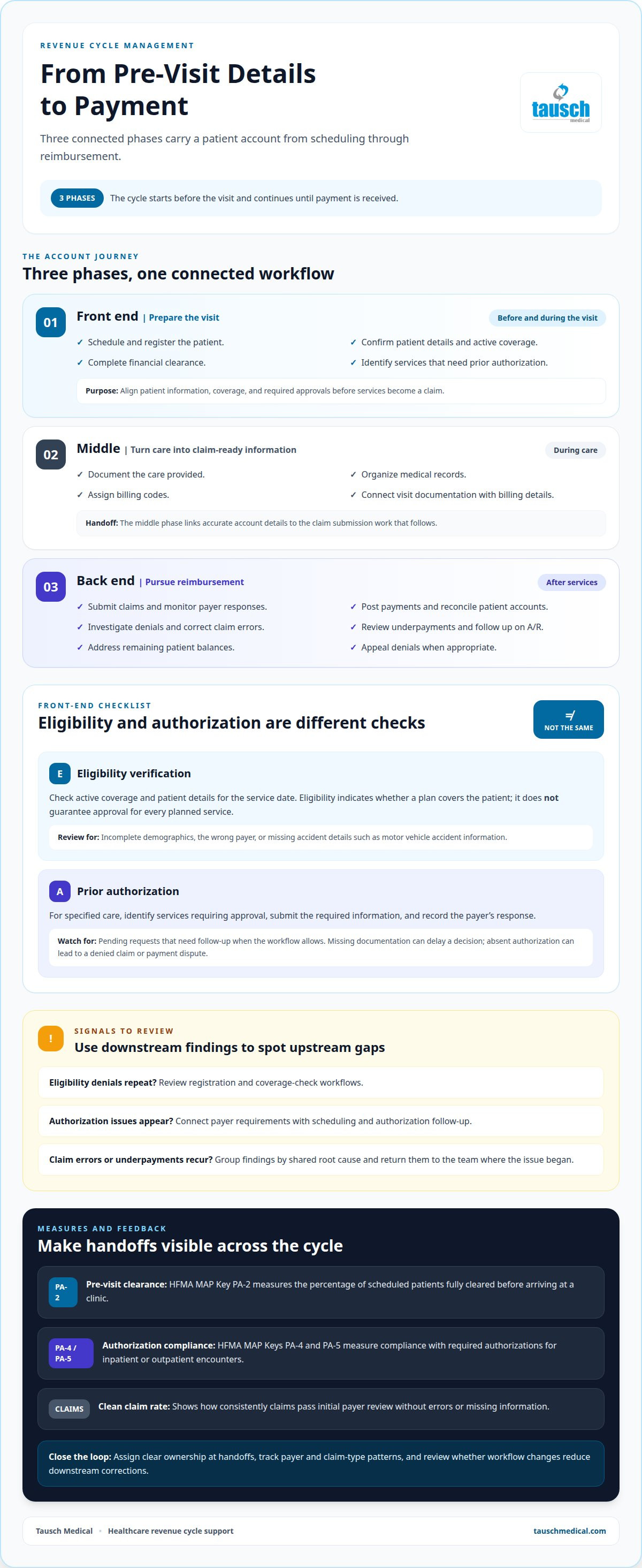
Revenue cycle phases: front end, middle, and back end
Revenue cycle management follows a patient account from first contact through payment. It has three phases: front end, middle, and back end. The front end prepares the visit through scheduling, registration, coverage checks, and financial clearance. The middle phase records care, organizes medical records, and assigns billing codes. The back end submits claims, tracks payer decisions, posts payments, and follows unresolved balances.
Front-end and back-end RCM processes differ in timing and responsibility: front-end teams establish accurate account details before care, while back-end teams pursue reimbursement after services. The middle phase connects them by turning documented care into claim-ready information. For example, a registration error may affect the account, while a coding error may surface during claim review.
Back-end revenue cycle work includes claim adjudication, payment reconciliation, denial resolution, underpayment review, accounts receivable follow-up, and final collection. Staff monitor submitted claims, investigate payer responses, correct errors, and appeal denials when appropriate. Payment posting records insurer payments in patient accounts, while patient collections address remaining balances. These activities show whether revenue is delayed or a claim needs further action.
Teams can connect all three phases by using shared root-cause categories for denials and underpayments. They can return findings to the originating department, track payer and claim-type performance across the lifecycle, and assign clear ownership at handoffs. Reviewing whether a workflow change reduces downstream corrections makes the cycle measurable. For practices addressing unpaid claims or recurring denials, A/R and denial support can help manage those back-end tasks.
Tausch Medical: Medical Billing Services
Tausch Medical supports healthcare practices with medical billing and related revenue cycle services. When registration or coverage checks lead to recurring claim issues, Insurance Verification and Authorization can support front-end accuracy. For unresolved claims and outstanding balances, Accounts Receivable Management supports back-end follow-up. Medical Billing Outsourcing can also help practices manage billing operations.
This support can be useful when eligibility gaps, authorization delays, denials, or aging accounts are diverting staff attention from other practice responsibilities. Connecting these needs across the revenue cycle helps teams address issues where they arise, rather than treating every denial as an isolated billing task.
To discuss how Tausch Medical can support your practice, contact Tausch Medical.
Make the Next RCM Improvement Deliberate
As your practice sets its next operational priority, focus on the work that most directly affects staff capacity and financial workflows. For dental practices looking to streamline front-office operations and patient intake, capacity optimization platforms like TurnUp World can help relieve administrative pressure. Clarifying which tasks need focused support helps leadership identify a practical next step while keeping existing processes and priorities in view.
A measured starting point gives your team a chance to assess how support fits day-to-day operations before making a longer-term decision. The conversation should begin with your practice’s needs and the administrative work you want to address.
Want to see how Tausch Medical can support your practice with reliable medical billing, prior authorization, eligibility verification, A/R follow-up, and RCM support? Start with our free two-week trial and experience the difference before making a commitment.
Frequently Asked Questions
Why Both Sides Matter?
Both sides matter: a front-end data gap can create back-end rework, while claim outcomes can reveal where the original process failed. For example, reviewing denial categories alongside registration records may uncover a recurring information mismatch. Connecting those findings helps teams address the source of an issue, not just resolve one affected account.
Why Practices Need End-to-End Support?
End-to-end support matters because practices need consistent ownership across scheduling, documentation, claims, and collections. Whether your team serves Houston, San Antonio, Dallas, Austin, El Paso, Arlington, Plano, New York, Boston, Philadelphia, Washington, D.C., Baltimore, Miami, Orlando, Tampa, Atlanta, Raleigh, Richmond, or Jacksonville, shared workflows help expose handoff gaps and recurring rework. Leaders can assign each issue to the team best positioned to resolve it.
What does revenue cycle management (RCM) include in healthcare?
Healthcare RCM includes the administrative and financial work that supports a patient account from initial contact through payment resolution. In addition to scheduling and claims, it may involve financial counseling, charge review, payer reconciliation, and communicating remaining balances. For example, comparing a payer’s explanation of benefits with posted account activity helps determine whether a balance remains outstanding or needs further review.
What are the front-end RCM processes in healthcare?
Front-end RCM processes prepare the account before services are billed. A typical workflow includes scheduling, patient registration, checking coverage and eligibility, confirming required authorization, and discussing expected patient responsibility. For example, staff can record updated insurance details during registration, then route a service requiring authorization for review before the appointment. This establishes a consistent account record for later stages.
What are the back-end RCM processes in healthcare?
Back-end RCM processes manage claims and account resolution after care. Teams submit claims, review payer responses, reconcile remittances, post payments, investigate denials, and follow outstanding balances. If a payment differs from the payer’s stated decision, staff can compare the remittance with the claim and supporting records, then decide whether correction, follow-up, or an appeal is appropriate.
Disclaimer
This article is for general informational purposes only and does not constitute legal, medical, billing, coding, compliance, or financial advice. Healthcare rules, payer policies, and reimbursement guidelines may change and may vary by situation. Please consult qualified professionals or official sources before making decisions based on this content. Tausch Medical is not responsible for any loss or liability arising from reliance on this information.


