


Article by
Dr. Sharafat Hussain Ph.D
Dr. Sharafat Hussain is a healthcare business consultant, entrepreneur, and academic with strong experience in the US healthcare industry. He is the Founder and Managing Director of Tausch Medical, a revenue cycle management company supporting US healthcare providers with medical billing, prior authorization, credentialing, eligibility verification, A/R follow-up, and patient support services. His work combines practical healthcare operations, business strategy, and academic insight to help medical practices improve efficiency, collections, and service quality.
A denied claim is a work item with a cause, an owner, and a next action, not simply a payment that has not arrived. Effective tracking and managing denied claims means classifying each denial, correcting or appealing it when appropriate, and monitoring its progress through resolution.
Follow-up can become reactive when denial reasons are recorded inconsistently or claims are handled one at a time. A structured process makes recurring issues easier to spot and helps billing teams prioritize the right next step.
This article explains denial management and how classifying claims by cause supports purposeful follow-up. Learn how to distinguish common denial categories, track each claim’s progress, and use patterns in the data to address problems before they recur.
Key Takeaways
- Track each denial from identification through correction, resubmission, or appeal so its status and next action remain clear.
- Use denial patterns to distinguish isolated errors from workflow issues that may need broader attention.
- Apply AI-assisted drafting and automated follow-up as support for a managed process, while keeping review and resolution visible to the team.
- Connect denial follow-up with billing, eligibility verification, authorization, and accounts receivable support to strengthen revenue cycle operations.
What Is Denial Tracking and Analysis?
Denial tracking records unpaid claims, their causes, and follow-up outcomes. Analysis turns those records into patterns that help medical organizations correct errors, protect revenue, and support cash flow.
Denied Claims Versus Rejected Claims
A rejected claim fails before it enters the payer’s system. A denied claim has been processed and refused because of a coverage or clinical issue. That distinction determines the next step: correct and resubmit a rejection, but review the payer’s explanation and applicable appeal path for a denial. Missing claim information, for example, may trigger a rejection, while a coverage issue may lead to a denial.
Denial Review and Resolution
Denial management means identifying each processed denial, reviewing its reason code and supporting records, and assigning a correction or appeal. Corrected coding or missing documentation may support resubmission; a disputed coverage or medical-necessity decision may require an appeal with relevant records. Track whether the payer later pays, partially pays, or upholds the denial. Clear ownership helps teams act before payer deadlines and identify which follow-up steps resolve claims.
A denial log can capture the claim number, service date, denied amount, and medical codes. Monthly reports should compare denial counts and dollars, since a smaller category can still affect revenue substantially. Payer-specific analysis can reveal recurring authorization, modifier, or documentation issues, helping organizations target the process behind each pattern.
Prevention starts before submission: verify eligibility, confirm required authorization, and review documentation and coding. Claim-scrubbing tools can flag incomplete information, coding discrepancies, and other errors for correction before a claim reaches the payer. These checks can reduce preventable denials and repeated follow-up.
Denials can also burden patients. People with annual household incomes below $50,000 are least likely to contest denied claims and have lower success rates when they do. Clear communication about claim status and a timely review process can help patients understand what happened and what action follows.
What Is Denial Management?
Denial management coordinates corrections, appeals, and follow-up to move healthcare claims toward resolution. A consistent process helps teams identify patterns, monitor cash flow, and learn which actions improve outcomes.
Correcting and Appealing Claims
Correcting a denied claim means fixing an identified issue; appealing challenges a payer decision with supporting documentation. Review the denial reason, compare it with the claim and medical record, then choose the appropriate route. Correct coding or missing records may support a corrected submission, while a disputed decision may require an appeal. Use the denial notice and payer policy to identify filing rules and deadlines; some preventive action timeframes can be as short as 90 days.
Prioritizing Follow-Up Work
Prioritize claims by appeal deadline, value, and likelihood of recovery. Address approaching deadlines first, then consider financial impact and whether the documentation supports an appeal. This makes limited staff time more purposeful and reduces the risk of missing a timely filing opportunity.
Resubmission and Appeal Tracking
A denial dashboard should record the claim number, service date, payer, denied amount, reason, owner, deadline, action, and outcome. Track whether each claim was corrected, resubmitted, appealed, paid, partially paid, or written off. An electronic log, work queue, and pre-submission claim-scrubbing tool can support the process. AI-assisted drafting may help organize appeal language, while staff review documentation and coding for accuracy before submission. Automated reminders can flag pending follow-up.
Appeal Performance and Recovery
Performance measures show whether appeal work is recovering revenue. Industry analyses indicate that 50-65% of denied claims can typically be successfully appealed when handled properly; recovered payments commonly appear within 30-60 days, depending on payer processing. HFMA recommends tracking time from denial to appeal and resolution, plus the percentage of denials overturned. These measures help teams identify patterns and refine follow-up. Practices seeking structured denial management support can connect those workflows with accounts receivable follow-up.
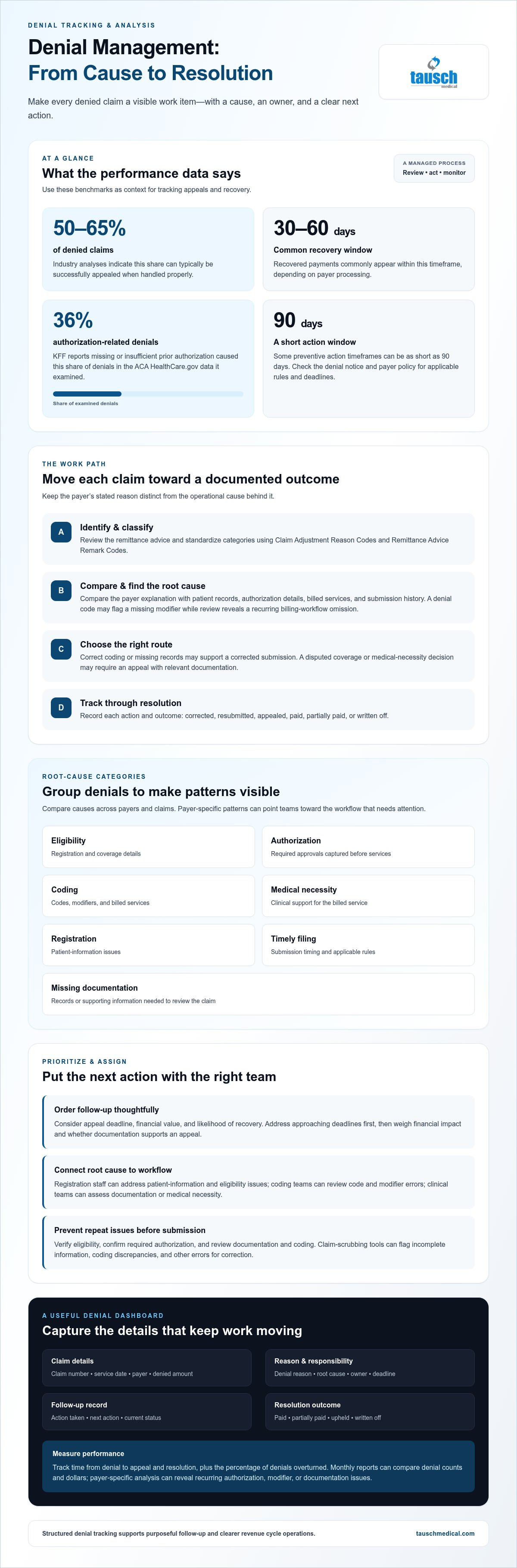
Denied claim identification and root-cause classification
Useful denial analysis separates the payer’s stated reason from the operational cause. A denial code may flag a missing modifier, for example, while review shows that the billing workflow repeatedly omits it. Classifying both helps practices correct the claim and address the process behind recurring revenue cycle problems.
Start with the remittance advice and standardize categories using Claim Adjustment Reason Codes and Remittance Advice Remark Codes. Group denials by eligibility, authorization, coding, medical necessity, registration, timely filing, or missing documentation. Compare the payer’s explanation with patient records, authorization details, billed services, and submission history to identify the underlying error.
Payer-specific trends sharpen that review. One payer may frequently flag authorization, while another highlights modifiers or supporting documentation. KFF reports that missing or insufficient prior authorization caused 36% of denials in the ACA HealthCare.gov data it examined. A practice can use payer-level patterns to target authorization checks rather than applying the same fix across every claim.
Assign each root cause to the workflow closest to it: registration staff can address patient-information and eligibility issues, coding teams can review code and modifier errors, and clinical teams can assess documentation or medical necessity. For example, repeated authorization denials should prompt a review of how approvals are captured before services, while an isolated coding error may require only a claim-level correction.
Consistent categories make denial reports actionable: teams can compare causes, payers, and claim outcomes to choose focused prevention strategies. Explore denial-management support to strengthen root-cause follow-up across medical billing workflows.
Tausch Medical: Medical Billing Services
Tausch Medical supports practices seeking a consistent approach to claim submission, denial follow-up, and revenue cycle work. Its Medical Billing Services connect billing with practical follow-through, while Insurance Verification and Authorization help address coverage and approval information before claims are submitted.
When internal teams have limited capacity to manage outstanding claims, Accounts Receivable Management and Medical Billing Outsourcing can support organized follow-up and billing workflows. These services can help when denials recur, payer-specific issues need closer attention, or staff time is stretched across revenue cycle tasks.
To discuss support for your practice, contact Tausch Medical.
Make Denial Follow-Up a Deliberate Practice
Each denial offers a chance to strengthen the workflow that produced it. Use recurring causes to guide staff training, refine handoffs, and prioritize claims needing timely follow-up. Making tracking and managing denied claims part of routine operations helps practices turn recurring issues into opportunities to improve internal processes.
A disciplined approach to tracking and managing denied claims also gives teams clear ownership as claims move between billing tasks. Tausch Medical’s Medical Billing Services, Insurance Verification and Authorization, and Accounts Receivable Management support these workflows.
Want to see how Tausch Medical can support your practice with reliable medical billing, prior authorization, eligibility verification, A/R follow-up, and RCM support? Start with our free two-week trial and experience the difference before making a commitment: free trial form
Frequently Asked Questions
How Do Healthcare Claim Denials Affect Medical Practices?
Denials delay payment, increase administrative work, and can leave patients uncertain about their balances. Unresolved denials may also complicate month-end revenue reviews. Practices serving patients in Houston, San Antonio, Dallas, Austin, El Paso, Arlington, Plano, New York, Boston, Philadelphia, Washington D.C., Baltimore, Miami, Orlando, Tampa, Atlanta, Raleigh, Richmond, and Jacksonville need clear internal ownership so billing staff can explain claim status consistently while reviewing payer decisions.
What is the denial rate in medical billing, and how good should it be?
A typical benchmark for medical billing denial rates is around 5-10 percent. Calculate the rate consistently by dividing denied claims by submitted claims for the same reporting period, then compare it over time and across payers. A lower rate is generally preferable, but the useful target is one that prompts investigation of recurring causes without masking differences in payer mix or services.
What are the most common reasons insurance claims are denied?
Common causes include eligibility discrepancies, missing authorization, coding or modifier errors, insufficient documentation, medical-necessity disputes, and filing delays. Claim details often reveal the specific issue: an authorization may cover a different service, or a note may not support the billed code. Comparing denial reasons by payer and service line helps distinguish isolated errors from repeated workflow gaps.
How do you track denied claims from denial through resolution?
Give every denial a unique claim reference and an accountable staff owner, then record its status and next action. For example, a work queue can separate claims awaiting records from those pending payer review. Reconcile the final remittance against the original balance, and close the item only after documenting payment, adjustment, or write-off.
What are the steps for investigating and appealing a denied claim?
First, compare the payer’s explanation with the submitted claim, medical record, authorization, and applicable coding. Correct factual or coding errors through the appropriate corrected-claim route; challenge a disputed decision with a focused appeal and relevant supporting records. Keep proof of submission and payer correspondence together, then compare the decision with the original denial reason to guide any further action.
Disclaimer
This article is for general informational purposes only and does not constitute legal, medical, billing, coding, compliance, or financial advice. Healthcare rules, payer policies, and reimbursement guidelines may change and may vary by situation. Please consult qualified professionals or official sources before making decisions based on this content. Tausch Medical is not responsible for any loss or liability arising from reliance on this information.


