


Article by
Dr. Sharafat Hussain Ph.D
Dr. Sharafat Hussain is a healthcare business consultant, entrepreneur, and academic with strong experience in the US healthcare industry. He is the Founder and Managing Director of Tausch Medical, a revenue cycle management company supporting US healthcare providers with medical billing, prior authorization, credentialing, eligibility verification, A/R follow-up, and patient support services. His work combines practical healthcare operations, business strategy, and academic insight to help medical practices improve efficiency, collections, and service quality.
A clinic’s revenue cycle runs from a patient’s first appointment through final payment of the balance. Understanding the full revenue cycle in healthcare means seeing how registration, insurance verification, care delivery, coding, claim submission, reimbursement, and patient billing connect. Each stage can affect whether a practice receives accurate, timely payment for the services it provides.
These tasks span clinical and administrative workflows, so an early delay or error can create extra work later, from correcting claims to following up on unpaid balances. This article explains what revenue cycle management includes, how payers process claims, and which clinic workflows practices can strengthen. You’ll see how eligibility checks, authorization, accurate billing, and consistent follow-up help keep revenue operations organized.
Key Takeaways
- Trace how patient registration, care documentation, coding, claims, and payment connect across the revenue cycle.
- Learn how accurate coding, complete claim details, and timely submission can help reduce avoidable denials.
- Identify front-end and follow-up processes clinics can strengthen to support smoother reimbursement and collections.
- See how billing, insurance verification, authorization, and accounts receivable support can help practices manage revenue workflows.
What is revenue cycle management?
Revenue cycle management connects the financial steps from a patient encounter through final payment. Each step supports accurate billing and a practice’s financial performance.
Medical Coding and Charge Entry
Medical coding translates documented diagnoses and services into standardized codes, while charge entry records billable services. Coders use CPT, ICD-10, ICD-11, and HCPCS codes to represent care. Clear documentation must support each code. At charge entry, staff verify patient demographics and insurance coverage. These checks help healthcare organizations submit correct charges for the services provided.
Charge Capture and Revenue Recognition
Charge capture records the services a physician provides so they can be billed. Revenue recognition reflects the revenue associated with those services as the practice records charges and tracks expected payment. Complete capture matters: a missed service can leave earned revenue off a claim. Utilization review examines whether care aligns with coverage and payer requirements, connecting clinical records with charges submitted for reimbursement.
Billing and Accounts Receivable Follow-Up
Billing turns documented, coded charges into claims for insurers and balances for patients. After submission, accounts receivable follow-up tracks unpaid claims and outstanding patient balances. Staff review insurer and patient payments, compare them with EOB or ERA statements, and reconcile discrepancies. This follow-through helps identify underpayments, denials, and unresolved balances, giving practices a clearer picture of revenue still awaiting collection.
Payer Billing Rules and Federal Requirements
Medicare, Medicaid, and commercial insurers have payer-specific billing requirements. Medicare and Medicaid are government programs; commercial plans are private coverage, and requirements can differ by payer and plan. HIPAA, enacted in 1996, sets responsibilities for protecting certain health information, according to the U.S. Congress. Useful KPIs include denial patterns, days in accounts receivable, and collection performance. HFMA MAP Keys offer standardized calculations for tracking revenue-cycle performance.
Claims submission and processing
A claim turns documented care into a request for payment from an insurer. Its accuracy and routing shape the practice’s path to reimbursement.
Submitting Claims for Reimbursement
Claim submission sends patient, provider, service, and coded information to the responsible payer for review. Before sending it, practices check that the claim is complete and directed to the correct payer. For example, the claim should match the patient’s coverage and the services recorded for the appointment. Missing details, inaccurate codes, late filing, or submission to the wrong payer can lead to a denial. Payer-specific requirements matter because reimbursement policies vary among insurers.
Processing Claims and Managing Denials
During processing, payers evaluate claims and may pay them in full, pay them in part, deny them, or reject them. Denials can result from missing information, coding errors, eligibility issues, or lack of medical necessity. The reason determines the next step. Practices can review the payer’s explanation, correct claim details, and gather supporting documentation before appealing. After resubmission, tracking the claim helps staff determine whether the payer has resolved it or further follow-up is needed.
Denials require more than resending the original claim. A claims team should identify whether the issue concerns administration, coding, or medical necessity, then match the appeal to that cause. For example, an eligibility issue calls for coverage verification, while a coding concern requires checking the documented service and assigned code. Consistent review can also reveal recurring process gaps, helping practices refine submission checks and support reimbursement without losing sight of patient care. Focused denial management support can help organize this follow-up and appeals work.
Improving clinic and physician-practice revenue cycle processes
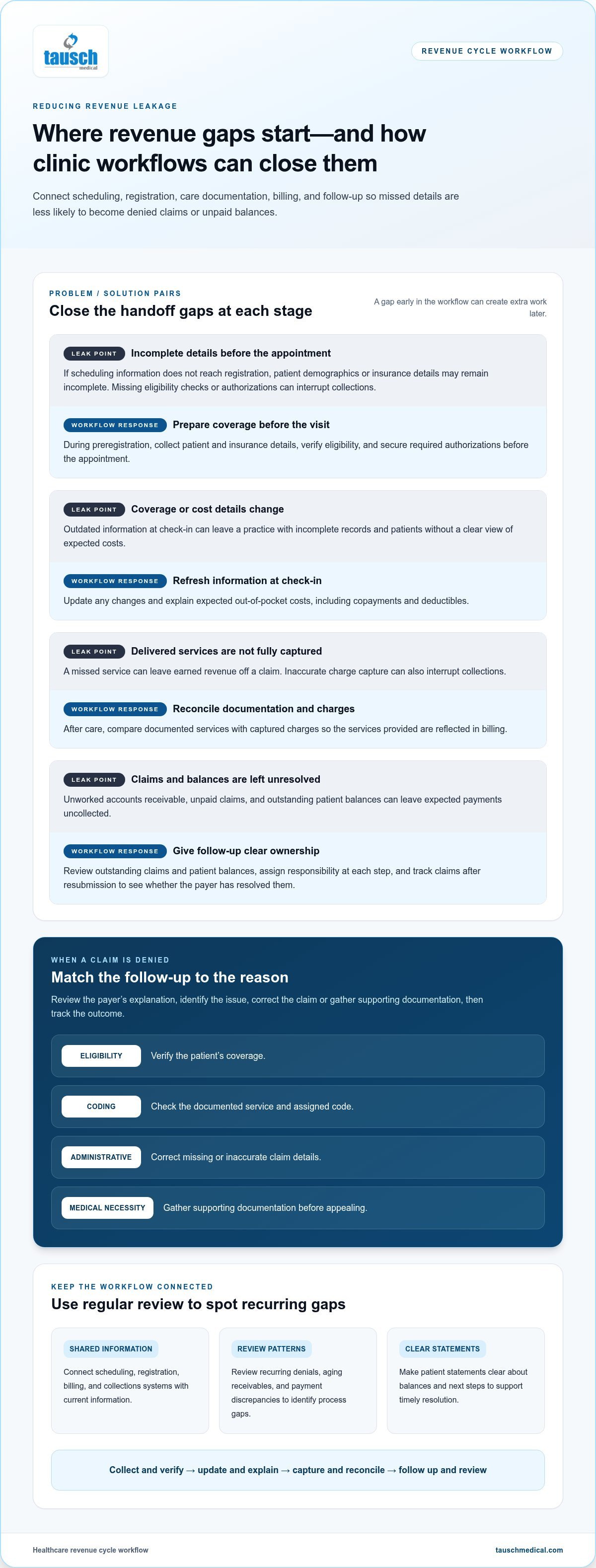
Revenue leakage can start with missed charges, registration errors, gaps in eligibility checks, or unresolved balances. Clinics can limit these gaps by connecting scheduling, patient access, documentation, and payment follow-up in a consistent workflow.
Common Causes of Revenue Leakage
Revenue leakage occurs when a practice fails to bill for delivered services or collect expected payment. For example, if a scheduling record does not reach registration, demographic or insurance details may remain incomplete. Missing authorizations, inaccurate charge capture, and unworked accounts receivable can also interrupt collections. When these tasks sit in separate systems, organizations may miss handoffs and discover problems only after claims are denied or balances remain unpaid.
Ways to Reduce Revenue Leakage
Start with preregistration: collect patient and insurance details, verify eligibility, and secure required authorizations before the appointment. At check-in, update any changes and explain expected out-of-pocket costs, including copayments and deductibles. After care, compare documented services with captured charges, then review outstanding claims and patient balances. Assigning clear ownership at each step helps staff find where a delay or omission began instead of treating every shortfall as a billing issue.
Revenue cycle management improves when scheduling, registration, billing, and collections systems share current information. Review recurring denials, aging receivables, and payment discrepancies to identify process gaps, then adjust staff workflows or system handoffs. Patient statements should clearly show balances and next steps, supporting timely resolution and a transparent experience. Regular review also helps organizations maintain accurate records and follow applicable regulatory and payer policies.
For recurring unpaid claims, strengthen claim follow-up and denial resolution with a focused workflow.
Tausch Medical: Medical Billing Services
Tausch Medical supports healthcare practices with medical billing services, insurance verification and authorization, accounts receivable management, and medical billing outsourcing. These services can help when claims follow-up, coverage checks, or billing workflows need focused operational support. Practices can use this support across key points in the revenue cycle while their teams concentrate on clinic operations.
Want to see how Tausch Medical can support your practice with reliable medical billing, prior authorization, eligibility verification, A/R follow-up, and RCM support? Start with our free two-week trial and experience the difference before making a commitment.
Build a More Resilient Revenue Workflow
Understanding the full revenue cycle in healthcare gives practice leaders a foundation for deciding where operational support may help. Start by identifying a handoff that takes up staff time, then define who owns it and how unresolved work is tracked. Reviewing the workflow with the team can show whether it fits the practice’s priorities and capacity. Deliberate adjustments can better align administrative work with patient-facing responsibilities.
Once the team has identified a workflow priority, consider whether experienced operational support could help address it while keeping the practice’s needs at the center.
Want to see how Tausch Medical can support your practice with reliable medical billing, prior authorization, eligibility verification, A/R follow-up, and RCM support? Start with our free two-week trial and experience the difference before making a commitment.
Frequently Asked Questions
What Is the Overall Goal of RCM?
The goal of RCM is to support accurate, timely payment for care while maintaining a financially sustainable practice. It aligns administrative work with services delivered, so revenue records reflect the care provided rather than missed charges or unresolved payer balances. For example, managers can review recurring payment delays and identify whether registration, documentation, or follow-up needs attention.
What are the main stages of the healthcare revenue cycle?
The main stages run from patient access and care documentation through coding, charge entry, claim submission, payment posting, and balance follow-up. Understanding the full revenue cycle in healthcare means recognizing how each handoff affects the next: incomplete intake information can complicate a claim later, while payment reconciliation shows whether an account has been resolved.
How does patient registration and insurance eligibility verification work?
Registration records a patient’s demographic and insurance details, while eligibility verification checks coverage relevant to planned services. Before an appointment, staff can confirm the insurer, review details such as copayments or deductibles, and identify authorization requirements. If a patient reports a plan change, updating the record helps prevent billing against outdated insurance information.
How do medical coding and charge capture affect healthcare billing?
Medical coding represents documented diagnoses and services with standardized codes, while charge capture records the billable services associated with an encounter. Codes should match the physician and date of service, and documentation should support the assigned codes. For example, if a note does not support a billed service, the mismatch can prompt a claim question or payment problem.
What are the steps for submitting and processing a healthcare insurance claim?
A practice prepares the claim with accurate patient, provider, and service details, checks it for completeness, and sends it to the appropriate payer. The payer reviews the submission and may pay in full, pay part, reject it, or deny it. Staff then post and reconcile payments. If a denial occurs, they address the reason, submit corrections or an appeal, and track the outcome.
Disclaimer
This article is for general informational purposes only and does not constitute legal, medical, billing, coding, compliance, or financial advice. Healthcare rules, payer policies, and reimbursement guidelines may change and may vary by situation. Please consult qualified professionals or official sources before making decisions based on this content. Tausch Medical is not responsible for any loss or liability arising from reliance on this information.


