


Article by
Dr. Sharafat Hussain Ph.D
Dr. Sharafat Hussain is a healthcare business consultant, entrepreneur, and academic with strong experience in the US healthcare industry. He is the Founder and Managing Director of Tausch Medical, a revenue cycle management company supporting US healthcare providers with medical billing, prior authorization, credentialing, eligibility verification, A/R follow-up, and patient support services. His work combines practical healthcare operations, business strategy, and academic insight to help medical practices improve efficiency, collections, and service quality.
A claim can pass clearinghouse edits and still fail to resolve with the payer. First-pass resolution rate is the percentage of claims paid on their first submission: divide first-pass-paid claims by total claims submitted, then multiply by 100. Applying first pass resolution rate best practices starts with keeping the counting rules consistent. For example, if 9,200 of 10,000 claims submitted during a month receive payment after their first submission, the rate is 92%.
A strong clean claim rate is useful, but it does not tell the whole story. First-pass resolution rate also reflects what happens after claims reach the payer. This article explains how to calculate the rate, how it differs from clean claim rate, and how to interpret it for your practice. You will also learn which revenue cycle processes affect first-pass performance and where more accurate workflows may help reduce rework and payment delays.
Key Takeaways
- Define which claims count as resolved on first submission, and keep that rule consistent when tracking performance.
- Use first-pass resolution and clean claim rate as distinct measures; each reveals a different point in the claims process.
- Compare results over time and by payer or service line to spot patterns that a single overall rate can hide.
- Review registration, authorization, coding, and claim submission workflows to identify where billing support could reduce avoidable rework.
How Do You Calculate First Pass Resolution Rate?
First-pass resolution rate measures whether a claim is paid on its initial submission, while first-call resolution tracks whether a patient’s need is addressed in a service interaction. Keep these measures distinct: one evaluates claims processing, the other patient service.
Defining First Pass Resolution
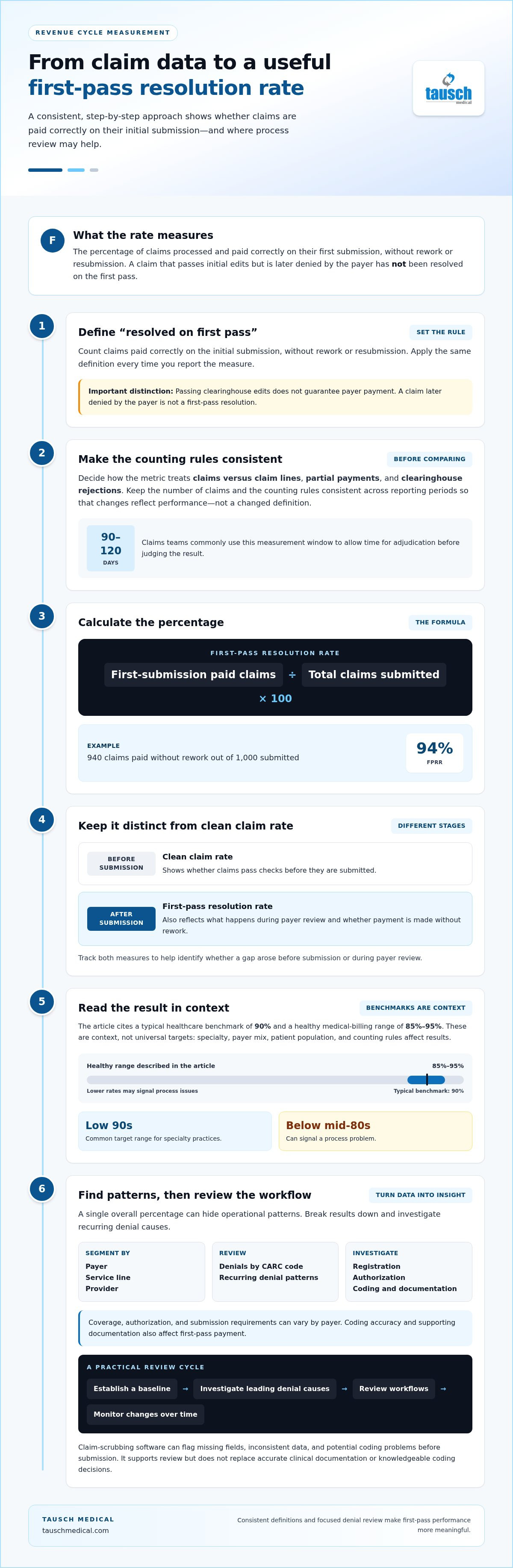
In revenue cycle management, first-pass resolution rate is the percentage of claims processed and paid correctly on their initial submission, without rework or resubmission. It reflects how effectively registration, authorization, coding, and documentation support payment. A claim that passes initial edits but is later denied by the payer has not been resolved on the first pass.
Calculating the Resolution Rate
Divide claims paid on the first submission by total claims submitted, then multiply by 100. For example, 940 of 1,000 claims paid without rework produce a 94% rate. Apply the same counting rules to each reporting period so changes reflect performance, not a different definition.
First-call resolution is a separate customer-service measure that applies across channels such as phone, email, and patient portals. Resolution means the patient completes the needed next step, not simply that a call ends. Patient satisfaction reflects the patient’s experience, while average handle time measures interaction length; neither confirms that the issue was resolved.
Customer service teams can improve first-call resolution by identifying the patient’s need, addressing it directly, and confirming the next step. Training in medical terminology, procedures, and common inquiries helps agents respond accurately, while a useful knowledge base supports consistent answers.
Routing patients to agents with relevant expertise can reduce transfers, while workforce management helps align coverage with incoming demand. However, prioritizing speed or a high resolution score over service quality can result in rushed answers or incomplete follow-through.
Audit performance by applying consistent definitions across channels and reviewing resolution trends alongside patient feedback and interaction duration. For claims, report the percentage by payer or service line and examine denials for recurring registration, authorization, or coding issues.
First pass resolution rate versus clean claim rate
Low first-pass performance often reflects registration errors, missing authorization, coding inaccuracies, or incomplete documentation. A claim can pass an initial edit and still receive a payer denial, so the measures reveal different process gaps.
Distinguishing Resolution from Clean Claims
Clean claim rate and first-pass resolution rate describe different stages of claims processing, with the latter also reflecting what happens after payer review. Passing clearinghouse edits does not guarantee that the payer will process and pay a claim without rework. For example, a correctly formatted claim may still be denied if its code, documentation, or authorization does not meet payer requirements. Track both measures to identify whether an issue arose before submission or during payer review.
Coding and Payer Factors
Medical coding affects first-pass resolution when codes do not accurately reflect services or lack supporting documentation. Payer mix also matters because coverage, authorization, and submission requirements can vary across plans. Out-of-network claims may have different coverage terms, making accurate eligibility information and payer-specific review especially useful. Compare denial patterns by payer and service line, then investigate recurring coding or authorization issues instead of relying on a single overall rate.
Claim-scrubbing software, including AI-assisted tools, can flag missing fields, inconsistent data, and potential coding problems before submission. These tools support review but do not replace accurate clinical documentation or knowledgeable coding decisions. Submit claims promptly and correct identified errors before transmission; unresolved issues can lead to denials, rework, and delayed collection.
When denial trends point to recurring claim errors, a structured denial management review can help organize follow-up and identify preventable patterns.
First pass resolution rate (FPRR)
FPRR helps a healthcare organization assess how effectively its billing processes support claim payment on initial submission. A typical healthcare benchmark is 90%, while a healthy range across medical billing generally falls between 85% and 95%. These benchmarks provide context, not a universal target, because specialty, payer mix, patient population, and counting rules influence results. Applying first pass resolution rate best practices means interpreting the metric alongside those factors.
For meaningful comparisons, keep the number of claims and counting rules consistent across reporting periods. Define whether the metric uses claims or claim lines, how it treats partial payments, and whether clearinghouse rejections count. Claims teams commonly measure performance over a 90-to-120-day window, allowing time for adjudication before judging the result.
A single percentage can conceal operational patterns. Break results down by payer, service line, and provider, then review denials by CARC code. Repeated authorization-related denials, for example, point to a different workflow issue than recurring coding errors. This detail helps teams connect billing results with targeted process reviews.
Specialty practices commonly target the low 90s, while rates below the mid-80s can signal a process problem. Use first pass resolution rate best practices to establish a baseline, investigate leading denial causes, and monitor whether corrective actions change performance over time.
A consistent billing workflow review can help identify areas for closer attention. Review your medical billing workflow to assess claim accuracy and follow-up processes.
Tausch Medical: Medical Billing Services
Tausch Medical provides medical billing services and medical billing outsourcing to help healthcare practices manage revenue cycle work. Insurance verification and authorization support claim preparation, while accounts receivable management helps practices follow up on outstanding balances.
These services may be useful when billing workloads, authorization tasks, or unpaid claims strain internal processes. Want to see how Tausch Medical can support your practice with reliable medical billing, prior authorization, eligibility verification, A/R follow-up, and RCM support? Start with our free two-week trial and experience the difference before making a commitment: free trial form
Turn Your Next Billing Review Into a Clear Action Plan
Use your next billing review to choose a process improvement, assign responsibility, and decide how your team will measure progress. A focused action plan can turn revenue cycle observations into practical workflow changes that reflect your practice’s priorities.
Want to see how Tausch Medical can support your practice with reliable medical billing, prior authorization, eligibility verification, A/R follow-up, and RCM support? Start with our free two-week trial and experience the difference before making a commitment: free trial form
Frequently Asked Questions
Why is first pass resolution more important than ever?
Unresolved claims consume staff time and can delay revenue as teams investigate, correct, and resubmit them. Because payer requirements and practice workflows vary, monitoring first-pass outcomes helps organizations spot emerging issues instead of treating each denial as an isolated event. Reviewing recurring denial reasons helps teams focus on the processes most affecting payment.
What are the main benefits of a high FCR rate?
A high first-call resolution rate can reduce repeat contacts, avoid duplicated staff effort, and help patients complete necessary next steps. For example, a patient who receives a clear answer about what to do after a scheduling call may not need another interaction to clarify the same issue. Track patient feedback alongside resolution so speed does not take the place of a complete, accurate response.
What benchmarks should specialty practices target for first pass resolution?
Outpatient mental health practices handling time-based psychotherapy claims typically sustain first-pass rates in the low-to-mid 90s when verification and coding processes are disciplined. A specialty practice’s meaningful target depends on payer mix, services, and consistent counting rules. Compare results with the practice’s own historical performance, then examine specific service lines to see whether a broader average is masking a localized billing issue.
What is a good first pass resolution rate benchmark by industry and channel?
For healthcare claims, benchmarks depend on specialty, payer mix, and how an organization counts claims; contact-center figures measure a different process. The industry standard for first-call resolution is about 75%, but it shouldn’t be treated as a medical-claim target. Compare like with like: patient-contact resolution by channel, and claim payment outcomes by payer or service line.
What processes and tools help agents resolve issues on the first contact?
Standardized protocols for common questions help agents give consistent answers, while post-contact follow-up can confirm that patients’ concerns were addressed. Call analytics can reveal repeat-contact patterns, and regular feedback from patients and agents can highlight gaps in existing procedures. Recurring questions about appointment preparation, for instance, may signal a need to clarify the information provided during scheduling.
Disclaimer
This article is for general informational purposes only and does not constitute legal, medical, billing, coding, compliance, or financial advice. Healthcare rules, payer policies, and reimbursement guidelines may change and may vary by situation. Please consult qualified professionals or official sources before making decisions based on this content. Tausch Medical is not responsible for any loss or liability arising from reliance on this information.


