


Article by
Dr. Sharafat Hussain Ph.D
Dr. Sharafat Hussain is a healthcare business consultant, entrepreneur, and academic with strong experience in the US healthcare industry. He is the Founder and Managing Director of Tausch Medical, a revenue cycle management company supporting US healthcare providers with medical billing, prior authorization, credentialing, eligibility verification, A/R follow-up, and patient support services. His work combines practical healthcare operations, business strategy, and academic insight to help medical practices improve efficiency, collections, and service quality.
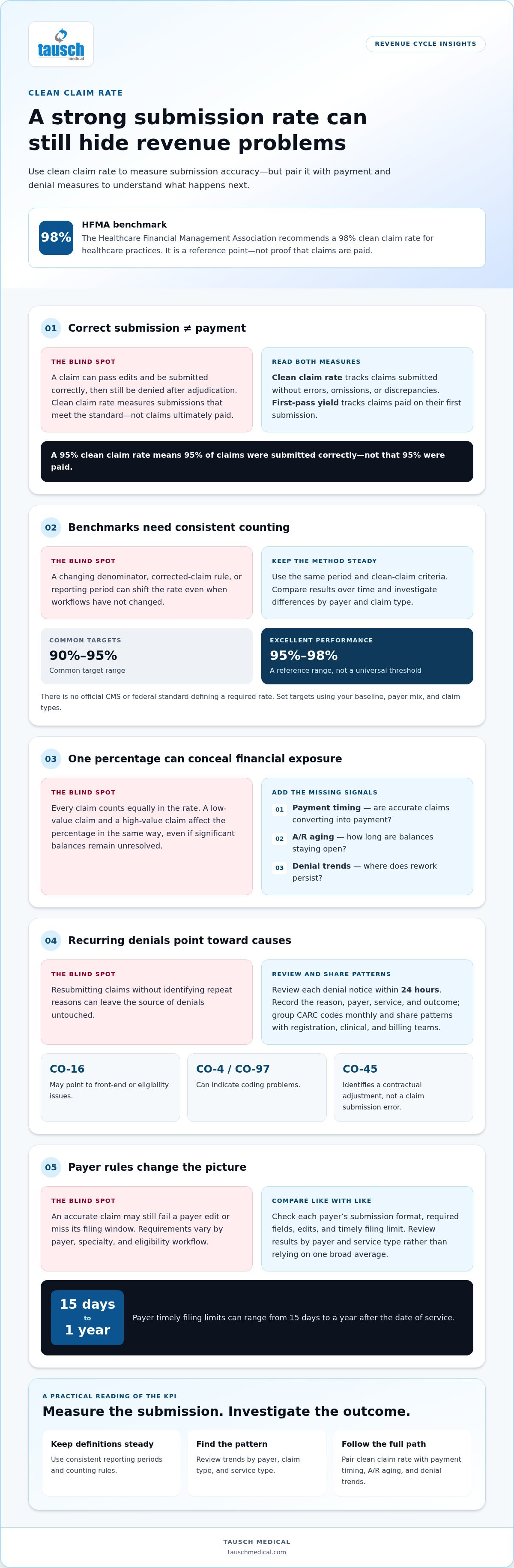
A clean claim rate can look strong while important revenue cycle problems remain hidden. A clean healthcare claim is submitted without errors, omissions, or discrepancies and meets payer requirements on its first submission; the rate is the percentage of claims that meet that standard. According to the Healthcare Financial Management Association, a 98% clean claim rate is a benchmark for healthcare practices, though the metric alone doesn’t show whether claims are ultimately paid.
It’s understandable to focus on clean claims: accurate submissions can reduce avoidable rework and keep billing operations moving. But the clean claim rate captures only part of performance, so use it alongside other indicators. This article explains what counts as a clean claim, why benchmarks vary, and where the KPI has limits. It also covers practical clean claim rate improvement strategies, from strengthening patient-information workflows to reviewing recurring errors and denials.
Key Takeaways
- Understand what makes a claim clean and how eligibility, medical necessity, and coding issues can disrupt first-pass processing.
- Compare your rate with industry benchmarks, while recognizing that a benchmark is a reference point rather than a universal standard.
- Pair clean claim rate with other revenue cycle measures to reveal payment delays and denials that this KPI alone can miss.
- Explore how billing, insurance verification, authorization, and A/R support can help address recurring workflow challenges.
What are Clean Claims?
A clean claim passes validation and payer-specific edits before submission without manual correction. The clean claim rate measures claims that pass those checks; first-pass yield measures claims paid on their first submission. The distinction matters: a claim can be submitted correctly and still be denied after adjudication.
Eligibility, medical necessity, and coding all affect claim outcomes. Verify that patient details match payer records and coverage is active, since eligibility can change between scheduling and service. Confirm that documentation supports each billed service and its medical necessity. Regular coding audits, staff education, and structured documentation templates help align procedure codes, service dates, and provider names with the medical record.
Automation can flag missing fields or inconsistent codes before a claim leaves the practice, but overly aggressive edits may hold valid claims or introduce errors when rules are outdated. Check flagged claims against the clinical record and payer requirements, then update edits when false flags recur. Targeted manual review helps protect accuracy without treating every alert as proof of an error.
For denied claims, review each notice within 24 hours and record the reason, payer, service, and outcome. Track denial reasons monthly, grouping CARC codes to expose root causes: CO-16 may point to front-end or eligibility issues, while CO-4 and CO-97 can indicate coding problems. Share patterns with registration, clinical, and billing teams so prevention addresses the source, not just resubmission.
Clean submissions can reduce avoidable denials, but they cannot prevent every adjustment. CO-45, for example, identifies a contractual adjustment rather than a claim submission error. A 95% clean claim rate means 95% of claims were submitted correctly, not that 95% were paid.
Clean claim rate benchmarks
Benchmarks help practices compare submission accuracy with common performance expectations, but they are useful only when calculation methods are consistent. Effective clean claim rate improvement strategies treat benchmarks as context and examine the practice’s own results by payer and claim type.
Calculating the Clean Claim Rate
Calculate the percentage by dividing clean claims by all claims submitted during the same reporting period, then multiplying by 100. For example, 90 clean claims out of 100 submissions equal a 90% rate. Keep the denominator and rules for counting corrected claims consistent between reports. That lets a practice distinguish genuine progress from a change in reporting format and see whether administrative errors are becoming less frequent.
Setting Clean Claim Rate Targets
The Healthcare Financial Management Association recommends a 98% clean claim rate benchmark for healthcare practices. Other common targets range from 90% to 95%, while 95% to 98% is described as excellent performance. These figures are reference points, not a universal threshold; there is no official CMS or federal standard defining a required rate. Set a target using your baseline, payer mix, and claim types. Among practical clean claim rate improvement strategies, compare results over time and investigate persistent differences before raising the target.
For a fair comparison, keep the reporting period and clean-claim criteria consistent. Payer requirements, specialty, and eligibility workflows can all affect performance, so an industry benchmark may not explain a local change. If a target is missed, review trends by payer and service type, then address recurring documentation or coding issues. This makes the benchmark a management tool, not a score that rewards a percentage without revealing its causes.
Limitations of clean claim rate as a revenue cycle KPI
A clean claim rate reflects submission quality, but it cannot show the full financial health of a revenue cycle. Each claim counts equally, so a low-value claim and a high-value claim affect the percentage in the same way. A practice could improve its rate while significant balances remain unresolved.
Pair the KPI with payment timing, accounts receivable aging, and denial trends to assess operational and financial performance. Together, these measures show whether accurate submissions are converting into payment, where rework persists, and how long balances remain open. Clean claim rate improvement strategies are more effective when they account for the full path from submission through payment, rather than optimizing one percentage alone.
Reporting choices can also skew comparisons. Changes to the denominator, corrected-claim treatment, or reporting period may shift the result even when workflows have not changed. Keep definitions consistent, then compare results by payer and service type. A broad average can conceal a recurring payer-specific issue or a bottleneck affecting one category of claims.
Payer requirements create another limit: an accurate claim can still fail a payer edit or miss its filing window. Check each payer’s submission format, required fields, edits, and timely filing limit, which can range from 15 days to a year after the date of service. Well-designed clean claim rate improvement strategies account for these payer differences instead of treating every variation as a staff error.
Use the rate as one dashboard measure, then investigate causes alongside payment results and outstanding balances. Accurate provider records also matter; provider credentialing services can support alignment between provider information and claim details.
Tausch Medical: Medical Billing Services
Tausch Medical supports healthcare practices with medical billing services that connect accurate claim submission with organized follow-up. When recurring denials, unresolved balances, or eligibility gaps affect internal workflows, practices can use insurance verification and authorization, accounts receivable management, and medical billing outsourcing to strengthen revenue cycle operations.
These services address different points in the billing process: verification and authorization support front-end accuracy, while billing and A/R management support claim handling and follow-up. The right focus depends on where a practice faces persistent workflow issues, such as missing coverage details or claims that need continued attention.
If your practice is reviewing its billing support needs, contact Tausch Medical to discuss the next step.
Turn KPI insight into a focused improvement plan
Use your clean claim rate as a starting point for a practical review, not as the final measure of financial health. Choose a recurring workflow issue, assign clear ownership, and assess whether changes improve both submission quality and payment follow-through.
Tausch Medical supports healthcare providers with billing needs through revenue cycle services, including billing, insurance verification, authorization, and A/R follow-up.
Want to see how Tausch Medical can support your practice with reliable medical billing, prior authorization, eligibility verification, A/R follow-up, and RCM support? Start with our free two-week trial and experience the difference before making a commitment.
Frequently Asked Questions
How Can You Prevent Claims Errors Before They Happen?
Build prevention into intake and handoffs instead of relying on billing staff to catch every issue at submission. For example, make subscriber details required during registration and return incomplete records to the responsible team. When an error occurs, document where it entered the workflow and share that finding with the staff member or team best positioned to prevent it from recurring.
How Should You Optimize Your Claims Workflow?
Make every handoff visible and assign an owner to unresolved items. A practice might separate claims awaiting documentation from those needing payer information, then track which queue is holding them. Review exceptions regularly and address upstream delays before they build up. This helps distinguish a slow handoff from a submission problem, giving managers a clearer basis for workflow changes.
What Technology Solutions Can Improve Your Claims Process?
Technology can validate required fields, apply payer-specific edits, and route exceptions to staff before submission. Connect clinical and billing workflows where possible to reduce repeated manual entry, while keeping edit rules current as payer requirements change. Also review a sample of claims that pass automated checks. This can reveal errors the rules miss and help ensure automation is not the only quality control.
What makes a claim “dirty”?
A claim is considered dirty when errors, missing information, or mismatches with payer rules prevent clean processing. Examples include an incorrect subscriber identifier, a procedure code that conflicts with documentation, or a required authorization detail missing from the submission. The underlying issue may begin during registration, documentation, coding, or billing, so correct the source rather than only fixing the individual claim.
Why are Claim Denials Increasing?
Healthcare denial rates have risen by more than 20 percent over the past five years. The causes can vary across practices and payers: changing submission edits, coverage details that differ from those recorded, incomplete documentation, or coding that does not match the service. Compare denial reasons over time and by payer to see whether the increase reflects one recurring workflow issue or several distinct causes.
Disclaimer
This article is for general informational purposes only and does not constitute legal, medical, billing, coding, compliance, or financial advice. Healthcare rules, payer policies, and reimbursement guidelines may change and may vary by situation. Please consult qualified professionals or official sources before making decisions based on this content. Tausch Medical is not responsible for any loss or liability arising from reliance on this information.


