


Article by
Dr. Sharafat Hussain Ph.D
Dr. Sharafat Hussain is a healthcare business consultant, entrepreneur, and academic with strong experience in the US healthcare industry. He is the Founder and Managing Director of Tausch Medical, a revenue cycle management company supporting US healthcare providers with medical billing, prior authorization, credentialing, eligibility verification, A/R follow-up, and patient support services. His work combines practical healthcare operations, business strategy, and academic insight to help medical practices improve efficiency, collections, and service quality.
Credentialing work may be handled closer to a practice, while final decision-making arrangements can vary. In the delegated credentialing vs. traditional credentialing comparison, the key difference is who verifies a provider’s qualifications and handles the credentialing decision: an authorized healthcare organization or the payer directly. In both models, primary source verification is central to evaluating a provider’s credentials.
This distinction shapes how responsibilities, oversight, and ongoing monitoring are organized. The right model depends on a practice’s operational capacity and payer arrangements. This article explains delegated credentialing, primary source verification, and who handles each part of the traditional and delegated processes, so you can understand where the work sits.
Key Takeaways
- Identify who performs credentialing and who retains final decision-making authority in each model.
- Assess whether your organization’s provider volume, payer relationships, and compliance capacity align with delegation eligibility.
- Understand how primary source verification supports credentialing decisions and which records need careful review.
- Compare the operational responsibilities and oversight involved to determine which approach best fits your practice.
What is Delegated Credentialing?
Delegated credentialing can involve a healthcare organization carrying out credentialing tasks on a payer’s behalf. The payer delegates credentialing tasks but retains final decision rights.
Delegation Eligibility and Provider Volume
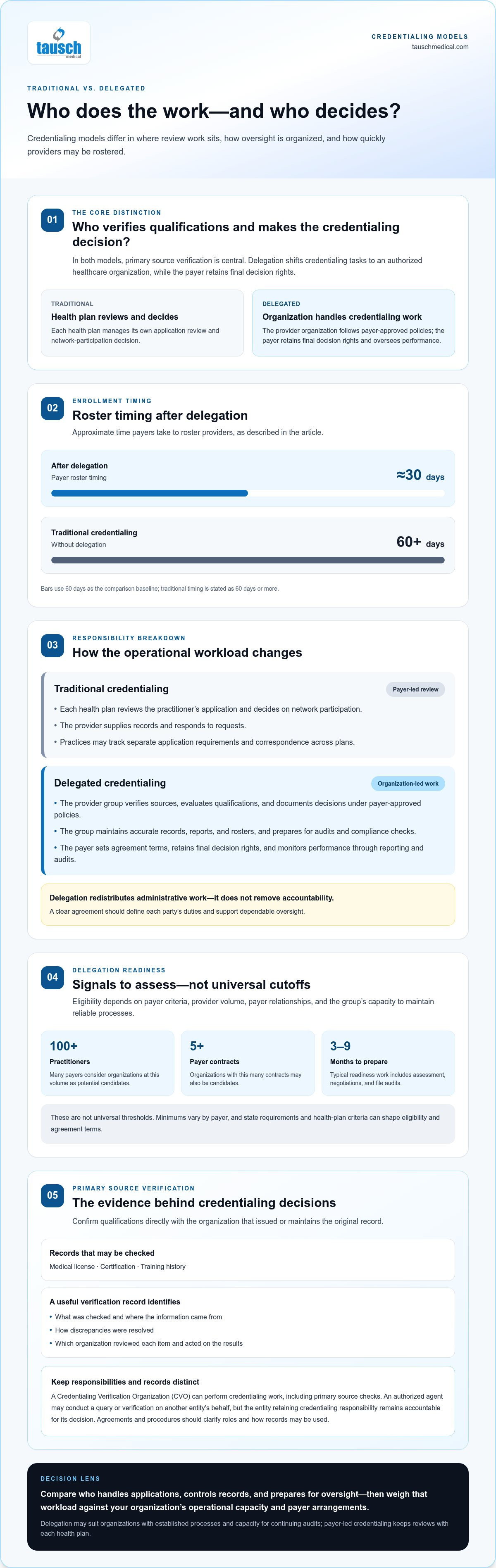
Eligibility depends on payer criteria, provider volume, and the group’s ability to maintain reliable verification and compliance processes. Many payers consider organizations with 100 or more practitioners as potential candidates; organizations with five or more payer contracts may also be candidates. These are not universal thresholds, because minimums vary by payer. State requirements and health-plan criteria can shape agreement terms and eligibility. Preparing a delegation-ready program typically takes 3-9 months, including readiness assessment, negotiations, and file audits. Volume matters because delegated work requires ongoing operational capacity, not only an initial review.
Enrollment Speed and Network Expansion
Delegated credentialing shifts parts of the credentialing process to the provider organization, which can support more coordinated onboarding. After delegation, payers take approximately 30 days to roster providers; traditional credentialing without delegation takes 60 or more days. Timely roster updates help payers assess network participation and can help specialists move toward enrollment. This may support practice growth, new locations, or network expansion, while reducing delays between verification and payer processing. Credentialing status alone does not determine reimbursement; payer enrollment and network participation also matter.
Payer and Provider Responsibilities
The provider group verifies sources, evaluates qualifications, and documents credentialing decisions under payer-approved policies. Payers set the agreement terms, retain final decision rights, and oversee delegated performance. Many payers require regular credentialing status reports or provider rosters, so groups need accurate records and a consistent reporting process. Delegation can streamline repeated reviews, but it also adds responsibility for audits, compliance checks, and follow-up. A clear agreement defines each party’s duties and supports dependable oversight as the organization onboards providers.
Primary source verification
Primary source verification confirms a practitioner’s qualifications directly with the organization that issued or maintains the original record. Depending on the credential, this may include a medical license, certification, or training history. The verification record should identify what was checked, where the information came from, and how discrepancies were resolved. Accurate records support sound credentialing decisions and help prevent errors in enrollment workflows.
A Credentialing Verification Organization (CVO) can perform credentialing work for a healthcare organization, including primary source checks. In a delegated arrangement, a provider group with suitable infrastructure and personnel may manage verification, compliance checks, and data reporting. For example, a hospital may coordinate practitioners’ records under payer-approved processes. A CVO can help streamline this work, but delegation does not guarantee payer approval or network enrollment.
Authority depends on the relationship. Under delegated credentialing, the organization evaluates qualifications and makes credentialing decisions for the payer under their agreement, while the payer retains final decision rights. An authorized agent may also conduct a query or verification on another entity’s behalf, but that is a distinct role: the entity retaining credentialing responsibility remains accountable for its decision. Clear records show which organization reviewed each item and acted on the results.
To assess verification accuracy, organizations can compare source records with application details, document follow-up on conflicting information, and review completed files for missing evidence. Those controls matter whether verification sits with the provider group or a CVO. Practices seeking support with this workflow can explore provider credentialing support as part of their enrollment operations.
Traditional versus delegated credentialing responsibilities
In traditional credentialing, each health plan reviews a practitioner’s application and decides whether to approve network participation. The provider supplies records and responds to requests, while the payer manages its own review process. A practice working with several plans may need to track separate application requirements and correspondence. This can simplify the practice’s decision-making role, but review timing remains part of each payer’s workflow.
The distinction in delegated credentialing vs. traditional credentialing is who performs the review and carries the ongoing operational workload. Under delegation, a healthcare organization follows payer-approved policies, documents decisions, and maintains records for oversight. The health plan monitors the arrangement through reporting and audits, while the provider group keeps its processes ready for review. Delegation redistributes administrative work; it does not remove accountability.
NPDB queries illustrate why responsibilities must be clearly separated. If a hospital queries as a PPO’s authorized agent, the response is for the PPO’s use, and the hospital cannot reuse that query for its own credentialing. The hospital must submit its own mandatory query directly or through an authorized agent. Agreements and internal procedures should distinguish these roles to prevent records from being used beyond their intended purpose.
For a delegated credentialing vs traditional credentialing decision, compare who handles applications, controls records, and prepares for oversight. Delegation may suit organizations with established processes and capacity for continuing audits; payer-led credentialing keeps those reviews with each health plan. Practices seeking help organizing provider credentialing workflows can explore provider credentialing services.
A delegated hospital or DSO may make future credentialing decisions for a PPO and handle credentialing without going through it. Recredentialing follows a structured cycle every 2-3 years.
Tausch Medical: Medical Billing Services
Tausch Medical supports healthcare practices with medical billing, insurance verification and authorization, accounts receivable management, and medical billing outsourcing. After credentialing decisions are made, these services can help practices manage related revenue-cycle work, including insurance checks and claim follow-up. This support is relevant when administrative demands make billing workflows harder to manage consistently, or when a practice is considering outsourcing billing operations. It complements credentialing without replacing payer approval, provider verification, or network enrollment decisions. To discuss how Tausch Medical’s services could fit your practice, contact Tausch Medical.
Choose a Credentialing Model That Fits Your Next Stage
The distinction between delegated and payer-led credentialing can guide how a practice plans its administrative capacity as it grows. Once roles and internal workflows are clear, healthcare providers can assess whether additional operational support would help their teams manage day-to-day responsibilities efficiently.
Want to see how Tausch Medical can support your practice with reliable medical billing, prior authorization, eligibility verification, A/R follow-up, and RCM support? Start with our free two-week trial and experience the difference before making a commitment.
Frequently Asked Questions
Cons: What Are the Downsides?
The main downside is that delegation shifts substantial administrative and compliance work to the provider organization. It must maintain complete files, follow payer policies, track reporting deadlines, and prepare for oversight audits. If staff capacity or documentation practices are weak, gaps can affect the program and provider records. Before pursuing delegation, assess whether your organization can sustain these duties alongside routine credentialing work.
How Long Does It Take to Become Delegated?
Organizations typically need 3-9 months to become delegated. Readiness assessments, agreement negotiations, process development, and initial file audits all contribute to the timeline. The work also involves establishing clear responsibilities and demonstrating consistent credentialing operations. A group planning for delegation can map these activities against staffing and payer engagement, then identify process gaps before formal reviews begin.
Pros: What Are the Benefits?
Delegation can give a qualified provider organization greater control over credentialing workflows and help coordinate onboarding with staffing plans. For example, a group adding specialists across locations can organize file reviews through a consistent internal process. This can reduce reliance on separate payer-led workflows and support expansion planning, provided the organization can maintain the required oversight and documentation.
What Is Delegated Credentialing in Healthcare?
Delegated credentialing is an arrangement in which a payer authorizes a healthcare organization to credential practitioners on its behalf. For example, a hospital may evaluate a physician’s credentials under an agreement with a preferred provider organization. The agreement assigns defined credentialing functions to the organization, while the payer retains final decision rights.
How Does Traditional Provider Credentialing Work?
In traditional provider credentialing, each practitioner applies directly to the insurer, which reviews qualifications and determines credentialing status. A physician joining several health plans may need to complete separate applications and respond to each plan’s requests. The practice can support the process by supplying accurate records and tracking application progress, while each payer manages its own review and network decision.
Disclaimer
This article is for general informational purposes only and does not constitute legal, medical, billing, coding, compliance, or financial advice. Healthcare rules, payer policies, and reimbursement guidelines may change and may vary by situation. Please consult qualified professionals or official sources before making decisions based on this content. Tausch Medical is not responsible for any loss or liability arising from reliance on this information.


