


Article by
Dr. Sharafat Hussain Ph.D
Dr. Sharafat Hussain is a healthcare business consultant, entrepreneur, and academic with strong experience in the US healthcare industry. He is the Founder and Managing Director of Tausch Medical, a revenue cycle management company supporting US healthcare providers with medical billing, prior authorization, credentialing, eligibility verification, A/R follow-up, and patient support services. His work combines practical healthcare operations, business strategy, and academic insight to help medical practices improve efficiency, collections, and service quality.
Preventing common billing errors starts with matching current codes to clinical documentation, confirming patient and insurance details, and checking claims for duplicates before submission. Knowing how to prevent common billing errors also means reviewing denials and recurring discrepancies, since mistakes can delay reimbursement and create avoidable work for a practice.
Accurate billing depends on a consistent process, not just a last-minute review. Keep coding aligned with the care provided, verify coverage and authorization, check for duplicate claims, and use regular audits to identify patterns before they disrupt revenue and operations.
Key Takeaways
- Compare billed codes with clinical documentation and keep coding workflows aligned with current code definitions.
- Track claim submissions and check processing status before resending a rejected or delayed claim.
- Verify patient details, insurance coverage, and required authorizations to reduce preventable claim rework.
- Review denials and recurring discrepancies to identify where billing processes may be affecting reimbursement and operations.
1. Coding accuracy and current code definitions
A practical approach to how to prevent common billing errors begins with current code definitions and documentation that supports each service. Before submitting a claim, verify that the diagnosis, procedure, modifier, patient information, eligibility, and authorization align. An outdated code or mismatch can prevent a payer from processing an otherwise accurate claim. These checks also give staff a consistent review point in the medical billing workflow.
Common errors include outdated codes, unsupported services, incorrect modifiers, and upcoding. Downcoding can also leave documented services unbilled. Match each code to the care provided, and use modifiers only when documentation supports them. For example, modifier 22 indicates increased procedural services, so records should explain the additional work. Never infer details the clinical note doesn’t establish.
For teams assessing how to prevent common billing errors, regular training and audits provide practical safeguards. Train coding and billing staff on code updates, payer edits, and documentation standards. Internal audits can compare clinical records, billed codes, charges, and payments, revealing recurring discrepancies. An external review can offer another perspective on persistent issues. The U.S. Department of Health and Human Services states that HIPAA violations can result in fines of up to $50,000 per violation.
To reconcile invoices, payments, and accounting records, match each submitted claim with its remittance advice, patient balance, and ledger entry. Investigate differences and document adjustments. Reduce data-entry errors by confirming patient details at each visit and following a consistent pre-submission checklist.
When an error appears, identify the affected claim, correct the underlying code or record, and follow the payer’s correction process. Notify the patient if the error changes their bill or balance. Use audit findings to guide staff training and prevent repeat issues.
2. Duplicate claim prevention
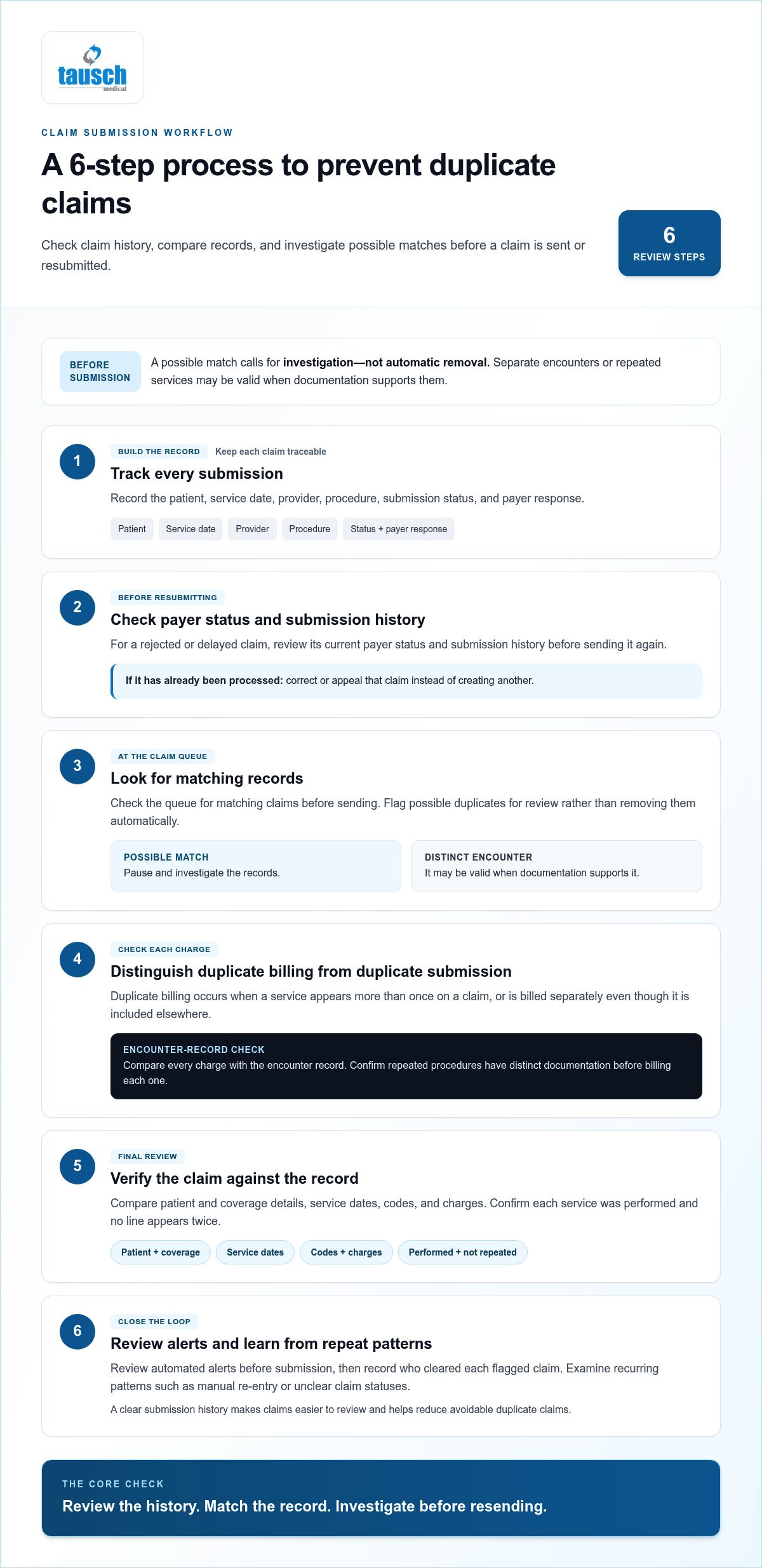
A duplicate claim can trigger a denial, delay payment, and add administrative work. It may result from a mistaken resubmission, repeated data entry, or a system sending the same claim twice. Before resubmitting a rejected or delayed claim, review its payer status and submission history. If it has already been processed, correct or appeal that claim instead of creating another.
Use a tracking process that records the patient, service date, provider, procedure, submission status, and payer response. Before sending claims, check the queue for matching records and flag possible duplicates for review. A match calls for investigation, not automatic removal: separate encounters or repeated services may be valid when the documentation supports them.
Duplicate billing differs from duplicate submission. It occurs when a service appears more than once on a claim, or when a service is billed separately even though it is included elsewhere. Compare each charge with the encounter record. For example, confirm that repeated procedures have distinct documentation before billing each one.
Staff guidance on how to prevent common billing errors should include invoice review. Compare patient and coverage details, service dates, codes, and charges with the record. Confirm that each service was performed and that no line appears twice. Review automated alerts before submitting, then record who cleared each flagged claim. These checks help catch costly mistakes and keep financial records traceable.
To understand how to prevent common billing errors in recurring workflows, examine what generates duplicate patterns, such as manual re-entry or unclear claim statuses. Strong medical billing workflows make submission history easier to review and help reduce avoidable duplicate claims.
3. Billing errors’ effects on reimbursement and operations
A claim denial can interrupt revenue even when treatment was delivered correctly. An incorrect patient name or incomplete documentation may prevent an insurer from processing payment. The practice must investigate, correct the record, resubmit the claim, and monitor the response. This work takes staff away from scheduling, patient communication, and other billing tasks.
Compliance gaps create measurable exposure: about 10% of medical claims are rejected due to a lack of compliance. When errors recur, providers may face insurer claims reviews requiring records, explanations, and corrections. Those requests extend resolution time and increase administrative demands. Track denial reasons by code, payer, and department to locate repeat failures.
The revenue impact also builds across unpaid claims and delayed follow-up. A missing document can hold a claim, while an inaccurate code can cause rejection. Review each explanation of benefits, classify the denial, and assign a clear owner. Corrected claims and timely appeals help keep unresolved balances visible in accounts receivable.
Patients can feel the effects, too: an incorrect bill may prompt disputes or increase out-of-pocket costs. Explain adjustments clearly, then reconcile patient balances after payer decisions. During each review, compare denials with documentation, workflows, and staff guidance. This turns individual claim corrections into process improvements rather than repeated fixes.
Protecting revenue requires accurate claim handling and follow-through on unresolved balances. For recurring denials, explore denial resolution support to strengthen follow-up and address avoidable operational rework.
Prompt attention matters because billing errors can delay or prevent healthcare reimbursement and require time-consuming claim resubmissions. Healthcare providers should address billing problems quickly to reduce recurring revenue losses. Repeated errors may also require supplying records, explaining inconsistencies, and making corrections during insurer claim reviews. Accurate bills matter to patients, too: errors can erode trust and lead to disputes or higher out-of-pocket costs.
Tausch Medical: Medical Billing Services
Tausch Medical supports healthcare practices with medical billing services and medical billing outsourcing. When billing work becomes difficult to manage internally, structured support can help maintain claim submission and follow-up workflows. Insurance verification and authorization help address coverage and approval steps before claims reach the payer, while accounts receivable management helps track outstanding balances for follow-up.
This support is useful when recurring billing errors, unresolved claims, or administrative demands put pressure on practice operations. Tausch Medical’s services can complement a practice’s efforts to improve billing consistency and manage reimbursement workflows. Clinical documentation and coding decisions should remain grounded in the care provided.
Contact Tausch Medical to discuss medical billing support for your practice.
Build a More Resilient Billing Process
Reliable billing depends on a process that can adapt as practice needs and payer requirements change. Set aside time to review workflow ownership and decide where consistent support would help your team stay focused on patient care and practice operations.
Want to see how Tausch Medical can support your practice with reliable medical billing, prior authorization, eligibility verification, A/R follow-up, and RCM support? Start with our free two-week trial and experience the difference before making a commitment.
Use the trial to assess how the support fits your practice’s workflow, then choose a next step with clarity and confidence.
Frequently Asked Questions
What billing software features help prevent errors?
Billing software can flag missing fields, validate patient details, import information from medical records, and identify potential duplicate billing before transmission. It can also centralize claim status and payment posting, helping staff distinguish a draft from a submitted claim. Treat alerts as prompts for review: staff still need to compare exceptions with documentation and payer responses.
What steps prevent duplicate charges and duplicate invoices?
Link each billable service to a distinct encounter record, then check invoice status before creating another statement. For example, if a corrected invoice replaces an earlier one, mark the original as void or superseded in the ledger, then issue only the corrected version. A queue that flags matching patient details, service dates, and charges can help reveal accidental repeats.
What controls help catch billing mistakes before payment is collected?
Put a statement on hold if a coding, payment-posting, or patient-balance discrepancy remains unresolved. Before releasing it, have a reviewer compare the charge with the encounter record, confirm insurance and payment postings, and document approval or correction. A clear escalation path keeps disputed balances from moving to collection while staff determine the amount owed.
What are the risks and costs of billing errors for businesses?
Billing errors can delay or prevent reimbursement, take staff time to correct, and trigger patient disputes over unexpected balances. Recurring patterns may prompt payer reviews that require records and explanations, diverting providers from administrative and clinical responsibilities. Practices in Houston, San Antonio, Dallas, Austin, El Paso, Arlington, Plano, New York, Boston, Philadelphia, Washington, D.C., Baltimore, Miami, Orlando, Tampa, Atlanta, Raleigh, Richmond, and Jacksonville can face these operational pressures.
Disclaimer
This article is for general informational purposes only and does not constitute legal, medical, billing, coding, compliance, or financial advice. Healthcare rules, payer policies, and reimbursement guidelines may change and may vary by situation. Please consult qualified professionals or official sources before making decisions based on this content. Tausch Medical is not responsible for any loss or liability arising from reliance on this information.


