


Article by
Dr. Sharafat Hussain Ph.D
Dr. Sharafat Hussain is a healthcare business consultant, entrepreneur, and academic with strong experience in the US healthcare industry. He is the Founder and Managing Director of Tausch Medical, a revenue cycle management company supporting US healthcare providers with medical billing, prior authorization, credentialing, eligibility verification, A/R follow-up, and patient support services. His work combines practical healthcare operations, business strategy, and academic insight to help medical practices improve efficiency, collections, and service quality.
Credentialing typically takes 60–120 days, and common provider credentialing delays often stem from incomplete applications, missing documentation, or payer-specific review steps. Set expectations around a process with several dependencies rather than a fixed start date, and build time for follow-up into the plan.
Common provider credentialing delays can be frustrating, especially when a provider’s start date is approaching and the application seems complete. A returned form, missing document, or payer review queue can all slow progress, so clear communication matters as much as early preparation.
This article explains how to manage provider expectations, prepare for payer-specific requirements, and distinguish initial credentialing delays from recredentialing setbacks. You’ll also find practical ways to keep applications moving and understand when credentialing support can ease administrative pressure on your practice.
Key Takeaways
- Review applications for missing signatures, incomplete fields, and outstanding provider documents before submission to reduce avoidable processing setbacks.
- Map each payer’s requirements and track applications separately, since review timelines and enrollment steps can vary across health plans.
- Prepare for recredentialing early by keeping provider records and CAQH profiles current, then monitor deadlines and follow up on pending reviews.
- When credentialing-related administrative work strains practice operations, Tausch Medical’s billing, insurance verification and authorization, and accounts receivable support can help strengthen revenue cycle workflows.
1. How Do You Manage Provider Expectations During Credentialing?
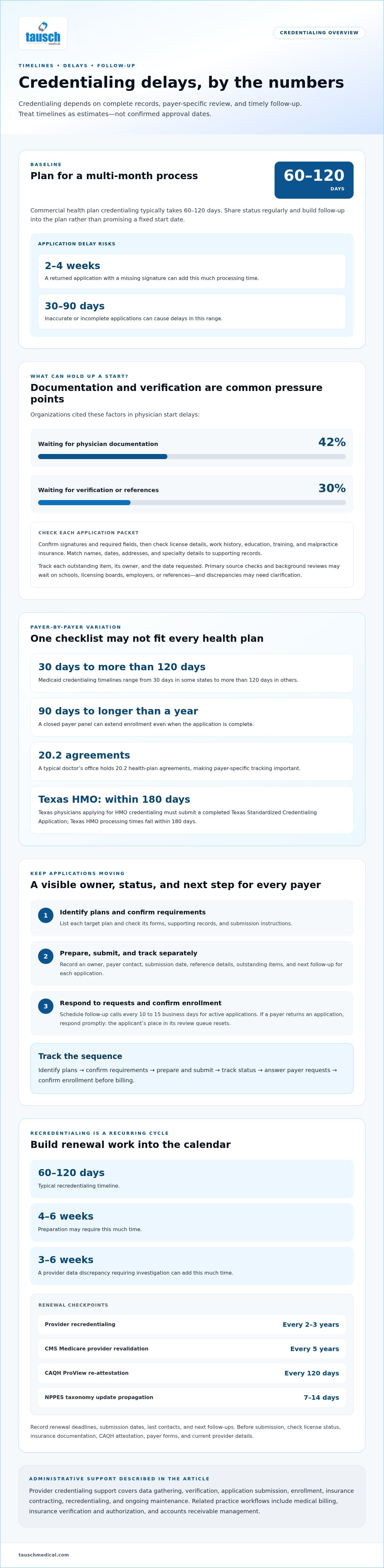
Common provider credentialing delays often start with incomplete applications, missing signatures, or slow provider responses. A returned application with a missing signature can add 2–4 weeks to processing, while inaccurate or incomplete applications can cause a 30- to 90-day delay. Explain these risks before setting a start date, and treat typical credentialing timelines as estimates rather than confirmed approval dates.
Before submitting, compare each application with a documentation checklist. Confirm that the provider’s license details, work history, education, training, and malpractice insurance information are complete and consistent. Check names, dates, addresses, and specialty details against supporting records. A mismatch between an application and a source document can prompt follow-up, even when the rest of the file is ready. Set an internal deadline for providers to return outstanding documents, then review the complete packet together.
Primary source verification and background checks can extend timelines when schools, licensing boards, employers, or references take time to respond. Verification may also reveal a discrepancy that requires clarification before the payer can proceed. Waiting for physician documentation was cited by 42% of organizations as a factor in physician start delays; waiting for verification or references was cited by 30%. Track each outstanding item, its owner, and the date requested so follow-ups are specific.
Delayed credentialing affects both operations and revenue: staff spend weeks gathering records and coordinating approvals, while services may be provided before billing can begin. Set expectations around payer timelines, share application status regularly, and explain that enrollment may take 90 to 120 days.
2. How Do Payer-Specific Requirements Affect Credentialing Timelines?
Each health plan applies its own application requirements, review workflow, and enrollment decisions. Commercial health plan credentialing typically takes 60 to 120 days, while Medicaid timelines range from 30 days in some states to more than 120 days in others. A closed payer panel can extend enrollment for 90 days or longer than a year, even when an application is complete.
Start by listing every plan the physician needs to join, then verify each payer’s forms, supporting records, and submission instructions. A typical doctor’s office holds 20.2 health-plan agreements, so a single generic application checklist may miss payer-specific details. For example, Texas physicians applying for HMO credentialing must submit a completed Texas Standardized Credentialing Application; Texas HMO processing times fall within 180 days.
Credentialing moves through distinct steps: identify target plans, confirm requirements, prepare and submit applications, track status, answer payer requests, and confirm enrollment before billing. Assign an owner to each application and record the payer contact, submission date, reference details, outstanding items, and next follow-up. This gives the team a clear view of responsibilities and helps coordinate enrollment across several plans.
Use a shared tracker to verify application status and prevent unanswered requests from extending review. For active applications, schedule follow-up calls every 10 to 15 business days. If a payer returns an application, respond promptly because the applicant’s position in its review queue resets. Separate tracking by payer also helps staff explain why one patient’s coverage pathway may be ready while another plan’s enrollment remains pending.
3. Credentialing and recredentialing delays
Initial enrollment and recredentialing follow separate cycles, so track both independently. Recredentialing typically takes 60 to 120 days, while preparation can require four to six weeks. Payers may request updated records, and a provider data discrepancy requiring investigation can add 3–6 weeks. A pending application therefore needs an owner, a documented status, and a clear next action.
Use a credential calendar that records each payer’s renewal deadline, submission date, and follow-up. Providers are typically recredentialed every two to three years, while CMS requires Medicare provider revalidation every five years. CAQH ProView profiles also require re-attestation every 120 days. Set reminders ahead of each deadline, then confirm the profile and supporting documentation remain accurate before submission.
Errors in license, taxonomy, or practice details can hold enrollment while records are reconciled. Updates to provider taxonomy data at NPPES can take 7–14 days to propagate across payer systems, so allow that time before relying on changes appearing everywhere. Review each payer record against the provider’s current information, and log corrections with their completion dates.
Protect continuity by preparing for renewals early and tracking payer requests through completion. Review license status, insurance documentation, CAQH attestation, and payer-specific forms. If an application remains pending, record the last contact and the next follow-up date so delays are visible before they disrupt billing. Recredentialing is not a one-time submission. It is a recurring enrollment workflow that requires accurate information and deadline tracking.
Tausch Medical: Medical Billing Services
Tausch Medical supports practices managing administrative workloads while provider enrollment is underway. Its Provider Credentialing Services cover data gathering, verification, application submission, enrollment, insurance contracting, recredentialing, and ongoing maintenance. Medical Billing Services and Medical Billing Outsourcing support billing operations, while Insurance Verification and Authorization and Accounts Receivable Management help manage related workflows.
These services address the financial operations around credentialing, rather than changing a payer’s review timeline. Practices may find this support useful when enrollment-related work competes with claims processing, eligibility checks, authorization tasks, or A/R follow-up. Coordinating these workflows can give staff a clearer view of outstanding billing responsibilities while applications remain pending.
To discuss provider credentialing and billing support for your practice, contact Tausch Medical.
Build a Credentialing Workflow That Stays Visible
Make credentialing a visible part of practice planning by assigning ownership and reviewing unresolved tasks during regular operational check-ins. A consistent process helps teams spot unclear handoffs and coordinate onboarding with the practice’s wider administrative priorities.
Want to see how Tausch Medical can support your practice with reliable medical billing, prior authorization, eligibility verification, A/R follow-up, and RCM support? Start with our free two-week trial and experience the difference before making a commitment: free trial form
Frequently Asked Questions
How Do You Manage Provider Expectations During Credentialing?
Set expectations with milestones, not a single promised start date. Explain which steps depend on the provider, the practice, and the payer, then share updates when responsibility shifts. For example, tell a physician when a payer requests clarification and explain the practice’s next step. This makes progress visible without implying that the practice controls the payer’s approval date.
When should you escalate a credentialing application?
Escalate when routine follow-ups produce no meaningful status update, a payer request remains unresolved, or a stated processing window has passed. For most commercial payers, escalation may be warranted after 90–120 days without resolution. Provide the application reference, submission date, and a concise record of prior contacts so the payer can locate the case and identify the obstacle.
Does prolonged medical credentialing and state licensing impact patient care?
Credentialing delays can affect how a practice schedules and bills for a provider’s services. Payer enrollment delays may mean care is delivered before the practice can bill, while a licensing delay can postpone a provider’s ability to work in that state. In some states, obtaining a physician medical license can take six months or more, making early workforce planning important.
How Do Payer-Specific Requirements Affect Credentialing Timelines?
Different payer forms, panel capacity, and review procedures can cause applications for the same physician to progress at different rates. A returned application may send it back into the payer’s review queue. Track each plan separately and note whether the delay stems from missing information, a payer request, or a closed panel. Each cause calls for a different follow-up.
How Long Does the Credentialing Process Take?
There isn’t one timeline that applies to every payer and enrollment type. The American Medical Association says provider credentialing can take from 1 to 180 days. Initial credentialing, Medicare enrollment, and recredentialing each involve distinct reviews, so estimate timing from the specific application stage and payer pathway rather than treating one general range as a firm start date.
Disclaimer
This article is for general informational purposes only and does not constitute legal, medical, billing, coding, compliance, or financial advice. Healthcare rules, payer policies, and reimbursement guidelines may change and may vary by situation. Please consult qualified professionals or official sources before making decisions based on this content. Tausch Medical is not responsible for any loss or liability arising from reliance on this information.


