


Article by
Dr. Sharafat Hussain Ph.D
Dr. Sharafat Hussain is a healthcare business consultant, entrepreneur, and academic with strong experience in the US healthcare industry. He is the Founder and Managing Director of Tausch Medical, a revenue cycle management company supporting US healthcare providers with medical billing, prior authorization, credentialing, eligibility verification, A/R follow-up, and patient support services. His work combines practical healthcare operations, business strategy, and academic insight to help medical practices improve efficiency, collections, and service quality.
What happens when a claim is delayed, but no one knows whether the practice or its billing partner owns the next step? Ambiguity can slow follow-up, hide denial patterns, and create gaps between clinical, front-office, and billing teams. The best practices for working with a billing company start with a shared operating model, not simply handing off claims and hoping the process runs smoothly.
A productive partnership gives each task a clear owner, establishes reliable communication routines, and makes performance visible through consistent reporting. This guide offers a practical checklist for defining responsibilities, reviewing claims, denials, and accounts receivable together, and agreeing on next actions. From eligibility checks and prior authorization through claim submission and A/R follow-up, a coordinated workflow helps your team and billing partner work toward the same operational goals.
Key Takeaways
- Set a clear scope for the partnership and assign ownership for eligibility, authorization, claims, collections, and practice-side information.
- Use a shared checklist to track each billing handoff, with an owner and a useful status update at every step.
- Review reports at a cadence that suits your practice, then turn trends in denials, A/R aging, claim value, and payer categories into assigned follow-up actions.
- Apply the best practices for working with a billing company to build a coordinated workflow that supports consistent revenue cycle operations.
Start a Medical Billing Company Partnership With Clear Scope and Ownership
Outsourcing works best when the practice and billing team agree on what each party handles, what information is needed, and who owns the next step. Without that agreement, verifying coverage, securing prior authorization, correcting claim details, or following up on unpaid balances can fall between teams. Start by defining responsibilities before routine work begins.
Map each workflow from the practice’s first handoff through billing and collections. Specify who provides complete patient, insurance, and encounter information; who verifies eligibility and authorization; who prepares and follows claims; and who supplies missing details or makes practice-side decisions. A shared understanding of Medical Billing Overview terms can also help teams discuss each stage consistently. Tausch Medical provides medical billing services through end-to-end or task-based support, so practices can align the scope with their operational needs.
Create a shared scope and communication plan
Document the agreed scope and distinguish outsourced work from responsibilities the practice retains, such as supplying accurate encounter details or responding to information requests. Choose a channel for routine updates, name primary and backup contacts for escalations, and specify what information should accompany each handoff. These agreements give both teams a practical way to resolve questions without relying on arbitrary response-time targets.
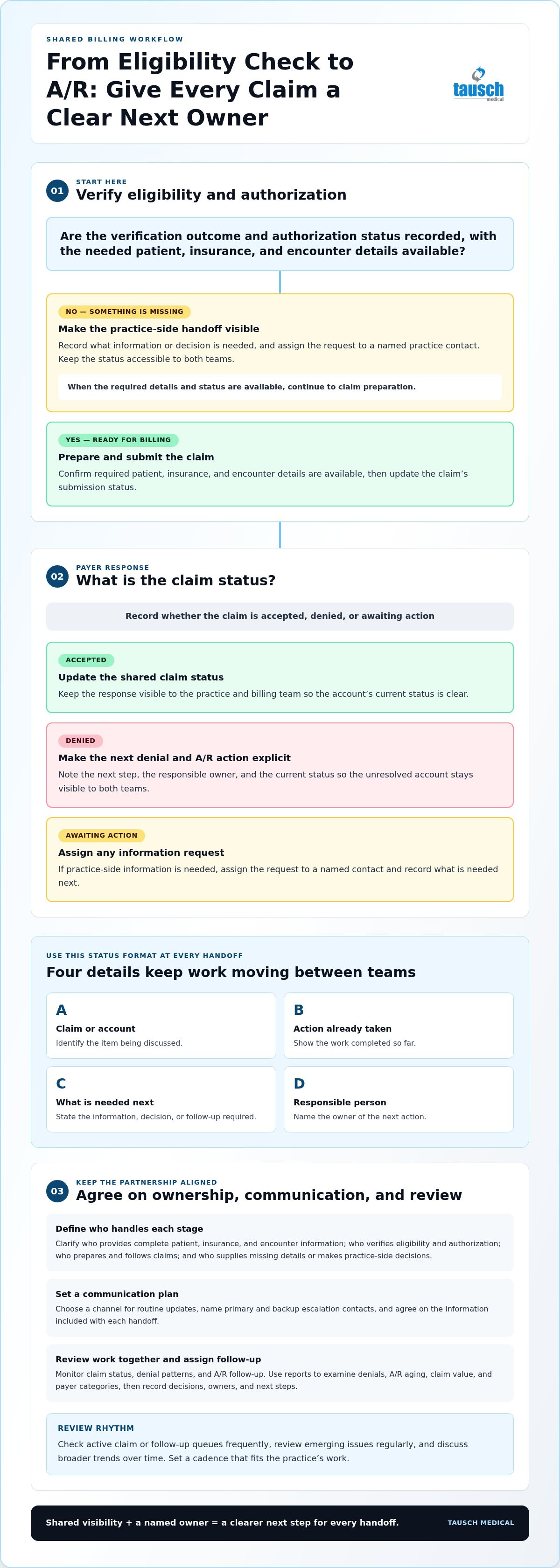
Use a consistent status format that identifies the claim or account, the action already taken, what is needed next, and the person responsible. For patient-facing calls, Tausch Medical’s service commitment is: Calls are answered by a human to ensure patient satisfaction - always on hand to answer questions and make sure that no call goes unanswered, 24/7. A clear operating plan gives both teams visibility and a dependable way to coordinate as needs change.
Use a Shared Checklist for Eligibility, Claims, Denials, and A/R
A shared checklist turns the agreed scope into a repeatable workflow. Each handoff should show who owns the next action and what information is still needed. These practices connect front-end verification to claim processing and follow-up, rather than treating every stage as a separate task.
- Verify eligibility and authorization. Record the verification outcome and authorization status, including any information the practice needs to provide.
- Prepare and submit the claim. Confirm that required patient, insurance, and encounter details are available, then update the claim’s submission status.
- Track the payer response. Record whether the claim is accepted, denied, or awaiting action. Assign any request for practice-side information to a named contact.
- Follow up on denials and A/R. Note the next step, responsible owner, and current status so unresolved accounts remain visible to both teams.
Make front-end and back-end handoffs visible
Eligibility and prior authorization results should reach the billing workflow in a consistent, accessible format before claim preparation. Agree on where status is recorded and which details must accompany it, such as the verification result, authorization reference, or an outstanding question. This gives the billing team useful context and helps the practice catch missing information before it delays downstream work.
Use agreed reports to monitor claim status, denial patterns, and A/R follow-up. If the same obstacle recurs, such as incomplete encounter details or unclear authorization status, share it with both teams and assign a practical change to address the cause. Tausch Medical’s A/R and denial management services support follow-up across these connected stages.
Review Billing Reports Together and Turn Findings Into Next Steps
Reports are most useful when both teams interpret the findings together and leave with clear actions. Set a review rhythm that fits the work: check active claim or follow-up queues frequently, review emerging issues regularly, and discuss broader trends over time. Agree on which reports matter, how each measure is defined, and who will act on a finding.
Build a regular review and improvement rhythm
Use analytics to examine denials, A/R aging, claim value, and payer categories, then compare the patterns with workflow context. If one payer category shows a recurring delay, review the affected accounts, identify the missing information or outstanding action, and assign an owner and next step. Record decisions so the next review can assess whether the change helped.
Keep the discussion focused on improvement, not just reporting. A trend in denial reasons may point to a front-end process that needs attention; an aging A/R segment may call for prioritized follow-up. The medical claim denial management guide offers additional context for discussing denial patterns, while the revenue cycle management strategic guide can help frame broader performance reviews.
Tausch Medical provides analytics-driven reporting and flexible task-based or end-to-end support. Its reporting can help practices review denials, A/R aging, claim value, and payer categories, then assign follow-up actions. Calls are answered by a human to ensure patient satisfaction - always on hand to answer questions and make sure that no call goes unanswered, 24/7. A consistent review rhythm turns shared visibility into practical follow-through.
Make Your Billing Partnership a Source of Momentum
A well-run billing relationship should do more than move claims through a queue. It should give your practice a dependable operating partner, clear visibility into work that needs attention, and room to refine processes as needs change. Applying the best practices for working with a billing company means building shared accountability into everyday work, not treating the partnership as a one-time setup exercise.
Over 100 certified medical coders and billers. Achieving over 95% accuracy. Tausch Medical is a HIPAA-compliant medical billing company. Its support includes medical billing, eligibility verification, prior authorization, denial management, A/R follow-up, and provider credentialing. Easy pricing options - FTE or Collection %.
Want to see how Tausch Medical can support your practice with reliable medical billing, prior authorization, eligibility verification, A/R follow-up, and RCM support? Start with our free two-week trial and experience the difference before making a commitment: https://tauschmedical.com/free-trial-form
Frequently Asked Questions
What should a medical practice discuss with a billing company at the start of a partnership?
Agree on the work covered, how staff will share records, which billing platforms are involved, and how progress will be reviewed. Also clarify how changes in providers, payer details, or office procedures will be communicated. Tausch Medical supports practices in Houston, San Antonio, Dallas, Austin, El Paso, Arlington, Plano, New York, Boston, Philadelphia, Washington, D.C., Baltimore, Miami, Orlando, Tampa, Atlanta, Raleigh, Richmond, and Jacksonville.
Can a medical billing company handle only selected tasks?
Yes. A practice can use task-based support for a defined need instead of outsourcing its entire billing workflow. For example, a team might begin with eligibility verification or A/R management while retaining other billing responsibilities in-house. Define how the selected work connects with the practice’s existing process so that responsibilities and handoffs remain clear.
Is support available 24/7, and are calls answered by a person?
Yes. Tausch Medical provides 24/7 support, and calls are answered by a human rather than relying on an automated voice-only system. Calls are answered by a human to ensure patient satisfaction - always on hand to answer questions and make sure that no call goes unanswered, 24/7. This gives practices a direct phone-support option for questions that arise during billing and revenue cycle operations.
Disclaimer
This article is for general informational purposes only and does not constitute legal, medical, billing, coding, compliance, or financial advice. Healthcare rules, payer policies, and reimbursement guidelines may change and may vary by situation. Please consult qualified professionals or official sources before making decisions based on this content. Tausch Medical is not responsible for any loss or liability arising from reliance on this information.


