


Article by
Dr. Sharafat Hussain Ph.D
Dr. Sharafat Hussain is a healthcare business consultant, entrepreneur, and academic with strong experience in the US healthcare industry. He is the Founder and Managing Director of Tausch Medical, a revenue cycle management company supporting US healthcare providers with medical billing, prior authorization, credentialing, eligibility verification, A/R follow-up, and patient support services. His work combines practical healthcare operations, business strategy, and academic insight to help medical practices improve efficiency, collections, and service quality.
Your strongest position in a payer negotiation isn’t simply a request for higher rates; it’s a clear case for the value your practice brings and the terms needed for a workable relationship. When navigating payer contract negotiations, assess your out-of-network alternatives alongside patient access, payer performance, and the operational impact of the agreement.
Reimbursement rates matter, but they are only one part of a payer contract. Contract terms also affect billing rules, claim resolution, and administrative workload. This guide explains how to assess negotiating leverage, support rate requests with practice data, and identify realistic compromises. It also covers the contract and billing provisions to review before discussions.
Key Takeaways
- Weigh out-of-network alternatives, patient access, and payer performance to understand your negotiating leverage.
- Support rate requests with practice-level evidence, including outcomes, utilization, and reimbursement patterns.
- Plan compromises around more than rates by considering care models, administrative workload, and shared performance goals.
- Review claim timelines, audit provisions, recoupments, and billing requirements to identify terms that could affect operations.
1. Assessing and timing out-of-network leverage
Medicare, Medicaid, and commercial payer arrangements differ in program structure, payment methods, and administrative requirements. Commercial agreements are negotiated with insurers, while Medicare and Medicaid participation follows each program’s rules. When navigating payer contract negotiations, compare rates, covered services, and operational requirements across each agreement.
Build leverage with evidence of the services your practice brings to a network. Document market share, geographic coverage, patient access, and the role your specialty plays locally. Then assess payer performance using clean claim rates, payment as a percentage of charges, denial and underpayment rates, appeal volumes, and appeal win rates. Together, these measures show how network participation is working in practice.
Rate transparency files can show differences between your contracted rates and publicly available rates for the same payer. Machine-readable files can be extensive, so narrow the analysis to relevant services, payers, and providers in your area. Use the comparisons to make navigating payer contract negotiations more evidence-based, rather than gathering data without a clear purpose.
Model out-of-network revenue alongside the effects of joining a payer’s network, including patient access and expected volume. One reported example involved three subspecialty doctors serving a county of almost 1.5 million people; the practice withdrew from its five lowest-paying carriers. That example illustrates a possible alternative, not a universal template. According to Program on Negotiation at Harvard Law School, a strong outside alternative can provide leverage to walk away from unsuitable terms.
Begin preparation ideally 12 months before the contract end date, and notify the payer of your intent to negotiate before renewal. As renewal or termination approaches, delays can strengthen the payer’s position. Keep a credible alternative, avoid bluffing, and address the other party’s anchor before making a counteroffer.
2. Justifying rate requests and planning compromises
A strong rate request links payment to the care and resources your practice provides. For navigating payer contract negotiations, analyze a year of charges and gross collections by payer, then compare reimbursement patterns with local benchmarks. Include current and expected patient volume to estimate the revenue impact of rate differences. Patient outcomes, service utilization, treatment costs, satisfaction, and efficient resource use can help support your case.
Make the proposal specific. Identify services where reimbursement does not match delivery costs or demand, then state the adjustment you seek and why it is operationally justified. For example, a practice could pair a rate request with evidence that its care model supports access or cost-effective treatment. Telehealth, digital health tools, and care models focused on improving outcomes while controlling costs can also inform a discussion of shared value.
Plan compromises across more than the fee schedule. Options may include adjusting service-delivery models, reimbursement structures, or performance metrics, and proposing bundled payments or shared-savings initiatives. A suggested benchmark is seeking rate increases of 3-5% every three years, but navigating payer contract negotiations requires grounding proposals in practice data and payer-specific conditions rather than treating that figure as automatic.
Address administrative friction alongside rates. For example, propose limits on information requests and audit volumes, clear appeal-response timelines, and protection from pre-payment review for claims the payer did not dispute within 30 days. These terms can reduce avoidable disruption while preserving a process for resolving legitimate questions.
If discussions stall, return to your documented priorities and explain which terms remain unresolved. Escalate to payer executive leadership when needed, while keeping your own executive team aligned. A hospital or physician group can propose a structured compromise that links payment terms to measurable outcomes, rather than making concessions without a clear return.
3. Reviewing contract terms and billing rules
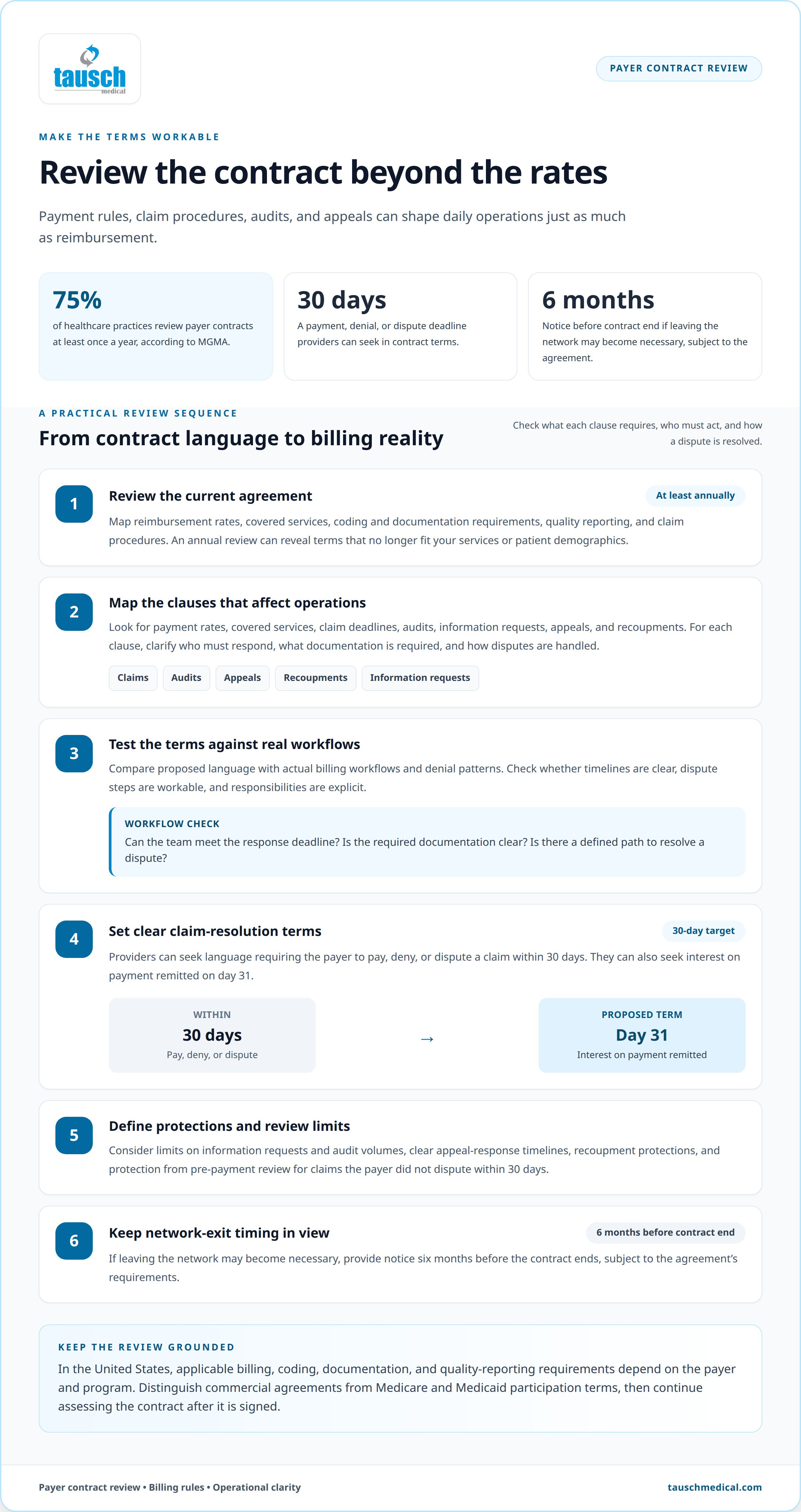
Review the current agreement before proposing a favorable contract. Map reimbursement rates, covered services, coding and documentation requirements, quality reporting, and claim procedures. MGMA reports that 75% of healthcare practices review payer contracts at least once a year, and an annual review can identify terms that no longer fit your services or patient demographics.
In the United States, payer negotiations must account for applicable requirements covering billing practices, coding, documentation, and quality reporting. The relevant rules depend on the payer and program, so distinguish commercial agreements from Medicare and Medicaid participation terms. Include this review in your negotiation strategy, and continue to assess the contract after it is signed.
Common clauses cover payment rates, covered services, claim deadlines, audits, information requests, appeals, and recoupments. One common mistake is to negotiate rates while overlooking administrative terms that affect payment and patient access. Review the practical effect of each clause: who must respond, what documentation is required, and how disputes are handled.
For payment timelines, providers can seek terms requiring the payer to pay, deny, or dispute a claim within 30 days, with interest on payment remitted on day 31. They can also seek protection from pre-payment review for claims the payer did not dispute within 30 days. Contract terms can limit information requests and audit volumes while defining appeal response timelines and recoupment protections.
Compare the proposed language with actual billing workflows and denial patterns. Check whether timelines are clear, dispute steps are workable, and responsibilities are explicit. If leaving the network may become necessary, provide notice six months before the contract ends, subject to the agreement’s requirements.
Tausch Medical
Tausch Medical supports the operational work that continues after payer terms are negotiated, helping practices manage billing processes and monitor claims activity. Its Medical Billing Services, Insurance Verification and Authorization, Accounts Receivable Management, and Medical Billing Outsourcing support revenue-cycle workflows tied to payer requirements.
Consider operational support when billing demands, eligibility checks, authorization steps, or outstanding receivables make it difficult to apply contract terms consistently. Clear workflows can help practices track payment patterns and identify issues to address in future payer discussions. Tausch Medical’s services complement negotiation strategy; providers remain responsible for decisions about contract terms.
Contact Tausch Medical to discuss support for your practice’s billing and payer-related workflows.
Carry Your Negotiation Strategy Into Practice
Signing an agreement does not end payer relationship management. At each renewal, compare the contract’s intent with how claims and payments are handled in practice. This ongoing review helps your team spot emerging issues and set clearer priorities for future discussions.
Navigating payer contract negotiations is more effective when decisions account for the workflows that follow. Tausch Medical supports healthcare practices with Medical Billing Services, Insurance Verification and Authorization, and Accounts Receivable Management.
Frequently Asked Questions
What are the key steps in negotiating a payer contract?
Assign a negotiation lead and align practice leadership on decision-making authority. Set priorities before discussions, distinguishing essential terms from areas open to adjustment. Record each proposal, response, and outstanding issue to track progress. Before signing, compare the final draft with the negotiated points and clarify who will oversee implementation.
How should providers prepare for payer contract negotiations?
Prepare a concise negotiation brief that ties the practice’s priorities to supporting evidence. Include the patient populations and services central to the agreement, operational concerns, and desired outcomes. Confirm who can approve proposed changes and set a communication plan for internal stakeholders. Practices in Houston, San Antonio, Dallas, Austin, and other markets should also account for local access needs.
Which financial and utilization metrics strengthen a payer negotiation?
Use measures that connect financial performance with care delivery, rather than presenting isolated figures. For example, review service utilization alongside patient outcomes and satisfaction, and explain how these measures relate to the services covered by the contract. Where possible, segment results by payer and service line to show what is working and where adjustments may help.
How do providers benchmark reimbursement rates and negotiate fee schedules?
Compare equivalent services under similar payer arrangements, matching the service, geography, and relevant plan details. Broad averages can hide important differences, so use benchmarks as context, not as the sole basis for a request. Clearly state the requested fee schedule changes, the services affected, and how the proposed structure supports sustainable access and care delivery.
What contract terms should providers negotiate beyond reimbursement rates?
Consider whether the agreement can adapt as services, technology, or patient needs change. Providers may propose terms for telemedicine, value-based care initiatives, changing patient volumes, or additional services. Measurable performance expectations and incentives can clarify how both parties will assess the relationship. Specify how updates are proposed and documented so future operational changes have a clear path into the contract.
Want to see how Tausch Medical can support your practice with reliable medical billing, prior authorization, eligibility verification, A/R follow-up, and RCM support? Start with our free two-week trial and experience the difference before making a commitment: https://tauschmedical.com/free-trial-form
Disclaimer
This article is for general informational purposes only and does not constitute legal, medical, billing, coding, compliance, or financial advice. Healthcare rules, payer policies, and reimbursement guidelines may change and may vary by situation. Please consult qualified professionals or official sources before making decisions based on this content. Tausch Medical is not responsible for any loss or liability arising from reliance on this information.


