


Article by
Dr. Sharafat Hussain Ph.D
Dr. Sharafat Hussain is a healthcare business consultant, entrepreneur, and academic with strong experience in the US healthcare industry. He is the Founder and Managing Director of Tausch Medical, a revenue cycle management company supporting US healthcare providers with medical billing, prior authorization, credentialing, eligibility verification, A/R follow-up, and patient support services. His work combines practical healthcare operations, business strategy, and academic insight to help medical practices improve efficiency, collections, and service quality.
A signed business associate agreement isn’t, by itself, proof of compliance. HIPAA compliance for medical billing companies depends on protecting protected health information (PHI), limiting its use to authorized work, and meeting the duties set out in the agreement; if a breach occurs, a business associate must notify the covered entity without unreasonable delay and no later than 60 days after discovery, according to the U.S. Department of Health and Human Services.
For billing specialists, HIPAA requirements shape everyday decisions about accessing, handling, and sharing patient information. This article explains key safeguards and responsibilities, what a business associate agreement should cover, and how breach notifications work. It also clarifies why a contract is one part of a compliance program, not a substitute for sound security practices.
Key Takeaways
- Understand how everyday billing tasks involve protected health information and the safeguards that help keep it secure.
- Identify the key provisions a business associate agreement should address, including permitted data use, subcontractors, and what happens when the agreement ends.
- Distinguish the reporting steps for smaller breaches from other notification duties, and clarify responsibilities between the billing company and the practice.
- See how medical billing, insurance verification and authorization, and accounts receivable management can support a practice’s revenue operations.
What Does a Medical Billing Specialist Need to Know about HIPAA?
Medical billing specialists handle protected health information (PHI) when reviewing claims and payment records. HIPAA compliance for medical billing companies means applying privacy, security, and breach notification requirements to routine work.
HIPAA Privacy, Security, and Breach Notification Rules
The Privacy Rule governs permitted uses and disclosures of PHI, while the Security Rule protects electronic health information. The Breach Notification Rule sets duties after certain exposures. Together, these rules guide how specialists access records, process claims, and report incidents. For example, sending patient details to an unauthorized recipient can expose PHI. The U.S. Department of Health and Human Services says affected patients must be notified without unreasonable delay and no later than 60 days after discovery.
A major proposed Security Rule update was issued on January 6, 2025; as of late October 2026, its target for a final rule was July 2027.
Security Risk Analysis and Management
Risk analysis identifies threats to electronic PHI, and risk management uses those findings to select and maintain safeguards. The Security Rule’s risk-analysis requirement is codified at 45 CFR § 164.308. Assess how systems, workflows, and access controls could expose information, then address relevant risks through documented policies and appropriate protections. A phishing message that captures an employee’s credentials, for instance, can put billing records at risk. Unique user accounts, multifactor authentication, encryption, and prompt access removal help reduce exposure. Specialists should report suspected incidents through their organization’s established process.
State Privacy Law Requirements
Yes. State privacy laws can add requirements beyond HIPAA, so obligations may depend on where a practice operates and whose information it handles. Texas and California are examples of states with medical privacy laws that may require additional training. This matters for billing teams serving practices across state lines: policies and training should account for applicable state requirements, not just federal rules. Clear procedures also help specialists handle claims consistently. For context on billing workflows, medical billing services support the claims process while privacy safeguards remain essential.
What should be included in a business associate agreement with a billing company?
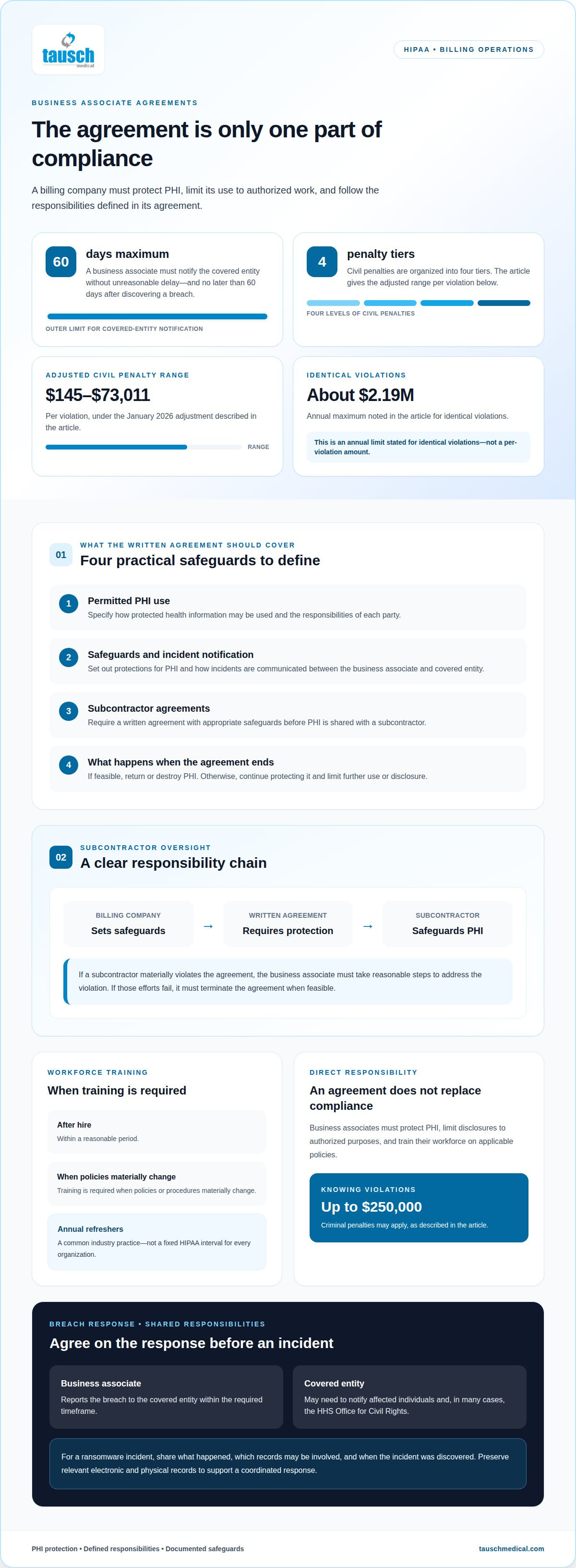
Yes. A billing company handling identifiable health data for a covered practice is generally a HIPAA business associate under 45 CFR 160.103, and must sign a written agreement with each practice it serves. Civil penalties have four tiers; under the January 2026 adjustment, they range from $145 to $73,011 per violation, with identical violations reaching about $2.19 million annually.
Business Associate Status
A business associate creates, receives, maintains, or transmits identifiable health information on a covered entity’s behalf. Processing claims or insurance information for a practice can therefore bring a billing company under HIPAA’s direct obligations. Since the 2013 Omnibus Rule, business associates can be directly liable for impermissible disclosures, Security Rule violations, and failures to report breaches or secure subcontractor agreements. Knowing violations can also carry criminal penalties, including up to $250,000.
Business Associate Agreements and Subcontractors
A Business Associate Agreement (BAA) is the contract that defines permitted PHI use and the parties’ responsibilities. HIPAA’s required BAA provisions appear at 45 CFR § 164.504(e). The agreement should address safeguards, incident notification, subcontractors, and what happens to PHI when the contract ends. If feasible, the business associate must return or destroy that information; otherwise, it must continue protecting it and limit further use or disclosure.
Before sharing PHI with a subcontractor, a billing company must have a written agreement requiring appropriate safeguards. If a subcontractor materially violates the agreement, the business associate must take reasonable steps to address the violation and, if those efforts fail, terminate the agreement when feasible.
Responsibilities and Workforce Training
A BAA supports compliance, but signing one alone doesn’t establish that a billing company follows HIPAA. Business associates must protect PHI, limit disclosures to authorized purposes, and train their workforce on applicable policies. HIPAA doesn’t set one fixed training interval for every organization; training is required within a reasonable period after hire and when policies or procedures materially change. Annual refreshers are a common industry practice. Documented training helps staff handle patient and insurance information consistently, while well-managed medical billing operations depend on clear roles and sound processes.
What breach notification duties apply to business associates?
A breach involving patient data requires coordinated action by the billing vendor and covered practice. The business associate agreement should define notification responsibilities before an incident occurs.
Shared Breach Notification Responsibility
The business associate reports the breach to the covered entity, while the agreement clarifies who handles patient and regulator notices. According to the U.S. Department of Health and Human Services, a business associate must notify the covered entity without unreasonable delay and no later than 60 days after discovery. The practice may need to notify affected individuals and, in many cases, the HHS Office for Civil Rights.
For a ransomware incident, the vendor should promptly share what happened, which records may be involved, and when the incident was discovered. Preserving relevant electronic and physical records helps both parties coordinate their response.
Breach Response and Reporting Deadlines
The notification timeline depends on the breach size and the recipient. Breaches affecting 500 or more people must be reported to HHS within 60 days. For smaller breaches, the U.S. Department of Health and Human Services requires reporting to HHS within 60 days after the end of the calendar year in which they occurred.
A practical response starts with reporting the incident through the agreed channel, preserving evidence, and identifying affected patient data. The business associate agreement should explain how the vendor will provide details and support the practice’s notifications. A clear process helps employees escalate incidents promptly and keeps the vendor’s and practice’s actions coordinated.
For practices reviewing their billing workflows alongside incident procedures, explore medical billing support.
Tausch Medical
Tausch Medical supports healthcare practices with billing operations spanning claims, insurance workflows, and accounts receivable follow-up. Services include medical billing, insurance verification and authorization, accounts receivable management, and medical billing outsourcing. These operational services can complement a practice’s compliance program, while the practice and its billing partner remain responsible for their respective HIPAA obligations and agreements.
This support can help when billing administration takes time away from other practice priorities or eligibility and authorization workflows need structured attention. The right combination depends on the operational support your practice needs.
Want to see how Tausch Medical can support your practice with reliable medical billing, prior authorization, eligibility verification, A/R follow-up, and RCM support? Start with our free two-week trial and experience the difference before making a commitment.
Build a More Confident Path Forward
Strong privacy practices rely on clear responsibilities, consistent workflows, and attention to how billing operations evolve. Treat HIPAA compliance for medical billing companies as an ongoing part of practice management, not a task completed when an agreement is signed. As workflows change, keep communication between your practice and billing partner aligned to support responsible handling of patient information.
Want to see how Tausch Medical can support your practice with reliable medical billing, prior authorization, eligibility verification, A/R follow-up, and RCM support? Start with our free two-week trial and experience the difference before making a commitment.
Frequently Asked Questions
What is HIPAA?
HIPAA, enacted in 1996, is a U.S. federal law that sets standards for handling protected health information and electronic healthcare transactions. For billing teams, it applies to work such as preparing claims and processing payment information. Its Privacy, Security, and Breach Notification Rules address how health information is used, protected, and reported after certain incidents.
How should billing companies safeguard protected health information?
Billing companies should limit access to patient records to employees who need them for their assigned duties. For example, an employee correcting claims should not share login credentials or send a spreadsheet containing patient details through an unapproved channel. Written procedures, workforce training, access reviews, and secure information transfers help make privacy requirements part of routine billing work.
Who is liable if a billing company causes a HIPAA breach?
The billing company and covered practice may both have responsibilities after a breach, depending on their roles and the circumstances. A business associate can be directly liable for certain HIPAA violations, and the HHS Office for Civil Rights can investigate business associates. The practice may also have notification duties, so the contract should support coordinated response and reporting.
Does a small, local medical billing company need the same safeguards as a large national vendor?
HIPAA safeguard categories apply regardless of company size, but specific controls can be scaled to an organization’s operations, technology, and risks. A small team might document who can access each billing system and promptly remove access when roles change. A larger vendor may need controls suited to more users and complex systems while meeting the same underlying protection requirements.
How must billing companies manage subcontractors that handle PHI?
Before sharing protected health information with a subcontractor, a billing company should put a written agreement in place that requires appropriate safeguards. The agreement should define permitted information handling and how incidents are escalated. If a subcontractor materially violates its obligations, the business associate must take reasonable steps to address the problem. If those efforts fail, termination may be required when feasible.
Disclaimer
This article is for general informational purposes only and does not constitute legal, medical, billing, coding, compliance, or financial advice. Healthcare rules, payer policies, and reimbursement guidelines may change and may vary by situation. Please consult qualified professionals or official sources before making decisions based on this content. Tausch Medical is not responsible for any loss or liability arising from reliance on this information.


