


Article by
Dr. Sharafat Hussain Ph.D
Dr. Sharafat Hussain is a healthcare business consultant, entrepreneur, and academic with strong experience in the US healthcare industry. He is the Founder and Managing Director of Tausch Medical, a revenue cycle management company supporting US healthcare providers with medical billing, prior authorization, credentialing, eligibility verification, A/R follow-up, and patient support services. His work combines practical healthcare operations, business strategy, and academic insight to help medical practices improve efficiency, collections, and service quality.
What turns a denied claim into a preventable pattern? A medical billing compliance checklist for 2026 gives your practice a repeatable way to review claim accuracy, documentation, payer requirements, and billing deadlines before small errors disrupt revenue.
It’s understandable to focus on individual rejections, but denial patterns can show where billing processes need attention. This guide explains how to review denials by payer, investigate diagnosis-code rejections, confirm claim attachments, track CMS deadlines, and check that documentation supports billed services. It also shows how to turn these checks into a practical routine, helping your team identify recurring issues and prioritize follow-up. The result is a clearer framework for accurate claims and consistent billing oversight.
Key Takeaways
- Break denial trends down by payer and investigate recurring diagnosis-code rejections to identify where claims processes need attention.
- Track claims attachment requirements and implementation dates, including the CMS-0053-F compliance deadlines set for May 26, 2028.
- Match billed codes to the services documented in the medical record, using the applicable code set for the date of service.
- According to the Centers for Medicare & Medicaid Services, Medicare providers must file claims within 1 calendar year after the date of service, so include filing timeliness in your audit routine.
Denial tracking and diagnosis-code rejection audits
A medical billing compliance checklist 2026 should turn denial data into targeted review. Group denials by payer, service, diagnosis code, and rejection reason. This helps distinguish registration issues from coding, documentation, or payer-edit problems. For example, repeated diagnosis-code rejections from one payer may indicate a mapping issue or missed update. Record each finding, owner, corrective action, and resolution in the revenue cycle audit trail.
During a focused billing audit, compare each claim with the signed medical record, the code set for its date of service, and the applicable payer rule. Confirm the diagnosis supports the service and documentation supports medical necessity. According to the Centers for Medicare & Medicaid Services, Medicare providers must file claims within 1 calendar year after the date of service. Late filing can put reimbursement at risk.
For 2026, CPT updates take effect January 1; the FY2027 ICD-10-CM code set applies from October 1, 2026, through September 30, 2027. Use the applicable HCPCS updates for the date of service. A medical billing compliance checklist 2026 should include a process for incorporating code updates into claim reviews.
Screen billing staff and vendors for exclusions and sanctions before engagement, then include repeat screening in ongoing oversight. Record the screening date, result, reviewer, and follow-up. Keep breach response records separate from routine denial files. According to the U.S. Department of Health and Human Services, Office for Civil Rights, affected people must be notified within 60 days of a breach. A breach affecting 500 or more people also requires notice to HHS and the media, according to the U.S. Department of Health and Human Services, Office for Civil Rights.
A structured medical billing process can help organize claim reviews and corrective actions.
Claims attachments and CMS implementation deadlines
Verify eligibility before each encounter, then confirm the payer’s authorization and attachment requirements. CMS-0053-F took effect on May 26, 2026, with compliance deadlines set for May 26, 2028. Maintain a timeline for implementation, assign an administrative owner, and record vendor updates. Store each required attachment with the claim so staff can trace what was submitted.
Connect charge capture to claim scrubbing before submission. Match the documented service to the charge, diagnosis, payer rules, and required modifiers. For example, flag a missing referral or attachment before submitting the claim. Track edits and corrections by claim identifier, then confirm whether the payer processed the corrected submission and issued payment.
For electronic claims, EFT, and ERA in 2026, coordinate transaction setup, submission, and reconciliation with each payer’s operating requirements. Assign responsibility for exceptions, and associate each ERA with its claim and deposit record. This workflow gives staff a clear path to collect payment and investigate mismatches without treating every transaction as an isolated task.
For split/shared services in 2026, use the FS modifier to identify the service on the claim. For applicable Medicare telehealth services, prepare for modifiers BB and BC starting January 1, 2027. Add those updates to the claim-scrubbing rules, and test a sample claim before changing routine submission workflows.
State requirements can vary, so map the rules that affect each practice location and payer, including claim submission, attachments, and telehealth billing. Keep an update log with the rule, effective date, owner, and workflow change. Practices refining these processes can explore billing workflow support as part of their revenue-cycle planning.
Medical billing, coding, and documentation accuracy
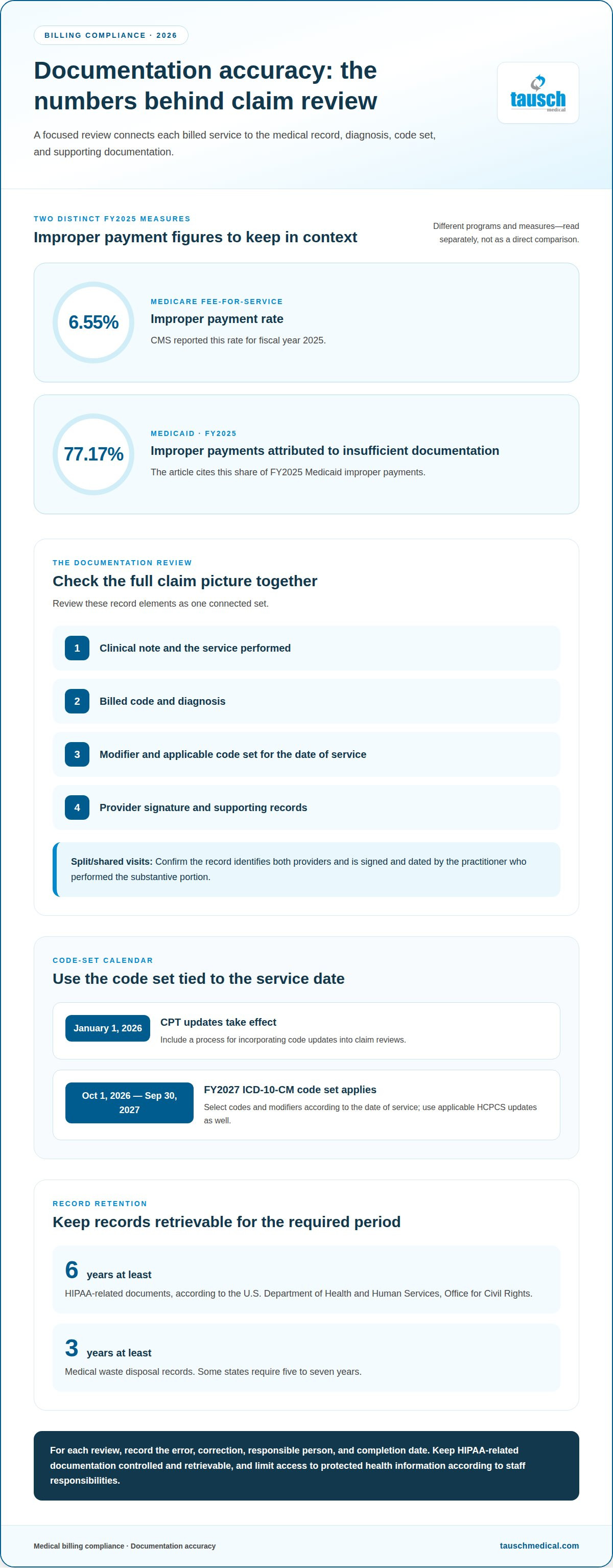
For accurate claims, match each billed service to the clinical record, diagnosis, and applicable code set. Confirm that documentation supports medical necessity and the service performed. A code describing more care than the record supports can lead to denials, repayment exposure, or audit findings. Use the date of service when selecting codes and modifiers.
CMS reported a 6.55% Medicare fee-for-service improper payment rate for fiscal year 2025. Insufficient documentation accounted for 77.17% of FY2025 Medicaid improper payments. These figures underscore why focused reviews should test whether records support the billed code, level of service, and modifier. For split/shared visits, confirm the record identifies both providers and is signed and dated by the practitioner who performed the substantive portion.
Keep HIPAA-related documentation in a controlled, retrievable record system. Clinics must retain HIPAA-related documents for at least six years, according to the U.S. Department of Health and Human Services, Office for Civil Rights. Limit access to protected health information according to staff responsibilities, and record billing-related corrections in the audit trail.
Healthcare practices should also retain waste-disposal records. Medical waste disposal records should be kept for at least three years; some states require five to seven years. Link each transporter record to the relevant pickup or disposal event so an auditor can trace the documentation.
Review the note, code, modifier, provider signature, and supporting records together. Record each error, correction, responsible person, and completion date. Then review recurring issues to improve coding accuracy and reduce claim rework.
Tausch Medical
Tausch Medical supports practices seeking dependable help with billing workflows and revenue cycle administration, so teams can focus their attention on delivering care and managing practice operations.
Want to see how Tausch Medical can support your practice with reliable medical billing, prior authorization, eligibility verification, A/R follow-up, and RCM support? Start with our free two-week trial and experience the difference before making a commitment.
Build a More Consistent Billing Process
Make compliance part of daily practice operations, with clear responsibility for maintaining processes as payer requirements and workflows change. Review team capacity to identify where administrative support could improve consistency, allowing staff to focus on their core responsibilities and keep billing operations moving.
Want to see how Tausch Medical can support your practice with reliable medical billing, prior authorization, eligibility verification, A/R follow-up, and RCM support? Start with our free two-week trial and experience the difference before making a commitment.
Frequently Asked Questions
What Is a Healthcare Compliance Checklist?
A healthcare compliance checklist is a working tool for assigning responsibilities, recording evidence, and tracking corrective actions across practice operations. For example, document who reviews billing policies, where training records are stored, and how identified problems are resolved. Keep the checklist aligned with actual workflows so staff can use it for routine oversight rather than treating it as a static policy document.
Does the OIG require a yearly billing audit?
The information summarized here does not establish a universal OIG requirement for an annual billing audit. It recommends an annual risk assessment and regular internal audits as practical compliance measures. OIG guidance identifies a starting sample of five or more medical records per payer for federal payer audits. Use risk findings and recurring billing issues to shape the audit scope and schedule.
How can a small independent practice afford a strong compliance program?
A small practice can build a focused program by assigning clear ownership and prioritizing consequential workflows. Start with a written risk assessment, then review a manageable sample of claims and document findings, corrections, and follow-up. OIG guidance suggests a starting sample of five to ten records per physician for practices with multiple physicians. This provides a structured review without auditing every claim.
Law, payer rules, and best practice: what's the difference?
Law establishes binding requirements, while payer rules set conditions for that payer’s claims, coverage, and payment processes. Best practices are operational methods a practice uses to reduce errors and strengthen oversight, even when no specific rule prescribes that exact workflow. For each claim, separate these layers: identify applicable legal requirements, confirm the payer’s terms, then use internal controls to support consistent handling.
What 2026 CMS billing and coding updates affect Medicare claims?
The CY 2026 Medicare Part B Physician Fee Schedule final rule governs Medicare Part B payment policy for 2026. For dates of service on or after October 1, 2026, use FY 2027 ICD-10-CM codes. In 2026, the FS modifier identifies split/shared services on claims. Keep code selection tied to the date of service and configure claim edits to reflect applicable changes.
Want to see how Tausch Medical can support your practice with reliable medical billing, prior authorization, eligibility verification, A/R follow-up, and RCM support? Start with our free two-week trial and experience the difference before making a commitment: https://tauschmedical.com/free-trial-form
Disclaimer
This article is for general informational purposes only and does not constitute legal, medical, billing, coding, compliance, or financial advice. Healthcare rules, payer policies, and reimbursement guidelines may change and may vary by situation. Please consult qualified professionals or official sources before making decisions based on this content. Tausch Medical is not responsible for any loss or liability arising from reliance on this information.


