


Article by
Dr. Sharafat Hussain Ph.D
Dr. Sharafat Hussain is a healthcare business consultant, entrepreneur, and academic with strong experience in the US healthcare industry. He is the Founder and Managing Director of Tausch Medical, a revenue cycle management company supporting US healthcare providers with medical billing, prior authorization, credentialing, eligibility verification, A/R follow-up, and patient support services. His work combines practical healthcare operations, business strategy, and academic insight to help medical practices improve efficiency, collections, and service quality.
A billing handoff works best when it supports the full process, from eligibility checks through payment. When a Houston practice chooses to outsource medical billing, it assigns billing and related work to an external team instead of handling every step in-house. This can connect claim preparation, submission, follow-up, and accounts receivable management.
Not every practice needs the same arrangement. The right scope depends on where work is slowing down, whether that is insurance verification and prior authorization, claim denials, payment posting, or follow-up on unpaid claims. This guide explains what outsourced medical billing involves, how it supports revenue cycle management, and which services it can include, helping you assess how it may fit your operations.
Key Takeaways
- Understand what shifting billing work to an external team can involve, from claim preparation through follow-up.
- See how coordinated revenue cycle management connects front-end processes with payments and accounts receivable.
- Identify which billing, eligibility, authorization, and A/R tasks may be included in outsourced support.
- Learn how Tausch Medical’s services can support practices seeking a more organized approach to billing operations.
What Is Outsourced Medical Billing?
Outsourced medical billing means assigning billing and claims-processing work to an external team rather than handling it entirely in-house. Depending on the scope, the work can connect coding, payer submissions, denial follow-up, and accounts receivable (A/R) tracking.
Billing and Claims Processing
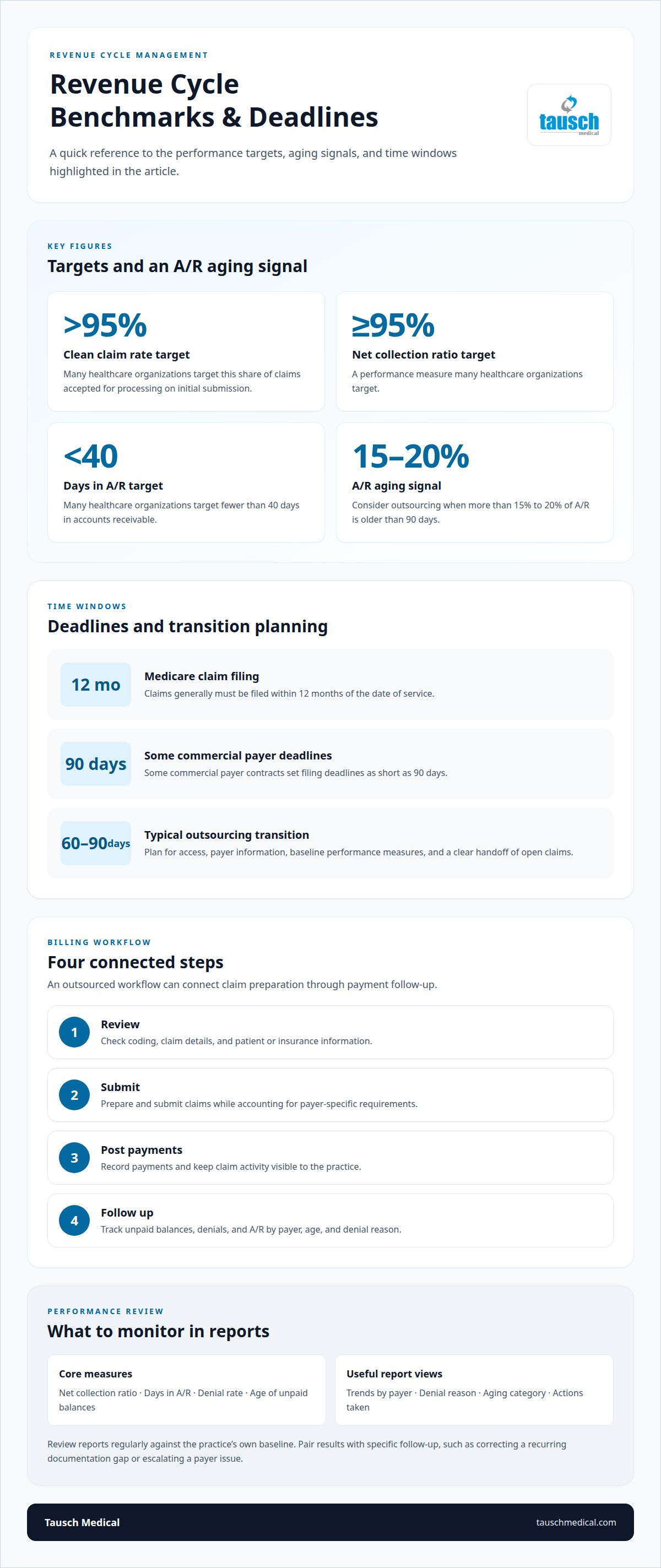
A billing workflow may review coding and claim details, submit claims, post payments, and follow up on unpaid balances. For patient data, ask how the vendor protects security, supports HIPAA compliance, and assigns compliance responsibilities. Before signing, ask what tasks the contract covers, how denials and appeals are handled, and what reporting you’ll receive. Practices that outsource medical billing should understand the service scope and how their team retains visibility into claims.
Payer Claim Handling
Claims for Medicare, Medicaid, and commercial payers can involve different submission rules and follow-up workflows. A billing team should account for payer-specific requirements alongside documentation and coding for the practice’s specialty. Ask how the process accommodates your specialty and payer mix. Houston practices can review medical billing services in the context of their local practice operations.
Clean Claims and Acceptance
A clean claim is complete and accurate enough for processing without avoidable correction or additional information. Clean claim rates measure the share of claims accepted for processing on initial submission; many healthcare organizations target above 95%. Coding or demographic errors can lead to rejections, denials, and delayed collections. Track those issues alongside A/R: a practice should consider outsourcing when more than 15% to 20% of its A/R is older than 90 days.
Processing and Reimbursement Timelines
Accurate coding, complete claim details, prompt submission, and timely follow-up can help reduce preventable processing delays, though payer adjudication also affects reimbursement timing. A transition to an outsourced billing workflow usually takes 60 to 90 days. Plan for access, payer information, baseline performance measures, and a clear handoff of open claims so operations remain coordinated during the change.
Revenue cycle management
Revenue cycle management connects billing tasks across a patient’s financial journey, from account activity through payment. Outsourced billing can coordinate follow-up, denial management, and performance reporting with the practice’s revenue priorities.
Accounts Receivable Follow-Up
A billing team can track unpaid claims by payer, age, and denial reason, then prioritize follow-up before filing deadlines pass. Medicare claims generally must be filed within 12 months of the date of service, while some commercial payer contracts set deadlines as short as 90 days. Clear work queues help maintain consistent attention to outstanding balances and support cash flow.
Denial management should identify patterns, not just reprocess individual claims. For example, repeated denials tied to missing documentation may call for a workflow correction, while payer-specific rejections may need targeted appeal handling. Practices can connect this work with denial management support.
Measuring Billing Performance
Measure a partner’s performance with a consistent set of metrics, reviewed against the practice’s own baseline. Useful measures include net collection ratio, days in accounts receivable, denial rate, and the age of unpaid balances. Many healthcare organizations target a net collection ratio of 95% or higher and fewer than 40 days in accounts receivable.
Ask for reports that show trends by payer, denial reason, and aging category, along with the actions taken. These details help distinguish a temporary payment delay from recurring coding or workflow issues and show whether collections are progressing.
Review reports regularly with the billing team and pair the results with specific follow-up actions, such as correcting a recurring documentation gap or escalating a payer issue. Accurate reporting and focused denial management help practices assess revenue cycle performance and maintain visibility into operations.
What outsourced medical billing services include
The scope can cover distinct administrative tasks across a healthcare organization’s revenue cycle. Defining responsibilities clearly helps providers understand which steps remain with practice staff and which are assigned to the billing team.
Common tasks include reviewing patient and insurance details, preparing and submitting claims, posting payments, and following up on outstanding balances. A practice might outsource claim preparation and follow-up while keeping clinical documentation and patient communication in-house. Define who handles corrections, appeals, and denials, and how unresolved cases are referred back to the practice.
For security, define how the billing team receives, uses, stores, and returns patient information, and who can access it. The agreement should explain safeguards, incident communication, and responsibilities for applicable privacy and security requirements. Documenting these procedures helps protect sensitive information throughout the working relationship.
A medical billing outsourcing contract should specify the tasks included, reporting, communication, fees, data handling, and responsibility for errors or appeals. It should also explain the term, termination notice, cancellation process, and transfer of records and open claims when service ends. Follow the written notice and transition steps in the agreement rather than assuming cancellation takes effect immediately.
For a practical review of outsourced medical billing support, consider how the service scope aligns with your administrative workflow, payer mix, and revenue cycle management priorities. A defined handoff can make responsibilities easier to track while helping the practice maintain oversight of claims and collections.
Tausch Medical
Tausch Medical helps practices align billing work with revenue cycle priorities through medical billing, insurance verification and authorization, and accounts receivable management. This support can fit practices assessing whether external billing help suits their workflow, payer mix, and follow-up needs. Start by identifying the tasks that need support to clarify the scope.
Want to see how Tausch Medical can support your practice with reliable medical billing, prior authorization, eligibility verification, A/R follow-up, and RCM support? Start with our free two-week trial and experience the difference before making a commitment.
Set a Clear Direction for Your Billing Workflow
Before changing your billing workflow, define what a more manageable process would look like for your practice. Consider which administrative tasks take the most staff time, where handoffs create friction, and what information leaders need for operational decisions. These priorities can guide a focused discussion about whether to outsource medical billing and how external support could fit your team’s responsibilities.
A useful next step is to discuss your practice’s workflow and the support you need, then consider how that approach fits your operational priorities. The conversation can clarify the scope of support and practical next steps without pressuring you to make an immediate decision.
Want to see how Tausch Medical can support your practice with reliable medical billing, prior authorization, eligibility verification, A/R follow-up, and RCM support? Start with our free two-week trial and experience the difference before making a commitment.
Frequently Asked Questions
How are payments received and posted?
Payments generally come through the practice’s established payer and patient payment channels, then are posted to the corresponding accounts. Tausch Medical provides payment posting, billing, and collections support. Remittance details, for example, help distinguish a payer’s payment from an adjustment, while patient payments are applied to outstanding balances. Clear account records make it easier to see what remains unpaid.
How do you handle denied claims?
Denied claims are reviewed to identify the reason and determine an appropriate next step, such as correcting claim information or pursuing an appeal. Tausch Medical provides denial management and accounts receivable support. If several denials point to a recurring documentation issue, tracking the pattern can help the practice address the underlying workflow.
How will this affect my patients?
Outsourcing changes administrative workflows, but the practice retains its clinical relationship with patients. Clear communication helps patients understand where to direct scheduling, billing, and payment questions. Tausch Medical provides patient scheduling and phone answering alongside billing support. Practices can define how inquiries are routed so administrative changes remain clear to patients and staff.
Is Outsourcing Expensive?
Outsourcing costs depend on the services and staffing arrangement, so compare the proposed scope with the resources needed to manage billing internally. Tausch Medical offers “Easy pricing options - FTE or Collection %.” Consider which tasks are included, how the arrangement fits your workload, and what reporting will support oversight. Request a quote to clarify the proposed structure for your practice.
What services are included in outsourced medical billing?
Services can range from selected billing tasks to broader revenue cycle support, depending on the arrangement. Tausch Medical provides eligibility and benefits verification, prior authorization, claim entry, charge and payment posting, accounts receivable management, denial analysis, and collections. Related administrative support includes patient scheduling and provider credentialing. Define the task mix around your practice’s operational needs.
Want to see how Tausch Medical can support your practice with reliable medical billing, prior authorization, eligibility verification, A/R follow-up, and RCM support? Start with our free two-week trial and experience the difference before making a commitment: https://tauschmedical.com/free-trial-form
Disclaimer
This article is for general informational purposes only and does not constitute legal, medical, billing, coding, compliance, or financial advice. Healthcare rules, payer policies, and reimbursement guidelines may change and may vary by situation. Please consult qualified professionals or official sources before making decisions based on this content. Tausch Medical is not responsible for any loss or liability arising from reliance on this information.


