


Article by
Dr. Sharafat Hussain Ph.D
Dr. Sharafat Hussain is a healthcare business consultant, entrepreneur, and academic with strong experience in the US healthcare industry. He is the Founder and Managing Director of Tausch Medical, a revenue cycle management company supporting US healthcare providers with medical billing, prior authorization, credentialing, eligibility verification, A/R follow-up, and patient support services. His work combines practical healthcare operations, business strategy, and academic insight to help medical practices improve efficiency, collections, and service quality.
An insurance card is only a starting point, not confirmation that a patient’s planned care is covered. Insurance verification services check whether coverage is active and clarify relevant benefits, including deductibles, copays, policy limits, network status, and prior authorization requirements. Eligibility verification establishes whether coverage is in effect; benefits verification examines what the plan may cover and what the patient may owe.
Accurate verification gives a practice a clearer financial picture before care and supports complete registration and billing workflows. This guide explains what verification includes, how eligibility checks differ from benefit reviews, and how to record verified details in practice management software. It also explains how professional verification support can help practices manage coverage and authorization tasks consistently.
Key Takeaways
- Confirm active coverage and review patient cost-sharing details before care to support clearer financial expectations.
- Separate eligibility checks, which establish whether coverage is active, from benefits reviews, which clarify plan details.
- Record verified benefit information in consistent fields so practice management software can support scheduling and billing workflows.
- Professional verification and authorization support can help practices manage coverage-related administrative work alongside billing and accounts receivable.
What Is Insurance Verification?
Insurance verification checks a patient’s active coverage and relevant plan terms before care. It helps healthcare practices understand billing responsibilities and reduce preventable coverage-related denials.
Coverage and Cost-Sharing Checks
A coverage review checks whether a plan is active and whether it includes the service. It can clarify the remaining deductible, copay, coinsurance, coverage percentage, and plan maximum. For example, a patient may owe a fixed copay and then share costs through coinsurance after meeting a deductible. These findings help staff explain likely financial responsibility before treatment and support accurate billing. The review can also identify restrictions that affect reimbursement.
Eligibility and Benefit Details
Eligibility answers whether coverage is active; benefits explain how a specific service may be covered. Insurance verification services assess coverage alongside the planned service and its CPT code, then record applicable benefit details. When selecting a service, look for clear status results, code-specific review, and usable documentation. HIPAA’s Privacy and Security Rules govern protected health information, so verification workflows should protect it through controlled access and secure handling. Medical coverage may include commercial plans, Medicare, or Medicaid, depending on the patient’s policy.
Real-Time Coverage Assessment
Electronic checks can return coverage information in seconds per patient. A sound workflow gathers patient and policyholder details, identifies the payer and planned service, checks eligibility and benefits, then records the results for billing. Verification is commonly scheduled before the appointment, with a recheck if coverage may have changed. Inaccurate or outdated details can lead to mistaken cost estimates, delayed reimbursement, or denials. Findings should be easy to use in patient conversations and practice records.
What's the difference between eligibility verification and benefits verification?
Eligibility and benefits checks answer different questions, and both inform a practice’s revenue cycle. Completing them before treatment helps staff discuss coverage and patient responsibility with clearer information.
Eligibility and Benefits Distinctions
Eligibility verification establishes whether the patient’s insurance coverage is active for the planned date of care. It confirms eligibility, but active status alone does not explain payment details. Benefits verification examines how the plan applies to a particular service, including coverage limits, cost-sharing, and referral or authorization requirements. Together, these checks give the practice a more complete view before treatment.
For example, a patient may have active coverage while a specialty service has separate benefit terms or a deductible that still applies. Reviewing both eligibility and benefits helps staff explain likely responsibility and document information for billing. Details vary by payer, plan, service, and provider network, so a general eligibility response should not be treated as a full benefits review.
State and Insurer Variations
Insurance verification services can vary by state because coverage arrangements and plan terms differ, and insurers may use distinct processes and formats to return information. A useful review identifies the specific payer and plan, then checks the applicable benefits for the patient’s service and provider. Interpret each response in context rather than assuming one insurer’s result applies to another.
Complete both checks before care and record the payer’s response in the patient’s account. Outsourcing insurance eligibility verification can streamline recurring administrative work, particularly across different insurers or specialties. Consistent checks support clearer patient conversations and connect front-end registration with later billing. They also help staff identify gaps early, rather than discovering a coverage issue during reimbursement follow-up.
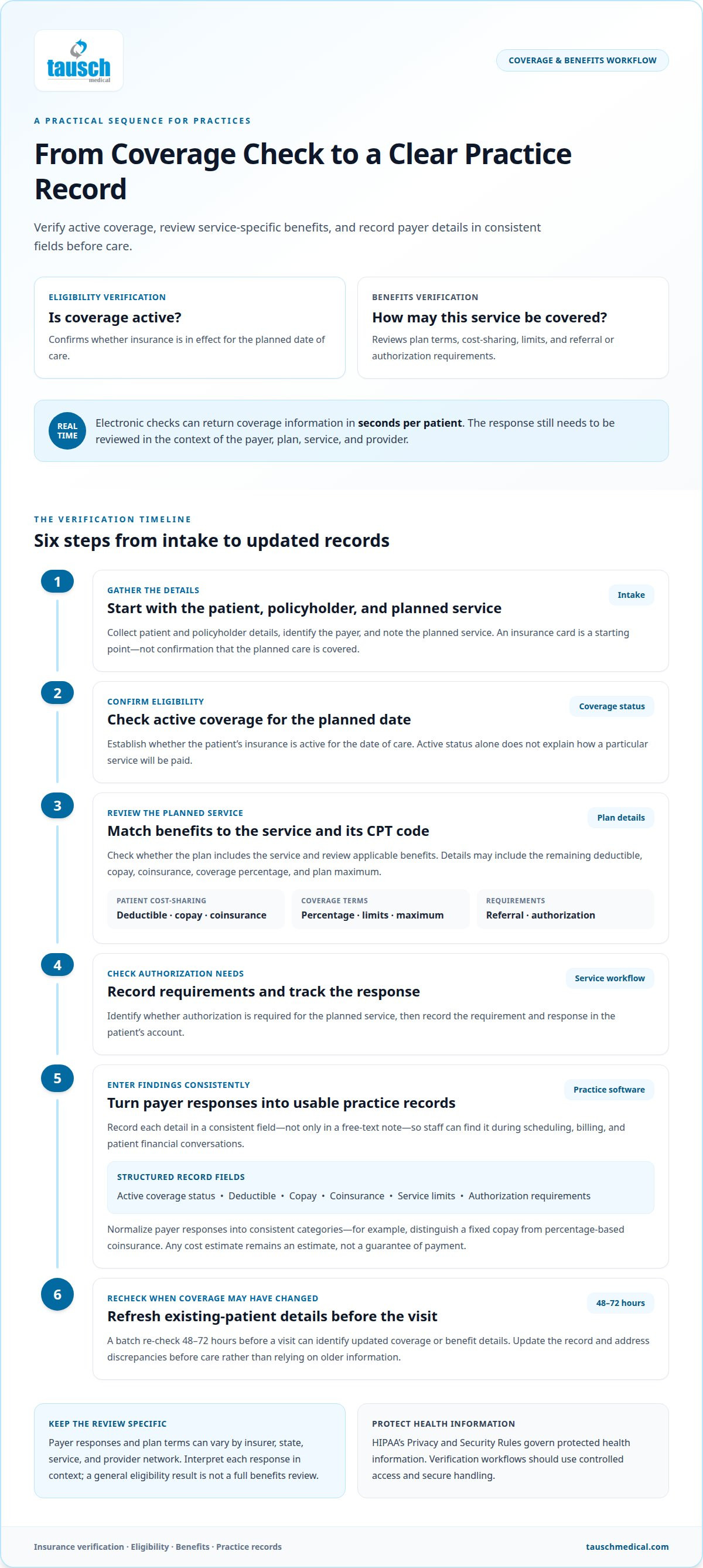
How insurance verification services enter benefit information into practice management software
Structured benefit entries turn payer responses into usable practice records. Clear fields connect patient estimates, authorization workflows, and claims preparation.
Recording Benefit Information in Practice Management Software
A verification professional records the payer’s response in the patient’s software account. Insurance verification services can capture active coverage status, deductible, copay, coinsurance, service limits, and authorization requirements. Record each detail in a consistent field rather than burying it in a free-text note. This structure helps staff find relevant information during scheduling, billing, and patient financial conversations.
Benefits normalization means presenting different payer responses in consistent categories. For example, staff can distinguish a fixed copay from percentage-based coinsurance. A cost estimate can then reflect the service, recorded benefit terms, and deductible information. It remains an estimate, not a guarantee of payment. Accurate entries also help the practice explain the basis for an estimate.
When to Recheck Existing Patients’ Benefits
Existing patients’ coverage can change, so an older account entry may not reflect current eligibility. A batch re-check 48-72 hours before a visit can identify updated coverage or benefit details. Insurance verification services can then support timely record updates and help staff address discrepancies before care, rather than relying on older information during claims processing.
Electronic workflows can organize benefit checks and prior authorization tasks around scheduled services. Staff can record whether authorization is required and track the response in the patient’s account. These workflows support accuracy, reduce avoidable rework, and keep revenue-cycle information aligned across software records.
Explore support for practice workflows that connect verification details with billing and authorization processes.
Tausch Medical: Insurance Verification and Authorization
Tausch Medical provides insurance verification and authorization support for healthcare practices managing payer checks and authorization workflows. When verification tasks compete with patient scheduling, claims, and follow-up, this support can help keep coverage information connected to billing operations. Practices can also draw on medical billing services and accounts receivable management to address related administrative needs.
For practices considering external support, medical billing outsourcing offers another way to organize revenue-cycle work. The right fit depends on which tasks the practice wants handled and how verification connects with its billing process.
Want to see how Tausch Medical can support your practice with reliable medical billing, prior authorization, eligibility verification, A/R follow-up, and RCM support? Start with our free two-week trial and experience the difference before making a commitment.
Set a Clear Direction for Your Verification Workflow
Before choosing support, define how verification should fit your practice. Clarify who handles payer follow-up, how updates reach the appropriate team, and where unresolved questions are recorded. These decisions help establish a process that supports your priorities and existing responsibilities.
A focused discussion with Tausch Medical can help identify how administrative support may fit your operations. Tausch Medical offers end-to-end or task-based outsourcing, giving practices a practical starting point for organizing their workload and planning improvements.
Want to see how Tausch Medical can support your practice with reliable medical billing, prior authorization, eligibility verification, A/R follow-up, and RCM support? Start with our free two-week trial and experience the difference before making a commitment.
Frequently Asked Questions
How are eligibility checks handled?
Tausch Medical provides insurance verification and authorization services. The workflow uses patient and policyholder details to request an active-coverage response from the payer, then records relevant findings for practice operations. Tausch Medical supports practices in Houston, San Antonio, Dallas, Austin, El Paso, Arlington, Plano, New York, Boston, Philadelphia, Washington, D.C., Baltimore, Miami, Orlando, Tampa, Atlanta, Raleigh, Richmond, and Jacksonville.
How am I notified when a verification check is completed?
Tausch Medical provides reports daily, weekly, and monthly, tailored to practice needs. These reports offer a structured way to review completed verification work and unresolved items. A useful completion update identifies the patient account, payer response, and next administrative action, such as following up on missing information or authorization. Clear reporting helps front-office and billing teams stay aligned.
How fast are verifications made?
Verification speed depends on the payer’s response and whether submitted patient and plan details match its records. Tausch Medical describes its turnaround as quick, though timing can vary with the request and any follow-up needed. Electronic payer transactions may return promptly, while cases requiring additional review can take longer. Scheduling checks ahead of care gives the practice time to address exceptions.
How much does it cost?
Cost depends on the service scope and practice arrangement. Tausch Medical’s stated pricing options are “Easy pricing options - FTE or Collection %.” The appropriate structure depends on which verification, authorization, billing, and follow-up tasks the practice assigns, as well as the workflow and volume included in the engagement.
What questions do you ask when checking coverage and benefits?
The review clarifies the patient, payer, planned service, and date of care, then identifies coverage details relevant to the visit. It may address whether a referral or prior authorization is needed, whether the clinician or facility is in network, and what cost-sharing applies. For example, a specialist appointment may require checking referral conditions alongside the plan’s service-specific benefits.
Want to see how Tausch Medical can support your practice with reliable medical billing, prior authorization, eligibility verification, A/R follow-up, and RCM support? Start with our free two-week trial and experience the difference before making a commitment: https://tauschmedical.com/free-trial-form
Disclaimer
This article is for general informational purposes only and does not constitute legal, medical, billing, coding, compliance, or financial advice. Healthcare rules, payer policies, and reimbursement guidelines may change and may vary by situation. Please consult qualified professionals or official sources before making decisions based on this content. Tausch Medical is not responsible for any loss or liability arising from reliance on this information.


