


Article by
Dr. Sharafat Hussain Ph.D
Dr. Sharafat Hussain is a healthcare business consultant, entrepreneur, and academic with strong experience in the US healthcare industry. He is the Founder and Managing Director of Tausch Medical, a revenue cycle management company supporting US healthcare providers with medical billing, prior authorization, credentialing, eligibility verification, A/R follow-up, and patient support services. His work combines practical healthcare operations, business strategy, and academic insight to help medical practices improve efficiency, collections, and service quality.
Can an outsourced billing team strengthen your revenue cycle without forcing your practice to replace its existing EHR? In many cases, the goal is to connect workflows, not change the system your team already knows. Still, it’s reasonable to worry that new billing support could disrupt documentation routines or leave unclear who owns claims, follow-up, and data handoffs.
Integrating billing services with existing EHR workflows requires clear responsibilities and reliable coordination, not assumptions about a technical connection. This guide explains how to map documentation, eligibility verification, prior authorization, claims, and A/R follow-up so work moves smoothly between your practice and billing partner. You’ll also learn how to compare task-based and end-to-end support, protect continuity during a transition, and assess a partner with practical measures before making a larger commitment.
Key Takeaways
- Think of integration as aligning billing work with your established EHR workflows, not replacing your system or installing new software.
- When integrating billing services with existing EHR workflows, map ownership for eligibility checks, prior authorization, claims, payment posting, A/R follow-up, and denial analysis.
- Define handoffs and reporting expectations before the transition, then review results to identify gaps and maintain continuity.
- Assess platform experience, HIPAA compliance, service flexibility, and reporting. Tausch Medical offers task-based or end-to-end support, with “Calls are answered by a human to ensure patient satisfaction - always on hand to answer questions and make sure that no call goes unanswered, 24/7.”
Integrating Billing Services with an Existing EHR: What Integration Really Means
Integrating billing services with an existing EHR means coordinating billing tasks with the practice’s documentation workflows, responsibilities, and reporting processes. It doesn’t necessarily mean adding billing software to the EHR or replacing the system. While Electronic Health Record (EHR) systems often include billing information, an external billing service is a team that carries out agreed revenue-cycle work; native EHR billing features are software tools within the system itself.
Service integration is the operational alignment of billing work with a practice’s existing EHR workflows, without automatically requiring an EHR replacement. For example, a practice might continue documenting visits in its current system while assigning specific billing activities, follow-up, and reporting to an external team. The essential question is how information and responsibility move through the workflow, not whether the service is built into the software.
Does integrating billing services require changing EHR software?
No. A practice can retain its existing EHR and coordinate billing work around established processes. It can define what documentation is needed before billing tasks begin, who reviews missing information, and who handles outstanding claims or follow-up. Clear ownership helps preserve familiar clinical routines while making billing responsibilities easier to track.
Specific interface and data-transfer capabilities depend on the practice’s operating setup, so integration shouldn’t be assumed to mean a particular technical connection. Start by defining the billing scope and the handoffs the team needs. Practices can align delegated claims and related revenue-cycle tasks with their workflows through medical billing services, while keeping responsibility and reporting expectations clear.
How to Connect Existing EHR Workflows with Billing Services
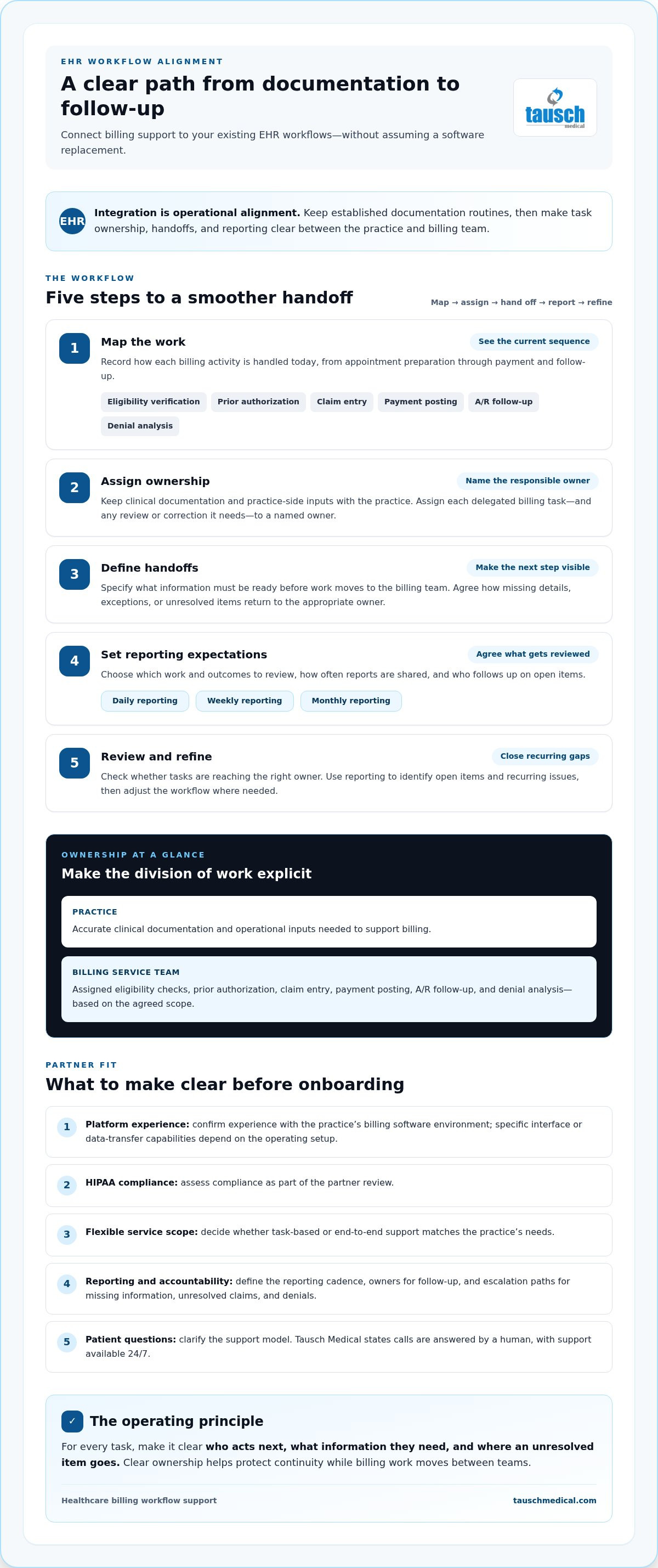
A practical workflow begins with a clear view of what happens from appointment preparation through payment and follow-up. When integrating billing services with existing EHR workflows, document the current sequence first, then agree on who completes each task, what information is needed, and how unresolved items are escalated.
- Map the work. Record how eligibility verification, prior authorization, claim entry, payment posting, A/R follow-up, and denial analysis are handled today.
- Assign ownership. Keep clinical documentation and practice-side inputs with the practice; designate responsibility for each billing task and any review or correction it requires.
- Define handoffs. Specify what information must be ready before a task moves to the billing team, and how missing details or exceptions return to the appropriate owner.
- Set reporting expectations. Agree on which work and outcomes to review, how often reports are shared, and who follows up on open items.
- Review and refine. Check whether tasks are reaching the right owner and adjust the workflow when recurring gaps appear.
Clear task ownership reduces avoidable handoff confusion by making it evident who acts next, what information they need, and where an unresolved item goes.
Which billing tasks should the practice and service team own?
The practice supplies accurate clinical documentation and the operational inputs needed to support billing. The service team can handle assigned eligibility checks, prior authorization, claim entry, payment posting, A/R follow-up, and denial analysis. The precise division should reflect the practice’s workflow and agreed scope. Tausch Medical works across multiple billing software platforms, supporting varied practice environments without assuming a particular EHR interface. Practices can shape delegated work through medical billing outsourcing services, whether they need task-based support or broader revenue-cycle assistance.
For patient questions, the support model also matters: Calls are answered by a human to ensure patient satisfaction - always on hand to answer questions and make sure that no call goes unanswered, 24/7. A defined workflow and consistent communication help keep responsibilities visible; learn about Tausch Medical’s practice support.
How to Evaluate an EHR-Aligned Billing Partner and Start Smoothly
A capable billing partner should fit the practice’s established environment and make ownership visible, not add uncertainty. As you assess options for integrating billing services with existing EHR workflows, consider platform experience, HIPAA compliance, flexible service scope, reporting cadence, and who is accountable for billing follow-up. Tausch Medical works across multiple billing software platforms and is a HIPAA-compliant medical billing company.
Service scope can be task-based or end-to-end, depending on where the practice needs support. Tausch Medical offers both models, with analytics-driven reporting to help practices review billing activity and performance. Set expectations up front: identify the work to be handled, the information needed from the practice, how exceptions are escalated, and which reports will inform ongoing decisions.
What should onboarding and ongoing performance reviews cover?
Document workflow owners and required inputs, along with escalation paths for missing information, unresolved claims, and denial follow-up. Agree on whether daily, weekly, or monthly reporting best fits the practice’s review needs, then use those reports to identify open items and recurring issues. For visibility into outstanding balances and denials, Tausch Medical’s A/R and denial management services support follow-up across these areas.
Review the workflow regularly with the billing team: are responsibilities clear, are follow-up items visible, and does reporting support timely decisions? Calls are answered by a human to ensure patient satisfaction - always on hand to answer questions and make sure that no call goes unanswered, 24/7.
Want to see how Tausch Medical can support your practice with reliable medical billing, prior authorization, eligibility verification, A/R follow-up, and RCM support? Start with our free two-week trial and experience the difference before making a commitment: access our free trial form.
Make Your Next Billing Step a Measured One
Integrating billing services with existing EHR workflows can be a practical way to strengthen revenue-cycle support while keeping the system your team already uses. Choose a service scope that fits your current priorities, then assess how well it works in your practice before making a longer-term commitment. Tausch Medical offers flexible, task-based or end-to-end billing support to align with practice needs.
Explore how Tausch Medical supports healthcare practices, then consider a focused trial to experience the workflow firsthand.
Want to see how Tausch Medical can support your practice with reliable medical billing, prior authorization, eligibility verification, A/R follow-up, and RCM support? Start with our free two-week trial and experience the difference before making a commitment: free trial form
Frequently Asked Questions
Can you outsource medical billing without changing your EHR?
Yes. Outsourcing billing doesn’t inherently require replacing the practice’s EHR; your team can continue documenting in its current system while delegating agreed billing work. Before launch, choose a limited workflow to review, such as a particular claim category, and confirm what documentation the billing team needs. This gives staff a focused way to identify handoff gaps before expanding the scope.
How do billing services work with different EHR systems?
Billing services coordinate around a practice’s established procedures, while the specific interface or information-transfer approach depends on its operating setup. Tausch Medical works across multiple billing software platforms. To make collaboration practical, define what information the billing team needs, how it will be accessed or shared, and how questions or exceptions are routed back to practice staff.
What billing tasks can an external team handle alongside an existing EHR?
An external team can take on assigned revenue-cycle tasks while practice staff remain responsible for clinical documentation. For a new-patient visit, for example, the practice records the encounter and supplies supporting details; delegated staff may verify coverage, manage authorization, submit the claim, post payments, and track payer responses. Clear boundaries help staff know who resolves documentation questions or outstanding balances.
How can a practice assess whether its billing workflow is improving?
Compare reports using consistent definitions and time periods. Practices in Houston, San Antonio, Dallas, Austin, El Paso, Arlington, Plano, New York, Boston, Philadelphia, Washington, D.C., Baltimore, Miami, Orlando, Tampa, Atlanta, Raleigh, Richmond, and Jacksonville can review A/R aging, denial reasons, and claim value, then investigate changes by payer or workflow stage. A stable baseline helps distinguish progress from reporting variation.
Disclaimer
This article is for general informational purposes only and does not constitute legal, medical, billing, coding, compliance, or financial advice. Healthcare rules, payer policies, and reimbursement guidelines may change and may vary by situation. Please consult qualified professionals or official sources before making decisions based on this content. Tausch Medical is not responsible for any loss or liability arising from reliance on this information.


