


Article by
Dr. Sharafat Hussain Ph.D
Dr. Sharafat Hussain is a healthcare business consultant, entrepreneur, and academic with strong experience in the US healthcare industry. He is the Founder and Managing Director of Tausch Medical, a revenue cycle management company supporting US healthcare providers with medical billing, prior authorization, credentialing, eligibility verification, A/R follow-up, and patient support services. His work combines practical healthcare operations, business strategy, and academic insight to help medical practices improve efficiency, collections, and service quality.
What if the key to switching billing partners without disrupting cash flow isn’t a faster handoff, but clear ownership of every claim at each stage? If you’re weighing how to transition to a new medical billing company, it’s reasonable to worry about outstanding claims, A/R follow-up, and whether billing will continue smoothly while two teams coordinate the change.
A structured transition makes responsibilities visible before the handoff begins. Start by setting a cutover date, documenting open work, and assigning owners for claim submission, payment posting, and denial follow-up. This guide walks through those steps, including how to organize access and records and set reporting expectations with your new partner.
Key Takeaways
- Before planning how to transition to a new medical billing company, document workflows, payer mix, platforms, open claims, denials, and reporting needs.
- Set a written cutover plan that assigns ownership for legacy A/R, in-flight claims, new submissions, denials, payer correspondence, and payment posting.
- Coordinate system access and records transfers, then monitor the handoff so claim follow-up and billing responsibilities remain clear.
- Tausch Medical provides end-to-end or task-based revenue cycle support with analytics-driven reporting. Calls are answered by a human to ensure patient satisfaction - always on hand to answer questions and make sure that no call goes unanswered, 24/7.
Before You Transition to a New Medical Billing Company, Define What Must Stay on Track
Concern about interrupted claim follow-up or delayed cash flow is understandable. Treat the billing change as a planned handoff, with documented responsibilities and a defined cutover, rather than an instant switch that could leave work between teams. A clear starting record helps your practice and incoming partner see which tasks need to continue and who owns them.
Document current billing workflows, payer mix, software platforms, open claims, denials, and reporting needs. For each open item, capture its status, last action, next step, and any relevant payer response. Also note recurring communication gaps and tasks that depend on a particular staff member or system. This risk map focuses the transition on your practice’s operational needs. For context on the processes involved, the Medical Billing Overview describes medical billing and its connection to revenue cycle management.
Which billing responsibilities need a clear owner before the change?
Separate existing A/R and denials from claims created after the agreed cutover date. For every open item, record whether it is awaiting documentation, correction, or a payer response, and name the person or team responsible for the next action. Include payer correspondence and appeal tasks so the incoming team has enough context to continue the work.
Define ownership for payment posting, payer correspondence, in-flight claims, and new submissions, then make the handoff record accessible to both teams. This gives your practice a practical way to plan how to transition to a new medical billing company without leaving legacy work or new claims unassigned. Tausch Medical’s medical billing services support billing and collections within a broader revenue cycle workflow, with responsibilities aligned to the practice’s needs.
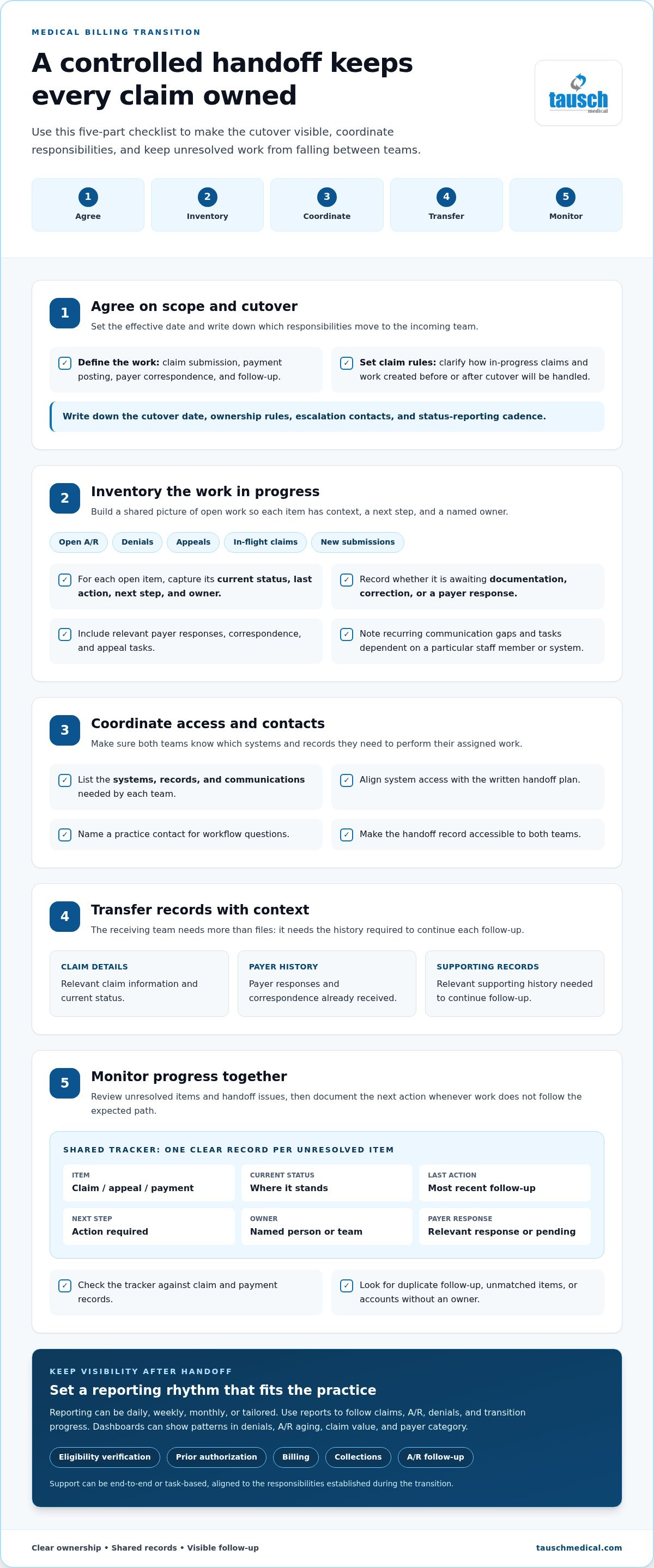
Medical Billing Transition: A Practical Handoff Plan
A controlled cutover takes more than transferring files. The practice and billing partner need an agreed scope, named owners, and a shared view of work in progress. As you plan how to transition to a new medical billing company, sequence the handoff around your workflows and dependencies rather than assuming a fixed transition duration.
- Agree on scope and cutover. Set the effective date and define which responsibilities move, including claim submission, payment posting, payer correspondence, and follow-up. Clarify how claims already in progress will be handled.
- Inventory the work. Organize open A/R, denials, appeals, in-flight claims, and new submissions. Record the current status, next action, and owner for each item.
- Coordinate access. List the systems, records, and communications each team needs to perform its assigned tasks. Align access with the handoff plan and identify a practice contact for workflow questions.
- Transfer records. Share relevant claim details, payer responses, and supporting history so the receiving team can continue follow-up with context.
- Monitor progress. Review unresolved items and handoff issues together. When a claim or payment does not follow the expected path, clarify ownership and document the next action.
How should a practice handle legacy A/R and claims during cutover?
Put the cutover date, claim ownership rules, escalation contacts, and status-reporting cadence in writing. A shared tracker can list each unresolved claim, appeal task, payer response, or payment requiring routing, along with its owner and next step. Check the tracker against claim and payment records to identify duplicate follow-up, unmatched items, or accounts without an assigned owner.
Consistent tracking supports organized A/R and denial management as outstanding accounts move through follow-up. HFMA’s Understanding Revenue Cycle Management outlines how revenue cycle processes connect across a patient’s financial journey, reinforcing the value of clear handoffs. Practices looking for a partner to support defined billing responsibilities can explore Tausch Medical’s revenue cycle support.
What to Expect from Your New Medical Billing Company's Ongoing Support
A successful handoff should lead into a clear, sustainable operating relationship. Tausch Medical provides end-to-end or task-based outsourcing, aligning support with the responsibilities established during your transition. Your practice can bring billing and related revenue cycle work under one coordinated scope or focus on selected functions.
Support includes eligibility verification, prior authorization, billing, collections, and A/R follow-up. Tausch Medical’s outsourced medical billing and RCM services offer a flexible scope for practices transitioning billing responsibilities while keeping ongoing work visible.
How can reporting and service flexibility support a smoother handoff?
Analytics-driven reporting is available daily, weekly, monthly, or in a tailored format. Choose a cadence that fits your practice’s review process, then use reports to follow claims, A/R, denials, and transition progress. Dashboards can help identify patterns in denials, A/R aging, claim value, and payer category, giving practice leaders a clearer view of what needs attention.
Tausch Medical provides 24/7 support. Calls are answered by a human to ensure patient satisfaction - always on hand to answer questions and make sure that no call goes unanswered, 24/7. Tausch Medical is a HIPAA-compliant medical billing company. Over 100 certified medical coders and billers. Achieving over 95% accuracy. Easy pricing options - FTE or Collection %. Reduce costs by up to 50%.
Build a Stronger Operating Partnership from the Start
A billing transition is also an opportunity to establish how your practice and billing partner will work together over time. Use regular conversations to clarify changing priorities, raise workflow concerns, and keep responsibilities aligned with your practice’s needs. Agree on who will review reports and how unresolved questions will be raised, so follow-up stays connected to the work being done.
Frequently Asked Questions
How long does it take to transition to a new medical billing company?
There’s no universal duration. The timeline depends on your workflows, the information to transfer, and the transition plan. Map key dependencies, such as access approvals, payer records, and internal review availability, then set a cutover date and milestones for transferring responsibilities instead of relying on a standard number of days.
What happens to outstanding A/R when a practice changes billing companies?
Outstanding A/R remains part of the practice’s revenue cycle, but the teams need a clear agreement about who handles each account. Specify how to manage cases such as a payer response that arrives after cutover or a payment that needs to be matched to an older claim. Reconcile these items against account records so their status and next steps remain clear through the change.
Can a practice change billing companies without changing its EHR?
Yes. Changing billing companies doesn’t automatically require replacing the practice’s EHR. Document the existing software setup and how billing information moves between practice staff and the billing team. Before cutover, agree on access, reporting formats, and a process for resolving workflow questions. A designated practice contact can help keep operational decisions moving without turning the transition into a software replacement project.
How can a practice avoid missed claims during a billing transition?
Assign an owner to every claim in progress and follow up on exceptions, not just completed submissions. Practices in Houston, San Antonio, Dallas, Austin, El Paso, Arlington, Plano, New York, Boston, Philadelphia, Washington, D.C., Baltimore, Miami, Orlando, Tampa, Atlanta, Raleigh, Richmond, and Jacksonville can compare submission records with payer acknowledgments during routine transition reviews. Investigate unmatched items and document their next action.
Want to see how Tausch Medical can support your practice with reliable medical billing, prior authorization, eligibility verification, A/R follow-up, and RCM support? Start with our free two-week trial and experience the difference before making a commitment: https://tauschmedical.com/free-trial-form
Disclaimer
This article is for general informational purposes only and does not constitute legal, medical, billing, coding, compliance, or financial advice. Healthcare rules, payer policies, and reimbursement guidelines may change and may vary by situation. Please consult qualified professionals or official sources before making decisions based on this content. Tausch Medical is not responsible for any loss or liability arising from reliance on this information.


