


Article by
Dr. Sharafat Hussain Ph.D
Dr. Sharafat Hussain is a healthcare business consultant, entrepreneur, and academic with strong experience in the US healthcare industry. He is the Founder and Managing Director of Tausch Medical, a revenue cycle management company supporting US healthcare providers with medical billing, prior authorization, credentialing, eligibility verification, A/R follow-up, and patient support services. His work combines practical healthcare operations, business strategy, and academic insight to help medical practices improve efficiency, collections, and service quality.
Managing multiple payer contracts is easier when staff can find the right term at the point it affects a claim, rather than relying on memory. Contract language can be difficult to compare and retrieve, and billing teams may be unsure which payer-specific rule applies. When reimbursement differs from expectations, a consistent record helps the team identify what to review.
This guide offers a repeatable way to organize contract information and translate key terms into eligibility checks, billing steps, A/R follow-up, and reporting. It covers how to track updates and compare expected with actual reimbursement, so potential issues can be investigated systematically. The goal is to connect contract administration with daily workflows, not create another document archive.
Key Takeaways
- Use one controlled inventory as the source of truth for payer names, contract versions, effective dates, renewal checkpoints, and internal owners.
- Managing multiple payer contracts is more practical when key terms become clear workflow steps assigned to the right team members.
- Connect payer-specific requirements to eligibility verification, prior authorization, claim entry, payment posting, and A/R follow-up.
- Use denial, A/R aging, claim value, and payer-category reports to identify patterns, then check potential discrepancies against the applicable contract.
Why managing multiple payer contracts starts with a clear contract inventory
Contract terms, amendments, renewal dates, and payer contacts may be spread across shared drives, emails, and billing references. That makes it harder to determine which agreement applies to a claim, especially when a practice works across specialties, locations, or provider groups. A controlled contract inventory gives staff one reliable index to current agreements and the people responsible for them.
Start with a register that identifies each payer and records the agreement version, effective date, renewal checkpoint, and internal owner. Link each entry to the signed document and retain prior versions so staff can distinguish current terms from superseded ones. The varied coverage arrangements in the U.S. insurance system make it useful to organize agreements around each specific payer relationship rather than rely on assumptions.
What information belongs in a payer contract register?
A payer contract is an agreement between a healthcare provider and an insurer that sets terms for participation and reimbursement. To make it useful in daily operations, capture the information staff need to locate and apply its provisions:
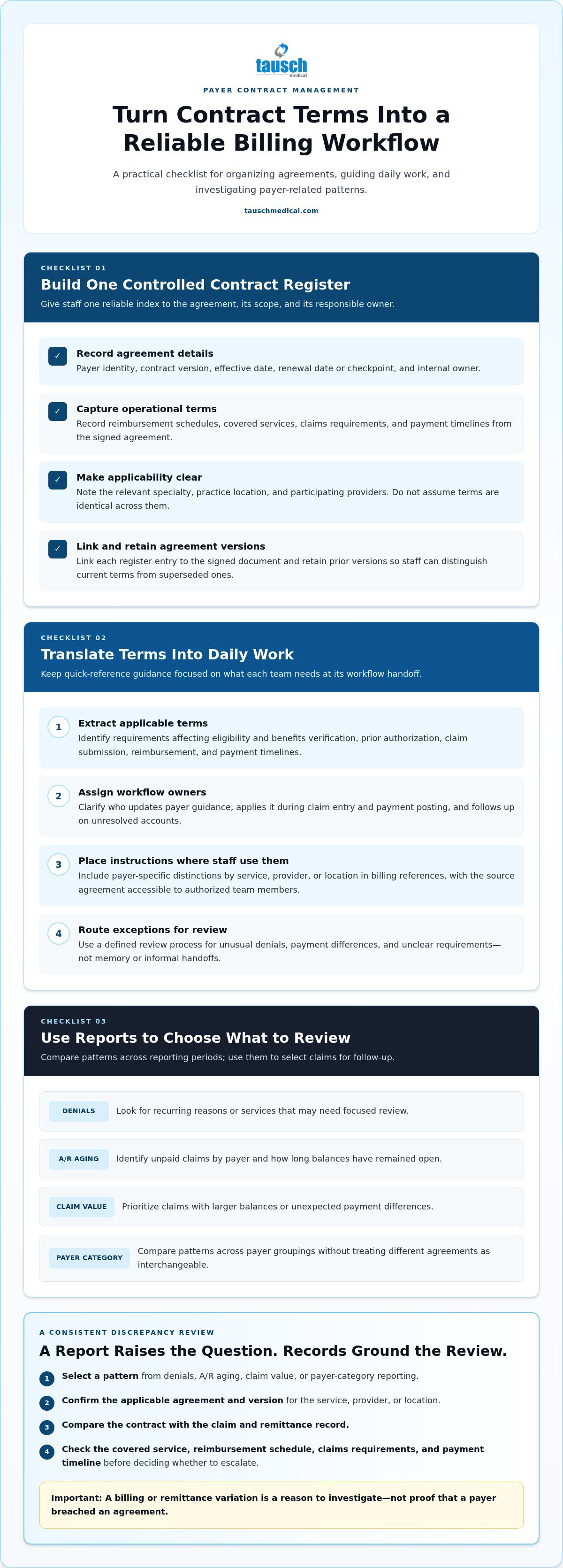
- Agreement details: Payer identity, contract version, effective date, renewal date or checkpoint, and responsible internal owner.
- Operational terms: Reimbursement schedules, covered services, claims requirements, and payment timelines, recorded from the signed agreement.
- Applicability: Relevant specialty, practice location, and participating providers, so teams can identify which agreement governs a service or claim.
Don’t assume a payer’s terms are identical across specialties, locations, or participating providers. Record those distinctions in the register, and make the underlying agreement easy to retrieve. This gives staff a practical starting point for applying payer-specific requirements during billing.
How to turn payer contract terms into consistent billing workflows
A contract becomes useful when its provisions shape routine work instead of sitting in a document repository. When managing multiple payer contracts, turn relevant terms into concise guidance for each revenue-cycle handoff, while keeping the signed agreement available as the authoritative reference.
- Extract applicable terms. Identify requirements that affect eligibility and benefits verification, prior authorization, claim submission, reimbursement, and payment timelines.
- Assign workflow owners. Clarify who updates payer guidance, who applies it during claim entry and payment posting, and who follows up on unresolved accounts.
- Update billing references. Put payer-specific instructions where staff use them, including distinctions by service, provider, or location.
- Review exceptions. Route unusual denials, payment differences, and unclear requirements through a defined review process instead of relying on memory or informal handoffs.
How can teams apply payer-specific requirements without adding unnecessary complexity?
Keep quick-reference guidance focused on the requirements staff need for each task, and make the source agreement accessible to authorized team members. For example, verification staff can use the applicable coverage information, billing staff can follow the contract’s claim requirements, and A/R staff can use its payment timelines to guide follow-up.
A billing or remittance variation is a reason to investigate, not proof that a payer has breached an agreement. Before escalating a discrepancy, compare the applicable contract language with the claim details and remittance record. Confirm that the correct agreement and version apply. This makes the review more precise and gives the team a clear basis for follow-up. Tausch Medical provides medical billing services to support these recurring billing tasks.
How billing and reporting support ongoing payer contract management
Routine billing data helps a practice decide which payer-related issues to review first. For managing multiple payer contracts, compare denials, accounts receivable (A/R) aging, claim value, and payer category across reporting periods. A cluster of denials for one payer or aging concentrated in a category can guide investigation, but it does not establish that contract terms were violated.
Which reports help teams investigate payer-related billing patterns?
Daily, weekly, or monthly reports give teams a consistent view of billing activity and exceptions. Analytics-driven dashboards can help staff filter by payer and examine:
- Denials: Look for recurring reasons or services that may need focused review.
- A/R aging: Identify unpaid claims by payer and how long balances have remained open.
- Claim value: Prioritize review of claims with larger balances or unexpected payment differences.
- Payer category: Compare patterns across payer groupings without treating different agreements as interchangeable.
Use these patterns to select claims for follow-up, then compare each claim and remittance record with the applicable agreement and version. Confirm the covered service, reimbursement schedule, claims requirements, and payment timeline before deciding whether to escalate a discrepancy. A report points to a question; the contract and claim records provide the basis for investigating it.
Eligibility verification, billing, A/R follow-up, and denial support help teams handle payer-specific workflows consistently. Tausch Medical provides A/R and denial management services to support this work. Calls are answered by a human to ensure patient satisfaction - always on hand to answer questions and make sure that no call goes unanswered, 24/7.
Put a stronger contract process into practice
A reliable approach to managing multiple payer contracts depends on consistent operational follow-through. Tausch Medical supports medical practices with billing and revenue-cycle services, including eligibility verification, prior authorization, denial management, and A/R follow-up. Over 100 certified medical coders and billers. Achieving over 95% accuracy. HIPAA-compliant medical billing company.
Want to see how Tausch Medical can support your practice with reliable medical billing, prior authorization, eligibility verification, A/R follow-up, and RCM support? Start with our free two-week trial and experience the difference before making a commitment: https://tauschmedical.com/free-trial-form
Take the next step toward steadier practice operations and a more confident revenue-cycle process.
Frequently Asked Questions
How often should a medical practice review its payer contracts?
Review contracts at renewal checkpoints and whenever an amendment, payer notice, or practice change could affect participation or reimbursement. When managing multiple payer contracts, assign an owner to track these triggers and record the outcome, including whether staff guidance needs updating. This event-based approach focuses attention on changes that may affect operations without assuming one review schedule fits every agreement.
What records should a practice keep for each payer contract?
Keep the signed agreement and amendments together with payer notices that clarify or change terms. A practical record set can also include a dated log of who reviewed each update, what operational guidance changed, and when staff were informed. Retain relevant claim and remittance examples when they help explain a billing question, so reviewers can trace the issue from contract language to operational impact.
Can a medical billing partner support workflows across multiple payers?
Yes. A billing partner can support payer-specific eligibility checks, prior authorization, claim processing, payment posting, and follow-up, while routing exceptions for review. Tausch Medical handles all payer claims and offers task-based or end-to-end billing and RCM support. This support is relevant to healthcare practices in Houston, San Antonio, Dallas, Austin, El Paso, Arlington, Plano, New York, Boston, Philadelphia, Washington, D.C., Baltimore, Miami, Orlando, Tampa, Atlanta, Raleigh, Richmond, and Jacksonville.
Disclaimer
This article is for general informational purposes only and does not constitute legal, medical, billing, coding, compliance, or financial advice. Healthcare rules, payer policies, and reimbursement guidelines may change and may vary by situation. Please consult qualified professionals or official sources before making decisions based on this content. Tausch Medical is not responsible for any loss or liability arising from reliance on this information.


