


Article by
Dr. Sharafat Hussain Ph.D
Dr. Sharafat Hussain is a healthcare business consultant, entrepreneur, and academic with strong experience in the US healthcare industry. He is the Founder and Managing Director of Tausch Medical, a revenue cycle management company supporting US healthcare providers with medical billing, prior authorization, credentialing, eligibility verification, A/R follow-up, and patient support services. His work combines practical healthcare operations, business strategy, and academic insight to help medical practices improve efficiency, collections, and service quality.
A small coding error can put an otherwise valid claim at risk. Common medical billing coding mistakes include duplicate charges, incorrect modifiers, missing prior authorizations, incomplete documentation, and codes that do not accurately reflect the service provided. These issues can lead to denials, delayed reimbursement, or lost revenue.
Billing and coding accuracy matters because each claim must connect the patient’s record, diagnosis, and treatment to the services billed. This article covers common errors, how inaccurate coding affects claims, and why a diagnosis code may not support a procedure code. It also explains what to review in code selection, documentation, and claim details so you can identify where revenue-cycle problems begin.
Key Takeaways
- Check whether procedure components are already included in a single CPT code before reporting them separately, and use modifiers only when the documentation supports them.
- Confirm patient, insurance, and provider details before submitting a claim to reduce avoidable processing problems.
- Compare the diagnosis with the billed treatment to ensure the documented condition supports the service reported.
- Review claim details and coding updates consistently so potential errors can be identified before they affect reimbursement.
1. What are some medical billing errors that can occur?
A medical billing error involves how a claim is prepared or submitted, such as billing the wrong payer. A medical coding error assigns an incorrect diagnosis or procedure code, or applies a code incorrectly. Reporting a service that was not performed is a billing error; choosing a code that does not describe the documented procedure is a coding error.
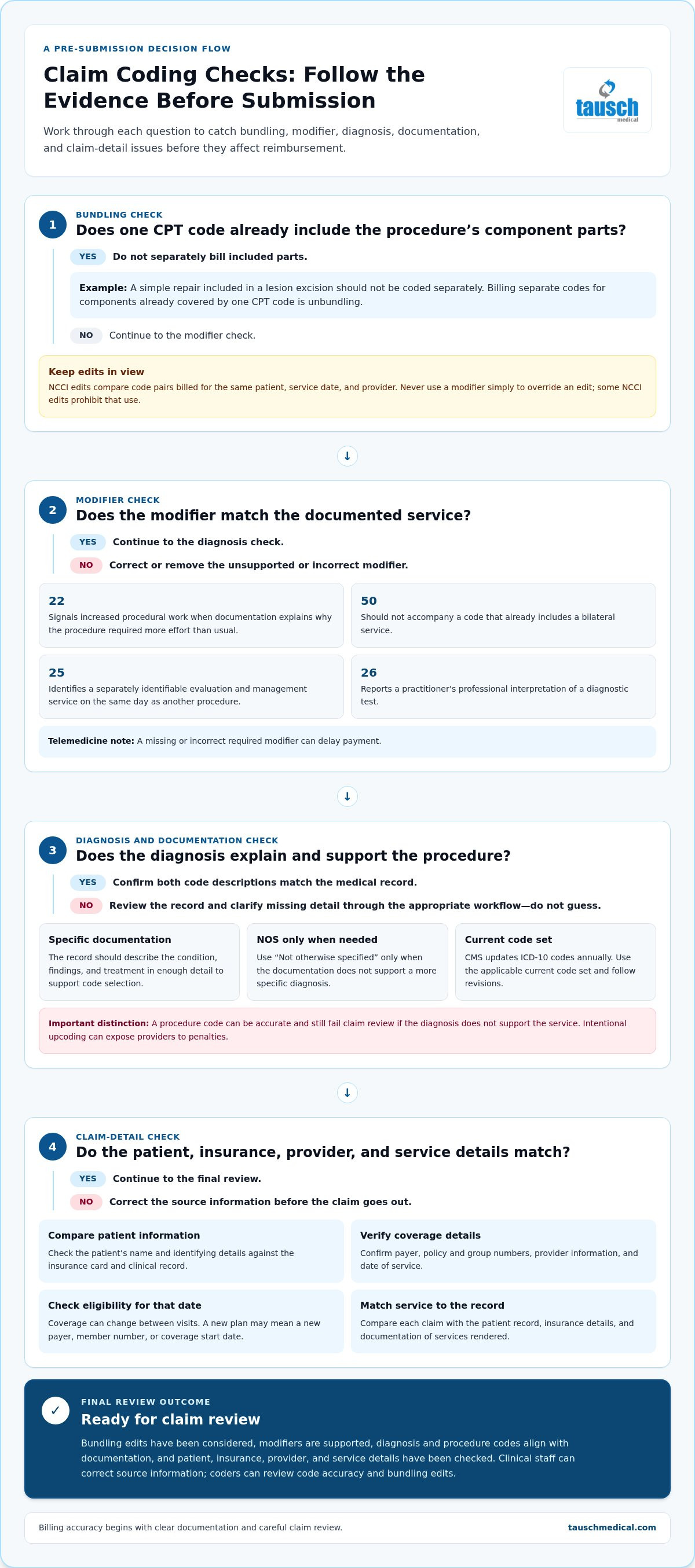
CPT bundling is a frequent source of confusion. If one CPT code covers a procedure’s component parts, billing separate codes for those parts is unbundling. A simple repair included in a lesion excision shouldn’t be coded separately. The National Correct Coding Initiative edits compare code pairs billed for the same patient, service date, and provider; according to the Centers for Medicare & Medicaid Services, they were implemented to support appropriate payment for Medicare Part B claims.
Modifiers add details to a procedure, but incorrect or missing modifiers can trigger denials or improper reimbursement. Modifier 22 signals increased procedural work when documentation explains why the procedure required more effort than usual. Modifier 50 shouldn’t accompany a code that already includes a bilateral service. Modifier 25 can identify a separately identifiable evaluation and management service on the same day as another procedure. Modifier 26 reports a practitioner’s professional interpretation of a diagnostic test. Telemedicine claims can also face payment delays when the required modifier is missing or incorrect. Never use a modifier simply to override an edit; some NCCI edits prohibit that use.
Patients can compare an itemized provider bill with their insurer’s explanation of benefits, checking each service, product, payment, and remaining charge. If a charge appears incorrect, they can raise the discrepancy with the provider and insurer. For practices refining workflows, medical billing processes connect documented services with submitted claims.
2. What are some consequences of inaccurate coding?
Incorrect patient, insurance, or provider information can send a claim to the wrong payer or cause a denial. A misspelled name, transposed policy digits, or incorrect date of service may prevent an insurer from matching the claim to the patient’s coverage. Incomplete provider details can also delay processing, even when the clinical record supports the service.
Before submission, compare the patient’s name and identifying details with the insurance card and clinical record. Verify the payer, policy and group numbers, provider information, and date of service. Confirm eligibility for the date of service, since coverage can change between visits. A patient who changed plans may have a new payer, member number, or coverage start date. Using the old plan can lead to rejection or an incorrect patient balance.
CMS updates ICD-10 codes annually, so coders and providers should use the applicable current code set and follow revisions. Organizations can reduce avoidable errors by keeping clinical documentation specific, training staff on updates, and reviewing patient and insurance data before claims go out.
Before submission, compare each claim with the patient record, insurance details, and documentation of services rendered. This focused review can catch mismatched identifiers, missing fields, incorrect dates, and code-selection issues. Clinical staff can correct source information, while coders review code accuracy and bundling edits.
How often do errors occur, and what do they cost? These figures highlight how a small information error can create repeated administrative work, delay reimbursement, and leave providers with claims to correct.
3. Mismatched diagnosis and treatment codes
A diagnosis code should support the procedure code, such as a CPT or HCPCS code, by explaining why the service was appropriate for the documented condition. If a claim pairs a diagnosis with a treatment it does not reasonably explain, an insurer may reject it. A procedure code can be accurate yet still fail claim review if the diagnosis does not support the service.
Documentation is the bridge between clinical care and coding. A coder needs enough detail about the patient’s condition, findings, and treatment to select codes that accurately represent the encounter. Missing specifics can lead to an incorrect diagnosis, while a code that no longer applies may cause submission problems. ICD-10 codes are updated annually, so outdated code sets can also contribute to coding errors and claim denials.
Incomplete clinical documentation, selecting a code before reviewing the full record, and relying on outdated code references can all lead to incorrect or unspecified codes. Use “Not otherwise specified” (NOS) only when the documentation does not support a more specific diagnosis. Applying it despite available detail can obscure the clinical reason for treatment.
Before submission, compare the diagnosis with the documented service and confirm that both code descriptions match the record. If the note lacks clinical detail, clarify the documentation through the appropriate workflow rather than guessing at a more specific code. Resolving a mismatch before submission can prevent avoidable denials and rework. Intentional upcoding, by contrast, can expose providers to penalties.
For practices managing recurring claim rejections tied to coding discrepancies, review claim support options as part of a structured denial follow-up process.
Tausch Medical: Medical Billing Services
Tausch Medical provides Medical Billing Services for practices that need structured support connecting documentation, coding, and claim submission. When recurring errors, delayed claims, or unresolved balances strain administrative workflows, billing support can help practices maintain consistent revenue-cycle processes. Insurance Verification and Authorization supports coverage checks and authorization workflows, while Accounts Receivable Management addresses follow-up on outstanding balances. Practices seeking to delegate billing operations can also consider Medical Billing Outsourcing. Explore medical billing services as a practical next step when billing tasks are taking time away from core practice operations.
Want to see how Tausch Medical can support your practice with reliable medical billing, prior authorization, eligibility verification, A/R follow-up, and RCM support? Start with our free two-week trial and experience the difference before making a commitment: free trial form
Build a more dependable billing workflow
Addressing common medical billing coding mistakes can strengthen claim review, not just correct isolated errors. Practices can use recurring discrepancies to improve handoffs between documentation, coding, eligibility checks, and follow-up. After a denial or correction, a brief review can reveal missing information, workflow gaps, and ways to catch similar issues earlier.
When billing capacity or follow-through is a challenge, Tausch Medical provides Medical Billing Services, Insurance Verification and Authorization, and Accounts Receivable Management. These services support the administrative work around claims and help practices maintain a more consistent billing workflow.
Want to see how Tausch Medical can support your practice with reliable medical billing, prior authorization, eligibility verification, A/R follow-up, and RCM support? Start with our free two-week trial and experience the difference before making a commitment.
Frequently Asked Questions
What are some medical billing errors that can occur?
Common errors include omitted services, incomplete claim details, incorrect payer selection, and missed filing deadlines. Trace a claim from the encounter note through charge entry and submission to pinpoint where these common medical billing coding mistakes occur. A simple exception log can reveal whether problems cluster around a service type, payer, or handoff in the billing workflow.
How can inconsistent code assignment affect a healthcare organization?
Inconsistent code assignment can make similar encounters look different in claims data, complicating denial analysis, reimbursement tracking, and internal reviews. A shared coding reference and regular case discussions can help coders apply the same documentation criteria. This is relevant for organizations serving patients in Houston, San Antonio, Dallas, Austin, El Paso, Arlington, Plano, New York, Boston, Philadelphia, Washington, D.C., Baltimore, Miami, Orlando, Tampa, Atlanta, Raleigh, Richmond, and Jacksonville.
What Are the Most Common Errors?
Frequent errors include missing claim information, billing for a service that was not performed, using outdated codes, and failing to bill for a documented service. These issues can arise during documentation, charge capture, code selection, or claim submission. Reviewing examples from each stage helps practices pinpoint where their process needs clearer checks.
What are some consequences of inaccurate coding?
Inaccurate coding can lead to claim denials, delayed reimbursement, extra correction work, or an incorrect patient balance. It can also make revenue reports less useful when claims do not consistently reflect documented services. Intentional overbilling carries greater risk: it may be treated as a fraudulent claim and can result in penalties.
What does unbundling mean in medical coding and why is it a problem?
Unbundling means reporting separate codes for components already covered by a single procedure code. This can make a claim represent more services than were performed separately, creating a risk of denial or payment review. Before billing components individually, compare the documented work with the applicable code descriptions and edits, and ensure each reported service is distinct and supported.
Disclaimer
This article is for general informational purposes only and does not constitute legal, medical, billing, coding, compliance, or financial advice. Healthcare rules, payer policies, and reimbursement guidelines may change and may vary by situation. Please consult qualified professionals or official sources before making decisions based on this content. Tausch Medical is not responsible for any loss or liability arising from reliance on this information.


