


Article by
Dr. Sharafat Hussain Ph.D
Dr. Sharafat Hussain is a healthcare business consultant, entrepreneur, and academic with strong experience in the US healthcare industry. He is the Founder and Managing Director of Tausch Medical, a revenue cycle management company supporting US healthcare providers with medical billing, prior authorization, credentialing, eligibility verification, A/R follow-up, and patient support services. His work combines practical healthcare operations, business strategy, and academic insight to help medical practices improve efficiency, collections, and service quality.
A lower accounts receivable figure doesn’t always mean payments are moving faster; the cause matters. To reduce accounts receivable days, first measure how long revenue remains unpaid: divide average accounts receivable by revenue for the period, then multiply by the number of days in that period. Calculations may use 365 days in a year or 360, so apply the same convention when comparing results.
When payments are slow to arrive, collection follow-up is an obvious place to look, but delays can start earlier in the billing process. To reduce accounts receivable days, first understand what the metric measures, then review payment timing, historical trends, and workflow steps that may be holding claims up. This guide explains how to interpret AR days in context, spot common sources of delay, and choose practical ways to move work from service to payment.
Key Takeaways
- Use a consistent calculation method to understand how long revenue remains unpaid and compare results over time.
- Interpret AR days alongside your payment terms and historical patterns, rather than relying on a generic benchmark alone.
- Trace delays across intake, eligibility verification, authorization, claim submission, and follow-up to locate where payment slows.
- When billing and receivables workflows need added support, explore how specialized services can help your practice manage them.
What are Accounts Receivable Days?
- Calculate the metric consistently. Accounts receivable days measure how long a balance remains outstanding before collection. Divide average accounts receivable by revenue for the period, then multiply by the days in that period. For example, $200,000 in receivables divided by $2,000,000 in sales, multiplied by 365 days, equals 36.5 days. A consistent calculation makes tracking more accurate and helps explain changes in cash flow.
- Track unbilled accounts alongside receivables. Unbilled balances have not yet entered accounts receivable, but delays in this stage can postpone payment. Track encounters through documentation, coding, claim creation, and submission. Standardize each handoff so responsibilities are clear, and use automated checks to flag missing information before it stalls billing. Separating unbilled work from overdue collections helps teams identify where a delay begins.
- Automate intake checks and authorization tracking. Eligibility verification and prior authorization delays can slow claim reimbursement. Use workflow alerts to surface pending requests and missing details before claims stall. Starting in 2026, payers must respond to standard prior authorization requests within 7 days, according to the Centers for Medicare & Medicaid Services. Tracking request status against that period helps teams identify unresolved items.
- Send invoices and reminders through a defined schedule. Issue invoices promptly after services are rendered, then send automated reminders before and after the due date. For a 30-day credit term, reminders can clarify the balance and due date before payment becomes overdue. Consistent follow-up helps prevent unresolved invoices from aging unnoticed.
- Connect payment receipt to accurate posting. Electronic funds transfer (EFT) moves payment electronically, while an electronic remittance advice (ERA) provides payment details. Match these records and automate posting where possible; the recommended target is 90% of payments. Review unmatched items so posting delays do not obscure collections or distort the receivables balance.
Interpreting AR days against payment terms and historical trends
Interpret the metric alongside payment terms and collection patterns, then adjust the workflows where delays persist.
-
Assess benchmarks and cash-flow impact
Compare your results with similar practices and your own historical trend. The American Academy of Family Physicians describes 30 to 40 days as a good clinic range and considers 50 days too high. There’s no single benchmark for every industry, so account for payment terms and payer mix. To measure cash-flow impact, compare collection timing and cash received before and after a process change, while accounting for revenue shifts.
-
Weigh collection and payment-term risks
Review customer relationships and payment patterns before tightening terms or escalating collections. Aggressive messages can strain trust, and abrupt changes to terms may cause disputes or discourage future business. Weigh the cost of delays against the risk of damaging cooperation, and apply credit policies consistently. Clear due dates and documented terms help prevent avoidable misunderstandings.
- Update terms and billing steps deliberately. A rise from 38 to 49 to 57 days over three quarters may signal worsening collections performance. Check whether invoice timing, approval steps, or follow-up changed during that period. For customers with late-payment histories, consider net 15 rather than net 30 terms, and communicate changes clearly before extending credit. An early-payment discount, such as 2% for payment within 10 days, can encourage timely payment. Track cash received and outstanding balances after each change to see whether it improves financial performance. If follow-up capacity is the bottleneck, receivables follow-up support can help address unresolved accounts.
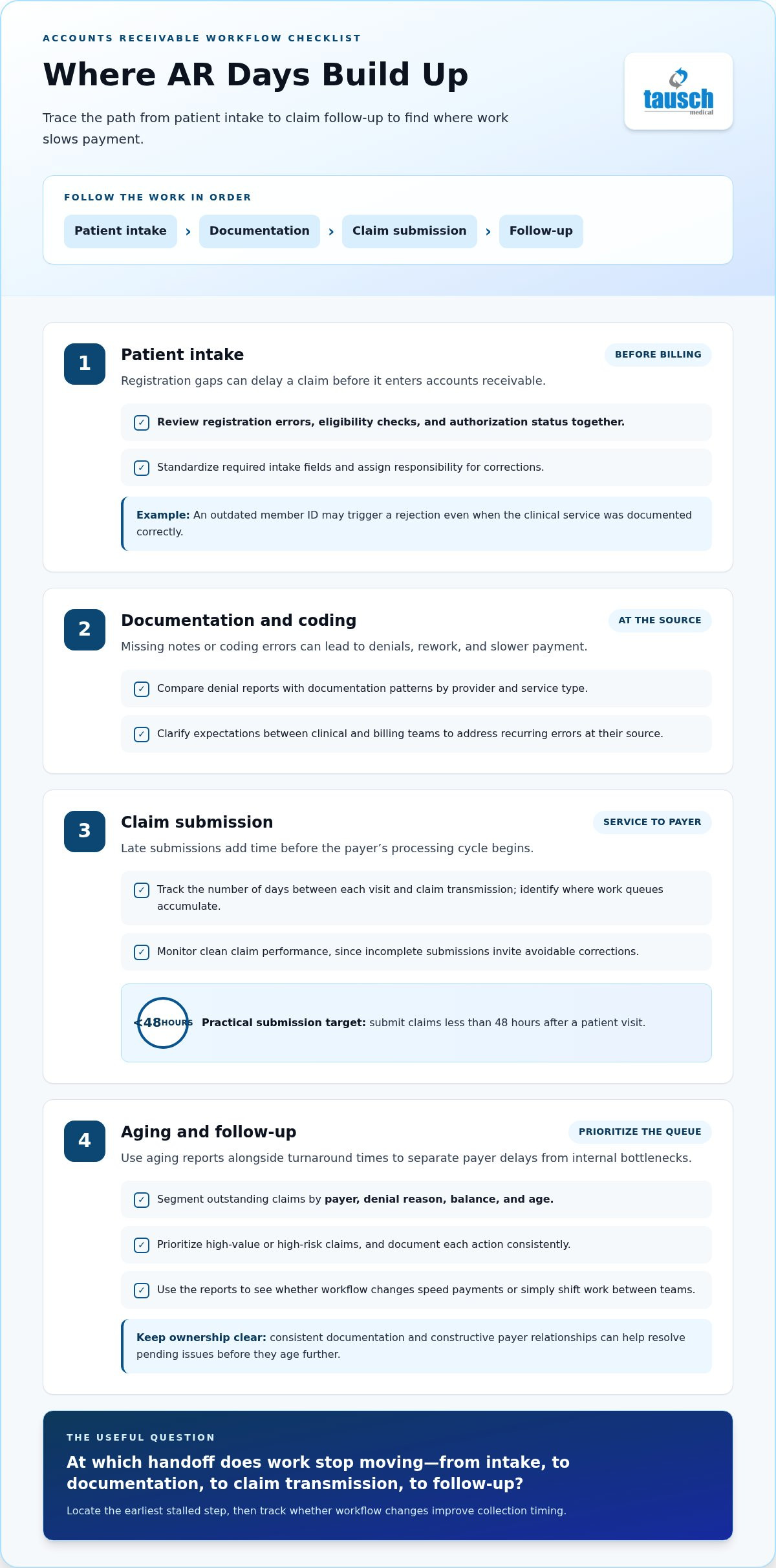
Factors that affect accounts receivable days
- Trace delays from patient intake. To reduce accounts receivable days, examine how registration details flow into billing. Incomplete demographic or insurance information can delay a claim before it enters receivables. Review registration errors, eligibility checks, and authorization status together. For example, an outdated member ID may trigger a rejection even when the clinical service was documented correctly. Standardize required intake fields and assign responsibility for corrections.
- Connect clinical documentation with billing requirements. Missing notes or coding errors can cause denials, rework, and slower payment. Compare denial reports with documentation patterns by provider and service type, then clarify expectations between clinical and billing teams. These steps to reduce accounts receivable days address recurring errors at their source instead of repeatedly correcting claims after submission.
- Measure the time from service to claim submission. Claims submitted late spend additional time outside the payer’s processing cycle. Track the number of days between each visit and claim transmission, then identify where work queues accumulate. A practical target is submitting claims less than 48 hours after a patient visit. Monitor clean claim performance too, since incomplete submissions invite avoidable corrections.
- Use aging reports to prioritize follow-up. Segment outstanding claims by payer, denial reason, balance, and age. Compare the reports with claim turnaround times to distinguish payer delays from internal bottlenecks. Prioritize high-value or high-risk claims, and document each action consistently. This shows whether workflow changes speed up payments or simply shift work between teams. Clear ownership and constructive payer relationships can help resolve pending issues before they age further.
Tausch Medical: Medical Billing Services
Tausch Medical provides medical billing services and accounts receivable management to help healthcare practices improve billing and follow-up workflows that can contribute to payment delays. Its insurance verification and authorization services address bottlenecks related to eligibility or authorization. Practices looking to outsource billing operations can also use Tausch Medical’s medical billing outsourcing services.
These services can help when internal teams struggle to move claims, denials, and outstanding balances through a consistent process. The right support depends on where work slows: before submission, during payer processing, or in receivables follow-up. Reviewing each stage helps a practice identify which billing responsibilities need additional support.
Healthcare providers can contact Tausch Medical to discuss support for their practice.
Make the Next Improvement Deliberate
Choose one recurring workflow gap, assign clear ownership, and decide how your practice will assess progress. A focused next step can help your team build a more consistent approach to payment operations.
Want to see how Tausch Medical can support your practice with reliable medical billing, prior authorization, eligibility verification, A/R follow-up, and RCM support? Start with our free two-week trial and experience the difference before making a commitment.
Frequently Asked Questions
How to Lower Your Days in AR?
Identify where balances are waiting, assign an owner, and review unresolved items by cause rather than treating every account alike. Practices in Houston, San Antonio, Dallas, Austin, El Paso, Arlington, Plano, New York, Boston, Philadelphia, Washington, D.C., Baltimore, Miami, Orlando, Tampa, Atlanta, Raleigh, Richmond, and Jacksonville can use a shared queue review to pinpoint the next improvement, whether in intake, billing, or follow-up.
How do you calculate accounts receivable days (DSO)?
Divide average accounts receivable by revenue for the period, then multiply by the number of days in that period. The result estimates how long revenue remains unpaid. If your financial reports use a 365-day or 360-day convention, keep that convention consistent across periods so a calculation change doesn’t look like a collection trend.
What are the fastest ways to reduce days sales outstanding?
Start with balances blocked by correctable issues: reconcile unapplied payments, resolve rejected claims, and route payer-specific questions to an accountable team member. These steps can clear administrative obstacles without changing credit terms. Then check whether the same issue affects multiple accounts, so one process correction can address a recurring source of delay.
How can businesses improve invoicing accuracy and speed?
Use a standard invoice template, validate required account and service details before release, and generate invoices as soon as supporting information is complete. Set a clear correction path for exceptions, such as a mismatched identifier or missing documentation. Regularly reviewing a sample of submitted invoices can reveal recurring data-entry problems before they cause rework.
How do payment terms and early payment discounts affect DSO?
Payment terms establish when an amount is due, so comparing actual payment timing with the due date helps explain DSO. Early-payment discounts may encourage quicker settlement, but they also reduce the amount collected. Weigh the cash-flow benefit against the effect on revenue, and communicate terms clearly before extending credit.
Disclaimer
This article is for general informational purposes only and does not constitute legal, medical, billing, coding, compliance, or financial advice. Healthcare rules, payer policies, and reimbursement guidelines may change and may vary by situation. Please consult qualified professionals or official sources before making decisions based on this content. Tausch Medical is not responsible for any loss or liability arising from reliance on this information.


