


Article by
Dr. Sharafat Hussain Ph.D
Dr. Sharafat Hussain is a healthcare business consultant, entrepreneur, and academic with strong experience in the US healthcare industry. He is the Founder and Managing Director of Tausch Medical, a revenue cycle management company supporting US healthcare providers with medical billing, prior authorization, credentialing, eligibility verification, A/R follow-up, and patient support services. His work combines practical healthcare operations, business strategy, and academic insight to help medical practices improve efficiency, collections, and service quality.
The total goes beyond payroll: training, software, compliance work, denial follow-up, and revenue that is never collected all affect the true cost.
It’s easy to focus on a biller’s salary because it is visible and predictable. But the full picture matters when deciding how to manage billing and protect practice revenue. This article explains how staffing and training expenses add up, why compliance and claim denials create more work, and how uncollected revenue can make in-house billing cost more than the budget suggests.
Key Takeaways
- Build a fuller staffing picture by accounting for benefits, recruitment, onboarding, and the time needed to train billing staff.
- Factor ongoing coding, payer-rule, and compliance work into the resources your billing operation needs.
- Follow denied claims through resolution and monitor aging receivables to see where potential revenue may be slipping away.
- Use your billing workload and unresolved claims to assess whether in-house processes or additional billing support better fit your practice.
How Much Does It Really Cost to Handle Medical Billing In-House?
In-house billing costs include more than salaries. Benefits, recruitment, training, and workflow interruptions also affect the budget.
Staff salaries and benefits
An experienced medical biller in a small U.S. practice represents a significant ongoing investment. That estimate includes payroll tax, health benefits, and paid time off. A salary-only calculation therefore understates the recurring expense of keeping an internal role staffed. It can also obscure how much practice cash flow goes toward claim submission.
Recruitment and training costs
New hires also need to learn the practice’s payer workflows, claim submission processes, and clearinghouse routines. These costs make staff continuity part of the billing budget, not just a human resources concern.
Absences, burnout, and revenue disruption
Annual turnover in medical billing roles is reported at 30-40%. An absence or vacancy can leave claims waiting for review, correction, or submission. For example, when a departing biller handled payer follow-up, another employee may need to learn account histories while covering the outstanding work. Delays can slow revenue and pressure cash flow, while patients may wait longer for billing updates. Practices comparing internal capacity with another operating model can review medical billing services as one option.
Billing training and compliance demands
Billing compliance requires ongoing attention to coding, payer rules, and protected health information. For an internal billing team, each change can mean updated procedures, technology checks, and additional overhead.
Payer-rule changes and coding complexity
Medical coding and payer requirements evolve, so billing staff must keep claim workflows current. ICD-10 and CPT codes change annually, while payers update billing rules quarterly. After a payer edit, review affected codes before claim submission. Otherwise, a once-clean claim may require correction, delaying collections and adding rework. These recurring updates affect the billing team’s capacity, not only its training budget.
Technology updates and compliance costs
Technology compliance costs include maintaining secure systems and adjusting workflows when software or payer processes change. A clearinghouse connection, for example, may require staff to understand revised edits and submission steps before claims move through the system. Budgeting only for software overlooks the staff time needed to test changes and resolve errors. Practices comparing internal and outsourced models can consider medical billing support as part of their operational approach.
HIPAA compliance and regulatory risk
HIPAA compliance involves protecting patient information throughout billing, access, and claim handling. Staff need clear procedures for using and sharing records, while managers must maintain consistent oversight. According to the U.S. Department of Health and Human Services, Office for Civil Rights, HIPAA violations can carry penalties of $100 to $50,000 per violation, capped at $1.5 million per year. That exposure makes documented processes and staff awareness essential parts of billing operations.
Denial management and uncollected revenue
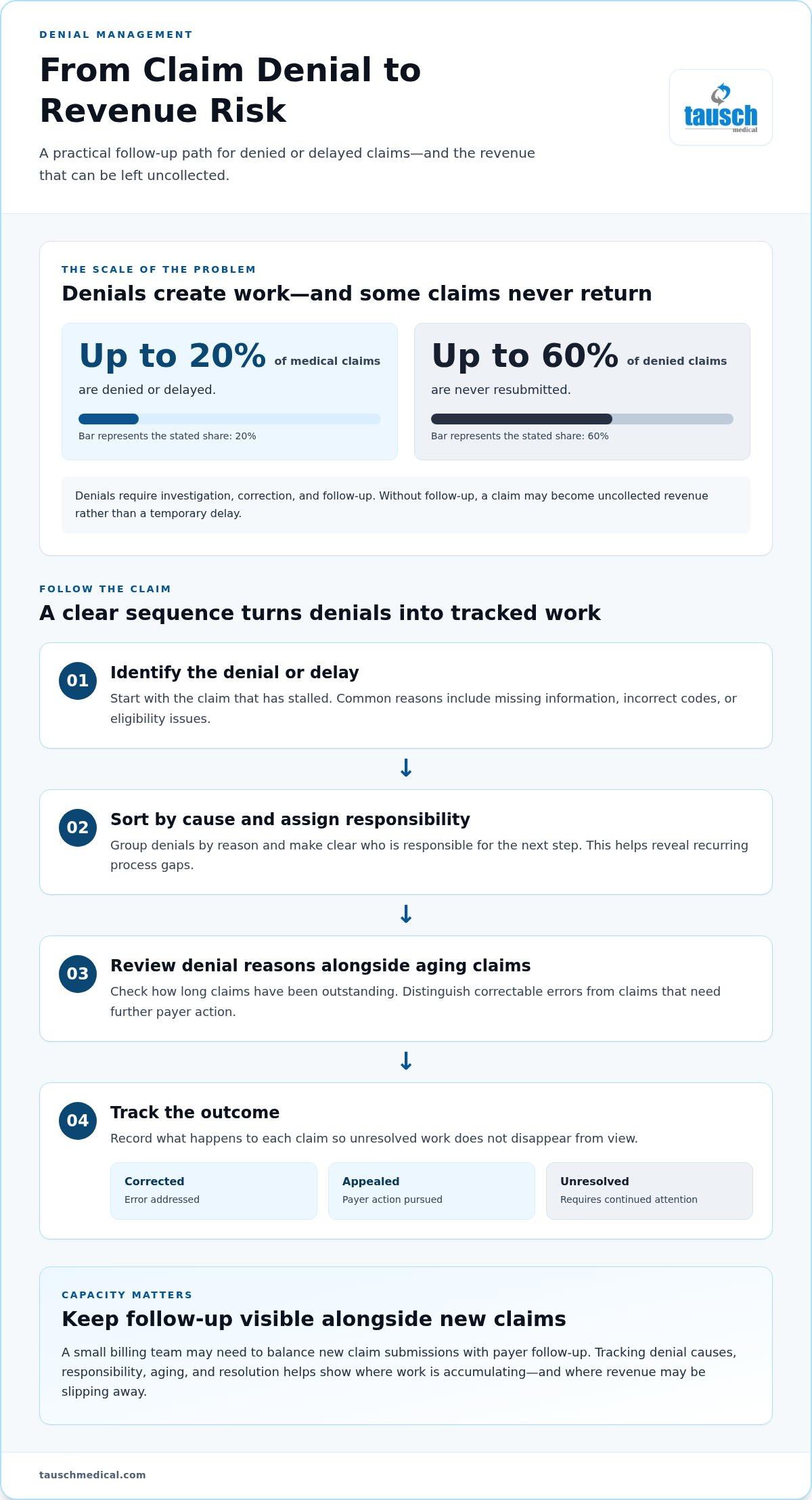
Denied claims create costs beyond the original billing work: they require investigation, correction, and follow-up. Up to 20% of medical claims are denied or delayed, often because of missing information, incorrect codes, or eligibility issues. Each unresolved claim can stall revenue while staff trace the error and determine the next action.
That expense increases when a small billing team must balance new claim submissions with payer follow-up. A practical revenue cycle review sorts denials by cause, assigns responsibility, and tracks whether each claim was corrected, appealed, or left unresolved. Reporting these categories can reveal recurring process gaps.
The revenue at risk can be substantial. Up to 60% of denied medical claims are never resubmitted, so a denial that receives no follow-up may become uncollected revenue rather than a temporary delay. The original salary and billing cost don’t capture this loss.
Review aging claims alongside denial reasons, then distinguish correctable errors from claims needing further payer action. Credentialing or eligibility issues may require attention before billing workflows can proceed smoothly. This makes denial tracking a useful measure of both staff capacity and revenue leakage, rather than merely a count of rejected claims. For practices seeking a more structured approach, explore denial management support for unresolved claims.
Tausch Medical: Medical Billing Services
Tausch Medical supports practices when billing workload, claim follow-up, or payment delays strain internal capacity. Its Medical Billing Services and Medical Billing Outsourcing help manage billing workflows, while Insurance Verification and Authorization supports coverage checks before services are billed. Accounts Receivable Management helps follow up on outstanding balances, including claims requiring continued attention.
This support can be useful when a practice is deciding whether to keep every billing task in-house or add capacity for a specific part of its revenue cycle. Focus on where work is accumulating, such as eligibility checks, claim processing, or aging receivables.
Healthcare providers can visit Tausch Medical to explore its services or get in touch about their practice’s billing needs.
Make Your Billing Model a Deliberate Choice
Understanding the hidden costs of in-house medical billing can help you assess whether your billing model fits your practice’s priorities. Identify where your team’s attention is needed most, then choose an approach that supports your operational goals.
Want to see how Tausch Medical can support your practice with reliable medical billing, prior authorization, eligibility verification, A/R follow-up, and RCM support? Start with our free two-week trial and experience the difference before making a commitment: free trial form
Frequently Asked Questions
How Hidden Fees Affect Your Healthcare Practice Profitability?
Hidden operating expenses can reduce the revenue available for staffing, equipment, and patient services. The hidden costs of in-house medical billing include more than payroll: management time, technology upkeep, coverage during absences, and work to resolve billing issues all add to the total. To assess the effect, compare billing-related spending with collections received, then identify which expenses recur and which stem from workflow problems. For organizations aiming to optimize overhead beyond payroll, consulting specialists such as Expense To Profit can help assess and reduce non-labor expenses to strengthen practice profitability.
Is outsourced billing better for small practices?
Outsourced billing can suit a small practice when billing responsibilities exceed the team’s capacity or require specialized follow-up. Keeping work in-house may make more sense when staffing is stable, processes are established, and the practice can use that capacity effectively. Compare the full internal workload with the support needed, including claim handling, payer follow-up, and receivables oversight.
Which Model Offers the Best ROI?
The model with the best return on investment is the one that supports reliable collections at an appropriate total operating cost. Compare staff time, systems, supervision, and rework with revenue collected and time returned to practice operations. Include workflow quality in the assessment: lower visible expenses may not mean better value if claims remain unresolved or follow-up is delayed.
What are the direct staffing costs of in-house medical billing?
Direct staffing costs include wages, employer payroll expenses, benefits, paid leave, recruitment, and onboarding. The total also includes supervision and coverage for billing duties when an employee is unavailable. For a practical comparison, separate recurring employment expenses from one-time hiring costs, then account for the capacity needed to maintain claim processing and payer follow-up without disrupting other administrative responsibilities.
How much do medical billing software, clearinghouse, and maintenance fees cost?
Software, clearinghouse, and maintenance expenses have no single standard total. Costs depend on the platform’s features, user or provider requirements, transaction arrangements, integrations, and support needs. To build a useful estimate, list each recurring subscription and service charge separately, then include setup, upgrades, and maintenance. This itemized view helps distinguish technology costs from staff time spent managing systems.
Disclaimer
This article is for general informational purposes only and does not constitute legal, medical, billing, coding, compliance, or financial advice. Healthcare rules, payer policies, and reimbursement guidelines may change and may vary by situation. Please consult qualified professionals or official sources before making decisions based on this content. Tausch Medical is not responsible for any loss or liability arising from reliance on this information.


