


Article by
Dr. Sharafat Hussain Ph.D
Dr. Sharafat Hussain is a healthcare business consultant, entrepreneur, and academic with strong experience in the US healthcare industry. He is the Founder and Managing Director of Tausch Medical, a revenue cycle management company supporting US healthcare providers with medical billing, prior authorization, credentialing, eligibility verification, A/R follow-up, and patient support services. His work combines practical healthcare operations, business strategy, and academic insight to help medical practices improve efficiency, collections, and service quality.
Medical billing report analysis turns payment, collection, and procedure-code data into practical insight for a medical practice. Review internal financial reports at least monthly, and track key measures regularly to catch changes in unpaid balances, payer performance, and revenue by CPT code before they become harder to address. The value lies not in the report alone, but in how clearly it shows where revenue is delayed or patterns are shifting.
Billing reports can offer a useful view of practice finances, but individual figures need context before they can guide sound decisions. This article explains when to review reports and how to interpret payment trends, accounts receivable, denials, and CPT revenue. These measures can reveal collection issues, payer differences, or changes in procedure-code performance, helping connect billing data with better-informed practice decisions.
Key Takeaways
- Use claims activity and denial patterns to spot where billing processes may be slowing revenue or creating repeat issues.
- Read aging balances alongside payer and patient payment patterns to identify where collection follow-up may need attention.
- Review revenue by CPT code to understand which procedures contribute most and how utilization patterns are changing.
- When billing trends point to operational gaps, billing, authorization, and accounts receivable support can help strengthen revenue cycle management.
When Is a Medical Bill Review Report Needed?
Review billing reports regularly to spot changes in claims activity, unpaid balances, and reimbursement delays. Medical billing report analysis connects these patterns with practical revenue cycle management decisions.
Billing Data Trends and Claims Activity
Billing trends show how claims move from submission through payment, denial, or correction. Compare the same measures across specialties and practice sizes, accounting for differences in procedure mix, payer mix, and claim volume. This context helps separate operational changes from normal variation. To analyze reports step by step, group claims by status, payer, service date, and CPT code, then identify recurring errors and choose an appropriate action.
Unpaid Patient Balances and Insurance Claims
Accounts receivable reports organize unpaid insurance claims and patient balances by payer, patient, or balance age. Review the categories together to see whether delays cluster around a particular payer or patient responsibility. For claims still unpaid after 120 days, identify the status and any prior follow-up; this helps prioritize collection work. Reporting software can generate accounts receivable aging reports, while payment records show whether balances have changed.
Aging, Held Claims, and Clean Claim Rates
Aging reports sort unpaid balances into intervals such as 30, 60, and 90 days, making older claims easier to identify. Held claims signal that submission or processing has stalled, so review their status and the reason for the hold. A first-pass claim rate shows how often claims are accepted without rework; 90% is a stated benchmark, while 98% is a typical industry target. Compare results by specialty and practice size, not in isolation.
Claim Tracking and Reimbursement Delays
Claim tracking follows each submission’s progress and makes delays visible before they become persistent collection issues. Denial reports can reveal recurring reasons, payer patterns, and coding errors that affect reimbursement. Reports containing identifiable patient information should be handled securely, with access limited to appropriate users. Billing platforms commonly produce claims and aging reports; the cost of reporting software depends on its capabilities, integrations, and practice needs. For focused billing support, medical billing services can support accurate claims and payment workflows.
Payment trends and collections
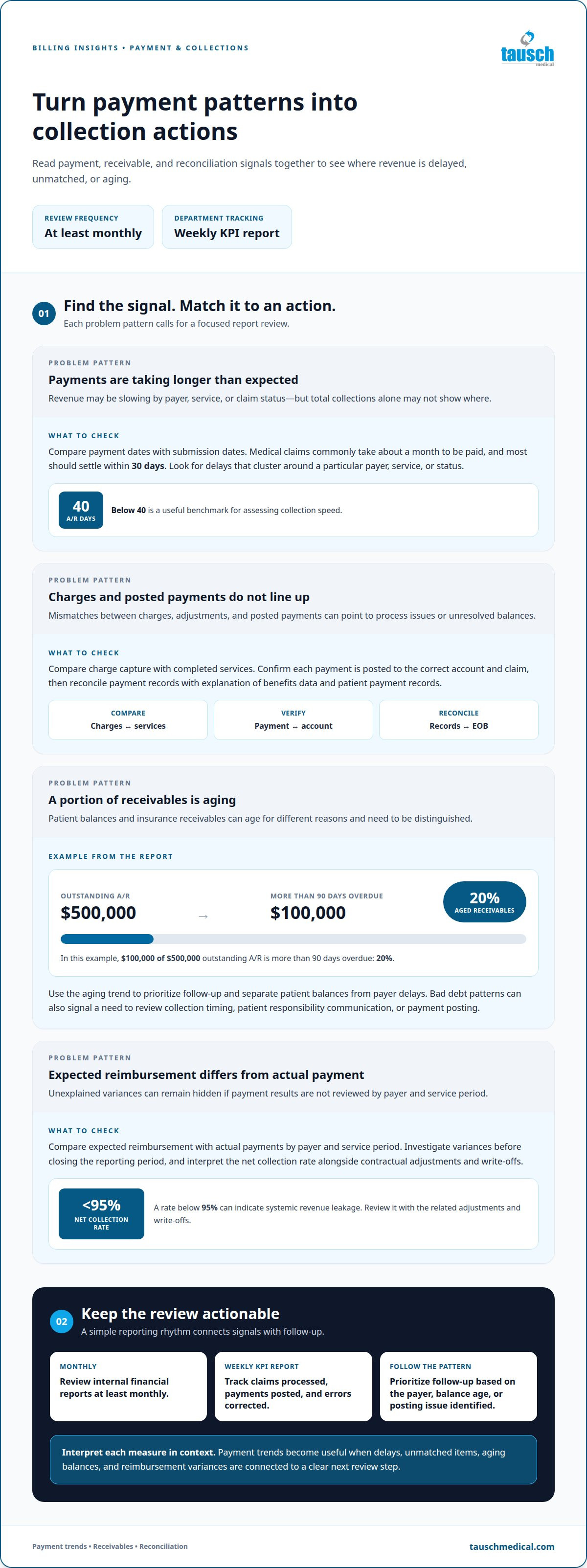
Payment reports connect submitted charges with insurance and patient payments, showing where expected revenue slows or falls short. Medical claims commonly take about a month to be paid, and most should settle within 30 days. Compare payment dates with submission dates to reveal whether delays cluster by payer, service, or claim status. A/R days below 40 is a useful benchmark for assessing collection speed.
Process issues often show up as mismatches between charges, adjustments, and posted payments. Compare charge capture with completed services, then check that each payment is posted to the correct account and claim. Reconcile payment records with explanation of benefits data and patient payment records; unmatched items may indicate posting errors or unresolved balances. A weekly KPI report can track claims processed, payments posted, and errors corrected.
Patient collections need separate attention from insurance receivables. For example, if $100,000 of a practice’s $500,000 outstanding A/R is more than 90 days overdue, 20% of receivables are aged beyond that point. Use this trend to prioritize follow-up and distinguish patient balances from payer delays. Bad debt patterns can also show whether collection timing, patient responsibility communication, or payment posting needs review.
For reconciliation, compare expected reimbursement with actual payments by payer and service period, then investigate variances before closing the reporting period. A net collection rate below 95% can indicate systemic revenue leakage; interpret it alongside contractual adjustments and write-offs. These measures make payment trends valuable for targeted action. Practices needing structured support with receivable follow-up can explore accounts receivable and denial management.
Revenue by CPT code
A procedure-code utilization report tracks how often each CPT code is used and how much revenue it generates. Group claims by code to see which services contribute most to practice revenue and where activity is changing. These insights give revenue cycle teams a clearer view of the service mix than total collections alone.
Compare code volume with submitted charges, payments, adjustments, and denials. If a code has frequent claims but lower-than-expected collections, review payer reimbursement, documentation, or coding accuracy. A rise in billed volume without a similar rise in payments may point to delayed processing or growing accounts receivable. Code-level tracking connects clinical activity with financial outcomes.
Revenue cycle management reports make CPT analysis more useful by connecting procedure activity to other metrics. Pair code revenue with denial patterns, payment timing, and collection results to distinguish a volume change from a reimbursement issue. For example, if a code generates more claims but also more denials, review the related denial reasons before interpreting the increase as stronger performance.
Use consistent reporting periods and compare like with like, including similar service categories and payer groups. Monthly internal financial reporting is the minimum, while weekly KPI reports can monitor billing department performance. Track code utilization, revenue, claim acceptance, and accounts receivable together, then assign follow-up based on the pattern. Billing software can generate these reports, but clear definitions matter: teams need to know whether a metric reflects charges, payments, or adjustments. That distinction makes raw figures actionable and supports informed decisions about service mix and revenue cycle priorities.
Tausch Medical
Tausch Medical helps healthcare practices connect billing activity with operational support across the revenue cycle. When reports point to recurring workflow gaps, its billing, insurance verification and authorization, and accounts receivable services can support coordinated processes.
Want to see how Tausch Medical can support your practice with reliable medical billing, prior authorization, eligibility verification, A/R follow-up, and RCM support? Start with our free two-week trial and experience the difference before making a commitment.
Turn Reporting Into a Clear Next Step
Make each review a decision point, not a reporting ritual. Medical billing report analysis works best when every finding leads to an assigned owner, a defined follow-up, and a later review to see whether the pattern changed. Recording the decision beside the metric also gives the team useful context for future reviews.
Want to see how Tausch Medical can support your practice with reliable medical billing, prior authorization, eligibility verification, A/R follow-up, and RCM support? Start with our free two-week trial and experience the difference before making a commitment.
Frequently Asked Questions
How can Medical Practices use the power of Analytics to streamline their Medical Billing process?
Use analytics to locate workflow bottlenecks and focus staff attention where it can move claims forward. For example, separate claims awaiting submission from those awaiting payer response or payment posting. If work repeatedly accumulates at one stage, review the related handoff, clarify responsibilities, and monitor the same measure after changing the process.
What Are Medical Billing Reports and Their Main Types?
Medical billing reports organize financial and operational data so practices can evaluate different parts of their billing workflow. Common types include claim-status reports, payment and adjustment reports, denial reports, accounts receivable reports, and CPT utilization reports. Each supports a different decision: a denial report helps investigate rejection reasons, while a payment report helps reconcile amounts received against submitted claims.
What are A/R reports?
A/R reports show outstanding balances owed to a practice, including amounts expected from insurers and patients. They can organize receivables by payer, patient, claim status, or age, helping teams distinguish recent balances from those requiring focused follow-up. For example, filtering by payer can reveal whether unresolved balances are concentrated in a particular insurance group.
What is the difference between manual and automated A/R reports?
Manual A/R reports are assembled from staff-entered records or spreadsheet exports, while automated reports are generated by billing software using its available data. Manual preparation can make recurring comparisons harder to maintain; automation can make repeat reporting more consistent. In either case, accurate source records and shared definitions are essential, or totals may not represent the same balances.
What role does Data Analytics play in the Medical Billing Process?
Data analytics helps teams move beyond viewing billing totals to identify patterns that deserve investigation. Results can be segmented by payer, service, claim status, or time period to guide decisions about where to focus review. After a workflow change, compare the same measures again to assess whether the issue has eased or persists.
Disclaimer
This article is for general informational purposes only and does not constitute legal, medical, billing, coding, compliance, or financial advice. Healthcare rules, payer policies, and reimbursement guidelines may change and may vary by situation. Please consult qualified professionals or official sources before making decisions based on this content. Tausch Medical is not responsible for any loss or liability arising from reliance on this information.


